
How Many Calories Are in a Wagon Wheel?
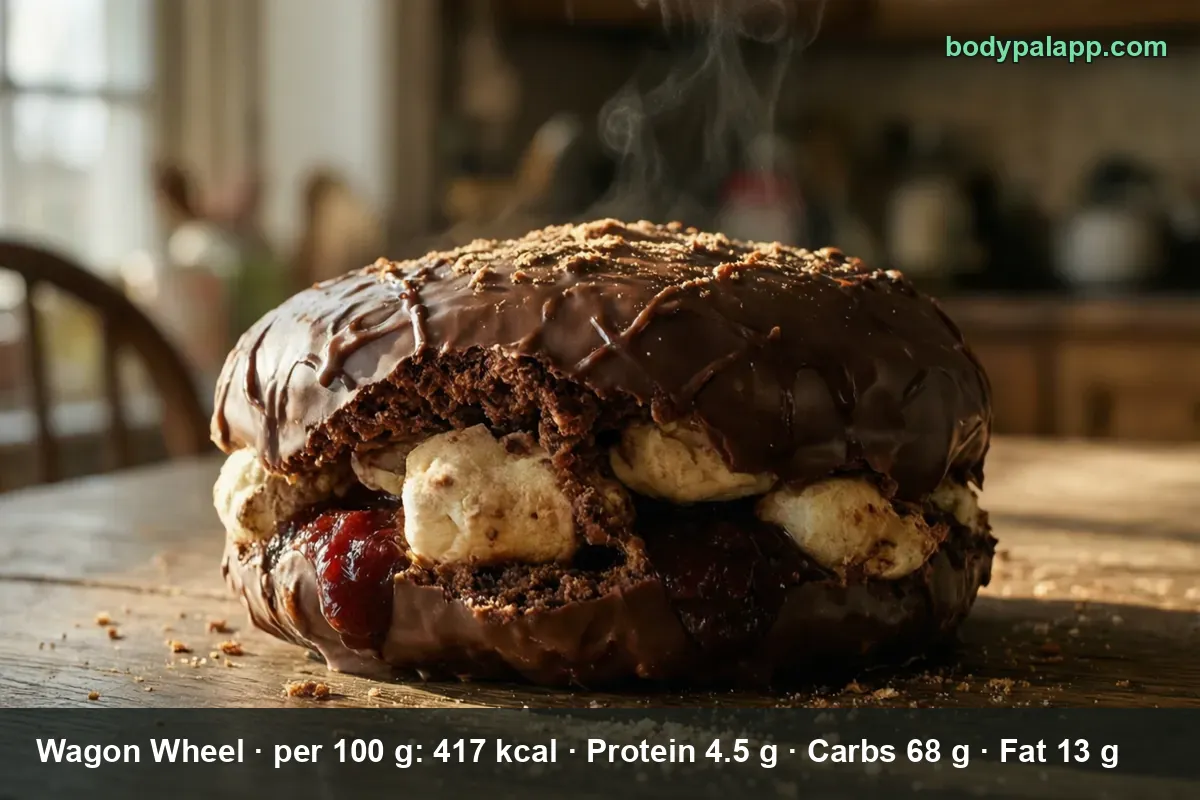
A Wagon Wheel is 160 calories. The label states 159.7 kcal for the whole biscuit and 417 kcal per 100 g, and UK government composition data holds an entry for precisely this kind of biscuit that reads 413. Two independent measurements, four calories apart. That almost never happens.
On this page
- Wagon Wheel quick facts
- What is actually inside one
- Why the marshmallow saves you 89 calories
- Jammie versus Teacakes
- The shrinking Wagon Wheel question
- Where it sits in the chocolate biscuit aisle
- Most popular Wagon Wheels products in the United Kingdom
- Wagon Wheel FAQs
Wagon Wheel quick facts
The reference here is Wagon Wheels Jammie, the jam-filled version that dominates the UK shelf. The per-wheel column is the one the label prints, so it is the one to log.
| Nutrient | Per wheel | Per 100 g | RI%* per wheel |
|---|---|---|---|
| Energy | 160 kcal / 668 kJ | 417 kcal / 1,745 kJ | 8% |
| Protein | 1.7 g | 4.5 g | 3% |
| Carbohydrates | 26.0 g | 68 g | 10% |
| – of which sugars | 14.9 g | 39 g | 17% |
| Fat | 5.0 g | 13 g | 7% |
| – of which saturates | 3.6 g | 9.4 g | 18% |
| Fibre | 0.7 g | 1.9 g | – |
| Salt | 0.10 g | 0.265 g | 2% |
*RI% = one wheel's share of an adult's daily reference intake, based on 2,000 kcal.
Verified nutrition data
Numbers on this page come from CoFID, the UK government’s Composition of Foods Integrated Dataset, and from manufacturer labels where a branded product is named. Last verified September 2026. How we verify our data →
Two rows do the talking. The sugars line, 14.9 g, is 17% of a day from one biscuit. The saturates line is worse in relative terms: 3.6 g is roughly a fifth of the 20 g daily reference, which for a 160 kcal snack is a lot of saturated fat per calorie. Salt is a non-event at 0.10 g.
Working back from the two label figures gives an implied weight of about 38 g per wheel. One British label states its serving outright as a 40 g wheel, which at 417 kcal per 100 g comes to 167 calories, so across packs a wheel runs roughly 160 to 167.
What is actually inside one
A Wagon Wheel is four foods stacked. Two soft biscuit discs, a layer of jam, a layer of marshmallow, and a full chocolate-flavoured coating over the lot. Each layer pulls the nutrition panel in a different direction, and that is why the finished number lands where it does.
The biscuit discs are flour. They contribute most of the 68 g of carbohydrate per 100 g and almost none of the sugar. The jam is nearly all sugar and no fat. The marshmallow is sugar and air with, in its plain form, zero grams of fat. The coating is the only layer carrying serious fat, and it is spread thin across a wide surface.
Add those up and you get a biscuit that is 68% carbohydrate and only 13% fat by weight. For comparison, a fully chocolate-coated biscuit with no marshmallow inside runs 27.2 g of fat per 100 g. The Wagon Wheel is less than half that, purely because most of its interior volume is not fat.
The catch sits in the sugar column. At 39 g per 100 g, well over a third of the wheel by weight is sugar, and 14.9 g of that lands in one biscuit. Milk chocolate is sweeter at 56 g per 100 g, but you would not eat 38 g of it in three bites without noticing.
Why the marshmallow saves you 89 calories
Line up the chocolate biscuit family and the pattern is immediate.
A biscuit fully coated with chocolate, no marshmallow, is 506 kcal per 100 g. The same biscuit with a marshmallow layer inside is 413. That is a difference of 89 kcal per 100 g, and the reason is embarrassingly simple: plain marshmallow contains 0.0 g of fat and 327 kcal per 100 g, so every gram of marshmallow displaces something denser.
Fat carries nine calories a gram. Sugar carries four. A marshmallow layer is a way of making a biscuit bigger without making it fattier, and it works. Wagon Wheels Jammie at 417 kcal per 100 g confirms the composition data almost exactly.
None of that makes a Wagon Wheel a light food. It makes it a large biscuit that costs what a smaller, denser biscuit would cost. The volume is real, though, and volume is the thing that ends a craving. Three bourbon biscuits are 204 calories against 160 for one Wagon Wheel, and the Wagon Wheel feels considerably more like an event.
Where it loses is protein. At 4.5 g per 100 g, one wheel gives you 1.7 g, which is nothing. This is a pure treat, not a snack that does any work between meals.
Jammie versus Teacakes
| Per 100 g | Calories | Protein | Carbs | Sugar | Fat | Saturates | Fibre | Salt |
|---|---|---|---|---|---|---|---|---|
| Wagon Wheels Jammie | 417 kcal | 4.5 g | 68 g | 39 g | 13 g | 9.4 g | 1.9 g | 0.265 g |
| Wagon Wheels Teacakes Jammie | 443 kcal | 3.5 g | 65.9 g | 44.5 g | 17.5 g | 10 g | 1.7 g | 0.23 g |
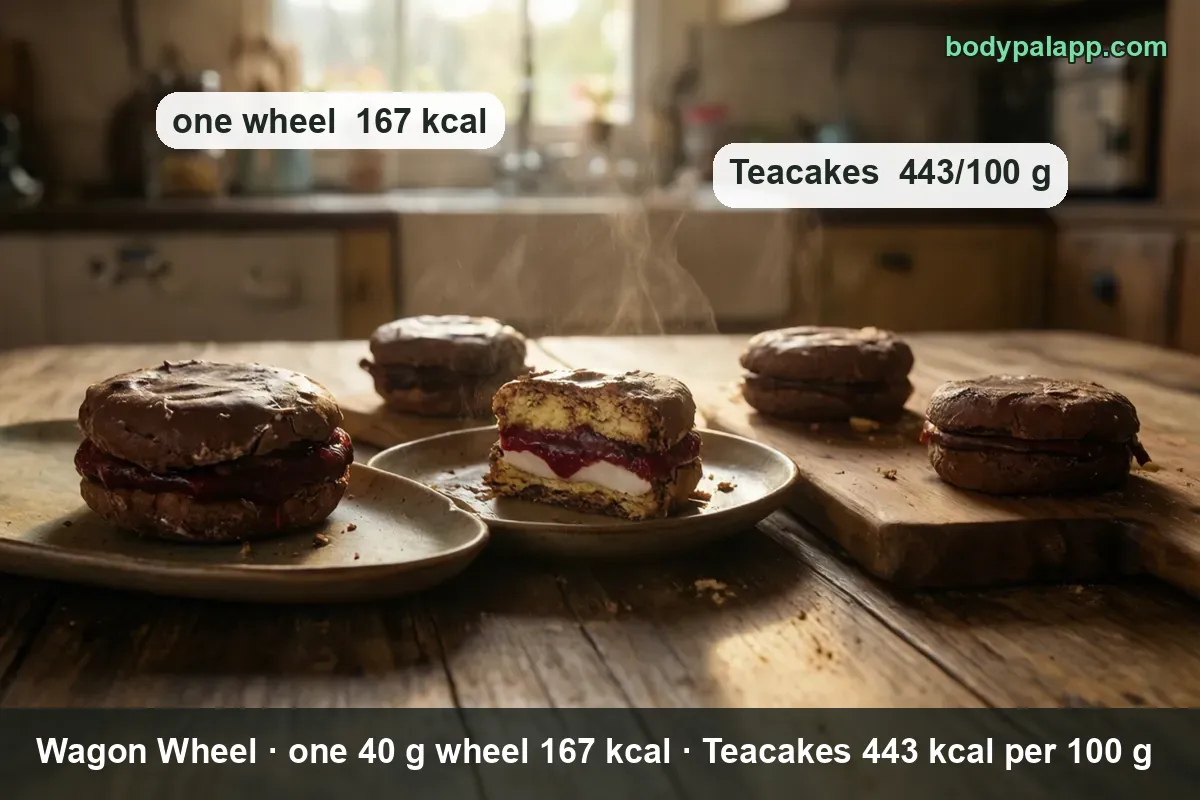
The Teacakes version is 26 kcal per 100 g heavier, and the two columns that move are fat, up from 13 to 17.5 g, and sugar, up from 39 to 44.5 g. Less biscuit, more filling and more coating. It is the richer product of the two by a clear margin.
Per unit the comparison is open, because a teacake is a different size from a wheel. Its label prints a 15 g serving, which at 443 kcal per 100 g is 66 calories a piece. If your pack prints a per-item figure, use it. If it prints only per 100 g, weigh one once and multiply by 4.43.
That multiply-once habit is the honest answer for the whole range. Any Wagon Wheel variant sits between roughly 415 and 445 kcal per 100 g, so gram weight, not flavour, decides your number.
The shrinking Wagon Wheel question
Every discussion of this biscuit arrives at the same claim: they were bigger once. It comes up so reliably that it is worth answering properly rather than arguing about it.
You cannot settle it from a nutrition label, because a label tells you calorie density, not size. What you can do is stop depending on memory. The per-100 g figure of 417 is fixed; the only variable is what your wheel weighs. Put one on the kitchen scale, divide by 100, multiply by 417, and the number is exact regardless of what the packet used to be in 1994.
The related error is more practical. People remember "about 160 calories" and apply it to the multipack mini versions, the teacake version and the seasonal editions alike. Those are different products with different weights and different densities, and 160 is only the Jammie figure.
One myth that does deserve killing: the idea that the marshmallow is the fattening part. It is the opposite. Marshmallow is the lightest layer in the biscuit at 327 kcal per 100 g with no fat at all. The chocolate coating is where the fat lives.
Where it sits in the chocolate biscuit aisle
| Per 100 g | Calories | Fat | Saturates | Sugar |
|---|---|---|---|---|
| Wagon Wheels Jammie | 417 kcal | 13 g | 9.4 g | 39 g |
| Chocolate-coated marshmallow biscuit, average | 413 kcal | 19.0 g | 10.64 g | 41.4 g |
| Biscuit fully coated with chocolate | 506 kcal | 27.2 g | 15.06 g | – |
| Marshmallows, plain | 327 kcal | 0.0 g | – | 64.5 g |
| Milk chocolate | 519 kcal | – | – | 56 g |
Gram for gram the Wagon Wheel undercuts an ordinary chocolate-coated biscuit by 89 calories and milk chocolate by 102. That is a genuinely good result for something this indulgent, and it is the case for eating one.
The case against is the unit size. At roughly 38 g a wheel is a big portion by biscuit standards, so 160 calories from one item is more than two bourbon biscuits or a decent handful of Maltesers. Density and dose are separate questions, and the Wagon Wheel wins the first and loses the second.
Our take: if you want one substantial chocolate thing with your tea, the Wagon Wheel is a better deal than a KitKat or a Twix per gram, and the marshmallow gives you bulk that a solid bar cannot. If you are watching saturated fat specifically, it is a poor choice at 3.6 g a wheel, and a flapjack or a chocolate chip cookie will not necessarily do better. One is a treat. Two is a fifth of a day's energy in six bites.
Most popular Wagon Wheels products in the United Kingdom
Ranked by how widely each product appears among foods sold in the United Kingdom, from the BodyPal food database of over 3.3 million products. Calories are the figures printed on each label.
| Product | Calories (per 100 g) |
|---|---|
| Burton’s Wagon Wheels Teacakes Jammie | 443 kcal |
| Burton’s Wagon Wheels Jammie | 430 kcal |
| Burton’s Wagon Wheels (blue) | 423 kcal |
| Burton’s Wagon Wheels | 420 kcal |
Brand popularity: BodyPal food database. Nutrition: manufacturer labels.
Wagon Wheel FAQs
How many calories are in a Wagon Wheel?
159.7 calories, which rounds to 160, for one Wagon Wheels Jammie. The per-100 g figure is 417 kcal, and UK composition data for chocolate-coated marshmallow biscuits agrees at 413. One wheel also carries 14.9 g of sugar and 3.6 g of saturated fat.
How many calories in two Wagon Wheels?
319 calories, plus 29.8 g of sugar and 7.2 g of saturated fat. That saturated fat total is more than a third of the 20 g daily reference, which is the row that makes two a genuinely different decision from one rather than just twice as many calories.
How many calories in Wagon Wheels Jammie?
417 kcal per 100 g, or 160 per biscuit. Jammie is the jam-filled standard and the figures on this page are all taken from its label: 68 g of carbohydrate, 39 g of sugar, 13 g of fat and 0.265 g of salt per 100 g.
How many calories in Wagon Wheels Teacakes?
443 kcal per 100 g for the Jammie Teacakes, 26 more than a standard wheel. The extra comes from fat, 17.5 g against 13 g, and sugar, 44.5 g against 39 g. Weigh one to convert that into a per-item figure, since the teacake is a different size.
How much sugar is in a Wagon Wheel?
14.9 g per biscuit, from 39 g per 100 g. That is 17% of the daily reference intake for sugars in one item. Most of it sits in the jam and the marshmallow rather than the biscuit discs, which are largely flour.
Are Wagon Wheels vegetarian?
The pack is the only place this is settled. The British Wagon Wheels labels in our data carry no vegetarian or vegan certification mark, so read the allergen box on the box in front of you rather than relying on a general answer.
Is a Wagon Wheel worse than a chocolate biscuit?
Per 100 g it is better: 417 kcal against 506 for a biscuit fully coated in chocolate, a gap of 89. The marshmallow layer has no fat and displaces denser ingredients. Per item it can still be worse, because a wheel is a larger piece of food than most chocolate biscuits.
How much does a Wagon Wheel weigh?
Roughly 38 g, worked back from the label's own figures of 159.7 kcal per biscuit and 417 kcal per 100 g. Packs and editions differ, so if you want an exact number for logging, weigh one on a kitchen scale and multiply the grams by 4.17.
Similar foods
- Drumstick lolly — 46 kcal each
- Rice Krispies Square — 119 kcal a bar
- Lollipop — 31 kcal small
- Rich tea biscuit — 38 kcal per biscuit
- Milky Way — 96 kcal per 21.5 g bar
- Crunchie — 186 kcal per bar
Log the wheel, not a guess
Point a camera at the plate and BodyPal sorts the biscuit from the jam and the marshmallow, sugar and saturates included.


How long does it take to burn off a Wagon wheel?
One Wagon Wheels Jammie is 160 kcal. Enter your weight to see how long it takes you to burn that off:
lb
| Activity | Time to burn 160 kcal |
|---|---|
| Walking, brisk | 32 min |
| Cycling, moderate | 20 min |
| Swimming, moderate | 23 min |
| Jogging | 19 min |
| Weight training, moderate | 36 min |
Times are for a 154 lb (11 st) adult at a steady pace; change the weight to see yours. BodyPal works this out from your steps automatically.
Want the bigger picture? Calculate your daily calorie needs — your maintenance figure, a target for losing or gaining, and the date you get there.