
Beer vs Wine: Which Has More Calories?
Per serve, beer: a pint of bitter is 170 calories against 133 for a 175 ml glass of red wine. Per 100 ml, wine, and it is not close: 76 kcal against 30, two and a half times as concentrated. Beer vs wine is really a question about glassware, because the drink that is weaker by the millilitre arrives in a vessel three times the size.
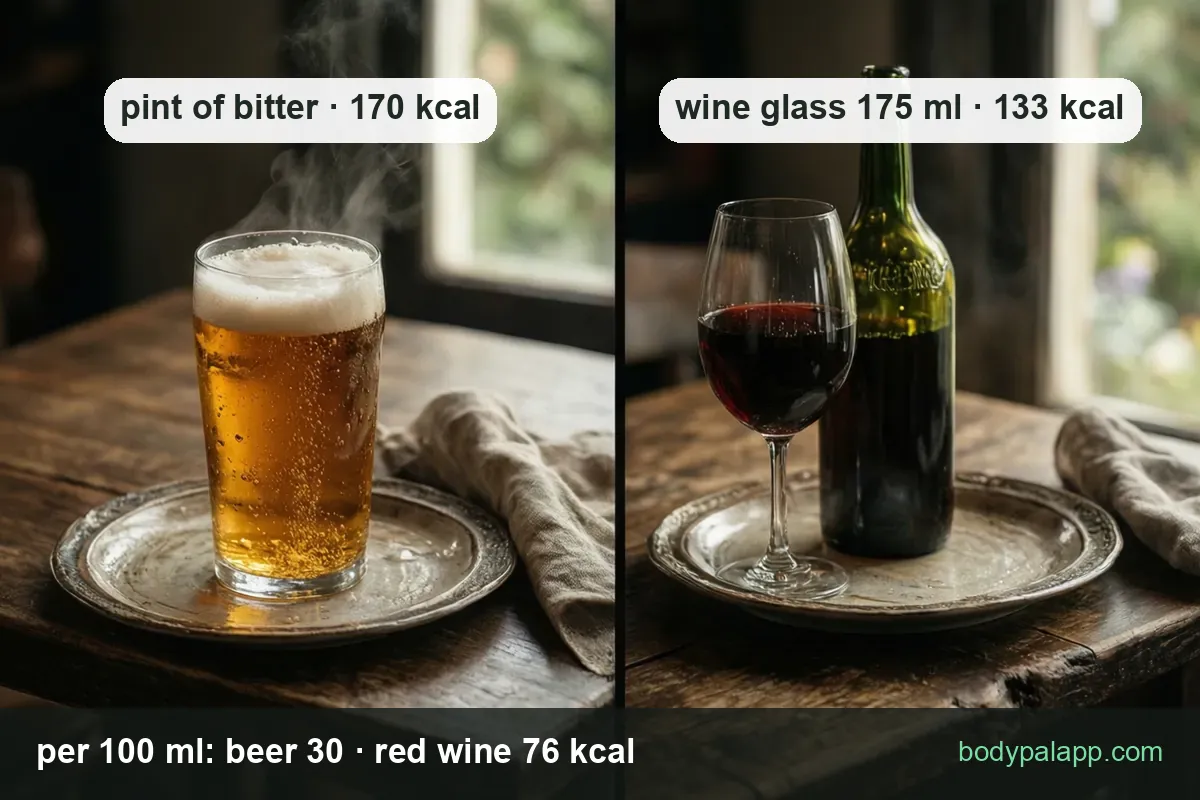
The numbers side by side
| Nutrient | Beer (bitter), per pint (568 ml) | Beer, per 100 ml | Red wine, per 175 ml glass | Red wine, per 100 ml |
|---|---|---|---|---|
| Energy | 170 kcal / 711 kJ | 30 kcal / 126 kJ | 133 kcal / 556 kJ | 76 kcal / 318 kJ |
| Protein | 1.7 g | 0.3 g | 0.2 g | 0.1 g |
| Carbohydrate | 12.5 g | 2.2 g | 0.4 g | 0.2 g |
| of which sugars | 12.5 g | 2.2 g | 0.4 g | 0.2 g |
| Fat | 0 g (Tr) | 0 g (Tr) | 0 g | 0 g |
| Fibre | 0 g (Tr) | 0 g (Tr) | 0 g | 0 g |
| Salt | 0.11 g | 0.02 g | 0.04 g | 0.02 g |
Verified nutrition data
Numbers on this page come from CoFID, the UK government’s Composition of Foods Integrated Dataset, and from manufacturer labels where a branded product is named. Last verified August 2026. How we verify our data →
The carbohydrate row explains why the two drinks feel different but land close together. Beer carries real carbs from the malt, 12.5 g in a pint. Dry wine carries almost none, 0.4 g in a glass, and nearly all of its energy comes from the alcohol itself, which delivers 7 kcal per gram, closer to fat's 9 than to sugar's 4. Neither drink's calories are the kind that fill you up.
Strength moves both numbers more than people expect. An ordinary bitter under 4% ABV is 30 kcal per 100 ml, but a strong bitter over 5% runs to 42, which is a 239-calorie pint. Premium lager sits at 29, making its pint 165, and a pint of stout lands around 199. On the wine side, dry white is 75 kcal per 100 ml to red's 76, so a 175 ml glass of white is 131, a saving of two calories that nobody will ever feel.
When beer is the lighter evening
Beer wins when you would drink slowly anyway. A half of bitter is 85 calories, the cheapest genuinely social unit on the bar, and even a full pint at 170 undercuts two glasses of wine by nearly 100. A 440 ml can of lager at home is about 128.
The failure mode is the session: three pints is 510 calories, which no glass-for-glass logic can rescue. Beer is the lighter drink only for the drinker who counts in ones and twos. If your evenings run longer, the arithmetic in our full pint of beer breakdown is worth ten minutes.
When wine is the lighter evening
Wine wins the single-drink scenario. One 175 ml glass with dinner is 133 calories and a natural stopping point, and a modest 125 ml pour drops it to 95, the lightest standard serve on this page. Dry red or white barely differ, so pick by taste.
The failure mode is the bottle. At 570 calories, a shared bottle is 285 each before anyone refills, and a bottle of wine finished alone is the calorie equivalent of three and a third pints of bitter. Wine's concentration means the pour size does all the work, and home pours are rarely 125 ml. Either way, both drinks spend the same 14-unit weekly budget the NHS advises spreading across the week, and the calories travel with the units.
Most popular beer and wine brands in the United Kingdom
Ranked by how widely each product appears among foods sold in the United Kingdom, from the BodyPal food database of over 3.3 million products. Calories are the figures printed on each label. Every wine on the list outweighs every beer per 100 ml, exactly as the side-by-side table predicts.
| Product | Calories (per 100 ml) |
|---|---|
| Barefoot Moscato | 107 kcal |
| Yellow Tail Shiraz | 98 kcal |
| Campo Viejo Rioja Tempranillo | 68 kcal |
| BrewDog Punk IPA | 49 kcal |
| Heineken | 42 kcal |
| Stella Artois | 41 kcal |
Brand popularity: BodyPal food database. Nutrition: manufacturer labels.
Frequently asked questions
Which has more calories, beer or wine?
By volume, wine: 76 kcal per 100 ml for red against 30 for bitter, roughly 2.5 times as much. By serve, beer: a 568 ml pint is 170 kcal while a 175 ml glass of wine is 133. The serve you actually order decides which drink costs more.
How many calories are in a pint of beer versus a glass of wine?
A pint of bitter is 170 kcal and a standard 175 ml glass of red wine is 133, a gap of 37. A premium lager pint is 165 and a dry white glass is 131, so the pairing barely moves. Swap to a large 250 ml wine glass and wine takes the lead at 190.
Is wine less fattening than beer?
Only at one glass. A single 175 ml serve at 133 kcal beats any pint, but a full bottle is 570 kcal, about the same as three and a third pints of bitter. Neither drink is fattening by nature; the total millilitres and the ABV set the calorie bill.
What is the lowest-calorie option between beer and wine?
A 125 ml glass of dry wine at about 95 kcal, with a half pint of bitter close behind at 85, technically the lowest on the page. Strength matters as much as size: ordinary bitter is 30 kcal per 100 ml while a strong ale runs 42, a 40% jump.
Why does alcohol have so many calories?
Alcohol itself carries 7 kcal per gram, nearly as much as fat's 9 and far above sugar's 4. That is why dry red wine reaches 76 kcal per 100 ml with only 0.2 g of sugars: the energy is in the ethanol, not the sweetness, and it cannot be brewed out.
More comparisons
- Protein shake: milk vs water — the milk is the difference
Count the round without the maths
BodyPal logs the pint or the pour from one photo, so the difference between a half and a large glass shows up in your day without a calculator.


Want the bigger picture? Calculate your daily calorie needs — your maintenance figure, a target for losing or gaining, and the date you get there.