
How Many Calories in a Bottle of Wine?
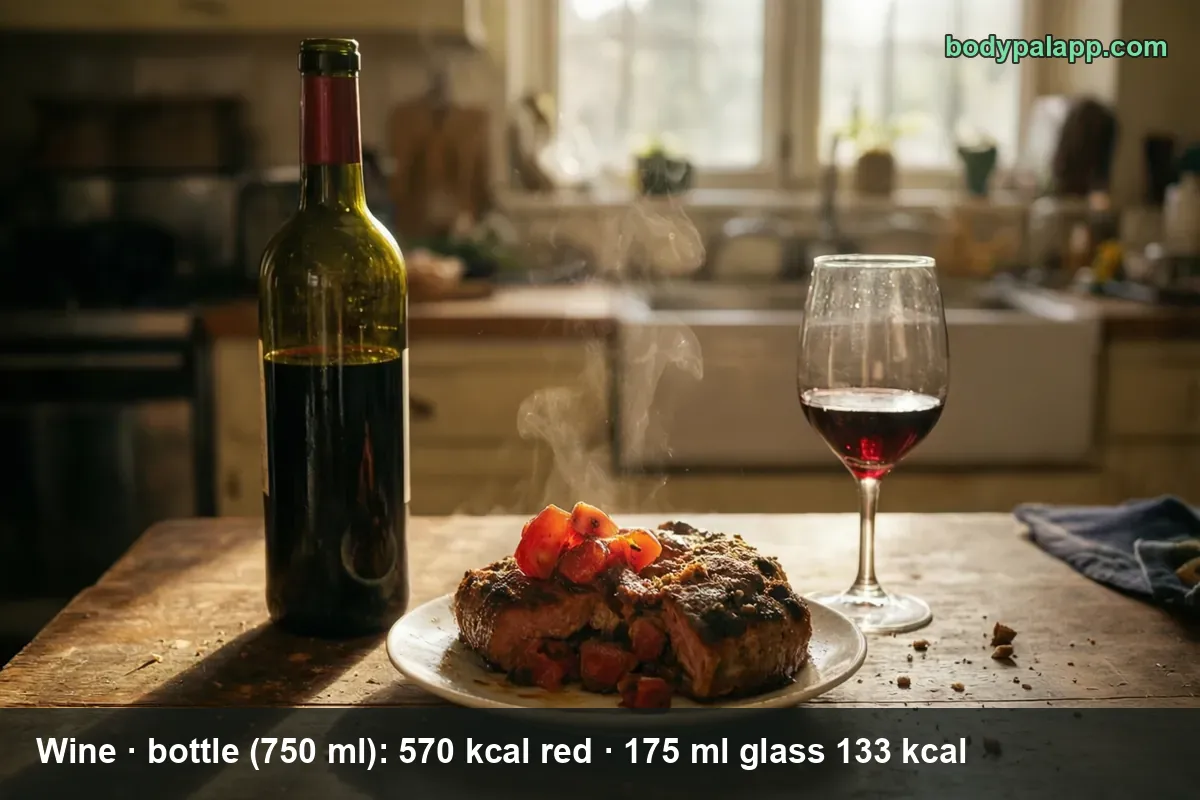
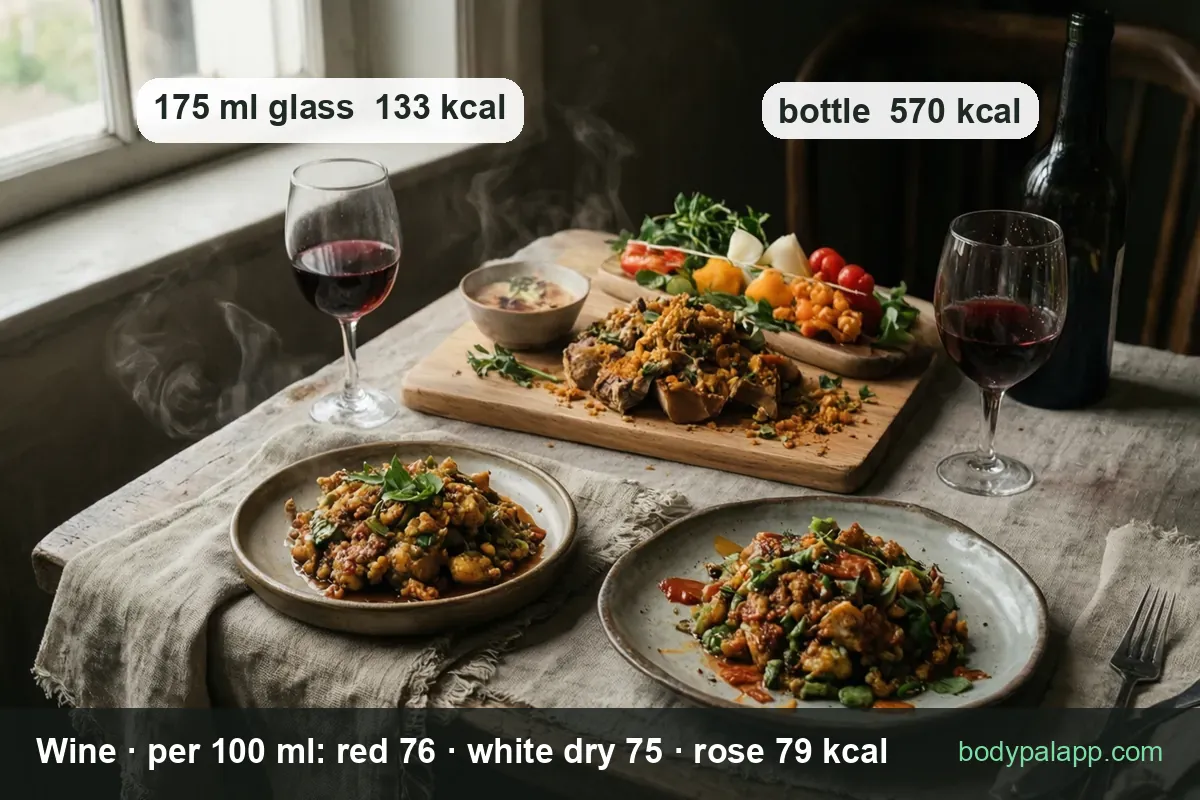
A bottle of red wine carries 570 calories, and a dry white is barely different at 563. That is 76 kcal per 100 ml, or 133 in a standard 175 ml glass. Nobody drinks a bottle in hundred-millilitre units, though, which is why the honest answer is a glass-by-glass table.
On this page
- Wine nutrition at a glance
- The glass-by-glass table
- Red, white and rosé
- Where the calories actually come from
- Calories and units move together
- Wine against beer, on the serve
- The white-wine myth
- Most popular wine brands
- FAQ
Wine nutrition at a glance
| Nutrient | Per 100 ml | Per 175 ml glass | %RI* per glass |
|---|---|---|---|
| Energy | 76 kcal / 318 kJ | 133 kcal / 556 kJ | 7% |
| Protein | 0.1 g | 0.2 g | 0% |
| Carbohydrate | 0.2 g | 0.4 g | 0% |
| of which sugars | 0.2 g | 0.4 g | 0% |
| Fat | 0 g | 0 g | 0% |
| Fibre | 0 g | 0 g | – |
| Salt | 0.02 g | 0.04 g | 1% |
*%RI = percentage of the reference intake for an average adult (2,000 kcal; 70 g fat, 260 g carbohydrate, 90 g sugars, 50 g protein, 6 g salt). Figures are for red wine.
Verified nutrition data
Numbers on this page come from CoFID, the UK government’s Composition of Foods Integrated Dataset, and from manufacturer labels where a branded product is named. Last verified August 2026. How we verify our data →
Look at that carbohydrate line for a moment. A dry red carries 0.2 g of sugars per 100 ml, effectively nothing, yet the glass still costs 133 calories. Wine is the clearest proof in the kitchen that sugar and calories are different questions.
The glass-by-glass table
Pub measures in the UK come in three legal sizes, and the jump between them is bigger than most people guess.
| Serving | Volume | Calories (red) |
|---|---|---|
| Small glass | 125 ml | 95 kcal |
| Standard glass | 175 ml | 133 kcal |
| Large glass | 250 ml | 190 kcal |
| Half bottle | 375 ml | 285 kcal |
| Bottle | 750 ml | 570 kcal |
A large glass is exactly a third of a bottle, and two large glasses at home rarely stop at the measuring line. Pour by eye into a big-bowled glass and 250 ml looks modest, which is how a "couple of glasses" quietly becomes 380 calories or more.
The bottle figure deserves saying plainly: 570 kcal is more than a quarter of a 2,000-kcal day, delivered without a single gram of fat or protein to show for it. Split between two people it is a 285-calorie line each in tomorrow's food diary.
Red, white and rosé
The colour matters far less than people think, and the style far more.
Red sits at 76 kcal per 100 ml. That makes a 175 ml glass 133 and the bottle 570. Sugars are 0.2 g per 100 ml, so nearly all of the energy is the alcohol itself.
White is 75 kcal per 100 ml whether dry or medium, which surprises almost everyone. A dry white holds 0.6 g of sugars per 100 ml; a medium white carries 3.0 g. The extra residual sugar in the medium style is balanced by slightly less alcohol, so the calorie count barely moves: a bottle of dry white is 563 kcal, and a glass 131. A sweeter style shifts where the calories come from, not how many there are.
Rosé is the heaviest of the three at 79 kcal per 100 ml, with 2.5 g of sugars. That is 138 for a 175 ml glass and 593 for the bottle, 23 more than the red. Not a reason to switch, but a reason not to assume pink means light.
Where the calories actually come from
Alcohol carries 7 calories per gram, nearly as many as fat's 9 and almost double the 4 from carbohydrate. In a dry wine the sugars have been fermented away, so the alcohol is doing practically all of the energy work. The same arithmetic runs our pint of beer page: ABV predicts calories better than anything else on the label.
That has a practical edge. A lower-alcohol wine is lower-calorie by definition, while "low sugar" wine marketing is mostly describing what every dry wine already is. If the back label shows 11% instead of 13.5%, the glass genuinely got lighter.
Calories and units move together
Because both come from the same alcohol, the two numbers track each other. At a typical 13% ABV, a 175 ml glass is about 2.3 units and a bottle is roughly 9.8 — two thirds of the 14 units a week the NHS advises staying under, in one sitting. The UK Chief Medical Officers' low-risk drinking guidelines are built on the same arithmetic.
If you are counting calories, the unit maths comes free: cut a glass and both ledgers improve at once.
Wine against beer, on the serve
Per 100 ml, wine is around two and a half times more calorific than beer. Per serve, the gap flips, because nobody pours wine by the pint.
| Drink, typical serve | Calories |
|---|---|
| Wine, 175 ml glass | 133 kcal |
| Bitter, pint (568 ml) | 170 kcal |
| Premium lager, pint | 165 kcal |
| Guinness, pint | 199 kcal |
The verdict: on a like-for-like evening, wine by the standard glass is the lighter round, and a pint drinker gives away 30 to 65 calories per order. The order reverses the moment the wine comes in 250 ml glasses. The full head-to-head, including what happens over three rounds, is in our beer vs wine comparison; a gin and tonic plays a different game again, since the mixer decides most of it.
The white-wine myth
"White is the light choice." Red is 76 kcal per 100 ml and white is 75. One calorie per 100 ml is not a choice, it is a rounding error; across a whole bottle the difference is 7 kcal, less than a bite of apple. If lighter is the goal, the lever that works is alcohol strength or glass size, not colour.
"Dry means diet." Dry does mean less sugar — 0.6 g per 100 ml against 3.0 g in a medium white. It does not mean fewer calories, because the alcohol, not the sugar, is carrying the bill. Both styles land on 75 kcal per 100 ml.
Most popular wine brands in the United Kingdom
Ranked by how widely each product appears among foods sold in the United Kingdom, from the BodyPal food database of over 3.3 million products. Calories are the figures printed on each label. The spread from 68 to 107 kcal is the residual sugar talking: the sweeter the style, the higher the number.
| Product | Calories (per 100 ml) |
|---|---|
| Barefoot Moscato | 107 kcal |
| Yellow Tail Shiraz | 98 kcal |
| Hardys Ancestors Chardonnay | 75 kcal |
| Blossom Hill White Zinfandel | 71 kcal |
| Campo Viejo Rioja Tempranillo | 68 kcal |
Brand popularity: BodyPal food database. Nutrition: manufacturer labels.
How long does it take to burn off a bottle of wine?
A 750 ml bottle of red is 570 kcal. Enter your weight and the amount you ate to see how long it takes you to burn that off:
lb ml
| Activity | Time to burn 570 kcal |
|---|---|
| Walking, brisk | 1 hr 54 min |
| Cycling, moderate | 1 hr 11 min |
| Swimming, moderate | 1 hr 21 min |
| Jogging | 1 hr 7 min |
| Weight training, moderate | 2 hr 7 min |
Times are for a 154 lb (11 st) adult at a steady pace; change the weight to see yours. The amount is set to the portion in the text (750 ml); change it to what you actually drank. BodyPal works this out from your steps automatically.
Burning it off is one side of it. The other is knowing your number: work out how many calories you need a day, with macros and a goal date.
Frequently asked questions
How many calories are in a bottle of red wine?
A 750 ml bottle of red wine is 570 calories, at 76 kcal per 100 ml. That splits into 95 kcal for a small 125 ml glass, 133 for a standard 175 ml pour and 190 for a large 250 ml one. A half bottle is 285.
How many calories are in a bottle of white wine?
A bottle of dry white is 563 calories, at 75 kcal per 100 ml, and a 175 ml glass is 131. A medium white lands in the same place: its extra 3.0 g of sugars per 100 ml comes with slightly less alcohol, so the total barely moves.
How many calories are in a bottle of rosé?
A bottle of rosé is about 593 calories, the highest of the three colours at 79 kcal per 100 ml, and a 175 ml glass is 138. It carries 2.5 g of sugars per 100 ml, more than red's 0.2 g, which is where the small premium comes from.
How many calories are in a glass of wine?
A standard 175 ml glass of red is 133 calories; a small 125 ml glass is 95 and a large 250 ml glass is 190. White dry runs a shade lower at 131 for the standard pour. The glass size moves the number far more than the wine inside it does.
Is wine more fattening than beer?
Per 100 ml, yes: wine is 76 kcal against around 30 for bitter. Per serve, no: a 175 ml glass is 133 calories while a pint of bitter is 170 and a pint of Guinness is 199. What decides the evening is the number of rounds and the size of the glass.
Why does wine have calories if it has almost no sugar?
Because alcohol itself carries 7 calories per gram. In a dry red the sugars are down to 0.2 g per 100 ml, yet the glass still costs 133 kcal, nearly all of it from the alcohol. Lower ABV, not lower sugar, is what makes a wine genuinely lighter.
Which wine is lowest in calories?
By colour the field is flat: white 75, red 76 and rosé 79 kcal per 100 ml. The real spread comes from strength, since the alcohol carries the energy — a lower-ABV bottle is lighter in direct proportion. A small 125 ml pour of anything beats a large glass of the "lightest" label.
How many units are in a bottle of wine?
Roughly 9.8 units at a typical 13% ABV, with a 175 ml glass at about 2.3. The NHS advises adults to stay under 14 units a week, so one bottle uses most of that allowance. Calories track the same alcohol, so the two numbers rise and fall together.
Can I drink wine and still lose weight?
A 133-kcal glass fits inside most calorie budgets if it is counted like any other line. The bottle is the trap: 570 kcal on top of dinner is hard to absorb in a deficit. Small pours, counted honestly, cost less than banning wine and rebounding on Friday.
Similar foods
- Pinot Grigio — 131 kcal a 175 ml glass
- Rosé wine — 138 kcal a 175 ml glass
- Gin and tonic — 100 kcal a single G&T
- Corona — 139 kcal a bottle
- Cider — 205 kcal a pint of dry
- Pint of Guinness — 199 kcal a pint
Count it without the maths
BodyPal logs the pour from one photo — glass, large glass or the regrettable third top-up — so the bottle stops being a mystery line in your week.

