
How Many Calories in Pinot Grigio? Every Glass Size, Measured
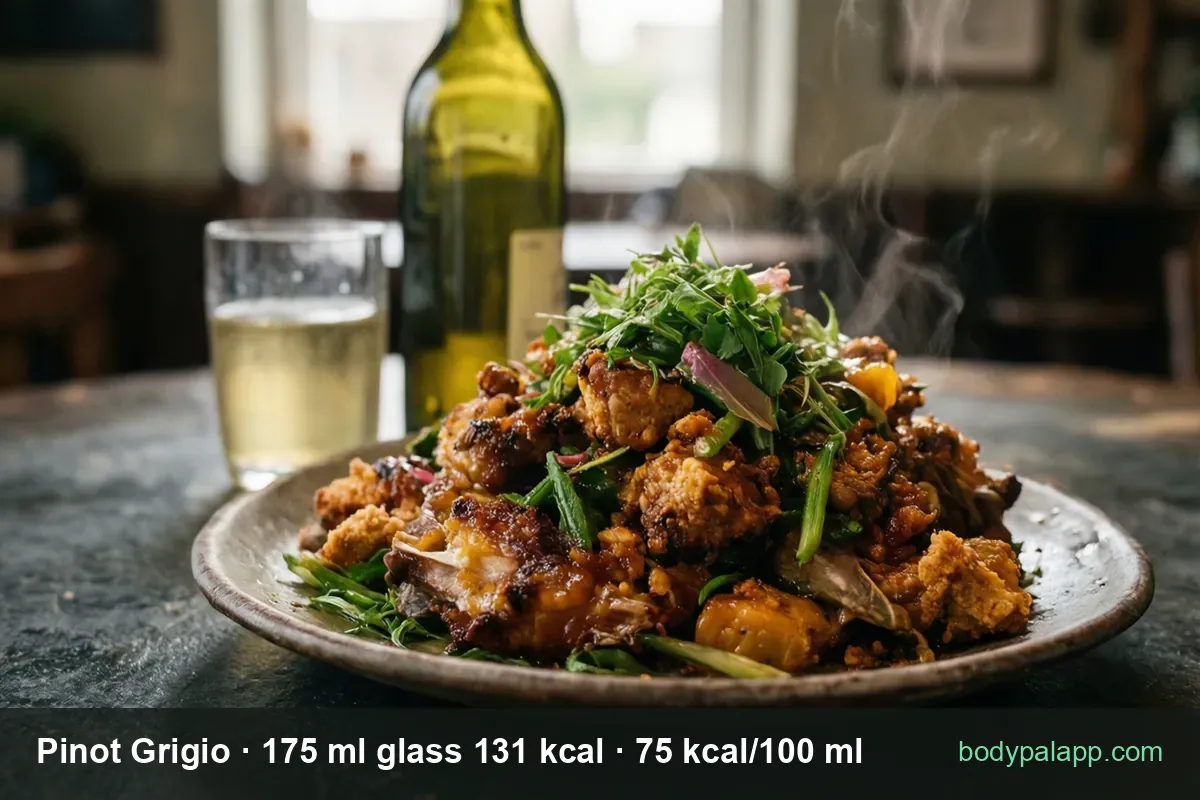
Pour yourself a standard 175 ml glass of pinot grigio and you're drinking 131 calories. Per 100 ml it's 75 kcal, which puts this dry white at the bottom of the wine scale. A small 125 ml glass holds 94, a large 250 ml pour 188, and the full 750 ml bottle 563. That's the short answer to how many calories in pinot grigio.
On this page
- Pinot grigio nutrition facts
- Calories by glass size
- Dry vs sweet vs sparkling
- How does pinot grigio compare?
- The light white myth
- Most popular Pinot Grigio brands
- FAQ
Pinot grigio nutrition facts
| Nutrient | Per 100 ml | Per 175 ml glass | RI% (glass) |
|---|---|---|---|
| Energy | 75 kcal / 314 kJ | 131 kcal / 548 kJ | 7% |
| Protein | 0.1 g | 0.2 g | <1% |
| Carbohydrates | 0.6 g | 1.1 g | <1% |
| Fat | 0 g | 0 g | 0% |
| Fibre | 0 g | 0 g | – |
| Sugar | 0.6 g | 1.1 g | 1% |
| Salt | 0.01 g | 0.02 g | <1% |
RI = reference intake of an average adult (8,400 kJ / 2,000 kcal).
Verified nutrition data
Numbers on this page come from CoFID, the UK government’s Composition of Foods Integrated Dataset, and from manufacturer labels where a branded product is named. Last verified August 2026. How we verify our data →
Look at where those 131 calories come from. Not sugar: a glass of dry white carries barely 1 g, a rounding error against the 30 g of free sugars the NHS sets as a daily maximum. Almost everything you're drinking is alcohol, and alcohol carries calories whatever colour the wine is.
Calories by glass size
Pub and restaurant measures decide your evening's total, so it pays to know them cold.
| Pour | Volume | Calories |
|---|---|---|
| Small glass | 125 ml | 94 |
| Standard glass | 175 ml | 131 |
| Large glass | 250 ml | 188 |
| Bottle | 750 ml | 563 |
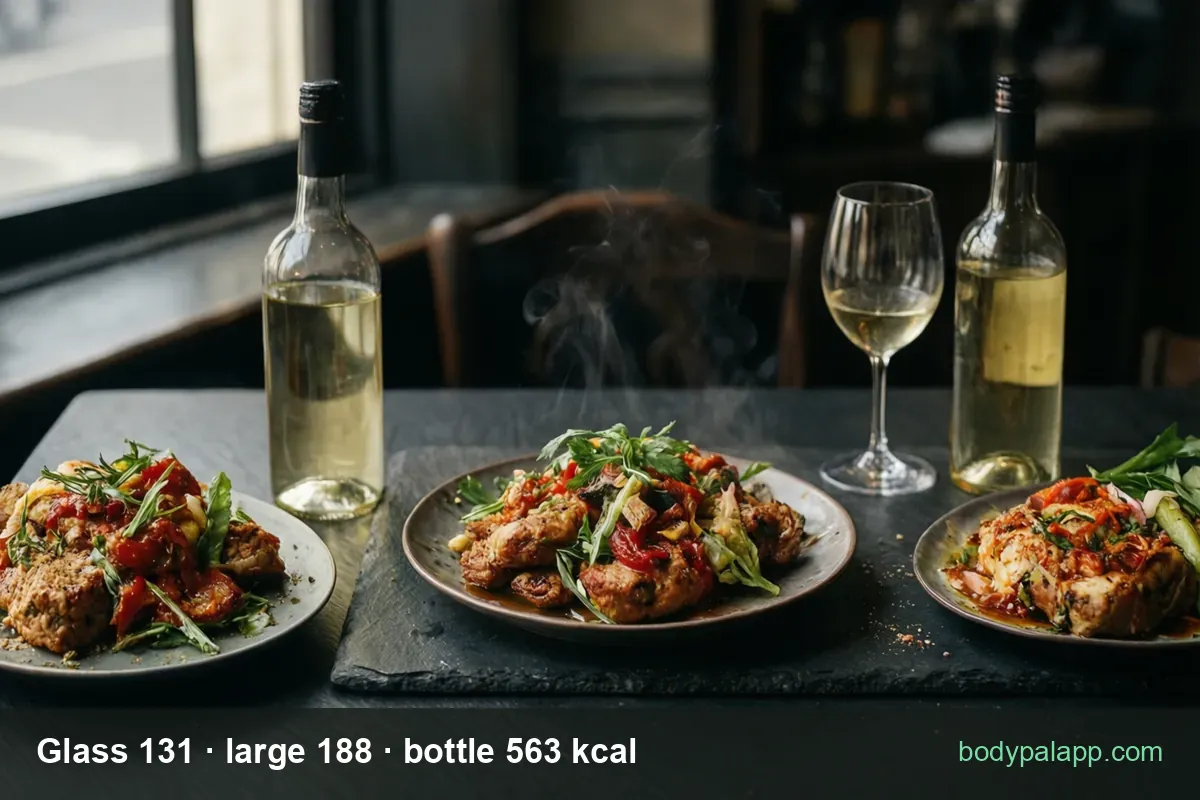
A large glass is a third of a bottle. Order two of them and you've had 376 calories — more than many people's breakfast. Split a bottle over dinner and your half is 282; the bottle itself pours just over four standard glasses.
Home pours deserve their own warning. Without a measure line, a "glass" at your own kitchen table tends to drift towards the 250 ml mark, especially in a large-bowled wine glass. If you're logging honestly, pour against a measured 175 ml once and memorise what it looks like in your usual glass — it's almost certainly less than you've been calling one glass.
One more number worth holding onto: the NHS advises no more than 14 units of alcohol a week, spread over three or more days. Glass size drives both counts at once, calories and units, which makes the 125 ml pour the single easiest cutback in this article.
Dry vs sweet vs sparkling
Pinot grigio's advantage is dryness. During fermentation the yeast eats nearly all the grape sugar, so a dry white finishes at 75 kcal per 100 ml while a sweet white sits at 94. Over a large glass, that's 188 versus 235 — the sweet option costs you 47 calories more for the same pour.
Sparkling wine lands in between at 84 kcal per 100 ml, but it comes with a built-in brake: the 125 ml flute. A flute of fizz is about 105 calories, less than a standard glass of pinot grigio, purely because the serve is smaller.
So within the wine aisle the ranking is simple. Dry beats sweet on every pour, and the glass size matters more than the grape.
How does pinot grigio compare?
| Drink | Serving | Calories | Per 100 ml |
|---|---|---|---|
| Pinot grigio | 175 ml glass | 131 | 75 |
| Wine (average) | 175 ml glass | 133 | 76 |
| Beer (bitter) | Pint (568 ml) | 170 | 30 |
| Gin and tonic | Single | 100 | – |
The verdict: for the lightest single drink at the bar, a gin and tonic at 100 calories beats any wine pour, and pinot grigio is the best of the wines. A pint of bitter costs the most per round at 170, yet it's by far the weakest per millilitre — with beer, you're mostly drinking water slowly.
The light white myth
"I'll have the pinot grigio, it's lighter." Lighter than what? Red wine runs about 76 kcal per 100 ml and this dry white runs 75. They're level. The calories travel with the alcohol, not with the colour, so switching red for white saves you essentially nothing.
The claim is only true against sweet whites, where the gap is real (75 vs 94). If you want a genuinely lower-calorie drink rather than a lower-calorie wine, you need less alcohol in the glass: a smaller pour, a spritzer lengthened with soda water, or a measured spirit with a sugar-free mixer, like vodka and soda.
Most popular Pinot Grigio brands in the United Kingdom
Ranked by how widely each product appears among foods sold in the United Kingdom, from the BodyPal food database of over 3.3 million products. Calories are the figures printed on each label.
| Product | Calories (per 100 ml) |
|---|---|
| Barefoot Pinot Grigio | 63 kcal |
Brand popularity: BodyPal food database. Nutrition: manufacturer labels.
Pinot grigio FAQs
How many calories in a bottle of pinot grigio?
A 750 ml bottle of pinot grigio has about 563 calories, based on 75 kcal per 100 ml for dry white wine. That's just over four standard 175 ml glasses. Finish one across an evening and you've drunk more than a quarter of a 2,000 kcal day.
How many calories in a large glass of pinot grigio?
A large 250 ml glass has about 188 calories — a third of a bottle in one pour. Restaurants often default to the large serve, so asking for the 175 ml (131 kcal) or 125 ml (94 kcal) glass is the simplest saving on the menu.
Pinot grigio or prosecco: which has fewer calories?
Per 100 ml, pinot grigio wins at 75 kcal against about 84 for sparkling wine. Per serve, the fizz often wins anyway: a 125 ml flute is roughly 105 calories, under the 131 in a standard glass of pinot grigio, because the pour is smaller.
How much sugar is in pinot grigio?
Very little — about 0.6 g per 100 ml, so a standard 175 ml glass carries roughly 1 g of sugar. Dry wines ferment nearly all their grape sugar into alcohol. The calories in your glass come from that alcohol, not from sweetness.
What is the lowest calorie wine?
Dry whites like pinot grigio sit at the bottom of the scale at about 75 kcal per 100 ml, with sparkling at 84 and sweet whites at 94. To go lower still, shrink the serve: a 125 ml glass is 94 calories, and a spritzer stretches it further.
How many calories in half a bottle of pinot grigio?
Half a 750 ml bottle — 375 ml — is about 282 calories, the same as drinking one large glass and one small one. It's a useful number if you routinely share a bottle over dinner: your half is closer to a light meal than a light drink.
How many calories in a small 125 ml glass?
A small 125 ml glass of pinot grigio has about 94 calories. It's the only pub measure that keeps a glass of wine under 100 kcal, and switching from large to small saves 94 calories per round without changing what you're drinking.
Is pinot grigio fattening?
A glass at 131 calories isn't, but the pattern can be: a bottle is 563 kcal and those calories carry no protein, fibre or fullness. If you're watching your weight, the pour size and the weekly total matter far more than the grape — the NHS guidance on drinking is a sensible frame.
Similar foods
- Wine — 133 kcal a 175 ml glass
- Rosé wine — 138 kcal a 175 ml glass
- Gin and tonic — 100 kcal a single G&T
- Corona — 139 kcal a bottle
- Cider — 205 kcal a pint of dry
- Pint of Guinness — 199 kcal a pint
Count the pour, not the guesswork
Log a glass in BodyPal and it tracks the calories from one photo — bottle, large pour or spritzer, without the mental arithmetic.


How long does it take to burn off Pinot Grigio?
A 175 ml glass is 131 kcal. Enter your weight and the amount you ate to see how long it takes you to burn that off:
lb ml
| Activity | Time to burn 131 kcal |
|---|---|
| Walking, brisk | 26 min |
| Cycling, moderate | 16 min |
| Swimming, moderate | 19 min |
| Jogging | 15 min |
| Weight training, moderate | 29 min |
Times are for a 154 lb (11 st) adult at a steady pace; change the weight to see yours. The amount is set to the portion in the text (175 ml); change it to what you actually drank. BodyPal works this out from your steps automatically.
This table assumes you know your daily total. If you do not, the daily calorie calculator works it out from five numbers.