
---
Gin and Tonic Calories: What's Actually in the Glass
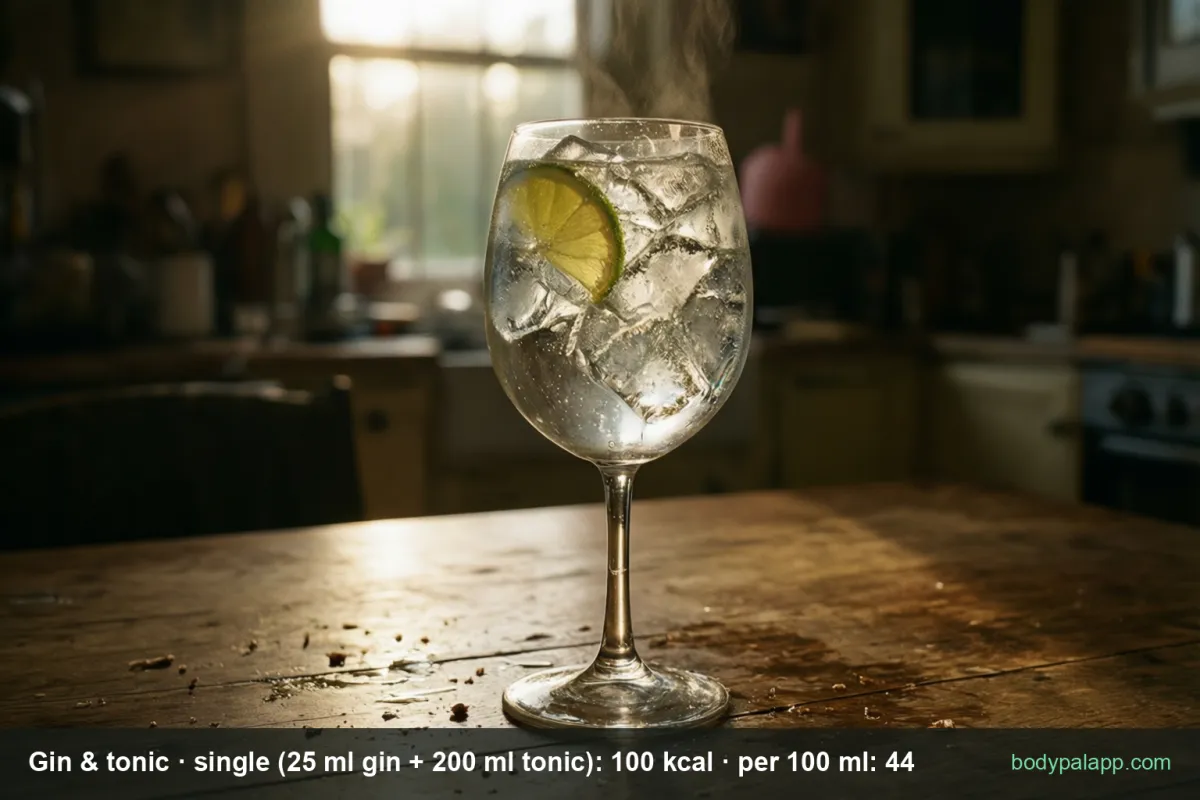
Gin and tonic calories start at 100 for a standard single: 56 from a 25 ml measure of gin, 44 from 200 ml of ordinary tonic. That is about 44 kcal per 100 ml of the finished drink. A double takes you to 156 kcal. Slimline tonic pulls a single down to roughly 60.
On this page
- Quick facts
- UK measures at a glance
- Slimline tonic: the 40-calorie swap
- Doubles and heavy pours
- Does your gin brand matter?
- How a G&T compares with other drinks
- The myth that the gin is the problem
- Units, sugar and where the drink fits
- Most popular tonic water brands
- Frequently asked questions
- Similar foods
Quick facts
| Nutrient | Per single (225 ml) | Per 100 ml | %RI per single |
|---|---|---|---|
| Energy | 100 kcal / 418 kJ | 44 kcal / 184 kJ | 5% |
| Protein | 0 g | 0 g | 0% |
| Carbohydrate | 11.8 g | 5.2 g | 5% |
| of which sugars | 11.8 g | 5.2 g | 13% |
| Fat | 0 g | 0 g | 0% |
| of which saturates | 0 g | 0 g | 0% |
| Fibre | 0 g | 0 g | – |
| Salt | 0.02 g | 0.01 g | <1% |
%RI = Reference Intake for an average adult (2,000 kcal). The zeros in the protein and fat rows are real: every gram of carbohydrate in the glass comes from the tonic, and the energy in the gin itself comes from the alcohol rather than from any macronutrient.
Verified nutrition data
Numbers on this page come from CoFID, the UK government’s Composition of Foods Integrated Dataset, and from manufacturer labels where a branded product is named. Last verified August 2026. How we verify our data →
UK measures at a glance
A pub single in England and Wales is 25 ml. That is the number almost every calorie figure you will see online is built on, and it is the number worth memorising.
| Serve | Build | Calories | kJ |
|---|---|---|---|
| Single G&T | 25 ml gin + 200 ml tonic | 100 kcal | 418 kJ |
| Double G&T | 50 ml gin + 200 ml tonic | 156 kcal | 653 kJ |
| Slimline single | 25 ml gin + 200 ml slimline tonic | ~60 kcal | ~251 kJ |
| Gin, neat | 25 ml | 56 kcal | 234 kJ |
Home pours are the wild card. Nobody measures 25 ml over the sink, and a generous free-hand pour into a big copa glass can easily double the gin without feeling like a double. If you want the numbers on this page to describe your drink, use a jigger or a measuring cap.
Slimline tonic: the 40-calorie swap
A slimline single lands at roughly 60 kcal against 100 for the full-sugar version. The saving is 40 kcal, and it is the cheapest 40 kcal you will ever cut, because it changes nothing about the gin.
Ordinary tonic carries 22 kcal and 5.9 g of sugar per 100 ml. Slimline sits at about 1-2 kcal per 100 ml with the sugar replaced by sweeteners. Over 200 ml that is the whole difference between the two drinks.
Two or three G&Ts on a Friday is where it starts to matter. Three singles with regular tonic come to 300 kcal; three slimline singles come to about 180. Same gin, same glasses, 120 kcal apart.
Doubles and heavy pours
A double G&T is 156 kcal: 50 ml of gin plus the same 200 ml of tonic. The tonic contribution does not change, so the extra 56 kcal is pure gin.
That makes the double an odd deal in calorie terms. You pay 56% more energy for twice the alcohol and the same amount of liquid in the glass. If you are drinking for the taste of the tonic and the ice, a single is better value; if you are ordering doubles to make one drink last, a slimline double at around 116 kcal does the same job for less than a full-sugar single and a half.
Does your gin brand matter?
Not for calories. Every gin bottled at 40% ABV lands at the same 222 kcal per 100 ml, so a 25 ml measure is 56 kcal whether it came from the supermarket own-label or the small-batch bottle with the wax seal.
Where brands do move the number is strength and sugar. A navy-strength gin bottled well above 40% will carry more energy per millilitre, and sweetened styles such as sloe gin or the flavoured pink gins are a different product with added sugar — check the bottle, because those labels differ by brand.
The mixer is where the real decision sits. Swapping brands changes the botanicals; swapping tonics changes the calories.
How a G&T compares with other drinks
| Drink | UK serve | Calories | Per 100 ml | P / C / F per serve |
|---|---|---|---|---|
| Gin and tonic | Single, 225 ml | 100 kcal | 44 kcal | 0 / 11.8 / 0 g |
| Slimline G&T | Single, 225 ml | ~60 kcal | ~27 kcal | 0 / ~0 / 0 g |
| Guinness | Pint, 568 ml | 199 kcal | 35 kcal | 1.7 / 15.3 / 0 |
| Lager | Pint, 568 ml | 165-199 kcal | 29-35 kcal | 1.7 / 13.6 / 0 |
| Prosecco | Glass, 125 ml | 94 kcal | 75 kcal | 0.3 / 1.8 / 0 |
The verdict: if you are counting and want the most drinks for the fewest calories, a slimline G&T at about 60 kcal beats everything else on this table by a wide margin, and it beats a glass of prosecco by more than a third with a far bigger glass. If you would rather have one long drink that lasts an hour, a pint of Guinness at 199 kcal gives you 568 ml for the calories of two singles, which is the better trade when the alternative is three quick G&Ts.
The myth that the gin is the problem
Clear spirits have a reputation as the "safe" drink, and people order a G&T thinking the gin is the part to watch. In a full-sugar single the gin is 56 kcal and the tonic is 44. The mixer is 44% of the drink and 100% of the sugar.
The second half of the myth is that slimline makes it a low-calorie drink. It does not. It makes it a 60-calorie drink, and all 60 of those calories are the gin, which is exactly the same gin you would drink neat. Slimline changes the mixer, not the spirit.
Units, sugar and where the drink fits
A 25 ml measure of 40% gin is one UK unit, so a double is two. The NHS guidance on units is to stay under 14 units a week, spread over three or more days.
The sugar figure is the one that surprises people. A single with ordinary tonic carries 11.8 g of sugar, and the NHS advises adults to keep free sugars under 30 g a day. Two G&Ts take most of that allowance before you have eaten anything. Slimline removes the problem entirely.
As a drink to build an evening around, the numbers are kind: three slimline singles come in under 200 kcal, which is less than one pint of Guinness. The NHS pages on cutting down are the place to go for the drinking side rather than the calorie side.
Most popular tonic water brands in the United Kingdom
Ranked by how widely each product appears among foods sold in the United Kingdom, from the BodyPal food database of over 3.3 million products. Calories are the figures printed on each label. The gin is the same 56 kcal a single whichever bottle you pour — the tonic is where the numbers move.
| Product | Calories (per 100 ml) |
|---|---|
| Schweppes Pink Tonic | 19 kcal |
| Fever-Tree Premium Indian Tonic | 30 kcal |
| Fever-Tree Mediterranean Tonic | 34 kcal |
Brand popularity: BodyPal food database. Nutrition: manufacturer labels.
How long does it take to burn off 100 kcal of gin and tonic?
A standard single (225 ml) is 100 kcal. Enter your weight and the amount you ate to see how long it takes you to burn that off:
lb ml
| Activity | Time to burn 100 kcal |
|---|---|
| Walking, brisk | 20 min |
| Cycling, moderate | 12 min |
| Swimming, moderate | 14 min |
| Jogging | 12 min |
| Weight training, moderate | 22 min |
Times are for a 154 lb (11 st) adult at a steady pace; change the weight to see yours. The amount is set to the portion in the text (225 ml); change it to what you actually drank. BodyPal works this out from your steps automatically.
Burning it off is one side of it. The other is knowing your number: work out how many calories you need a day, with macros and a goal date.
Frequently asked questions
How many calories are in a gin and tonic?
A standard single gin and tonic is 100 kcal, made up of 56 kcal from a 25 ml measure of gin and 44 kcal from 200 ml of tonic water. That is 418 kJ, or about 44 kcal per 100 ml of the finished 225 ml drink. Swapping to slimline tonic brings the same glass down to roughly 60 kcal.
How many calories are in a slimline gin and tonic?
A slimline single is about 60 kcal, against 100 kcal for the full-sugar version, so the swap saves around 40 kcal per drink. Slimline tonic contributes roughly 1-2 kcal per 100 ml instead of 22, and no sugar. Everything left in the glass is the gin itself.
How many calories are in a double gin and tonic?
A double gin and tonic is 156 kcal: 50 ml of gin plus 200 ml of tonic. The tonic stays at 44 kcal, so the entire increase of 56 kcal comes from the second measure of gin. A slimline double works out at roughly 116 kcal.
How many calories are in gin on its own?
A 25 ml measure of gin at 40% ABV is 56 kcal, and gin is 222 kcal per 100 ml. Neat gin has no sugar, no protein and no fat, so a G&T with slimline tonic is only about 4 kcal more than the same gin drunk straight over ice.
Is gin the lowest-calorie alcohol?
Gin at 40% is 222 kcal per 100 ml, the same as any other spirit bottled at that strength, so no single spirit wins on calories. What decides the drink is the measure and the mixer: 56 kcal of gin with slimline tonic is about 60 kcal, while the same gin with ordinary tonic is 100.
Gin and tonic versus wine: which has fewer calories?
A single G&T at 100 kcal beats a 125 ml glass of prosecco at 94 kcal only if you go slimline, which drops the G&T to about 60. Prosecco is 75 kcal per 100 ml against 44 for a full-sugar G&T, so the wine is denser but the glass is smaller. Still wine comes in bigger glasses, which is usually where the evening total runs away.
Does gin and tonic make you gain weight?
A single G&T is 100 kcal, or 5% of a 2,000 kcal reference intake, so one drink is a small addition to a day. The arithmetic changes with volume: four full-sugar singles are 400 kcal and 47 g of sugar. Slimline tonic cuts the same four drinks to about 240 kcal.
How much sugar is in a gin and tonic?
A single with ordinary tonic contains 11.8 g of sugar, which is 13% of the reference intake and all of it from the mixer, since tonic water carries 5.9 g of sugar per 100 ml. Gin itself has none. Slimline tonic removes effectively all of it.
Does the brand of gin change the calories?
No, not at the same strength. Any gin bottled at 40% ABV is 222 kcal per 100 ml, so a 25 ml measure is 56 kcal regardless of the label. Higher-strength gins carry more energy per millilitre, and sweetened styles such as sloe or flavoured pink gin are a separate product with added sugar.
How many units is a gin and tonic?
A 25 ml measure of 40% gin is one UK unit, so a single G&T is one unit and a double is two. The NHS advises no more than 14 units a week, spread over three days or more. Calories and units move together here: 100 kcal buys you one unit in a single.
Similar foods
- Corona — 139 kcal a bottle
- Cider — 205 kcal a pint of dry
- Pint of Guinness — 199 kcal a pint
- Pint of beer — 170 kcal a pint of bitter
- Pinot Grigio — 131 kcal a 175 ml glass
- Wine — 133 kcal a 175 ml glass
Count it without the maths
BodyPal logs a G&T, a double or a slimline in a couple of taps and keeps the running total for the evening, so you are not doing sums at the bar.

