
Calories in a Pint of Guinness (and Why It Is Lighter Than It Looks)
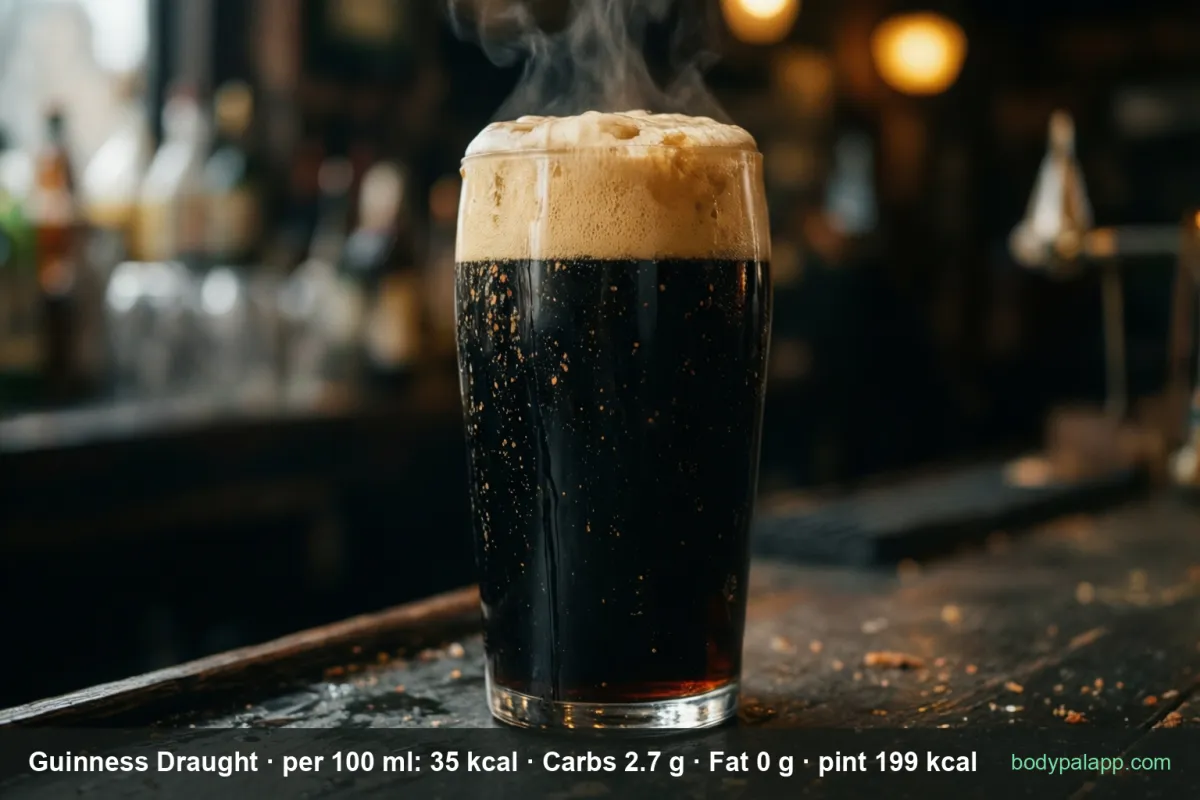
There are 199 calories in a pint of Guinness, working from the 35 kcal per 100 ml on the label. A 440 ml can comes to 154. That puts the black stuff below a pint of dry cider and roughly 34 calories above a lager, which is not the reputation it drinks with.
On this page
- Guinness nutrition at a glance
- Pint, half and can
- Draught, can and Guinness 0.0
- How does a pint of stout compare?
- Two things people get wrong
- Most popular stout brands
- FAQ
- Similar drinks
Guinness nutrition at a glance
| Nutrient | Per 100 ml | Per pint (568 ml) | %RI* per pint |
|---|---|---|---|
| Energy | 35 kcal / 146 kJ | 199 kcal / 833 kJ | 10% |
| Protein | 0.3 g | 1.7 g | 3% |
| Carbohydrate | 2.7 g | 15.3 g | 6% |
| Fat | 0 g | 0 g | 0% |
| Salt | 0 g | 0 g | 0% |
*%RI = share of the reference intake for an average adult (2,000 kcal; 70 g fat, 260 g carbohydrate, 90 g sugars, 50 g protein, 6 g salt).
Verified nutrition data
Numbers on this page come from CoFID, the UK government’s Composition of Foods Integrated Dataset, and from manufacturer labels where a branded product is named. Last verified August 2026. How we verify our data →
Two rows are worth a second look. Fat is a flat zero, and 2.7 g of carbohydrate per 100 ml cannot account for 35 kcal on its own. The alcohol does the rest, which is why a stout and a lager land so close together.
Pint, half and can
A UK pint is 568 ml. Everything below scales from that.
| Serving | Calories |
|---|---|
| Half pint (284 ml) | 99 kcal |
| Pint (568 ml) | 199 kcal |
| Can (440 ml) | 154 kcal |
| Pint of Guinness 0.0 (568 ml) | 97 kcal |
Three pints across an evening is 597 kcal. For scale, one pint sits just under a plain bagel at 230 kcal.
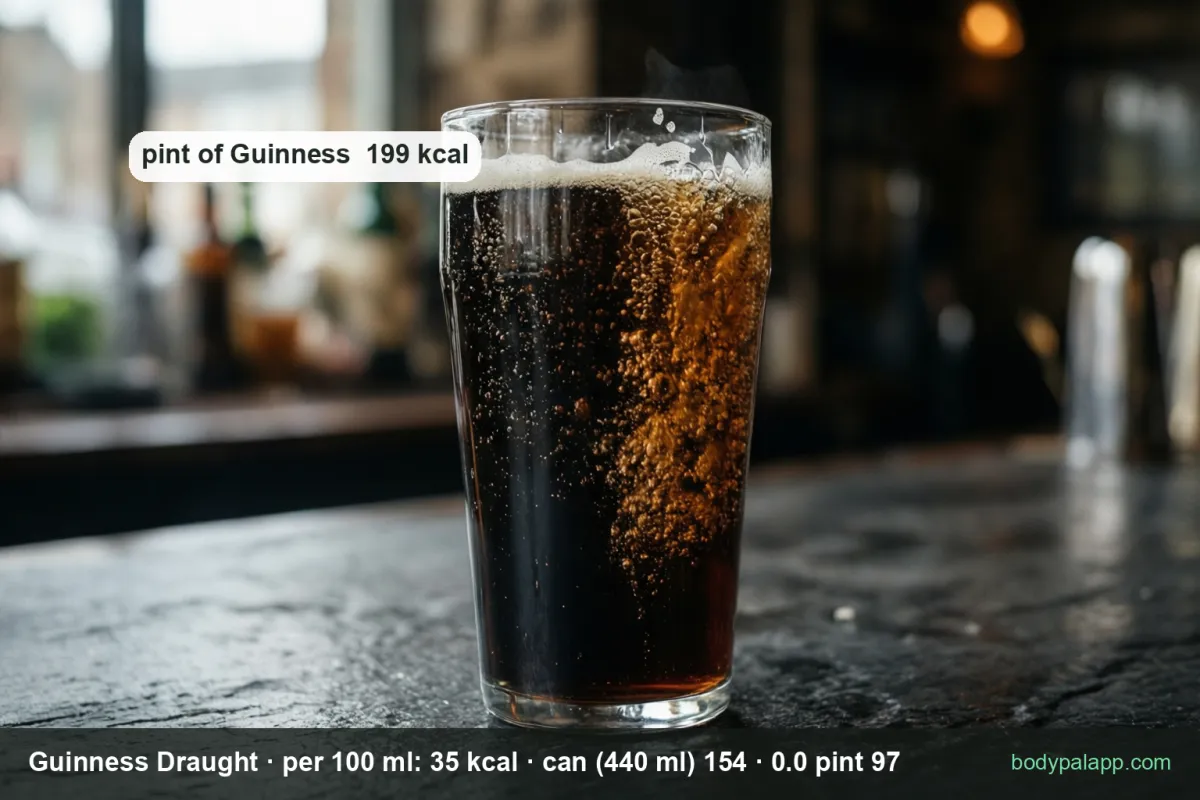
Three versions turn up in UK fridges and taps, and only one of them changes the maths meaningfully.
Draught, can and Guinness 0.0
Guinness Draught, pint (568 ml): 199 kcal. The label figure scaled to a pint: 35 kcal per 100 ml, no fat, 1.7 g of protein.
Guinness Draught, can (440 ml): 154 kcal. Same liquid, smaller measure. The 45-calorie gap against a pint is volume, not recipe, so a four-pack is 616 kcal rather than the 796 four pints would be.
Guinness 0.0, pint: about 97 kcal. The alcohol-free version is 17 kcal per 100 ml on the label, so a pint is roughly 97 and a 440 ml can about 75. Swapping one pint in a session for a 0.0 saves around 102 calories.
How does a pint of stout compare?
| Drink | Per 100 ml | Per pint (568 ml) |
|---|---|---|
| Premium lager | 29 kcal | 165 kcal |
| Bitter | 30 kcal | 170 kcal |
| Guinness | 35 kcal | 199 kcal |
| Dry cider | 36 kcal | 204 kcal |
Four pints, a 39-calorie spread between the lightest and the heaviest. That is the whole argument in one table.
The verdict: if you are counting, bitter and lager are the cheapest pints here, but the honest saving against Guinness is about 30 calories a glass. Pick the pint you actually want and count how many, because the fourth one costs roughly 200 calories whichever of these you chose. The NHS alcohol advice pages cover what this page does not: weekly limits, drink-free days and how units are worked out, with a calculator at Drinkaware.
Two things people get wrong
"It is a meal in a glass." It is 199 kcal, less than a pint of dry cider and less than a bagel. The reputation comes from the mouthfeel: Guinness is poured with nitrogen rather than carbon dioxide, and the fine, dense head that produces reads as richness. Fat on the label is zero.
"Guinness is good for you." That line was an advertising slogan, not a nutrition statement, and the iron claim that trails after it is advertising history too. No iron figure is published on this page, because the label does not carry one.
Most popular stout brands in the United Kingdom
Ranked by how widely each product appears among foods sold in the United Kingdom, from the BodyPal food database of over 3.3 million products. Calories are the figures printed on each label.
| Product | Calories (per 100 ml) |
|---|---|
| Guinness Draught | 35 kcal |
| Guinness Draught 0.0 | 17 kcal |
| Murphy's Irish Stout | 42 kcal |
Brand popularity: BodyPal food database. Nutrition: manufacturer labels.
How long does it take to burn off a pint of Guinness?
A pint (568 ml) is 199 kcal. Enter your weight and the amount you ate to see how long it takes you to burn that off:
lb ml
| Activity | Time to burn 199 kcal |
|---|---|
| Walking, brisk | 40 min |
| Cycling, moderate | 25 min |
| Swimming, moderate | 28 min |
| Jogging | 23 min |
| Weight training, moderate | 44 min |
Times are for a 154 lb (11 st) adult at a steady pace; change the weight to see yours. The amount is set to the portion in the text (568 ml); change it to what you actually drank. BodyPal works this out from your steps automatically.
This table assumes you know your daily total. If you do not, the daily calorie calculator works it out from five numbers.
Frequently asked questions
How many calories are in a pint of Guinness?
A pint is 199 kcal, taking the 35 kcal per 100 ml on the label across 568 ml. That is about 10% of a 2,000-calorie day. The glass also carries 1.7 g of protein, 15.3 g of carbohydrate and no fat at all.
How many calories are in a can of Guinness?
A 440 ml can is 154 kcal, 45 fewer than a pint, because a can holds 128 ml less than a UK pint glass. A four-pack comes to 616 kcal. If you log cans as pints you overcount by roughly a quarter every time.
How many calories are in Guinness 0.0?
Guinness 0.0 is 17 kcal per 100 ml on the label, so a pint is about 97 kcal and a 440 ml can about 75 kcal. That is under half the draught version. Swapping one pint of the draught for a 0.0 saves roughly 102 calories.
Does Guinness have more calories than lager?
Slightly. A pint of Guinness is 199 kcal against 165 for a pint of premium lager, a difference of 34 calories, and 170 for a pint of bitter. The colour has nothing to do with it. Per 100 ml the three sit within 6 kcal of each other.
Is Guinness fattening?
A pint is 199 kcal with zero fat, so it adds weight the way any drink does, by pushing your daily total past what you use. Three pints is 597 kcal, which is where the trouble usually starts. The pint itself is lighter than the dessert-in-a-glass reputation suggests.
Guinness or cider: which has fewer calories?
Guinness, by 5 calories a pint: 199 against 204 for a pint of dry cider. They are effectively level, so the choice is not a calorie decision. Against lager at 165 a pint the gap is bigger, though still only 34 calories.
How many calories are in a half pint of Guinness?
A half pint is 99 kcal at 284 ml. Two halves and one pint are the same 199 either way, so the glass size only helps if it actually slows you down. A half is roughly the calories of one medium slice of bread.
Why does Guinness taste creamy if it has no fat?
The label reads 0 g of fat per 100 ml. The texture comes from the nitrogen it is poured with, which makes smaller, denser bubbles than the carbon dioxide used in most beers. That is a physical effect in the head, not an ingredient, and it carries no calories.
Similar foods
- Cider — 205 kcal a pint of dry
- Pint of beer — 170 kcal a pint of bitter
- Corona — 139 kcal a bottle
- Gin and tonic — 100 kcal a single G&T
- Pinot Grigio — 131 kcal a 175 ml glass
- Wine — 133 kcal a 175 ml glass
Count it without the maths
BodyPal logs the pint, the can and the round after it, so the evening total is there in the morning without any scaling from 100 ml.

