
Protein Shake with Milk or Water: What the Choice Really Costs
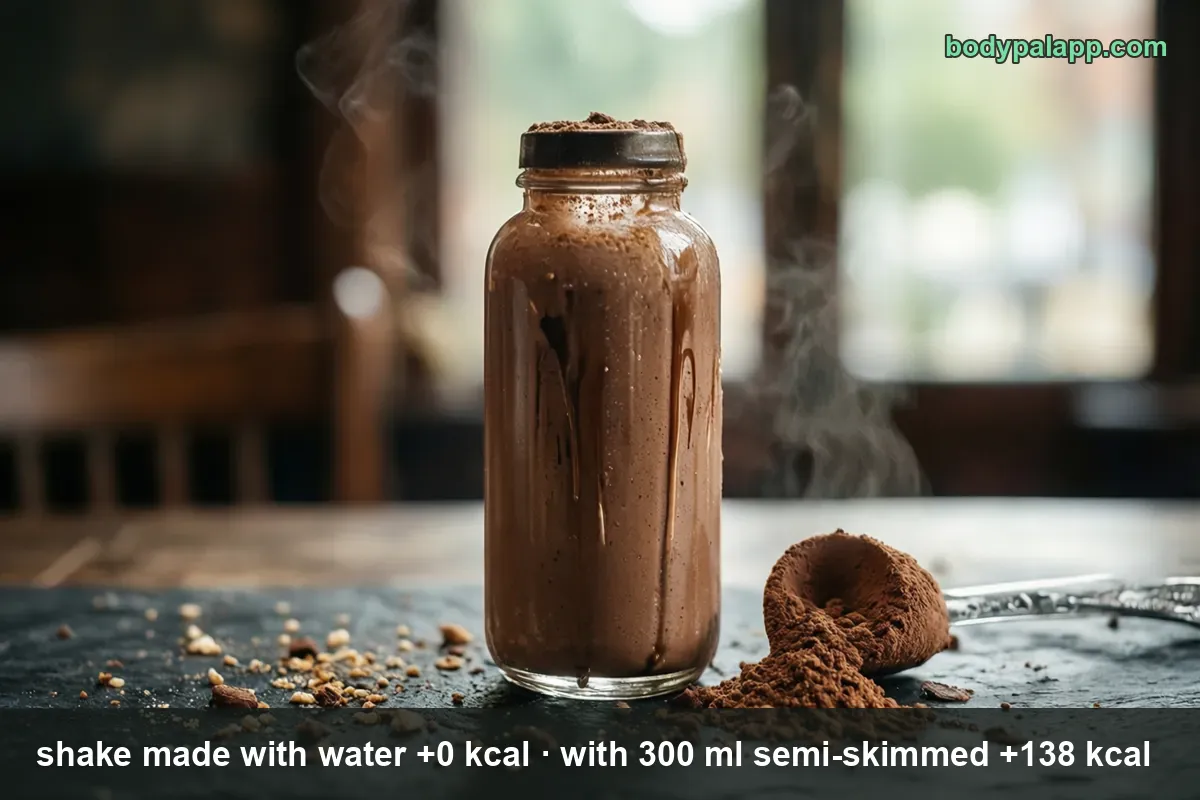
Mixing a protein shake with milk or water changes exactly one thing: 300 ml of semi-skimmed milk adds 138 calories, and water adds zero. Your powder costs the same either way. So the question is never "how many calories is a shake", it is what you pour on top of the scoop, and that runs from 0 to 189.
What each liquid adds to the shaker
| Per 300 ml of liquid | Water | Skimmed milk | Semi-skimmed milk | Whole milk |
|---|---|---|---|---|
| Energy added | 0 kcal | +102 kcal / 427 kJ | +138 kcal / 577 kJ | +189 kcal / 791 kJ |
| kcal per 100 ml | 0 | 34 | 46 | 63 |
| Protein added | 0 g | +10.5 g | +10.5 g | +10.2 g |
| Carbohydrate added | 0 g | +14.4 g | +14.1 g | +13.8 g |
| of which sugars | 0 g | +14.4 g | +14.1 g | +13.8 g |
| Fat added | 0 g | +0.9 g | +5.1 g | +10.8 g |
| Salt added | 0 g | +0.33 g | +0.33 g | +0.33 g |
Verified nutrition data
Numbers on this page come from CoFID, the UK government’s Composition of Foods Integrated Dataset, and from manufacturer labels where a branded product is named. Last verified August 2026. How we verify our data →
Milk figures are the CoFID averages for UK pasteurised milk. The sugars line is lactose, naturally present in milk rather than added, and it barely moves between the three: skimming removes fat, not sugar or protein.
That protein line deserves a second look. Milk is not just a calorie cost; 300 ml of any of the three carries about 10.5 g of protein, which can lift a 20 g scoop into the high-20s per shake. Whether that is a bonus or a redundancy depends entirely on why you are drinking it.
If you buy shakes ready-made instead of mixing them, the average UK ready-to-drink product comes in at 65 kcal per 100 ml with 10.6 g of protein, so a typical 330 ml bottle is around 215 kcal. That sits between the water and whole-milk versions of a home shake, which is worth knowing when you compare prices.
When to pick water
Pick water when the shake's job is protein in a calorie deficit. The 138 kcal a semi-skimmed shake adds every day is close to 1,000 kcal a week, which is a meal. Water keeps the scoop's protein at the scoop's price, mixes faster, and needs no fridge, and for a post-gym drink whose whole purpose is hitting a protein target cheaply, it is the rational default.
The taste penalty is real but smaller than it used to be; most modern powders are built to survive water. If yours isn't, skimmed milk buys most of the creaminess back for 102 kcal, 36 fewer than semi-skimmed.
When to pick milk
Pick milk when the shake is a meal's understudy rather than a supplement. A whole-milk shake at +189 kcal with an extra 10.2 g of protein is closer to a small breakfast, and for anyone using shakes to gain weight or to cover a missed meal, those are calories you wanted anyway. Whole milk also carries the fat that makes a shake actually satisfying.
The halfway option is the one most UK fridges already hold: semi-skimmed at +138 kcal splits the difference between richness and restraint, which is why it is the default pour for people who are maintaining rather than cutting. Match the liquid to the goal, not to habit.
Most popular ready-to-drink protein shake brands in the United Kingdom
Ranked by how widely each product appears among foods sold in the United Kingdom, from the BodyPal food database of over 3.3 million products. Calories are the figures printed on each label. All four are milk-based, which is why they cluster near the made-with-milk column rather than the water one.
| Product | Calories (per 100 ml) |
|---|---|
| Valio PROfeel Protein Milkshake | 70 kcal |
| Ufit Strawberry Protein Milkshake | 54 kcal |
| Arla Protein Chocolate Milk Drink | 51 kcal |
| Müller x Myprotein Strawberry Shake | 48 kcal |
Brand popularity: BodyPal food database. Nutrition: manufacturer labels.
Frequently asked questions
Should I make a protein shake with milk or water for weight loss?
Water, if the calories are the constraint: it adds nothing, while 300 ml of milk adds 102 kcal (skimmed), 138 (semi-skimmed) or 189 (whole). Over a daily shake that gap is roughly 700 to 1,300 kcal a week, which is large enough to show up on the scales.
How many calories does milk add to a protein shake?
Per 300 ml: 102 kcal for skimmed, 138 for semi-skimmed and 189 for whole milk, on top of whatever your powder contains. Scale by your actual pour, since milk runs 34 to 63 kcal per 100 ml. A 250 ml pour of semi-skimmed adds 115 kcal.
How many calories are in a protein shake made with water?
Exactly what the powder label says, because water contributes zero. There is no universal scoop figure, so check your tub's per-serving line. For comparison, ready-to-drink shakes average 65 kcal per 100 ml in the UK, about 215 kcal for a 330 ml bottle.
Does milk add protein to a shake?
Yes, about 10.5 g per 300 ml, and skimming does not reduce it: skimmed, semi-skimmed and whole milk all sit near 3.5 g per 100 ml. That can turn a modest scoop into a high-protein drink, which is the strongest argument for milk when calories are not tight.
Is a shake with skimmed milk worth it over semi-skimmed?
It saves 36 kcal per 300 ml (102 against 138) while keeping the same 10.5 g of protein and most of the texture, since the sugars and protein stay when the fat goes. If you drink a shake daily, that single swap is worth about 250 kcal a week.
More comparisons
- Beer vs wine — pint 170 vs glass 133 kcal
Log the shake without the maths
BodyPal logs the scoop and the pour in one go, so the difference between a water day and a milk day lands in your diary by itself.


One food is easy to picture; a whole day is harder. See how many calories you need a day and what a deficit actually looks like.