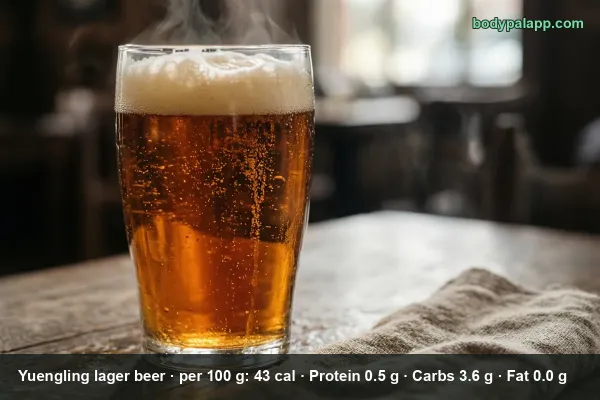
Beer and lager calories come to 153 for a 12 oz can (356 g) and 43 per 100 g. Light beer cuts a can to 103. The thing to notice is how fast cans stack up: beer has almost no protein, no fat and no fiber, so every round adds calories without adding any fullness.
153kcal
1 12 oz can · 356 g, regular lager, all types
11%protein
1.6 gProtein
13 gCarbs
0 gFat
How to burn off 153 kcal
—Walking, brisk
—Jogging
—Cycling, moderate
—Swimming
Skip the math. BodyPal counts these calories from your steps and workouts automatically.
Nutrition facts
Regular lager, all types · per 356 g
Calories
153 kcal
Protein
1.6 g
Carbohydrate
12.6 g
Fat
0 g
Saturated fat
0 g
Cholesterol
0 mg
Sodium
14 mg
Potassium
96 mg
Iron
0.1 mg
Source: USDA FoodData Central
🛡️
Verified nutrition data
Numbers on this page come from USDA FoodData Central, the U.S. Department of Agriculture’s food composition database, and from manufacturer labels where a branded product is named. Last verified September 2026. How we verify our data →
Beer: calories, protein and sodium by serving
Percent of daily value uses the FDA reference of 2,000 kcal a day.
Serving
kcal
Protein
Carbs
Fat
Sodium
% DV kcal
12 oz can (356 g)
153
1.6 g
12.6 g
0 g
14 mg
8%
Light beer can (354 g)
103
0.8 g
5.8 g
0 g
14 mg
5%
16 oz pint (480 g)
206
2.2 g
17 g
0 g
19 mg
10%
100 g
43
0.5 g
3.6 g
0 g
4 mg
2%
3 × 12 oz can (356 g)
459
4.9 g
43 mg
5 × 12 oz can (356 g)
765
8.2 g
71 mg
Five cans add up to 765 calories
A single 12 oz can of regular lager carries 153 calories, about 8% of the daily value. A 16 oz pint pushes that to 206, or 10% of the daily value, simply because the glass holds 480 g of beer instead of 356 g. Pour size matters more than most drinkers think, and bar pints are rarely the smaller option.
The total climbs in a straight line with every round. Two cans come to 306 calories, three reach 459, and five land at 765. That last figure is 1,780 g of liquid, and it brings only 8.2 g of protein along with it. At a game or a long dinner, the number of cans sets the evening's calorie load far more than the label on them.
Light beer is the simplest lever you have. A light can of 354 g lists 103 calories against 153 for regular, so each swap trims about a third off the round. Across 5 rounds that gap turns into a real difference on the day's log, with no change in how many drinks you hold.
Carbs and alcohol carry the calories, not protein
Per 100 g, beer lists 3.6 g of carbohydrate, 0.5 g of protein and 0 g of fat. On the macro split, carbs make up 89% and protein 11%, with fat at 0%. Sugars read 0 g for regular lager, and fiber is 0 g as well.
That split only tells part of the story. Protein and carbs alone do not account for all 43 calories in 100 g; the remainder comes from alcohol, which the nutrition table does not list as a macro. Stronger beers carry more alcohol, so they usually carry more calories too, even when the carb line looks much the same.
The practical takeaway is blunt. Beer supplies energy and very little else. A can delivers 1.6 g of protein, just 3% of the daily value, so it will not stand in for food. Treat it as a drink you account for, not as part of a meal's nutrition.
Carbs are the row that moves, sodium barely registers
Regular beer is low on nearly every row people usually watch. A 12 oz can has 14 mg of sodium, only 1% of the daily value, and even 5 cans total just 71 mg. Fat, saturated fat and cholesterol all read 0, so there is nothing to track on those lines.
Carbs are where the choices differ. A regular can holds 12.6 g, a pint holds 17 g, and a light can drops to 5.8 g. If you count carbs, light beer roughly halves the load per can, and its 0.3 g of sugars is close to nothing. Regular lager's carbs show up as carbohydrate rather than sugar on the label.
Potassium sits at 27 mg per 100 g, a small figure. Nothing in this profile makes beer a meaningful source of minerals or protein. Judge it on calories and carbs alone, and the decision between regular, light and pint size gets simple.
Plan the food around the beer
Because beer brings calories with almost no protein or fiber, it pairs best with food that supplies both. Grilled chicken, a bean chili or a big salad with lean meat fills the gaps beer leaves behind. Salty snacks and fried bar food mostly stack calories on top of calories.
If you track intake, log the beer first and build the rest of the day around it. Two cans at 306 calories is a real line item, and a pint at 206 is bigger than a can. Knowing that number up front makes it easier to decide whether a second round fits.
Alternating each beer with a glass of water slows the pace and keeps the can count down. BodyPal can log a beer from a photo of the can or glass, which makes the tally easier on a busy night out.
How does beer compare?
Here is how regular beer stacks up against Budweiser, Heineken and Yuengling lager, per 100 g and per usual serving.
Verdict: These lagers are nearly identical: Heineken and Yuengling match this page at 43 calories per 100 g, and Budweiser comes in a hair lower at 41, or 146 per can. If you want fewer calories, switch to a light beer at 103 per can instead of hopping between regular brands.
Beer FAQs
How many calories are in a can of beer?
A 12 oz can (356 g) of regular beer or lager has about 153 calories, and a can of light beer (354 g) about 103.
Is beer good for weight loss?
A 12 oz can adds 153 calories and 12.6 g of carbs with only 1.6 g of protein. Light beer brings that down to 103 calories and 5.8 g of carbs per can.
Beer vs Budweiser: which has more calories?
Regular beer has 43 calories per 100 g and Budweiser 41, so a 356 g can comes to about 153 vs 146 calories.
How many carbs are in a beer?
Regular beer has 3.55 g of carbs per 100 g, about 12.6 g per 12 oz can, with 0 g of sugar listed.
How many calories are in a pint of beer?
A 16 oz pint of regular beer has 206 calories, about 10% of the daily value. It also carries 17 g of carbs, 2.2 g of protein and 0 g of fat, so the extra volume over a can shows up directly in the total.
How many calories are in a light beer?
A light beer can (354 g) has 103 calories, compared with 153 for a regular 12 oz can. It also has 5.8 g of carbs instead of 12.6 g, which makes it the easiest swap if you are counting either one.
How many calories are in three beers?
Three 12 oz cans of regular beer add up to 459 calories, with 43 mg of sodium and 4.9 g of protein. Make it 5 cans and the total climbs to 765 calories.
Does beer have sugar?
Regular beer lists 0 g of sugars per can and per 100 g, while light beer shows 0.3 g per can. The 12.6 g of carbs in a regular can are listed as carbohydrate rather than sugar.
How much sodium is in beer?
A 12 oz can of beer has 14 mg of sodium, just 1% of the daily value. A pint has 19 mg, and even 5 cans together come to only 71 mg.