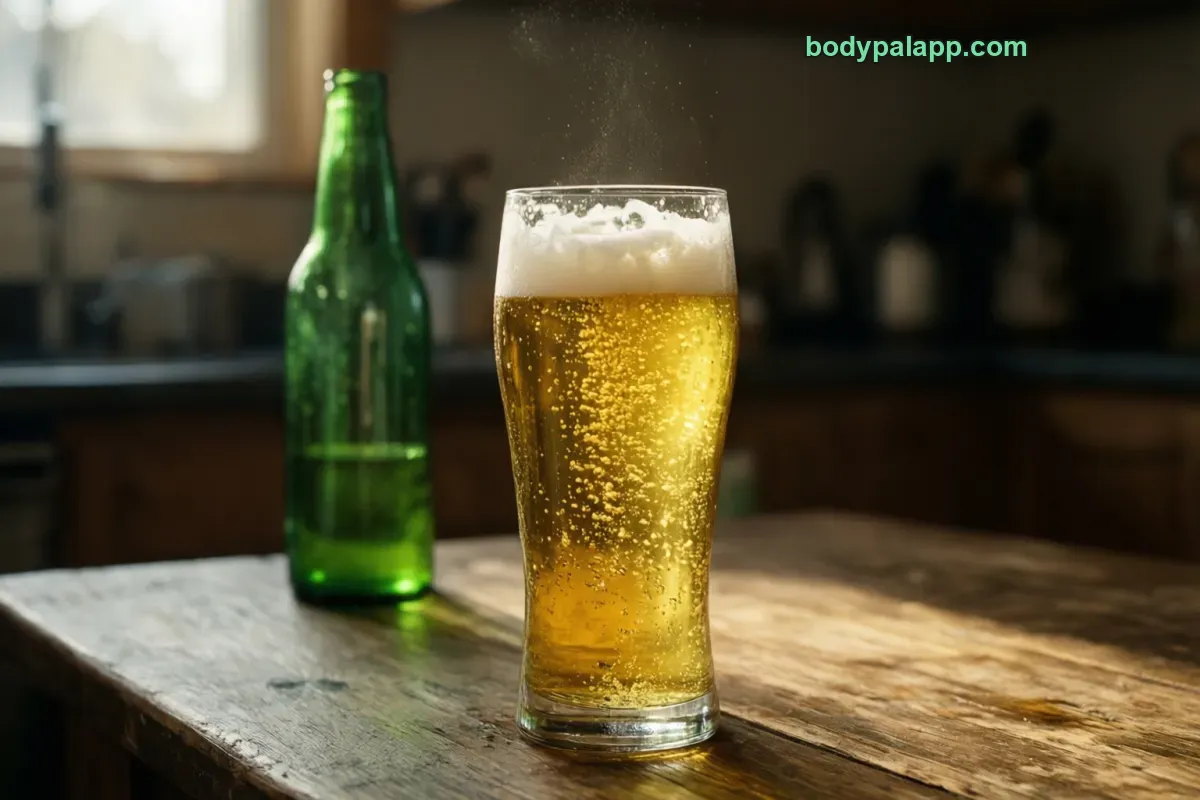
Heineken beer calories come to 153 for one 356 g bottle and 43 per 100 g. What matters is how fast bottles stack. The label shows no fat, almost no protein and 0 g of sugars, so the total moves with only one thing: how many you open.
153kcal
1 12 fl oz bottle · 356 g, regular lager
11%protein
1.6 gProtein
13 gCarbs
0 gFat
How to burn off 153 kcal
—Walking, brisk
—Jogging
—Cycling, moderate
—Swimming
Skip the math. BodyPal counts these calories from your steps and workouts automatically.
Nutrition facts
Regular lager · per 356 g
Calories
153 kcal
Protein
1.6 g
Carbohydrate
12.6 g
Fat
0 g
Saturated fat
0 g
Cholesterol
0 mg
Sodium
14 mg
Potassium
96 mg
Iron
0.1 mg
Source: USDA FoodData Central
🛡️
Verified nutrition data
Numbers on this page come from USDA FoodData Central, the U.S. Department of Agriculture’s food composition database, and from manufacturer labels where a branded product is named. Last verified September 2026. How we verify our data →
Heineken beer: calories, protein and sodium by serving
Percent of daily value uses the FDA reference of 2,000 kcal a day.
Serving
kcal
Protein
Carbs
Fat
Sodium
% DV kcal
1 bottle (356 g)
153
1.6 g
12.6 g
0 g
14 mg
8%
Light beer (354 g)
103
0.8 g
5.8 g
0 g
14 mg
5%
100 g
43
0.5 g
3.6 g
0 g
4 mg
2%
3 × 1 bottle (356 g)
459
4.9 g
43 mg
5 × 1 bottle (356 g)
765
8.2 g
71 mg
Three bottles reach 459 calories
One 356 g bottle of Heineken holds 153 calories, which is 8% of the daily value used on nutrition labels. On its own, that is a modest line in a food log. The trouble is that beer rarely arrives one bottle at a time, and nothing in it makes the second one less tempting.
Two bottles come to 306 calories. Three reach 459, and a five-bottle evening lands at 765 calories across 1,780 g of liquid. That is a meal-sized number, delivered with only 8.2 g of protein and no fiber at all. Sodium stays low even then, at 71 mg for five bottles, so calories are the only total that really climbs.
If you track intake, count bottles, not evenings. Logging each one as it is opened keeps the total honest, and BodyPal can log a bottle from a photo so the third and fourth do not slip through. Knowing the single-bottle figure by heart makes it easy to plan the night before it starts.
Carbs, not sugar, fill the label
Per 100 g, Heineken lists 3.6 g of carbs, 0.5 g of protein and 0 g of fat. In a full bottle that becomes 12.6 g of carbs and 1.6 g of protein. Sugars read 0 g, so none of those carbs are counted as sugar.
Of the calories the macros account for, carbs supply 89% and protein 11%, with fat at 0%. That split is why beer looks like a carb drink on paper. It also leaves a gap: the grams of carbs and protein alone do not add up to the full 43 calories per 100 g. The rest comes from the alcohol itself, which the macro rows do not show.
The practical takeaway is simple. Protein is too low to matter, at 3% of the daily value per bottle. If you are budgeting carbs, 12.6 g per bottle is the number to log, and it climbs with every round. If you are budgeting calories, log the full 153, because the macro grams undercount what the bottle actually delivers.
Light beer cuts about a third
The light beer serving on this page, 354 g, carries 103 calories against 153 for a regular Heineken bottle. That is about a third fewer for nearly the same volume. Carbs fall from 12.6 g to 5.8 g, and protein slips from 1.6 g to 0.8 g.
Light beer is not sugar-free on this data. It lists 0.3 g of sugars where regular Heineken lists 0 g. The difference is tiny, but it shows the swap is about total calories and carbs, not sugar. Sodium stays at 14 mg in both, so there is no trade-off on that row.
The swap matters most when you drink more than one. At a single bottle, the saving is small enough to shrug off. Across a long evening, the light option keeps each round at 5% of the daily value instead of 8%, and that gap widens with every refill. If you like the taste of regular lager, fewer bottles does the same job.
Sodium is a non-issue; the snacks are not
A bottle of Heineken holds just 14 mg of sodium, 1% of the daily value. Cholesterol and saturated fat both sit at 0. Potassium is a modest 27 mg per 100 g. Nothing on this label needs watching except the calorie line.
That changes once food arrives. Beer is often drunk alongside salty, fried bar snacks, and those bring the sodium and fat the beer itself lacks. If you watch sodium or fat, the plate next to the bottle deserves more attention than the bottle does.
Pairing beer with a protein-rich meal fills the gap Heineken leaves, since a bottle offers only 1.6 g of protein. Planning the drinks into the day's total, rather than adding them afterward, makes it easier to land where you intended. Water between rounds is an easy way to slow the pace without skipping the occasion.
How does Heineken beer compare?
Here is how Heineken stacks up against Budweiser, Corona and Guinness, per 100 g and per usual serving.
Verdict: Heineken, Corona and Guinness share identical figures here, 153 calories per bottle and 43 per 100 g, so choose among them on taste. If you want the leanest regular beer in this group, Budweiser edges ahead at 146 calories per can and 41 per 100 g.
Heineken beer FAQs
How many calories are in a bottle of Heineken?
A 12 fl oz bottle (356 g) has about 153 calories, which works out to 43 calories per 100 g.
Is Heineken good for weight loss?
One bottle is 153 calories, so three bottles add about 459 calories with no protein or fat to speak of. A 12 fl oz light beer is 103 calories, about 50 fewer per bottle.
Heineken vs light beer: which has fewer calories?
Light beer is 29 calories per 100 g against 43 for regular beer, so a 12 fl oz serving is 103 calories versus 153.
How many carbs are in Heineken?
About 3.6 g per 100 g, so roughly 12.6 g in a 12 fl oz bottle. Protein is 0.5 g per 100 g and the fat is 0 g.
What are the nutrition facts for a Heineken?
A 356 g bottle of Heineken has 153 calories, 12.6 g of carbs, 1.6 g of protein, 0 g of fat and 0 g of sugars. Sodium is 14 mg, just 1% of the daily value.
How many calories are in a 12 oz Heineken?
A standard Heineken bottle of 356 g, the usual 12 oz size, has 153 calories, or 8% of the daily value. Two of them reach 306 calories, and three reach 459.
How many calories are in 100 g of Heineken?
Heineken has 43 calories per 100 g, with 3.6 g of carbs, 0.5 g of protein and 0 g of fat. That matches Corona and Guinness on this site and sits just above Budweiser at 41.
How many calories do several Heineken beers add up to?
Three bottles of Heineken add up to 459 calories, with 4.9 g of protein and 43 mg of sodium. Five bottles reach 765 calories, so the count builds quickly over an evening.
Does Heineken have sugar?
Heineken lists 0 g of sugars per bottle and per 100 g. Its 12.6 g of carbs per bottle are not counted as sugar, while the light beer serving shows only 0.3 g.