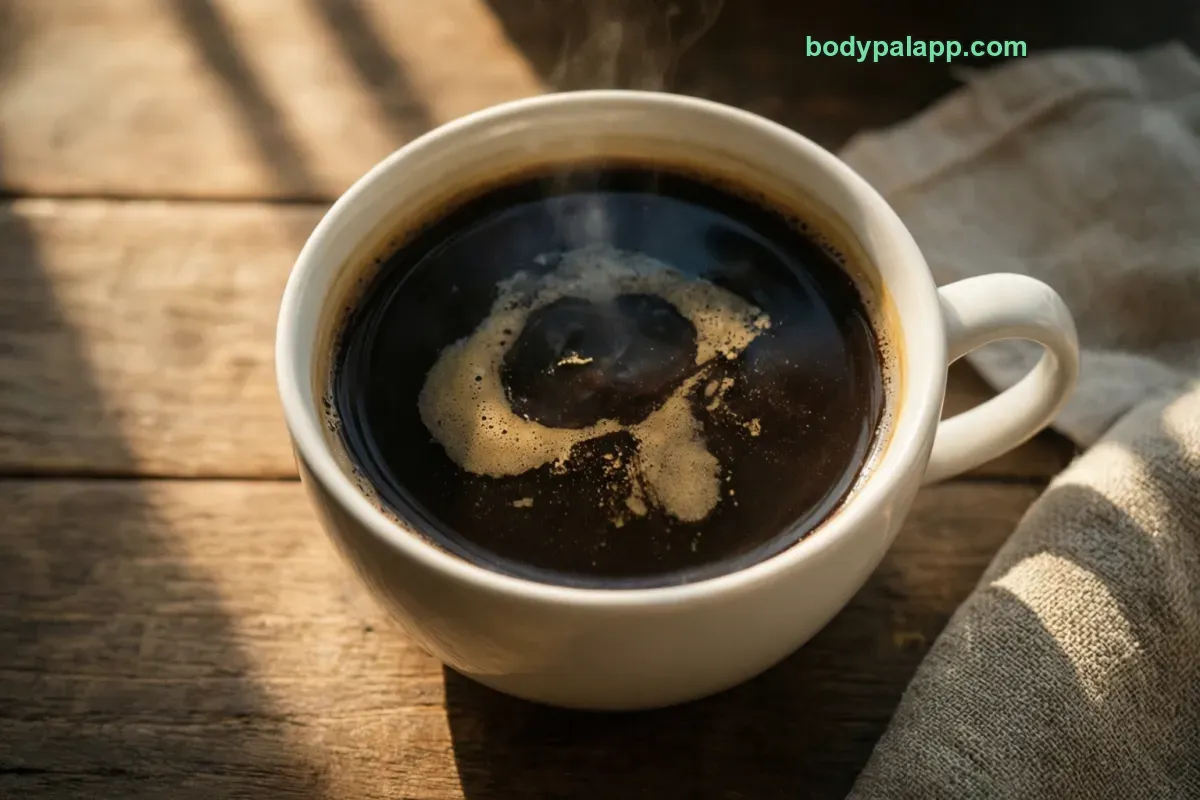
Black coffee calories come to 5 for a 1 cup (248 g) serving and 2 per 100 g, brewed and unsweetened. The number to notice is how little it moves: even 5 cups add only 25 calories. What you stir into the cup, not the coffee, decides the total.
5kcal
1 cup · 248 g, brewed, unsweetened
64%protein
0.7 gProtein
0 gCarbs
0 gFat
How to burn off 5 kcal
—Walking, brisk
—Jogging
—Cycling, moderate
—Swimming
Skip the math. BodyPal counts these calories from your steps and workouts automatically.
Nutrition facts
Brewed, unsweetened · per 248 g
Calories
5 kcal
Protein
0.7 g
Carbohydrate
0.4 g
Fat
0 g
Saturated fat
0 g
Cholesterol
0 mg
Sodium
2 mg
Potassium
124 mg
Iron
0 mg
Source: USDA FoodData Central
🛡️
Verified nutrition data
Numbers on this page come from USDA FoodData Central, the U.S. Department of Agriculture’s food composition database, and from manufacturer labels where a branded product is named. Last verified September 2026. How we verify our data →
Black coffee: calories, protein and sodium by serving
Percent of daily value uses the FDA reference of 2,000 kcal a day.
Serving
kcal
Protein
Carbs
Fat
Sodium
% DV kcal
1 cup (248 g)
5
0.7 g
0.4 g
0 g
2 mg
0%
Large mug (340 g)
7
1 g
0.6 g
0 g
3 mg
0%
100 g
2
0.3 g
0.2 g
0 g
1 mg
0%
3 × 1 cup (248 g)
15
2.2 g
7 mg
5 × 1 cup (248 g)
25
3.7 g
12 mg
Five cups still add up to just 25 calories
A standard 1 cup (248 g) serving of brewed black coffee carries 5 calories. Move up to a large mug (340 g) and the count rises to 7. Both register as 0% of the daily value for calories, which shows how small the gap really is. Cup size matters for caffeine and habit, not for energy.
Refills barely move the number either. Two cups (496 g) come to 10 calories, three cups (744 g) to 15, and five cups (1,240 g) to 25. That last figure covers a heavy coffee day, and it still barely registers against a full day of eating.
The practical takeaway: you do not need to weigh black coffee. If you track intake, log the cups and move on. The portions that deserve attention are the ones you pour into the mug, not the coffee itself.
Protein supplies 64% of a very small total
Per 100 g, black coffee lists 2 calories, 0.3 g of protein, 0.2 g of carbs and 0 g of fat. Split by energy, protein accounts for 64% of the calories and carbs for 36%. Fat contributes nothing at all.
That protein share looks impressive on paper and means little in the cup. A 1 cup serving holds 0.7 g of protein, or 1% of the daily value. A large mug reaches 1 g, which is 2%. Even five cups deliver only 3.7 g.
So the split explains where the few calories come from; it does not turn coffee into a protein source. If you are building a high-protein breakfast, treat the coffee as a neutral side and let the food next to it do the work. Fiber and sugars both read 0 g.
Sodium, sugar and fat all sit near zero
Plain brewed coffee has no row that demands attention. A cup lists 2 mg of sodium, which is 0% of the daily value, plus 0 g of sugars and 0 g of saturated fat. Per 100 g, sodium is 1 mg and cholesterol is 0.
The one mineral with a visible number is potassium, at 50 mg per 100 g. It is a modest amount, but it is the only figure on the label that is not close to zero. Drink five cups and sodium still totals just 12 mg.
This is why the watch list changes the moment you customize the cup. Sugar, cream and flavored syrups fill in the rows that plain coffee leaves empty. Ready-to-drink options such as Starbucks Cold Brew Premium Black Coffee Drink or Death Wish Coffee Co Cold Brew Unsweetened Black Coffee deserve a quick label check, since bottled products set their own serving sizes.
Black coffee is a free slot in your day
Because a cup costs 5 calories, black coffee fits around almost any eating pattern without trade-offs. It does not crowd out room for food, and it adds no sugar. The real decision is what you eat alongside it, and how you take it.
If staying full until lunch is the goal, pair the coffee with foods that bring the protein and fiber it lacks, such as eggs, yogurt or oats. If you prefer a lighter morning, the coffee alone keeps your running total close to 0 until you sit down to eat. Either way, the cup itself is not the variable.
Logging is simple: BodyPal can log black coffee from a photo, so a quick snap of each cup keeps the tally honest. The entries will be tiny. Their real value is in showing the day a plain cup quietly turns into a sweetened, creamy one, because that is where the numbers start to climb.
How does black coffee compare?
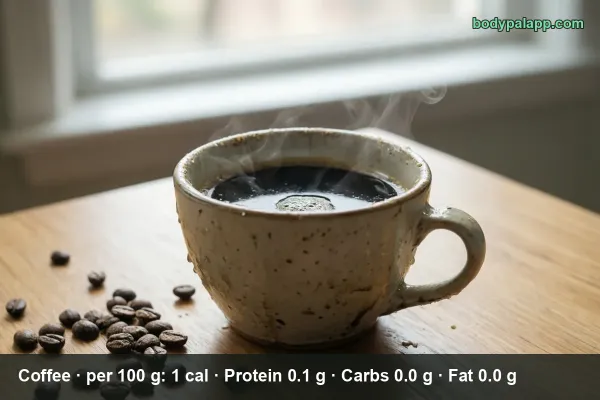
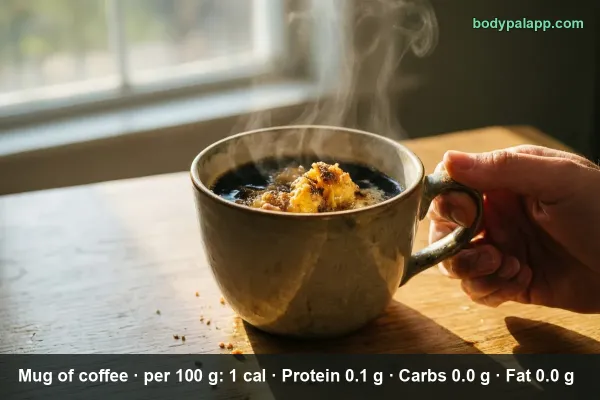
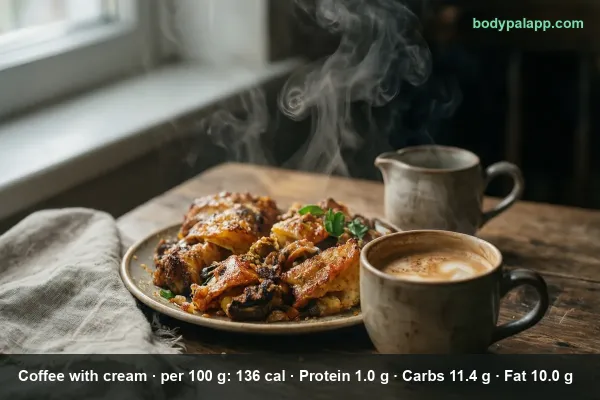
Here is how black coffee stacks up against plain coffee, a mug of coffee and coffee with cream, per 100 g and per usual serving.
Verdict: Black coffee, coffee and a mug of coffee are effectively tied at 2 or 1 calories per 100 g, so pick whichever you like if calories are the goal. Coffee with cream jumps to 136 per 100 g with 10 g of fat, about 68 times black coffee, so the cream is the part worth measuring.
Most popular black coffee brands in the United States
Ranked by popularity in the BodyPal database
# Productkcal / 100 g
1Green Mountain Coffee Pure Black Coffee Shot1 bottle · 60 ml0 kcal
2Starbucks Cold Brew Premium Black Coffee Drink9.5 oz · 281 ml5 kcal
3Stok Black Coffee Shot13 ml77 kcal
4Death Wish Coffee Co Cold Brew Unsweetened Black Coffee1 can · 240 ml188 kcal
5The Coffee Tree Premium Cold-Brewed Black Coffee12 oz · 360 ml0 kcal
6Venice Cold Brew Black Coffee12 oz · 355 ml0 kcal
7Chameleon Cold Brew Organic Black Coffee4 oz · 118 ml0 kcal
Bottled shots and concentrates are labeled per undiluted liquid, so they read much higher per 100 ml than a brewed cup. Source: manufacturer labels / USDA FoodData Central.
Black coffee FAQs
How many calories are in a cup of black coffee?
One cup (248 g) of brewed black coffee is about 5 calories. A large 12 oz mug (340 g) comes to about 7 calories.
Is black coffee good for weight loss?
Black coffee is 2 calories per 100 g, so a cup adds only about 5 calories to the day. The same cup with cream is based on 136 calories per 100 g instead.
Black coffee vs coffee with cream: how big is the difference?
Black coffee is 2 calories per 100 g and coffee with cream is 136, so a 248 g cup goes from about 5 calories to about 337.
Does black coffee have carbs, fat or protein?
Per 100 g black coffee has 0.17 g carbs, 0 g fat and 0.3 g protein, which is 0.4 g carbs and 0.7 g protein in a 248 g cup.
How many calories are in a large black coffee?
A large mug of black coffee (340 g) has 7 calories. That is 0% of the daily value for calories, with 1 g of protein and 3 mg of sodium. Size up freely; the add-ins are what change the total.
What are the nutrition facts for black coffee per 100 g?
Per 100 g, brewed black coffee has 2 calories, 0.3 g of protein, 0.2 g of carbs and 0 g of fat. It also lists 1 mg of sodium and 50 mg of potassium, with 0 g of sugars.
How much protein is in a large mug of black coffee?
A large mug (340 g) holds 1 g of protein, or 2% of the daily value. Protein makes up 64% of the coffee's calories, but the amount is far too small to count as a protein source.
Does black coffee contain sugar or sodium?
Black coffee has 0 g of sugars and 2 mg of sodium per 1 cup (248 g), which is 0% of the daily value. Sugar and sodium only show up once you add sweeteners, syrups or creamers.
Is pure black coffee really close to zero calories?
Pure black coffee has 5 calories per 1 cup (248 g) and 2 per 100 g, so yes, it is close to zero. Even 5 cups total just 25 calories, so the coffee itself rarely moves a daily count.