
How many calories are in a cup of coffee?
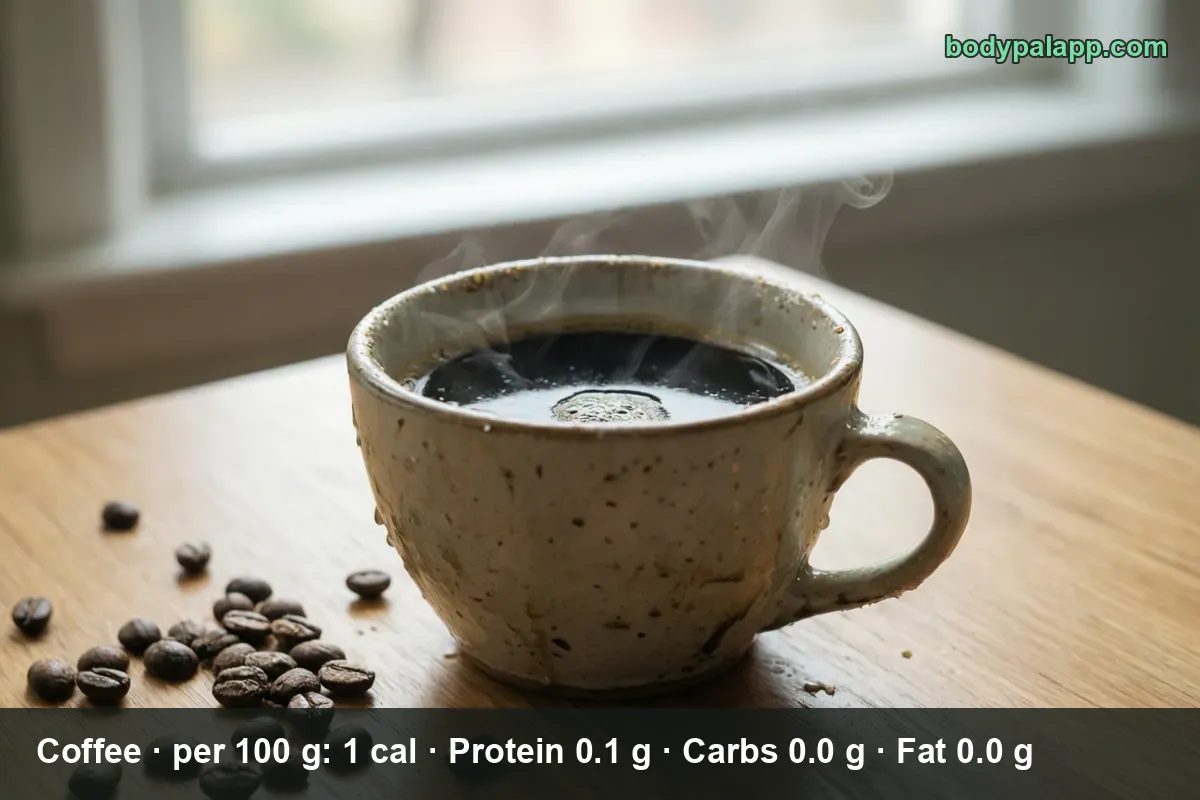
A standard 8 fl oz cup of black brewed coffee carries 2 calories, and per 100 g the drink runs 1 calorie. That is the whole number for coffee itself. Everything people actually count in a coffee, from milk to sugar to syrup, arrives later, and usually in far larger amounts than the brew.
On this page
- Coffee quick facts
- US serving sizes for brewed coffee
- Espresso decaf and instant coffee
- Cappuccino latte and bottled coffee
- What goes in the cup is the whole calorie count
- Potassium is the row worth reading
- How does coffee compare?
- Most popular coffee brands
- Coffee FAQs
Coffee quick facts
The figures below come from the USDA record FNDDS 2710375, "Coffee, brewed". That is plain coffee made with water and nothing else, which is what a person holding a mug at 7 a.m. is drinking. It was chosen over the older SR Legacy 171890 entry, which lists the identical drink with identical values but does not carry the household cup sizes Americans order in.
| Nutrient | Per 100 g | Per 1 cup (8 fl oz) (240 g) | % Daily Value |
|---|---|---|---|
| Calories | 1 | 2 | — |
| Total fat | 0.02 g | 0.0 g | 0% |
| Saturated fat | 0 g | 0 g | 0% |
| Carbohydrate | 0 g | 0 g | 0% |
| Dietary fiber | 0 g | 0 g | 0% |
| Total sugars | 0 g | 0 g | — |
| Protein | 0.12 g | 0.3 g | 1% |
| Sodium | 2 mg | 5 mg | 0% |
% Daily Value is based on a 2,000-calorie diet.
Verified nutrition data
Numbers on this page come from USDA FoodData Central, the U.S. Department of Agriculture’s food composition database, and from manufacturer labels where a branded product is named. Last verified September 2026. How we verify our data →
Two rows you would see on a bottle are missing here. USDA does not publish added sugars or trans fat for this FNDDS record, so they are left out rather than guessed, and black coffee is zero on both anyway. Cholesterol is 0 mg in the cup. Potassium is the one mineral with a number worth saying out loud: 49 mg per 100 g, or 118 mg in the cup, which is 3% of the Daily Value set by the FDA.
US serving sizes for brewed coffee
Coffee is ordered by fluid ounces, and USDA lists the drink that way too. Small, medium and large in the table below are the household measures attached to the record, not shop sizes invented for this page.
| Serving | Weight | Calories |
|---|---|---|
| 1 oz | 28 g | 0 kcal |
| 1 cup (8 fl oz) | 240 g | 2 kcal |
| 1 small (12 fl oz) | 360 g | 4 kcal |
| 1 medium (16 fl oz) | 480 g | 5 kcal |
| 1 large (20 fl oz) | 600 g | 6 kcal |
| Per 100 g | 100 g | 1 kcal |
The 1 oz line is our own arithmetic from the USDA 100 g figure rather than a USDA serving, and it lands at zero once rounded. The cup, small, medium and large lines are all USDA household measures. Notice what the whole table is telling you: going from an 8 fl oz cup to a 20 fl oz large, two and a half times the drink, moves the count by four calories. There is no realistic cup size at which black coffee becomes worth budgeting for.
Coffee is also one of the few foods where fluid ounces and grams line up almost exactly, because the drink is essentially water. An 8 fl oz cup weighs 240 g, a 20 fl oz large weighs 600 g. That makes coffee unusually easy to log by volume, which is not true of the milk drinks further down.
Espresso decaf and instant coffee
| Version | Per 100 g | Typical serving | Calories |
|---|---|---|---|
| Brewed coffee | 1 kcal | 1 cup (8 fl oz), 240 g | 2 kcal |
| Espresso | 9 kcal | 1 shot (1 fl oz), 30 g | 3 kcal |
| Decaf brewed | 0 kcal | 1 cup (8 fl oz), 240 g | 0 kcal |
| Instant, prepared | 3 kcal | 1 cup (8 fl oz), 240 g | 7 kcal |
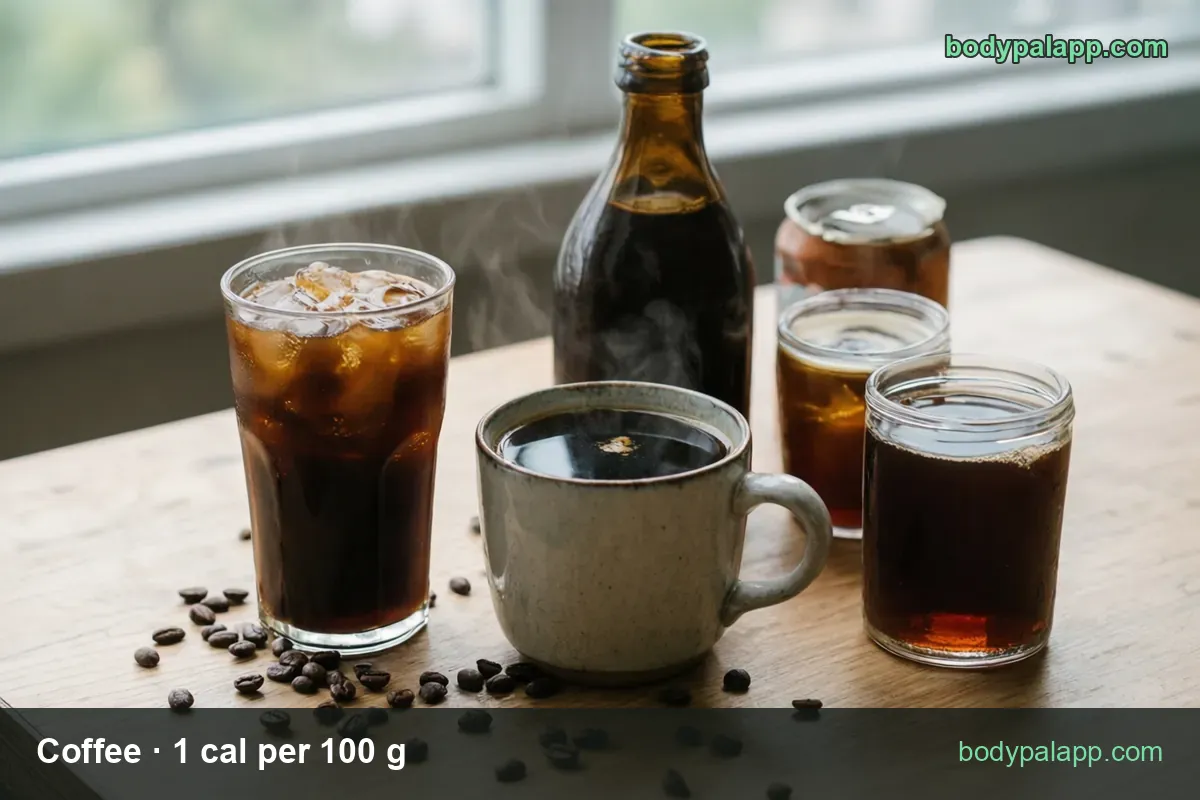
Espresso is the densest black coffee on this page at 9 calories per 100 g, nine times drip coffee, and that is the number people misread. Density is not a portion. A single shot is 30 g, so the whole thing is 3 calories. It also carries 14 mg of sodium per 100 g, the highest of the unsweetened records here, which still means nothing at shot size.
Decaf goes the other way. USDA lists brewed decaffeinated coffee at 0 calories per 100 g, so a full cup rounds to zero, and the trace 0.02 g of fat in regular coffee disappears with the caffeine. Instant coffee prepared with water is the odd one, at 3 calories per 100 g and 7 in a cup, because 0.63 g of carbohydrate per 100 g survives the drying and reconstituting. Seven calories a cup is the largest gap you will find between two cups of plain black coffee, and it is still smaller than a stick of gum.
Cappuccino latte and bottled coffee
| Version | Per 100 g | Typical serving | Calories |
|---|---|---|---|
| Cappuccino | 27 kcal | 1 cup (8 fl oz), 240 g | 65 kcal |
| Latte | 43 kcal | 1 cup (8 fl oz), 240 g | 103 kcal |
| Bottled or canned coffee | 71 kcal | 1 cup (8 fl oz), 240 g | 170 kcal |
This is where a coffee stops being coffee in a calorie sense. Hold the cup size steady at 240 g and the count runs 2 for black, 65 for cappuccino, 103 for latte, 170 for bottled. The latte is 101 calories above the black cup out of a total of 103, and every one of those 101 comes from the milk, not the beans.
The composition confirms it. Scaling the USDA 100 g figures ourselves, a 240 g latte holds 6.7 g of protein and 9.7 g of sugars, and a cappuccino 4.1 g of protein, none of which exists in brewed coffee at all. Those per-cup nutrient figures are our own arithmetic from the USDA 100 g values, not USDA servings. A cappuccino is about a third milk and a latte is mostly milk, which is exactly the ratio the calorie counts describe.
Bottled and canned coffee is a third category. At 71 calories per 100 g it is 170 in a 240 g cup and carries 25.6 g of total sugars, again our own scaling of the USDA 100 g figures, against 0 g in brewed coffee. Store shelves back this up: USDA's branded data lists STOK Cold Brew Black at 4 calories per 100 g, a 405 ml bottle at 16, while the same brand's Mocha Protein Cold Brew runs 47 per 100 g and 208 calories in one can. Same aisle, same word on the label, thirteen times the calories.
What goes in the cup is the whole calorie count
If you are tracking, the useful habit with coffee is to stop logging the coffee and start logging the additions. The brew is a rounding error at 2 calories; the milk, cream, sugar and syrup are the entire entry. That is unusual. For most foods on a plate the base ingredient dominates and the extras nudge; here the base is effectively nothing and the extras are everything.
It also means the difference between two coffee habits can be large without either one looking like a treat. Two black coffees a day is 4 calories. Two lattes a day is 206, using the same cup size. Nothing about the order sounds different at the counter.
Unsweetened coffee sits with water and plain milk on the MyPlate drinks guidance as a beverage that adds little or nothing, and the Dietary Guidelines for Americans put the same emphasis on beverages without added sugars. If you are watching sugar, brewed coffee with milk added at home is the easier pick over a sweetened bottled version, purely because you can see how much goes in.
Potassium is the row worth reading
Black coffee is not a nutrient source in any meaningful sense, but two rows are worth a glance. Potassium is 49 mg per 100 g, which makes an 8 fl oz cup 118 mg, or 3% of the 4,700 mg Daily Value. A 20 fl oz large works out to 294 mg, about 6%, by our own arithmetic from the USDA 100 g figure.
Sodium is the mirror image. That same 600 g large carries 12 mg of sodium, half a percent of the 2,300 mg Daily Value, which is less than a hundredth of a teaspoon of table salt. A drink that delivers 6% of a day's potassium and almost no sodium is rare, and coffee gets there by being 99% water. Protein is 0.3 g in a cup, or 1% of the Daily Value, and that is the end of the nutrition story for black coffee.
How does coffee compare?
| Drink | Per 100 g | US serving | Calories |
|---|---|---|---|
| Coffee, brewed | 1 kcal | 1 cup (8 fl oz), 240 g | 2 kcal |
| Decaf brewed coffee | 0 kcal | 1 cup (8 fl oz), 240 g | 0 kcal |
| Iced coffee, brewed | 1 kcal | 1 fl oz, 30 g | 0 kcal |
| Instant coffee, prepared | 3 kcal | 1 fl oz, 30 g | 1 kcal |
Our take: among these four, instant is the only record above 1 calorie per 100 g, and it is above it by two. Brewed hot and brewed iced coffee are the same drink at the same density, so pouring it over ice changes nothing but the temperature. If you want the lowest number on the page, decaf is literally 0, though choosing coffee on a 2-calorie difference is not a decision worth making. Pick the one you like and spend the attention on what you pour into it.
Most popular coffee brands in the United States
Ranked by how widely each product appears among foods sold in the United States, from the BodyPal food database of over 3.3 million products. Calories are the figures printed on each Nutrition Facts label, checked against USDA FoodData Central.
| Product | Calories (per 100 g) |
|---|---|
| STOK Cold Brew Coffee Black | 4 cal |
| STOK Cold Brew Black Chocolate | 19 cal |
| STOK Mocha Protein Cold Brew | 47 cal |
| STOK Latte Oatmilk Cold Brew | 33 cal |
| STOK Mocha Almondmilk Cold Brew | 33 cal |
| STOK Peppermint Mocha Creamed Cold Brew | 42 cal |
Brand popularity: BodyPal food database. Nutrition: manufacturer labels / USDA FoodData Central.
Coffee FAQs
How many calories are in a cup of black coffee?
An 8 fl oz cup of brewed black coffee is 2 calories, from a USDA figure of 1 calorie per 100 g. There is no fat, no carbohydrate and no sugar in the record, only 0.3 g of protein and 5 mg of sodium. Black coffee is effectively a free drink in a calorie log.
How many calories in coffee with milk?
A 240 g cappuccino is 65 calories and the same size latte is 103, against 2 for black coffee. The gap is milk. The latte record works out to 6.7 g of protein and 9.7 g of sugars per cup, and none of that comes from the coffee beans themselves.
Is decaf coffee zero calories?
Effectively yes: USDA lists brewed decaffeinated coffee at 0 calories per 100 g, so a 240 g cup rounds to 0, against 2 calories for regular brewed. Removing the caffeine also strips out the trace 0.02 g of fat in the regular record. Neither drink is worth logging when you take it black.
How many calories in an espresso shot?
A 1 fl oz shot of espresso is 3 calories, from 9 calories per 100 g. Espresso is the most concentrated brewed coffee in the USDA data, about nine times the density of drip, but the pour is only 30 g, so the shot still lands within a couple of calories of zero.
How many calories in iced coffee?
Brewed iced coffee is 1 calorie per 100 g, the same as hot drip coffee, so the USDA 1 fl oz pour rounds to 0. Bottled and canned iced coffee is a different drink at 71 calories per 100 g, which makes a 240 g cup 170 calories with 25.6 g of total sugars.
Is instant coffee higher in calories than brewed?
Slightly: instant coffee prepared with water is 3 calories per 100 g against 1 for brewed, so an 8 fl oz cup is 7 calories instead of 2. The difference is 0.63 g of carbohydrate per 100 g that survives drying and reconstituting. In practice, five calories changes nothing in a day.
How many calories in a large 20 oz coffee?
A 20 fl oz large black coffee weighs 600 g and comes to 6 calories. The 16 fl oz medium is 5 calories and the 12 fl oz small is 4. Even the biggest cup USDA lists stays under a single bite of most foods, so the syrup and cream are what actually move the number.
How much potassium is in coffee?
An 8 fl oz cup of brewed coffee carries 118 mg of potassium, 3% of the 4,700 mg Daily Value. A 20 fl oz large works out to about 294 mg, roughly 6%, by our own arithmetic from the USDA figure of 49 mg per 100 g. Sodium in that same large cup is only 12 mg.
Similar foods
- Black Tea — 2 cal per cup
- Green Tea — 2 cal per cup
- Mug Of Coffee — 4 cal per mug, 12 fl oz
- Black Coffee — 5 cal per cup
- Coca-cola Zero — 0 cal per can, 12 fl oz
- Black Coffee — 5 cal per cup
Count it without the math
Point the camera at the mug and BodyPal counts it for you, milk and all.


Burning it off is one side of it. The other is knowing your number: work out how many calories you need a day, with macros and a goal date.