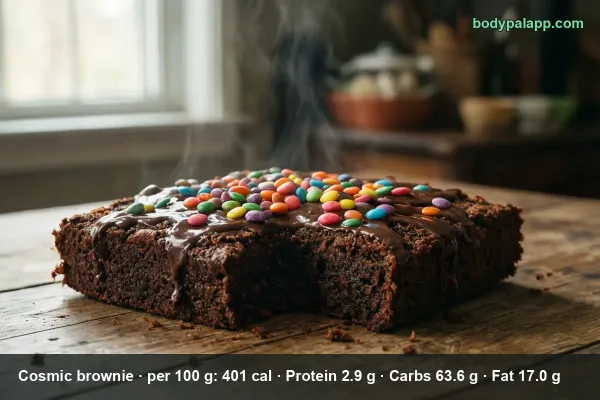
Brownie with frosting calories come to 220 for 2 brownies (50 g) and 440 per 100 g, based on packaged brownie bites as labeled. Sugar stands out most. One serving carries 21 g of sugar, and protein barely shows up at 1 g. Almost all the energy comes from sugar, starch and fat.
220kcal
1 serving of 2 brownies · 50 g, packaged, per label
2%protein
1 gProtein
30 gCarbs
12 gFat
How to burn off 220 kcal
—Walking, brisk
—Jogging
—Cycling, moderate
—Swimming
Skip the math. BodyPal counts these calories from your steps and workouts automatically.
Nutrition facts
Packaged, per label · per 50 g
Calories
220 kcal
Protein
1 g
Carbohydrate
30 g
Fat
12 g
Saturated fat
3.5 g
Cholesterol
0 mg
Sodium
85 mg
Source: USDA FoodData Central
🛡️
Verified nutrition data
Numbers on this page come from USDA FoodData Central, the U.S. Department of Agriculture’s food composition database, and from manufacturer labels where a branded product is named. Last verified September 2026. How we verify our data →
Brownie with frosting: calories, protein and sodium by serving
Percent of daily value uses the FDA reference of 2,000 kcal a day.
Serving
kcal
Protein
Carbs
Fat
Sodium
% DV kcal
2 brownies (50 g)
220
1 g
30 g
12 g
85 mg
11%
1 oz portion (28 g)
123
0.6 g
16.8 g
6.7 g
48 mg
6%
100 g
440
2 g
60 g
24 g
170 mg
22%
3 × 2 brownies (50 g)
660
3 g
255 mg
5 × 2 brownies (50 g)
1,100
5 g
425 mg
Two small bites are 220 calories, and they stack quickly
The label serving is 2 brownies (50 g), which lands at 220 calories, or 11% of a 2000-calorie daily value. That sounds modest for a dessert. The catch is the size. These are bite-sized pieces, and bite-sized pieces rarely stop at two.
Watch how the total moves. Two servings, or 100 g, reach 440 calories. Three servings, 150 g, come to 660. Five servings, 250 g, hit 1,100 calories, which is more than half of a 2000-calorie day eaten straight from the tray. Nothing about the texture slows you down, so the package math deserves a look before you open it.
If you want a smaller marker, a 1 oz portion (28 g) is 123 calories, about 6% of the daily value. That is roughly one bite with a bit to spare. Plating a set number of pieces, rather than eating from the box, is the simplest way to keep the count where you planned it.
Carbs and fat split the calories almost evenly
The calorie split is close to a coin toss: 52% from carbohydrates, 47% from fat and just 2% from protein. Per 100 g that works out to 60 g of carbs, 24 g of fat and only 2 g of protein. This is energy dense food with almost nothing structural in it.
Fat matters here. A 2-brownie serving holds 12 g of fat, set against a 78 g daily value. Per 100 g, 7 g of that fat is saturated, compared with a 20 g daily value for saturated fat. The frosting is a big part of the reason: it adds fat and sugar on top of a brownie that already has both.
Protein is the thin row. One serving gives 1 g, just 2% of the 50 g daily value. Fiber is similarly small at 1 g per serving. That combination explains why a frosted brownie tends to disappear without leaving you full. It delivers calories quickly and offers little that lingers.
Sugar is the row to watch, not sodium
Of the 30 g of carbohydrates in a serving, 21 g are sugars. Per 100 g the sugar figure is 42 g out of 60 g of carbs, so well over half the carbohydrate is sugar. Frosting is mostly sugar and fat by design, and the numbers show it.
Sodium, by contrast, is low. A serving has 85 mg, which is 4% of the 2300 mg daily value, and 100 g carries 170 mg, or 7%. Cholesterol is listed at 0 on the label. If you track sodium, this is not where your day goes wrong. If you track added sweetness, it is.
Scale matters for sugar too. Three servings put you at 660 calories and roughly triple the sugar of a single serving. If sugar is the number you are managing, treat one serving as the whole dessert and skip the second handful.
Pair it so the dessert is not the whole snack
A frosted brownie works best as a planned treat rather than a stand-in for a snack. Because it brings so little protein or fiber, pairing it with something that has both, like a glass of milk, plain yogurt or a piece of fruit, makes the moment more filling without adding much effort.
Timing helps. Eaten after a meal, a 220-calorie serving reads as dessert. Eaten alone mid-afternoon, it often turns into a second and third serving. Brands on this page include Hyde And Eek! Boutique, Signature Select and The Bakery, and all of them sell small frosted bites that invite grazing, so portioning matters more than the brand you pick.
If you log what you eat, BodyPal can record a frosted brownie from a photo, which makes it easier to see how many bites actually went in. A clear count beats a guess, especially with snacks this small.
How does brownie with frosting compare?
Here is how a brownie with frosting compares with other brownies on our site, per 100 g and per usual serving.
Verdict: If you want the fewest calories, a plain brownie bite at 113 per 1 bite (28 g) or a brownie square at 203 per 50 g beats the frosted version at 440 per 100 g. Those unfrosted options also carry more protein, 4.8 g per 100 g versus 2 g, and much less fat at 16.3 g versus 24 g.
Most popular brownie with frosting brands in the United States
Ranked by popularity in the BodyPal database
# Productkcal / 100 g
1Hyde And Eek! Boutique Brownie Bites With Frosting2 brownies · 50 g440 kcal
2Signature Select Decorated Brownie Bites With Chocolate And Vanilla Frosting2 brownies · 50 g440 kcal
The label serving of 2 bite-size frosted brownies (50 g) is 220 calories, so a single brownie is about 110 calories.
Are frosted brownies good for weight loss?
They are calorie dense: 440 calories per 100 g, with 42 g sugar and 24 g fat. A 50 g serving is 220 calories, so small portions keep the total low.
Brownie with frosting or brownie bite: which has more calories?
Frosted brownies have 440 calories per 100 g and plain brownie bites 405, a gap of 35 calories per 100 g.
How much sugar is in a brownie with frosting?
There are 42 g of sugar per 100 g, so the 50 g serving of two brownies has 21 g. The same serving also has 12 g fat and 1 g protein.
How many calories are in 100 g of brownie with frosting?
There are 440 calories in 100 g of brownie with frosting, which is 22% of a 2000-calorie daily value. That amount equals two label servings and contains 60 g of carbs, 24 g of fat and 42 g of sugar.
How many calories are in a 1 oz frosted brownie?
A 1 oz portion (28 g) of brownie with frosting has 123 calories. It carries 6.7 g of fat, 16.8 g of carbohydrates and 11.8 g of sugar, with only 0.6 g of protein.
How many calories are in three servings of frosted brownie bites?
Three servings of 2 brownies (50 g), or 150 g in total, add up to 660 calories. Five servings, 250 g, reach 1,100 calories, so small bites add up quickly when eaten from the package.
How much fat is in a brownie with frosting?
A serving of 2 brownies (50 g) has 12 g of fat, against a 78 g daily value. Per 100 g there are 24 g of fat, 7 g of it saturated, and fat supplies 47% of the calories.
Does a brownie with frosting have much protein?
No. A serving of 2 brownies (50 g) has just 1 g of protein, which is 2% of the daily value. Protein supplies only 2% of the calories, while carbs give 52% and fat 47%.
How much sodium is in a frosted brownie?
A serving of 2 brownies (50 g) contains 85 mg of sodium, only 4% of the daily value. Per 100 g the figure is 170 mg, or 7%, so sodium is low compared with the sugar.