
How Many Calories in Bubble Tea?
A full bubble tea is 239 calories — that is the 435 g drink USDA measures, at 55 calories per 100 g. An 8 fl oz cup of the same thing is 132. Order the 24 fl oz size and you are at 396. The calories in bubble tea are set by the cup you pick up, not by the recipe.
On this page
- Bubble tea quick facts
- Why 55 calories per 100 g is the wrong number to remember
- Every cup size, from a taste to 24 fl oz
- The pearls are starch, not sugar
- Saturated fat leads, sodium does not
- Milk tea without the pearls
- How does bubble tea compare?
- FAQ
Bubble tea quick facts
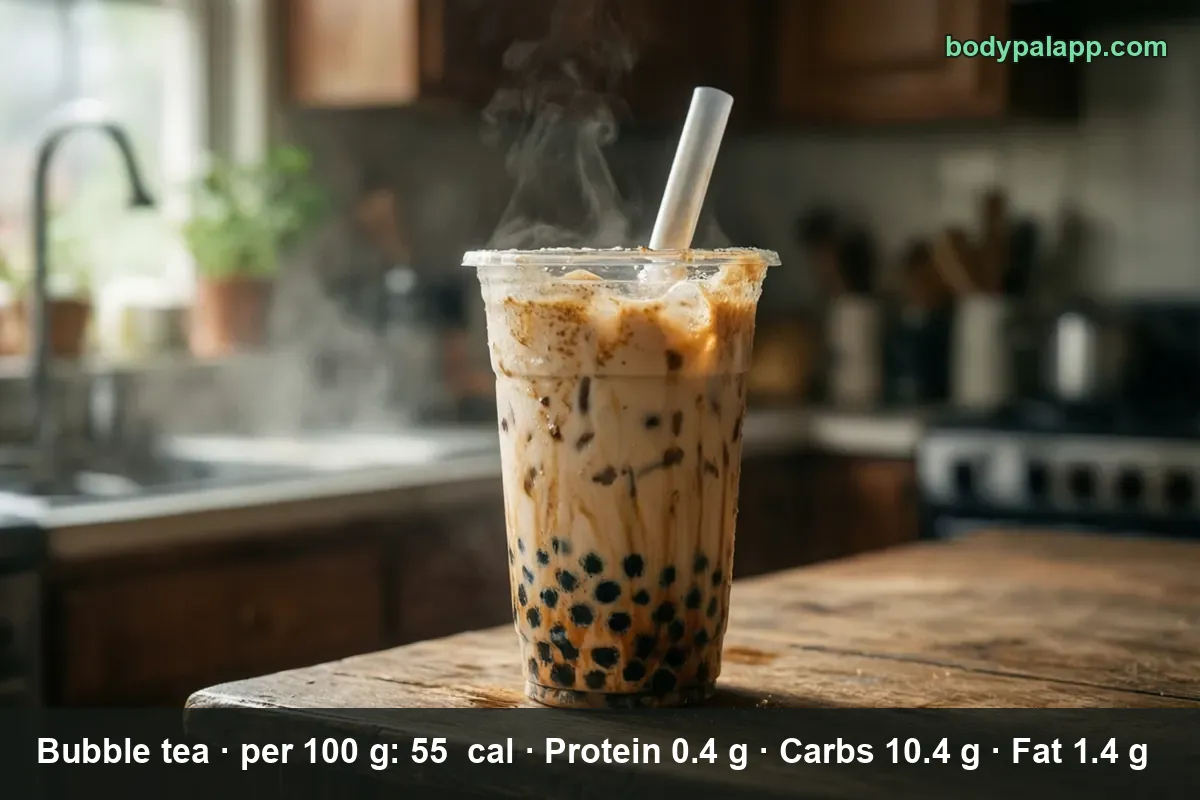
The reference entry is USDA's Tea, bubble (fdc_id 2710508) — milk tea with tapioca pearls, exactly the cup in the photo. The serving is the one USDA lists for it as one item, any size: 435 g.
| Nutrient | Per 100 g | Per 1 drink (435 g) | % Daily Value |
|---|---|---|---|
| Calories | 55 kcal | 239 kcal | — |
| Total fat | 1.39 g | 6.0 g | 8% |
| Saturated fat | 0.84 g | 3.7 g | 18% |
| Carbohydrate | 10.35 g | 45.0 g | 16% |
| Dietary fiber | 0.1 g | 0.4 g | 2% |
| Total sugars | 3.5 g | 15.2 g | — |
| Protein | 0.39 g | 1.7 g | 3% |
| Sodium | 9 mg | 39 mg | 2% |
% Daily Value is based on a 2,000-calorie diet, the reference set out in the FDA's Daily Value tables. Total sugars have no Daily Value, so that row stays empty.
Verified nutrition data
Numbers on this page come from USDA FoodData Central, the U.S. Department of Agriculture’s food composition database, and from manufacturer labels where a branded product is named. Last verified September 2026. How we verify our data →
Two rows an American label normally carries are missing here on purpose. Added sugars and trans fat are not printed as zero in this USDA entry — they were never collected for it, so this page leaves them out rather than borrowing a figure from a different dataset to fill the gap.
The entry does carry two nutrients the panel above does not show. Cholesterol runs 4 mg per 100 g, which is 17.4 mg in a full drink, or 6% of the day. Potassium is 17 mg per 100 g, or 74 mg a drink, 2% of the day. The cholesterol line is the interesting one: it is only there because the recipe behind this entry uses real dairy.
Why 55 calories per 100 g is the wrong number to remember
Fifty-five calories per 100 g sounds like nothing. Brewed tea territory. That reading is the single most common mistake made with this drink, and it happens because of how bubble tea is built.
Most of what you are holding is water and ice. Spread the milk, the sweetener and the tapioca across all that liquid and the calories per gram come out low, the same way a bowl of soup reads low. Density says almost nothing about what you actually drank.
The object says everything. USDA weighs one bubble tea at 435 g, and 435 g of a 55-calorie-per-100-g drink is 239 calories. That is not a beverage number. That is a breakfast number, arriving through a straw, usually alongside a meal rather than instead of one.
So log the cup, not the density. Every figure on this page that matters is a per-serving figure, and the per-100 g column is only there so you can scale a size we have not listed.
Every cup size, from a taste to 24 fl oz
| Serving | Weight | Calories |
|---|---|---|
| One sip, 1 fl oz | 30 g | 16.5 kcal |
| Small, 8 fl oz | 240 g | 132 kcal |
| USDA drink, one item any size | 435 g | 239 kcal |
| Medium, 16 fl oz | 480 g | 264 kcal |
| Large, 24 fl oz | 720 g | 396 kcal |
Three of those weights come straight from USDA's portion data for this entry: 30 g for 1 fl oz, 240 g for one cup, 435 g for one drink. The 16 fl oz and 24 fl oz rows are our own scaling from that same USDA conversion of 1 fl oz = 30 g, which is why the arithmetic stays inside one source instead of jumping between two.
Now look at the spread. Small to large is 132 calories against 396 — a gap of 264, which is more than the entire small drink. Nothing about the recipe changed. Nobody added extra pearls or a second pump of syrup. The cup got bigger.
That makes size the strongest lever on this page by a wide margin, and the easiest one to pull. Dropping from a 24 fl oz to a 16 fl oz cup saves 132 calories on its own, which is more than any topping swap will ever return.
The 435 g USDA drink sits between the small and the medium, and it is worth knowing why. USDA is describing a typical purchased bubble tea rather than a shop's menu size, so it lands where real orders average out.
The pearls are starch, not sugar
Here is the number almost nobody checks. Per 100 g, bubble tea holds 10.35 g of carbohydrate but only 3.5 g of total sugars. In a full 435 g drink that is 45.0 g of carbohydrate against 15.2 g of sugars.
Subtract one from the other and 29.8 g of carbohydrate is not sugar at all. That is starch, and the tapioca pearls are where it comes from. Tapioca is cassava starch shaped into balls, and starch behaves like carbohydrate on your log whether or not it tastes sweet.
The practical consequence is blunt. If you judge bubble tea by the sugar line, you undercount its carbohydrate by roughly threefold. A carb-counting app that only watches added sugar will wave this drink straight through while 29.8 g of starch goes unrecorded.
The Dietary Guidelines for Americans frame sweetened drinks around added sugars, which is the right frame for soda. It is an incomplete frame for this one. USDA publishes no added sugars figure for bubble tea, so there is no honest way to split the 15.2 g into what the tea brought and what the counter poured in — but the starch sitting underneath it is measured, and it is the larger half.
Fiber does not rescue any of this. It is 0.1 g per 100 g, so 0.4 g in a whole drink, 2% of the day. Cooked tapioca is close to pure starch.
Saturated fat leads, sodium does not
Run your eye down the % Daily Value column and one row stands taller than the rest. Saturated fat is 18% of the day in a single drink. Only carbohydrate, at 16%, comes anywhere near it.
The odd part is that total fat is modest: 6.0 g, or 8% of the Daily Value. So the fat is not plentiful, it is concentrated. Of those 6.0 g, 3.7 g are saturated — close to two thirds. The FDA sets the Daily Value for saturated fat at 20 g, and one bubble tea uses 3.7 g of that allowance without contributing a single gram of anything filling.
That profile comes from the creamy component rather than the tea. The same entry carries 4 mg of cholesterol per 100 g, which points at real dairy in the recipe. Shops that build their drinks on non-dairy creamer powder instead will land somewhere different, and USDA has no separate entry for that version, so this page does not guess at one.
Sodium goes the other way and deserves to be dismissed properly. A full drink carries 39 mg, which is 2% of the Daily Value — roughly a fiftieth of the day. Bubble tea is a calorie question and a saturated fat question. It is not a salt question, and comparing it to soda or bottled iced tea on sodium tells you nothing useful.
Protein is the other row worth reading as a warning rather than a feature: 1.7 g in a whole drink, 3% of the day. For 239 calories, that is almost nothing. MyPlate's guidance on drinks treats beverages as calories that rarely register as food, and a drink delivering 239 calories with under 2 g of protein is a clean example of the problem.
Milk tea without the pearls
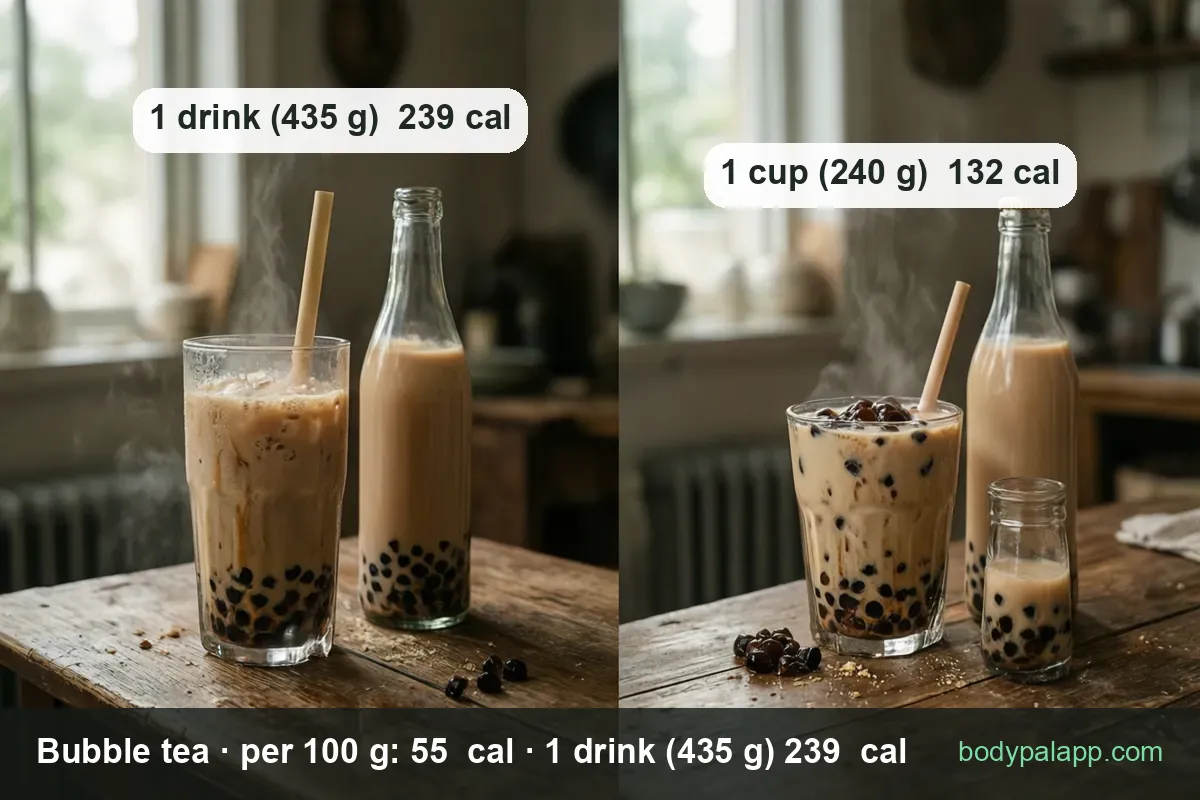
| Drink | Per 100 g | Per 1 cup (240 g) | Protein |
|---|---|---|---|
| Bubble tea, with pearls | 55 kcal | 132 kcal | 0.9 g |
| Milk tea, no pearls | 51 kcal | 122 kcal | 3.8 g |
| Sweetened iced black tea | 32 kcal | 77 kcal | 0.0 g |
Ordering the same drink without pearls saves 10 calories a cup. Ten. That is the finding most people find hardest to believe, and it falls out of the tapioca doing two things at once: it adds calories, and it takes up room that would otherwise be filled with sweetened milk tea.
What does change is the shape of the cup. Milk tea without pearls carries 3.8 g of protein against 0.9 g, because a larger share of the cup is milk. Carbohydrate falls from 24.8 g to 21.5 g and fat from 3.3 g to 2.5 g. Better numbers across the board, for a saving in calories you will never notice.
Sweetened iced black tea is the genuine step down. At 77 calories a cup it runs about 1.7 times lighter than bubble tea for the same volume, and it gets there by having no dairy and no starch rather than by any clever substitution.
One thing this page will not do is invent a low-sugar bubble tea. USDA has no entry for an unsweetened or half-sugar version, and building one by scaling the sugar line down would produce a number that describes nothing real.
How does bubble tea compare?
Every row below uses the same 240 g cup, the household measure USDA itself lists for bubble tea, so the volumes match.
| Drink (USDA entry) | Per 100 g | Per 1 cup (240 g) | Protein | Carbs | Fat |
|---|---|---|---|---|---|
| Tea, bubble | 55 kcal | 132 kcal | 0.9 g | 24.8 g | 3.3 g |
| Tea, hot, with milk | 51 kcal | 122 kcal | 3.8 g | 21.5 g | 2.5 g |
| Tea, iced, bottled, black | 45 kcal | 108 kcal | 0.0 g | 25.9 g | 0.5 g |
| Iced tea and lemonade juice drink | 34 kcal | 82 kcal | 0.5 g | 22.0 g | 0.1 g |
| Tea, iced, brewed, black, pre-sweetened | 32 kcal | 77 kcal | 0.0 g | 19.1 g | 0.0 g |
Bubble tea is the heaviest cup on that list, and it also carries the most fat. The carbohydrate column is the surprise: bottled black iced tea actually holds more carbohydrate per cup than bubble tea does, at 25.9 g against 24.8 g. It just holds all of it as sugar, with no dairy alongside, which is why it lands 24 calories lighter.
Our take: if you want a lighter cup and you like tea, pre-sweetened brewed iced tea at 77 calories is the honest choice, and it saves 55 calories a cup over bubble tea without pretending to be the same drink. If you want bubble tea, order bubble tea — dropping the pearls buys you almost nothing, so spend the decision on the cup size instead. Small to large costs 264 calories, and no ingredient swap on this page comes close to that.
Bubble tea FAQs
How many calories are in bubble tea?
239 calories in the 435 g drink USDA measures, at 55 calories per 100 g. An 8 fl oz cup is 132 calories, a 16 fl oz cup is 264 and a 24 fl oz cup is 396. The size of the cup moves the number far more than the recipe does.
How many calories in boba?
Same drink, same figure: 239 calories for a full 435 g boba tea, or 132 for an 8 fl oz cup. USDA files it as "Tea, bubble" (fdc_id 2710508) and holds no separate entry under the name boba, so the numbers are identical whichever word your local shop uses.
How much sugar is in bubble tea?
15.2 g of total sugars in a 435 g drink, at 3.5 g per 100 g. That figure understates the drink, though: total carbohydrate is 45.0 g, so 29.8 g of it is starch from the tapioca rather than sugar. USDA publishes no added sugars figure for this entry.
How many calories are in a large bubble tea?
396 calories in a 24 fl oz cup, which weighs 720 g. A 16 fl oz medium is 264 calories and an 8 fl oz small is 132. Going from the largest cup to the smallest saves 264 calories, more than the entire small drink contains.
How many calories are in the boba pearls?
Ordering the drink without the pearls saves only about 10 calories a cup, 132 against 122. USDA has no separate entry for the pearls themselves, so no honest per-pearl figure exists. The pearls displace liquid as well as adding starch.
Is bubble tea healthy?
One drink carries 239 calories with 1.7 g of protein and 0.4 g of fiber, so it contributes very little besides energy. The row that stands out is saturated fat at 3.7 g, 18% of the Daily Value. Sodium is negligible at 39 mg, or 2% of the day.
How many carbs are in bubble tea?
45.0 g of carbohydrate in a 435 g drink, which is 16% of the Daily Value, and 24.8 g in an 8 fl oz cup. Only 15.2 g of the full drink's carbohydrate is sugar. The rest is tapioca starch, which most people never count.
Bubble tea or iced tea — which has more calories?
Bubble tea, by 55 calories a cup: 132 against 77 for pre-sweetened brewed black iced tea, both measured at 240 g. Bottled black iced tea sits between them at 108 calories a cup, and it carries slightly more carbohydrate than bubble tea despite the lower calorie count.
Similar foods
- Boba Drink — 239 cal per item, any size
- Boba Tea — 239 cal per boba tea
- Boba Milk Tea — 239 cal per drink
- Pumpkin Spice Latte — 273 cal per medium, 16 fl oz
- Cranberry Juice — 137 cal per cup (8 fl oz)
- Orange Julius Blended Orange Drink — 134 cal per cup
Count it without the math
Point the camera at the cup and BodyPal logs the calories, the carbs and the saturated fat before the pearls reach the bottom.


How long does it take to burn off bubble tea?
An 8 fl oz cup is 132 kcal. Enter your weight to see how long it takes you to burn that off:
lb
| Activity | Time to burn 132 kcal |
|---|---|
| Walking, brisk | 26 min |
| Cycling, moderate | 16 min |
| Swimming, moderate | 19 min |
| Jogging | 16 min |
| Weight training, moderate | 29 min |
Times are for a 155 lb adult at a steady pace; change the weight to see yours. BodyPal works this out from your steps automatically.
Want the bigger picture? Calculate your daily calorie needs — your maintenance figure, a target for losing or gaining, and the date you get there.