
How many calories are in butternut squash?
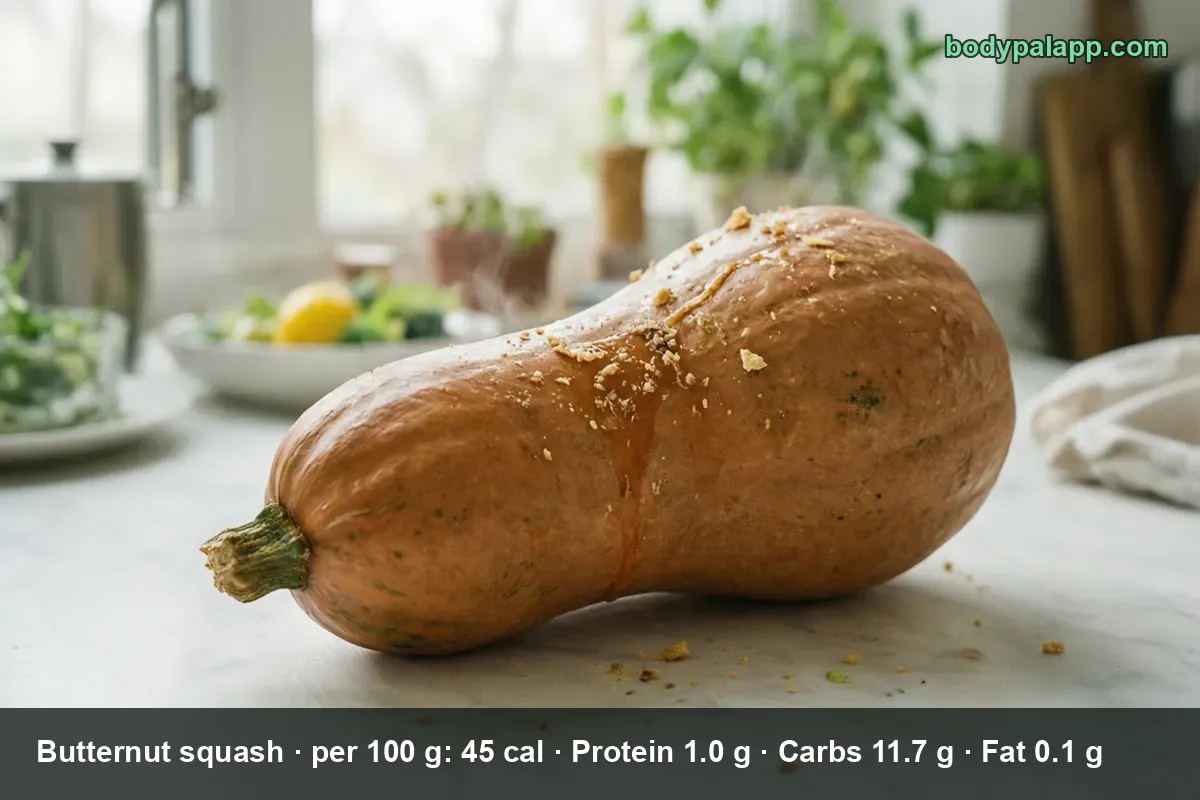
A 1-cup serving of raw butternut squash cubes weighs 140 g and carries 63 calories. Per 100 g the raw squash runs 45 calories. The orange flesh reads as sweet, but total sugars are only 2.2 g per 100 g, and the full cup holds 16.4 g of carbohydrate against 2.8 g of fiber.
On this page
- Butternut squash quick facts
- US servings from one ounce to two cups
- Raw versus baked versus frozen
- Butternut squash is not the butternut nut
- The potassium and fiber payoff
- How does butternut squash compare?
- Most popular butternut squash brands
- FAQ
Butternut squash quick facts
In the US, "butternut" on a shopping list means butternut squash, and the number people want is for the whole raw squash they just picked up. That is USDA record 169295, "Squash, winter, butternut, raw", an SR Legacy entry with a complete profile: sugars, saturated fat, fiber and potassium all measured.
There is a newer Foundation record for the same vegetable, 2685570, listing 48 calories per 100 g. It is the same squash, but its calorie figure is calculated with Atwater factors and it carries no sugar or saturated fat values at all. The fuller record wins here, and the gap between 45 and 48 calories is smaller than the gap between two squashes on the same shelf.
| Nutrient | Per 100 g | Per 1 cup cubed (140 g) | % Daily Value |
|---|---|---|---|
| Calories | 45 | 63 | — |
| Total fat | 0.1 g | 0.1 g | 0% |
| Saturated fat | 0.02 g | 0.0 g | 0% |
| Carbohydrate | 11.69 g | 16.4 g | 6% |
| Dietary fiber | 2 g | 2.8 g | 10% |
| Total sugars | 2.2 g | 3.1 g | — |
| Protein | 1 g | 1.4 g | 3% |
| Sodium | 4 mg | 6 mg | 0% |
| Cholesterol | 0 mg | 0 mg | 0% |
| Potassium | 352 mg | 493 mg | 10% |
% Daily Value is based on a 2,000-calorie diet.
Verified nutrition data
Numbers on this page come from USDA FoodData Central, the U.S. Department of Agriculture’s food composition database, and from manufacturer labels where a branded product is named. Last verified September 2026. How we verify our data →
Two rows you would see on a package label are missing here. USDA does not publish added sugars or trans fat for raw butternut squash in this edition, and on a vegetable that has been through nothing but a knife there are no added sugars to publish. The %DV column uses the FDA reference amounts for a 2,000-calorie diet.
US servings from one ounce to two cups
| Serving | Weight | Calories |
|---|---|---|
| 1 oz | 28 g | 13 kcal |
| 1/2 cup cubes | 70 g | 32 kcal |
| 4 oz raw | 113 g | 51 kcal |
| 1 cup cubes | 140 g | 63 kcal |
| 2 cups cubes | 280 g | 126 kcal |
| Per 100 g | 100 g | 45 kcal |
The 1-cup, 140 g line is a USDA household measure attached to the record itself. Everything else in that table is our own arithmetic from the USDA 100 g figure, not a USDA serving: the half cup, the 4 oz slab you cut off before roasting, and the two-cup pile that a sheet pan turns into one side dish.
That two-cup line is the useful one. Most people who roast butternut are not eating 140 g of it. Two cups is 280 g and still only 126 calories raw, about the same as the single tablespoon of oil most recipes tell you to toss it in. The squash is rarely the expensive part of the dish.
Raw versus baked versus frozen
| Version | Per 100 g | Typical serving | Calories |
|---|---|---|---|
| Raw, cubed | 45 kcal | 1 cup cubes (140 g) | 63 kcal |
| Baked, no salt | 40 kcal | 1 cup cubes (205 g) | 82 kcal |
| Baked, salted | 40 kcal | 1 cup cubes (205 g) | 82 kcal |
| Frozen, unprepared | 57 kcal | 1/3 package (113 g) | 64 kcal |
| Frozen, boiled | 39 kcal | 1 oz (28 g) | 11 kcal |
Here is the trap that per-100-g tables hide. Baked butternut squash is 40 calories per 100 g, lower than the 45 of raw, because the oven drives off water. But a measuring cup of baked cubes weighs 205 g, not 140 g, since soft cubes settle against each other. Same cup, more squash: 82 calories baked against 63 raw. Roasting did not add calories. The cup did.
Frozen runs the other way. Frozen unprepared butternut is 57 calories per 100 g, 27% above raw, with 14.41 g of carbohydrate against 11.69 g. That is not a packaging error and it is not added sugar. Processors freeze riper fruit, and riper winter squash is starchier. Boil those same cubes and water goes back in, dropping the number to 39 calories per 100 g, the lowest figure on this page.
Branded bags mostly track the plain vegetable. Green Giant Fresh Butternut Squash and Pero Family Farms cubes both sit at 47 calories per 100 g, and frozen cut and riced bags land at 58 to 59. The exception is the mashed style with brown sugar stirred in, at 88 calories per 100 g and 99 calories for a 1/2 cup (113 g) label serving — roughly a cup and a half of raw cubes for half a cup of mash.
Butternut squash is not the butternut nut
Searching "butternut" turns up a second USDA record that catches people out: butternuts, dried, the nut of the white walnut tree, at 612 calories per 100 g and 174 calories per ounce. That is 13 times the calories of an ounce of the squash, with 56.98 g of fat per 100 g against 0.1 g. If a tracker returns a number in the hundreds for what you thought was a vegetable, this is why.
The potassium and fiber payoff
Potassium is where butternut squash earns its place. A 1-cup serving carries 493 mg, 10% of the 4,700 mg Daily Value, for 63 calories. Fiber does the same work: 2.8 g per cup, also 10% of the DV. Very few things in the produce aisle return two 10% rows for under 70 calories, which is part of why the MyPlate vegetable group leans on starchy vegetables rather than excluding them.
Baking concentrates the fiber more than it concentrates anything else. Baked squash is 3.2 g of fiber per 100 g, so a 205 g cup comes to 6.6 g, about 23% of the Daily Value — more than double the raw cup. That figure is our own arithmetic from the USDA 100 g value rather than a listed serving, but the direction is not in doubt.
Salt is the one row that moves sharply, and only if you add it. Raw squash is 4 mg of sodium per 100 g, effectively nothing. Baked with salt during cooking, the USDA record jumps to 240 mg per 100 g, which is 492 mg in a 205 g cup, or 21% of the Daily Value against 0% unsalted. That is roughly a quarter teaspoon of table salt. If you are watching sodium, season at the table instead of on the sheet pan, and you keep the whole difference.
How does butternut squash compare?
| Food | Per 100 g | US serving | Calories |
|---|---|---|---|
| Butternut squash, raw | 45 kcal | 1 cup cubes (140 g) | 63 kcal |
| Butternut squash, baked | 40 kcal | 1 cup cubes (205 g) | 82 kcal |
| Butternut squash, frozen | 57 kcal | 1/3 package (113 g) | 64 kcal |
| Butternuts, dried | 612 kcal | 1 oz (28 g) | 174 kcal |
Our take: if the goal is the lowest calorie count for the volume, boiled frozen cubes at 39 calories per 100 g win, and raw squash is right behind at 45. If the goal is staying full, take the baked cup at 82 calories and 6.6 g of fiber — 19 extra calories over the raw cup buys more than double the fiber. Frozen unprepared is the one to log carefully, because 57 calories per 100 g quietly makes a large bowl cost more than you expect. And whatever you pick, the oil decides the total: a tablespoon adds about as many calories as the two cups of squash it coats.
Most popular butternut squash brands in the United States
Ranked by how widely each product appears among foods sold in the United States, from the BodyPal food database of over 3.3 million products. Calories are the figures printed on each Nutrition Facts label, checked against USDA FoodData Central.
| Product | Calories (per 100 g) |
|---|---|
| Green Giant Butternut Squash Riced Veggies | 59 cal |
| Alexia Mashed Butternut Squash with Brown Sugar | 88 cal |
| Pictsweet Farms Butternut Squash | 58 cal |
| Green Giant Fresh Butternut Squash | 47 cal |
| Pero Family Farms Butternut Squash | 47 cal |
Brand popularity: BodyPal food database. Nutrition: manufacturer labels / USDA FoodData Central.
Butternut squash FAQs
How many calories are in 1 cup of butternut squash?
63 calories for a 1-cup serving of raw cubes, 140 g on the scale. That cup brings 16.4 g of carbohydrate, 2.8 g of fiber and 1.4 g of protein. A cup of baked cubes is a different weight, 205 g, and lands at 82 calories instead.
Is butternut squash good for weight loss?
At 45 calories per 100 g, butternut squash is one of the cheapest ways to fill a plate with something that eats like a starch. A cup of raw cubes costs 63 calories and returns 2.8 g of fiber, 10% of the Daily Value. Roast it without oil and that arithmetic holds.
How many carbs are in butternut squash?
11.69 g per 100 g raw, which works out to 16.4 g in a 1-cup serving of cubes. Fiber is 2 g per 100 g, or 2.8 g per cup, so net carbohydrate for that cup is 13.6 g. Frozen unprepared squash is higher, at 14.41 g per 100 g.
Does roasting butternut squash add calories?
Not by itself: baked butternut squash is 40 calories per 100 g, below the 45 of raw, because the oven drives off water. The catch is the cup: baked cubes pack tighter at 205 g against 140 g raw, so a cup of baked squash comes to 82 calories. Oil is what actually adds.
Is frozen butternut squash as low in calories as fresh?
Frozen unprepared squash is 57 calories per 100 g, 27% above the 45 of fresh raw, because processors freeze riper fruit carrying more carbohydrate, 14.41 g against 11.69 g. Boil those cubes and water returns: frozen boiled butternut drops to 39 calories per 100 g, the lowest number on this page.
How much potassium is in butternut squash?
352 mg per 100 g, or 493 mg in a 1-cup serving of raw cubes. That is 10% of the 4,700 mg Daily Value from a 63-calorie serving. A two-cup portion, 280 g, doubles it to 986 mg for 126 calories, which is our own arithmetic from the USDA 100 g figure.
Is butternut squash keto friendly?
A 1-cup serving of raw cubes carries 16.4 g of carbohydrate and 2.8 g of fiber, so 13.6 g net — most of a strict 20 g daily budget. Half a cup, 70 g, is 6.8 g net for 32 calories. Those half-cup values are our own arithmetic from the USDA 100 g figure.
How many calories are in half a butternut squash?
Weigh it: raw butternut is 45 calories per 100 g, so a 400 g half is 180 calories and a 500 g half is 225. USDA does not publish a weight for half a whole squash, so there is no listed figure to quote. That scaling is our own arithmetic, not a USDA serving.
Similar foods
- Carrot — 53 cal per cup chopped
- Cooked Onions — 92 cal per cup
- Red Onion — 87 cal per onion
- Greek Salad — 50 cal per cup
- Snap Peas — 26 cal per cup whole pods
- Sugar Snap Peas — 26 cal per cup whole
Count it without the math
Point the camera at the plate and BodyPal counts the squash for you, cubes, cup and all.


How long does it take to burn off 63 kcal of butternut squash?
A 1-cup (140 g) serving of cubes is 63 kcal. Enter your weight and the amount you ate to see how long it takes you to burn that off:
lb
| Activity | Time to burn 63 kcal |
|---|---|
| Walking, brisk | 13 min |
| Cycling, moderate | 8 min |
| Swimming, moderate | 9 min |
| Jogging | 7 min |
| Weight training, moderate | 14 min |
Times are for a 155 lb adult at a steady pace; change the weight to see yours. The amount is set to the portion in the text (140 g); change it to what you actually ate. BodyPal works this out from your steps automatically.
Burning it off is one side of it. The other is knowing your number: work out how many calories you need a day, with macros and a goal date.