
How many calories are in a carrot?
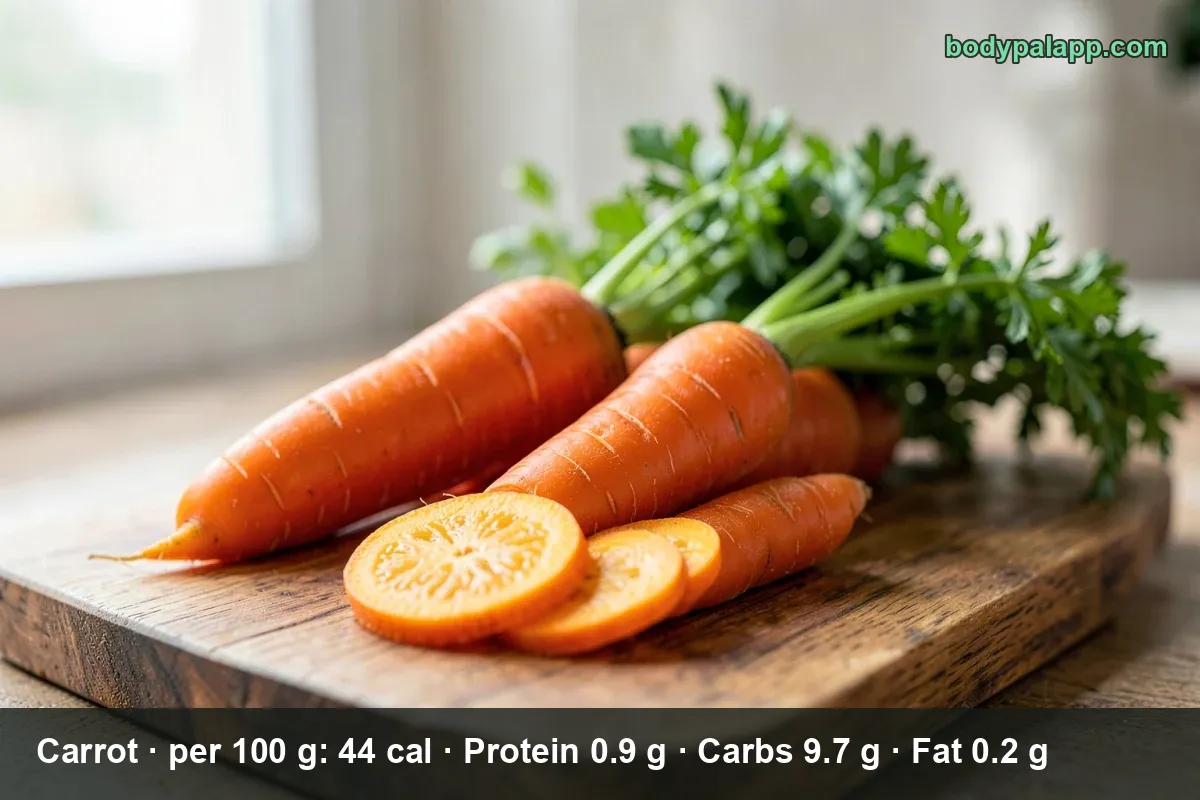
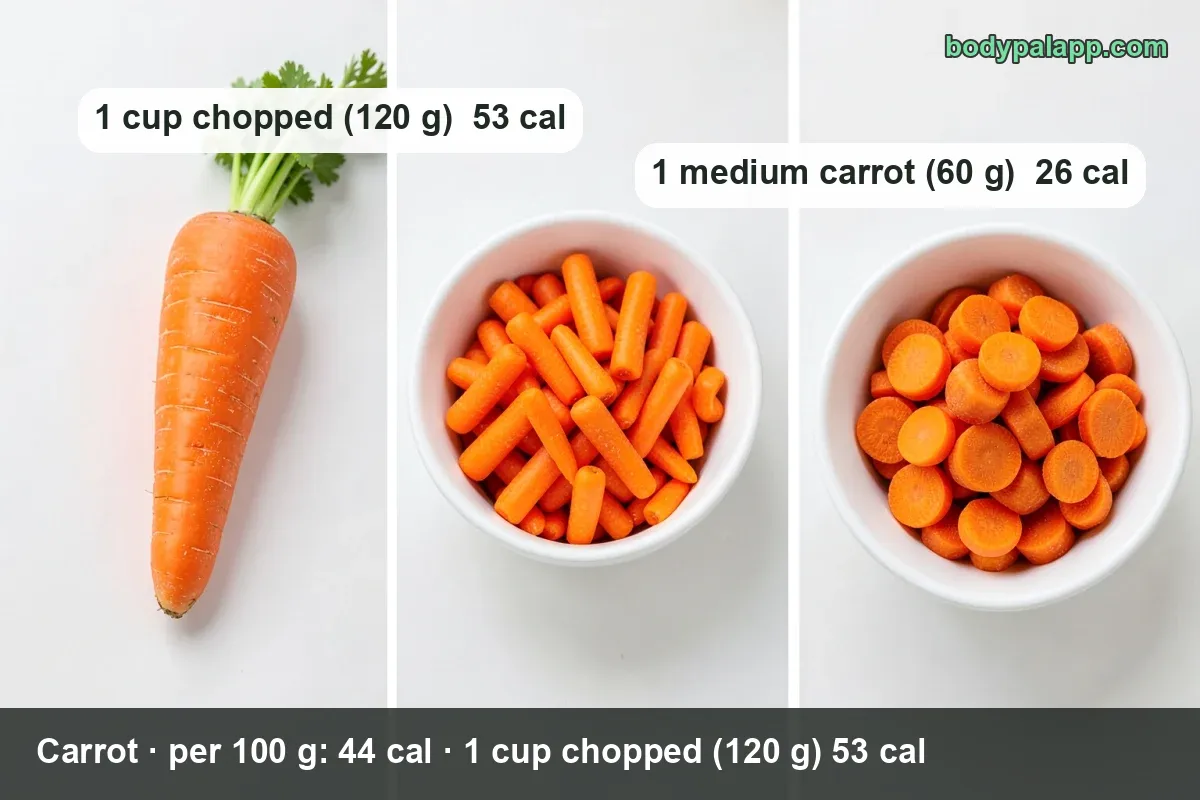
A 1-cup serving of chopped raw carrots weighs 120 g and carries 53 calories. Per 100 g, raw carrot is 44 calories. One medium carrot is 26, a single baby carrot 4. What moves the number is not the carrot but the pan: that same cup, cooked in oil, is 122 calories.
On this page
- Carrot quick facts
- US servings from one baby carrot to a full cup
- Raw cooked glazed and canned carrots
- Fiber is the row that earns its keep
- How do carrots compare once they hit the pan?
- Most popular carrot brands
- Carrot FAQs
Carrot quick facts
The row below is FNDDS 2709660, "Carrots, raw". It is the record for the thing most people are actually holding when they look this up: a whole raw carrot, or a bag of chopped ones on a cutting board. It is also the only raw carrot record that comes with the full set of American household measures, from a single baby carrot up to a chopped cup, which is what the numbers below are built on.
Three USDA records describe the same raw carrot and they do not agree exactly. The older SR Legacy entry, 170393, gives 41 calories per 100 g; the Foundation Foods entry for mature raw carrots computes 48. The spread is about 7 calories per 100 g, which is roughly 8 calories on a chopped cup — the difference between sampling rounds, not between different vegetables. We stay on the FNDDS row throughout rather than averaging them.
| Nutrient | Per 100 g | Per 1 cup chopped (120 g) | % Daily Value |
|---|---|---|---|
| Calories | 44 | 53 | — |
| Total fat | 0.24 g | 0.3 g | 0% |
| Saturated fat | 0.03 g | 0.0 g | 0% |
| Carbohydrate | 9.68 g | 11.6 g | 4% |
| Dietary fiber | 2.9 g | 3.5 g | 12% |
| Total sugars | 4.75 g | 5.7 g | — |
| Protein | 0.87 g | 1.0 g | 2% |
| Sodium | 75 mg | 90 mg | 4% |
% Daily Value is based on a 2,000-calorie diet.
Verified nutrition data
Numbers on this page come from USDA FoodData Central, the U.S. Department of Agriculture’s food composition database, and from manufacturer labels where a branded product is named. Last verified September 2026. How we verify our data →
There is no added sugars row and no trans fat row here, because this FNDDS edition does not publish either for raw vegetables — and a raw carrot has no added sugar and no source of trans fat to publish. Cholesterol is 0 mg. Potassium is worth a line: 258 mg per 100 g, so 310 mg in a chopped cup, about 7% of the Daily Value.
US servings from one baby carrot to a full cup
| Serving | Weight | Calories |
|---|---|---|
| 1 baby carrot | 10 g | 4 kcal |
| 1 oz raw, chopped | 28 g | 12 kcal |
| 1 medium carrot | 60 g | 26 kcal |
| 1 single-serving snack bag | 80 g | 35 kcal |
| 1 cup chopped | 120 g | 53 kcal |
| Per 100 g | 100 g | 44 kcal |
The baby carrot, the medium carrot, the snack bag and the chopped cup are USDA household measures attached to the raw carrot record. The 1 oz line is our own arithmetic from the USDA 100 g figure, not a USDA serving, and it is there because bagged carrots on the shelf are labeled in ounces.
That labeling is where most of the confusion starts. Bagged baby-cut carrots from the big American growers list 35 to 41 calories per 100 g, so a 3 oz (85 g) label serving lands around 30 to 35 calories and a 2 oz (56 g) serving around 20. Those are lower per gram than a whole carrot for one reason only: cut, washed carrots hold more water.
Raw cooked glazed and canned carrots
| Version | Per 100 g | Typical serving | Calories |
|---|---|---|---|
| Raw carrot | 44 kcal | 1 cup chopped (120 g) | 53 kcal |
| Baby carrots, raw | 35 kcal | 1 oz (28 g) | 10 kcal |
| Cooked, no added fat | 50 kcal | 1 cup (155 g) | 78 kcal |
| Cooked with oil | 76 kcal | 1 cup (160 g) | 122 kcal |
| Glazed, cooked | 97 kcal | 1 oz (28 g) | 27 kcal |
| Canned, drained | 25 kcal | 1 oz (28 g) | 7 kcal |
The 1 oz lines for baby, glazed and canned carrots in that table are our own scaling from the USDA 100 g figures, not USDA household servings.
Cooking a carrot in plain water raises it from 44 to 50 calories per 100 g. Nothing was added; water left. The serving grows anyway, because a cup of cooked carrot rounds packs down to 155 g instead of 120 g, and 155 g at 50 calories is 78.
Oil is the real jump. Carrots cooked with oil are 76 calories per 100 g, and a 160 g cup is 122 calories — 2.3 times the raw cup for the same vegetable. Glazed carrots, the holiday version, go further still at 97 calories per 100 g, with 12.14 g of total sugar against 4.75 g raw and 1.39 g of saturated fat where raw carrot has 0.03 g. A 1 oz spoonful is 27 calories, our own scaling from the USDA 100 g figure for glazed carrots, FNDDS 2709677.
Canned drained carrots are the lightest thing on this page at 25 calories per 100 g, and the saltiest: 242 mg of sodium per 100 g, against 75 mg raw. That is about 3.2 times as much, or roughly a tenth of a teaspoon of table salt in every 100 g.
Here is the trap that costs people the most accuracy. The cup measure is not one weight. A raw chopped cup is 120 g, a cooked cup is 155 to 160 g. Log a cooked cup at the raw cup's weight and you have quietly dropped 35 to 40 g — about a quarter of the serving — before you even account for the oil it was cooked in.
Fiber is the row that earns its keep
A chopped cup of raw carrot delivers 3.5 g of fiber, 12% of the 28 g Daily Value the FDA sets for the Nutrition Facts label, while contributing only 4% of the day's carbohydrate and 2% of its protein. Very few foods pull that lopsided a ratio. If you are choosing a crunchy snack to sit next to a sandwich, that is the argument for carrots over a cracker.
Protein is the row not to expect anything from: 1.0 g in a cup. Carrots are a vegetable serving, not a protein source, and MyPlate counts a cup of raw or cooked carrots as a full cup toward the vegetable group either way.
Sodium is the surprise in the other direction. Raw carrot already carries 75 mg per 100 g, which is high for a plain vegetable, and the cooked FNDDS rows land near 211 mg because the sampled recipes were salted. If you are watching sodium, raw or plain-cooked carrots are the better pick over the canned version.
How do carrots compare once they hit the pan?
| Carrot dish | Per 100 g | US serving | Calories |
|---|---|---|---|
| Raw, chopped | 44 kcal | 1 cup (120 g) | 53 kcal |
| Cooked, no added fat | 50 kcal | 1 cup (155 g) | 78 kcal |
| Cooked with butter or margarine | 69 kcal | 1 cup (160 g) | 110 kcal |
| Cooked with oil | 76 kcal | 1 cup (160 g) | 122 kcal |
Our take: the carrot is never the problem. Across these four rows the vegetable itself is identical and the range is 53 to 122 calories a cup, so the fat and the cup weight account for every calorie of the 69-calorie gap. For weight loss, raw or plain-cooked is the pick, and 53 calories a cup makes carrots one of the cheapest ways to add volume to a plate. For satiety at dinner, spend the fat on purpose: butter costs 12 calories a cup less than oil, and either one is what makes the rest of the meal go down. Just log the version you actually cooked, not the raw entry.
Most popular carrot brands in the United States
Ranked by how widely each product appears among foods sold in the United States, from the BodyPal food database of over 3.3 million products. Calories are the figures printed on each Nutrition Facts label, checked against USDA FoodData Central.
| Product | Calories (per 100 g) |
|---|---|
| Cal-Organic Farms Cut & Peeled Baby-Cut Carrots | 36 cal |
| Bunny-Luv Organic Baby Carrots | 41 cal |
| Signature Farms Carrots | 38 cal |
| Grimmway Farms Petite Carrots | 35 cal |
| Pictsweet Farms Sliced Carrots | 47 cal |
| Deal Farms Carrots | 38 cal |
Brand popularity: BodyPal food database. Nutrition: manufacturer labels / USDA FoodData Central.
Carrot FAQs
How many calories are in one medium carrot?
A medium carrot weighs 60 g and holds 26 calories, based on the USDA figure of 44 calories per 100 g. It brings 1.7 g of fiber and 5.8 g of carbohydrate, both scaled from that 100 g record. Peeling changes the weight slightly, not the calorie density.
How many calories are in a cup of chopped carrots?
One cup of chopped raw carrot weighs 120 g and comes to 53 calories, with 11.6 g of carbohydrate, 3.5 g of fiber and 90 mg of sodium. That is 12 percent of the Daily Value for fiber against only 4 percent for carbohydrate, which is the useful trade in this vegetable.
How many calories are in baby carrots?
Baby carrots run 35 calories per 100 g, so one 10 g baby carrot is 4 calories and a 1 oz handful of 28 g is 10. They are lighter than a full carrot because the cutting and washing leaves more water in them, not because of any trimming.
Do cooked carrots have more calories than raw carrots?
Yes, per gram: 50 calories per 100 g cooked without fat against 44 raw. Per serving the gap is bigger, because a cooked cup weighs 155 g and a raw cup only 120 g, so the cup goes from 53 calories to 78. Cooked with oil it reaches 122.
How many carbs are in a carrot?
Raw carrot has 9.68 g of carbohydrate per 100 g, of which 2.9 g is fiber and 4.75 g is naturally occurring sugar. A medium 60 g carrot works out at 5.8 g of carbohydrate, and a 120 g cup at 11.6 g, which is 4 percent of the Daily Value.
How much fiber is in a carrot?
Raw carrot carries 2.9 g of fiber per 100 g. A medium carrot gives 1.7 g and a chopped cup 3.5 g, or 12 percent of the 28 g Daily Value. Cooking concentrates it a little: carrots cooked without added fat hold 3.2 g per 100 g.
How many calories are in glazed carrots?
Glazed carrots are 97 calories per 100 g, so a 1 oz spoonful of 28 g is 27 calories, our own arithmetic from the USDA 100 g figure. The glaze more than doubles raw carrot's 44 and pushes total sugar to 12.14 g per 100 g against 4.75 g raw.
Are canned carrots high in sodium?
Canned drained carrots carry 242 mg of sodium per 100 g against 75 mg in raw carrot, roughly 3.2 times as much, or about a tenth of a teaspoon of table salt. They are also the lightest version on this page at 25 calories per 100 g, with the most water in them.
Similar foods
- Cooked Onions — 92 cal per cup
- Red Onion — 87 cal per onion
- Butternut Squash — 63 cal per cup cubed
- Snap Peas — 26 cal per cup whole pods
- Sugar Snap Peas — 26 cal per cup whole
- Carrot Chips — 35 cal per 3 oz portion
Count it without the math
Point the camera at the plate and BodyPal counts the carrots for you, glaze and all.


How long does it take to burn off carrots?
A 1-cup serving of chopped carrots (120 g) is 53 kcal. Enter your weight and the amount you ate to see how long it takes you to burn that off:
lb
| Activity | Time to burn 53 kcal |
|---|---|
| Walking, brisk | 11 min |
| Cycling, moderate | 7 min |
| Swimming, moderate | 8 min |
| Jogging | 6 min |
| Weight training, moderate | 12 min |
Times are for a 155 lb adult at a steady pace; change the weight to see yours. The amount is set to the portion in the text (120 g); change it to what you actually ate. BodyPal works this out from your steps automatically.
This table assumes you know your daily total. If you do not, the daily calorie calculator works it out from five numbers.