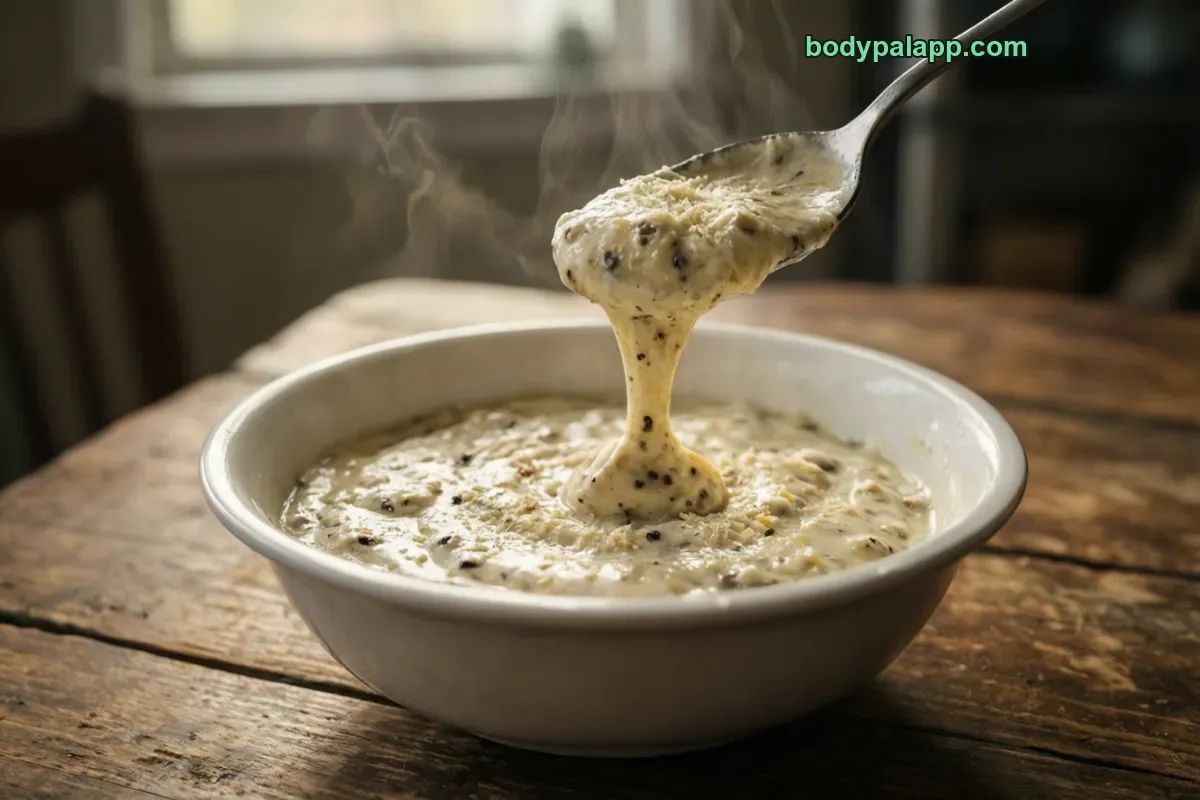
Caesar dressing calories come to 163 for a 2 tbsp (30 g) serving and 542 per 100 g. Fat supplies 96% of those calories, so by energy this dressing is almost pure oil. The same small serving also carries 363 mg of sodium, which is 16% of the daily value before the salad gets any other toppings.
163kcal
1 2 tbsp serving · 30 g, regular, ready to eat
2%protein
0.7 gProtein
1 gCarbs
17.4 gFat
How to burn off 163 kcal
—Walking, brisk
—Jogging
—Cycling, moderate
—Swimming
Skip the math. BodyPal counts these calories from your steps and workouts automatically.
Nutrition facts
Regular, ready to eat · per 30 g
Calories
163 kcal
Protein
0.7 g
Carbohydrate
1 g
Fat
17.4 g
Saturated fat
2.6 g
Cholesterol
12 mg
Sodium
363 mg
Potassium
9 mg
Iron
0.3 mg
Source: USDA FoodData Central
🛡️
Verified nutrition data
Numbers on this page come from USDA FoodData Central, the U.S. Department of Agriculture’s food composition database, and from manufacturer labels where a branded product is named. Last verified September 2026. How we verify our data →
Caesar dressing: calories, protein and sodium by serving
Percent of daily value uses the FDA reference of 2,000 kcal a day.
Serving
kcal
Protein
Carbs
Fat
Sodium
% DV kcal
2 tbsp (30 g)
163
0.7 g
1 g
17.4 g
363 mg
8%
1 tbsp (14.7 g)
80
0.3 g
0.5 g
8.5 g
178 mg
4%
Light, 2 tbsp (30 g)
33
0.1 g
5.6 g
1.3 g
344 mg
2%
100 g
542
2.2 g
3.3 g
57.9 g
1,209 mg
27%
3 × 2 tbsp (30 g)
488
2 g
1,088 mg
5 × 2 tbsp (30 g)
813
3.3 g
1,814 mg
The pour decides the total, not the lettuce
A level 2 tbsp serving weighs 30 g and lands at 163 calories, about 8% of the daily value. Cut it to 1 tbsp (14.7 g) and you are at 80 calories. That is the label math. The trouble is that almost nobody measures dressing, and a creamy dressing hides in romaine far better than a vinaigrette does.
Double the pour to 60 g and the dressing alone reaches 325 calories. A heavy hand of 90 g, which is easy to hit with a restaurant-style salad that arrives already tossed, brings 488 calories. Five servings, or 150 g, add up to 813 calories. At that point the dressing outweighs the greens, the croutons and often the chicken on the plate.
The practical fix is boring and it works. Measure 2 tbsp once with a spoon so you know what it looks like in your bowl, then ask for dressing on the side when you eat out. Dipping the fork instead of pouring keeps you closer to the 30 g serving without giving up the taste.
Fat is 96% of every calorie
Per 100 g, caesar dressing has 57.9 g of fat, 3.3 g of carbs and just 2.2 g of protein. Translate that into calories and the split is 96% fat, 2% carbs and 2% protein. In a 2 tbsp serving you get 17.4 g of fat, 1 g of carbs and 0.7 g of protein.
That profile tells you what the dressing does and does not bring. It adds richness and flavor, and it helps a plate of raw vegetables feel like a meal. It does not add protein worth counting, and it brings almost no fiber, only 0.5 g per 100 g. Sugar is low too, at 2.8 g per 100 g, which sets the regular version apart from many sweeter bottled dressings.
Saturated fat sits at 8.8 g per 100 g and cholesterol at 39 mg per 100 g. Neither is extreme at a normal serving, but both scale with the pour just like the calories. If you track fat closely, treat the dressing as your fat source for that meal and keep the rest of the salad lean: grilled chicken, eggs or beans rather than extra cheese and bacon.
Sodium climbs faster than you expect
Sodium is the row to watch here. A 2 tbsp serving holds 363 mg, or 16% of the daily value, and even 1 tbsp brings 178 mg, 8% of it. Per 100 g the figure is 1,209 mg, which is 53% of the daily value in a portion that is easy to pour over a large salad.
The multiples make the point. Three servings deliver 1,088 mg of sodium, and five servings reach 1,814 mg. A classic caesar salad usually adds salty extras on top of the dressing, such as grated cheese and croutons, so the bowl as a whole can end up saltier than the dressing number alone suggests.
Switching to light dressing barely helps on this row. The light version carries 344 mg per 2 tbsp, 15% of the daily value, against 363 mg for regular. If you watch sodium, portion size is the lever that matters, not the word light on the bottle.
Light caesar cuts calories, not salt
Light caesar dressing comes in at 33 calories for 2 tbsp (30 g), compared with 163 for regular. Fat drops to 1.3 g from 17.4 g. The trade-off is in the carbs: the light version has 5.6 g of carbs and 4.9 g of sugars per serving, against 1 g and 0.8 g for regular. Calorie for calorie, that is still a large saving.
On the shelf you will see both styles from the same makers, such as Ken's Steak House Creamy Caesar Dressing next to Ken's Steak House Lite Creamy Caesar Dressing, plus light options like ShopRite Light Caesar Dressing and Caesar Cardini's Light Caesar Dressing. Labels vary between brands, so check the serving size on the bottle you buy.
For a balanced plate, let the dressing do the flavor work and build the rest around protein and volume: romaine, cucumber, tomatoes and a lean protein. Regular dressing at a measured 2 tbsp fits most days; light dressing gives you room for a bigger pour. BodyPal can log your salad and dressing from a photo if you would rather not weigh it.
How does caesar dressing compare?
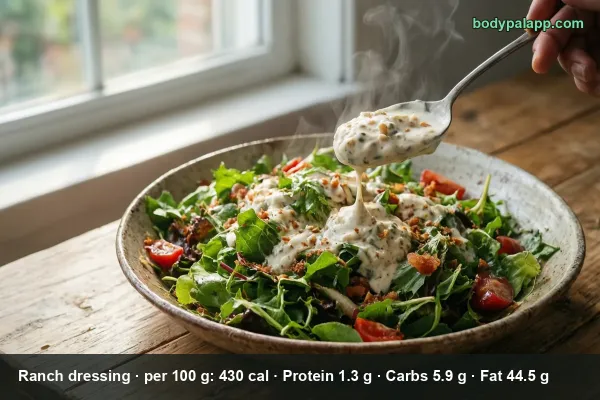
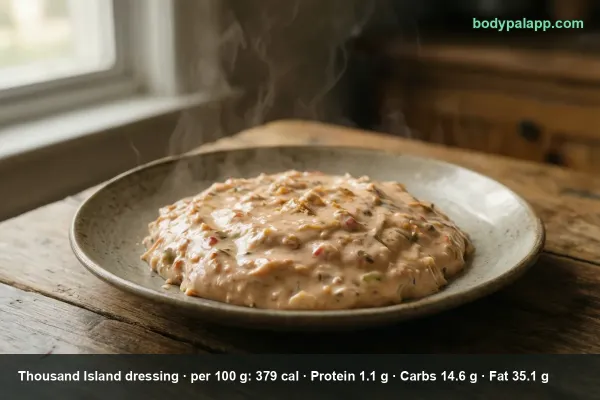
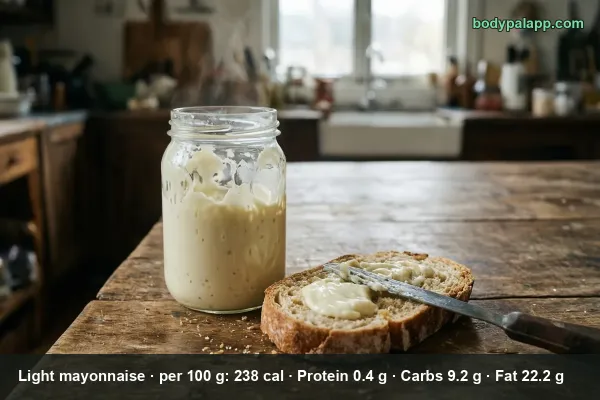
Here is how caesar dressing stacks up against ranch, thousand island and light mayonnaise, per 100 g and per usual serving.
Verdict: If calories matter most, light mayonnaise at 238 per 100 g or thousand island at 379 beat caesar's 542, and ranch at 430 is the closest creamy swap. Caesar also has the most sodium of the four at 1,209 mg per 100 g, so it is the dressing to measure rather than pour.
Most popular caesar dressing brands in the United States
Ranked by popularity in the BodyPal database
# Productkcal / 100 g
1Ken's Steak House Creamy Caesar Dressing2 tbsp · 30 g567 kcal
2Ken's Steak House Lite Creamy Caesar Dressing2 tbsp · 31 g290 kcal
3Newman's Own Caesar Dressing2 tbsp · 30 g500 kcal
4Newman's Own Creamy Caesar Dressing2 tbsp · 30 g533 kcal
5Riverton Valley Caesar Dressing2 tbsp · 30 g103 kcal
6Cains Caesar Dressing2 tbsp · 30 ml267 kcal
7ShopRite Light Caesar Dressing2 tbsp · 30 ml300 kcal
8Caesar Cardini's Light Caesar Dressing2 tbsp · 30 g267 kcal
Light and lite bottles are thinned with water, so their label numbers land far below the 542 calories per 100 g of a regular dressing. Source: manufacturer labels / USDA FoodData Central.
Caesar dressing FAQs
How many calories are in caesar dressing?
A standard 2 tbsp serving is 163 calories and one tablespoon is 80 calories. Regular caesar dressing is 542 calories per 100 g.
Is caesar dressing good for weight loss?
Two tablespoons carry 163 calories and 17.4 g of fat. The light version is 33 calories and 1.3 g of fat for the same 30 g.
Which has more calories, caesar or ranch dressing?
Caesar is higher at 542 calories per 100 g against 430 for ranch. Over 2 tbsp that is 163 calories versus 129.
How much sodium is in caesar dressing?
About 363 mg in a 2 tbsp serving, from 1209 mg per 100 g. The light version is close at 1148 mg per 100 g.
How many calories are in 2 tbsp of caesar dressing?
Two tablespoons (30 g) of regular caesar dressing have 163 calories. Almost all of it comes from 17.4 g of fat, with 1 g of carbs and 0.7 g of protein.
How many calories are in light caesar dressing?
Light caesar dressing has 33 calories per 2 tbsp (30 g), against 163 for regular. It has 1.3 g of fat but more sugar, 4.9 g per serving, and sodium stays high at 344 mg.
How many calories are in 1 tbsp of caesar dressing?
One tablespoon (14.7 g) of caesar dressing has 80 calories, 8.5 g of fat and 178 mg of sodium. That is 4% of the daily value for calories and 8% for sodium.
How many calories does caesar dressing add to a restaurant salad?
It depends on the pour. At 60 g the dressing adds 325 calories, at 90 g it adds 488, and at 150 g it adds 813. Asking for it on the side helps you stay near 2 tbsp.
How much fat is in caesar dressing?
Caesar dressing has 57.9 g of fat per 100 g and 17.4 g in a 2 tbsp serving. Fat supplies 96% of its calories, with 8.8 g of saturated fat per 100 g.