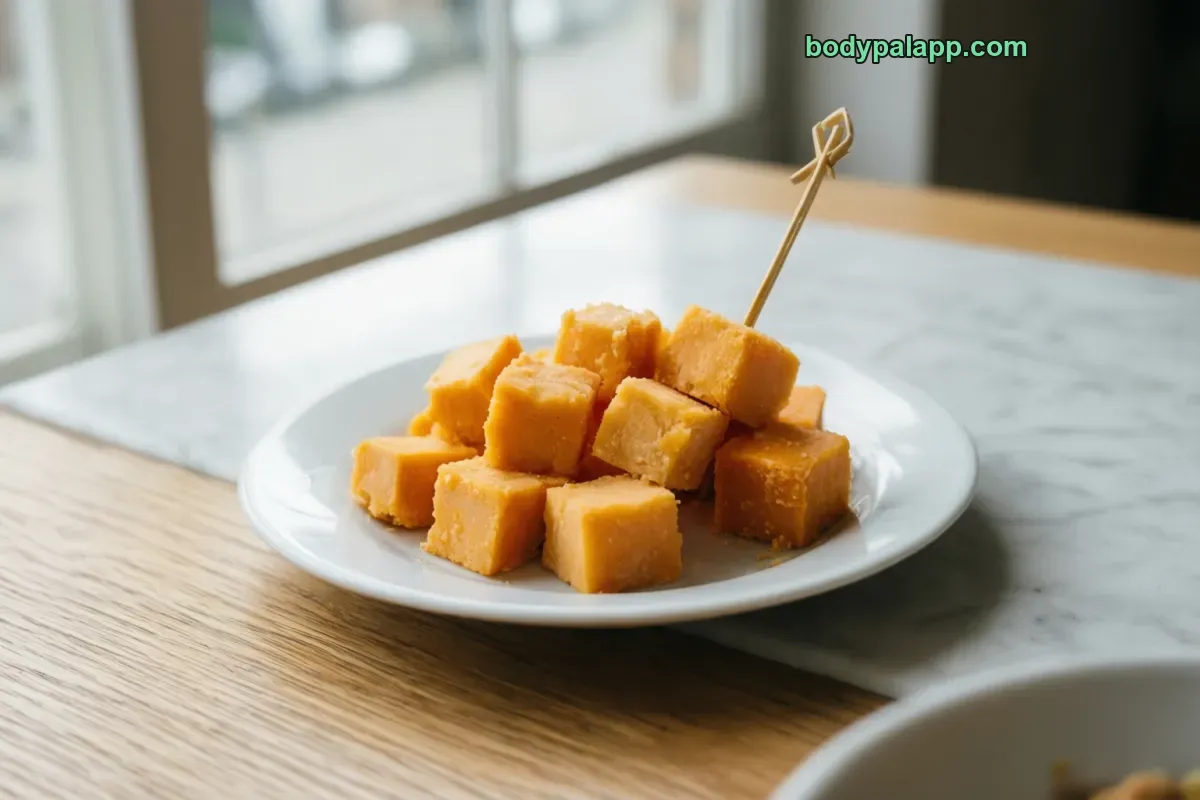
Cheese cube calories come to 69 for one 17 g cube of cheddar and 408 per 100 g. Fat supplies 75% of those calories, so the cubes are dense and easy to stack up. A small handful of 5 cubes reaches 347 calories and 556 mg of sodium before the plate looks empty.
69kcal
1 cube · 17 g, cheddar, cubed
23%protein
4 gProtein
0 gCarbs
5.8 gFat
How to burn off 69 kcal
—Walking, brisk
—Jogging
—Cycling, moderate
—Swimming
Skip the math. BodyPal counts these calories from your steps and workouts automatically.
Nutrition facts
Cheddar, cubed · per 17 g
Calories
69 kcal
Protein
4 g
Carbohydrate
0.4 g
Fat
5.8 g
Saturated fat
3.3 g
Cholesterol
17 mg
Sodium
111 mg
Potassium
13 mg
Iron
0 mg
Source: USDA FoodData Central
🛡️
Verified nutrition data
Numbers on this page come from USDA FoodData Central, the U.S. Department of Agriculture’s food composition database, and from manufacturer labels where a branded product is named. Last verified September 2026. How we verify our data →
Cheese cube: calories, protein and sodium by serving
Percent of daily value uses the FDA reference of 2,000 kcal a day.
Serving
kcal
Protein
Carbs
Fat
Sodium
% DV kcal
1 cube (17 g)
69
4 g
0.4 g
5.8 g
111 mg
3%
1 oz portion (28 g)
114
6.5 g
0.7 g
9.5 g
183 mg
6%
100 g
408
23.3 g
2.4 g
34 g
654 mg
20%
3 × 1 cube (17 g)
208
11.9 g
334 mg
5 × 1 cube (17 g)
347
19.8 g
556 mg
Five cubes are a 347-calorie snack
One cube is a modest bite. At 17 g it carries 69 calories, about 3% of a 2000-calorie daily value, plus 4 g of protein. The trouble is that nobody eats one. Cheese cubes come on party trays, in snack boxes and in lunch kits, and they disappear in twos and threes.
Watch how the total moves. Two cubes (34 g) land at 139 calories. Three cubes (51 g) reach 208. Five cubes (85 g) hit 347 calories, which is close to a light meal. A standard 1 oz portion is 28 g and 114 calories, or about 6% of the daily value, so it sits between one cube and two.
The simplest fix is to count before you eat. Put the cubes you plan to have on a small plate instead of grazing from the bag or the tray. If you want the snack to feel bigger, cut each cube in half: the calories stay the same, but the portion lasts longer. Pre-packed cubes from brands like Sargento, Tillamook or Market Pantry make counting easier, since the pieces are uniform.
Fat is three quarters of every cube
Cheddar is a fat-first food. Of its calories, 75% come from fat, 23% from protein and only 2% from carbs. Per 100 g that works out to 34 g of fat, 23.3 g of protein and 2.4 g of carbs. A single cube holds 5.8 g of fat and just 0.4 g of carbs.
Saturated fat is the bigger part of that fat. Cheddar has 19.2 g of saturated fat per 100 g, against a daily value of 20 g. In other words, 100 g of cubes uses up nearly the whole day's saturated fat allowance on its own. Cholesterol sits at 100 mg per 100 g, with a daily value of 300 mg.
The protein is real, though. One cube gives 4 g, which is 8% of the daily value. Three cubes give 11.9 g and five give 19.8 g. That makes cubes a decent protein add-on, but not an efficient protein source, because the fat calories come along for the ride. If protein is your goal, a few cubes next to a leaner food works better than a big pile of cheese.
Sodium is the row to watch
Cheddar is salted during cheesemaking, and the numbers show it. One cube has 111 mg of sodium, about 5% of the daily value. A 1 oz portion carries 183 mg, or 8%. Per 100 g the figure is 654 mg, which is 28% of the daily value in one sitting.
Like the calories, the sodium scales with every cube. Two cubes bring 222 mg, three bring 334 mg and five bring 556 mg. On their own those are not alarming numbers. The issue is what cubes usually share a plate with: crackers, cured meats, pickles and olives, all of which push the sodium total higher.
If you watch sodium, treat cheese cubes as the salty item on the plate and keep the rest plain. Fresh fruit, raw vegetables and unsalted nuts balance the tray without adding much sodium. Choosing a smaller count of a sharper cheddar can also help, since a stronger flavor tends to satisfy with fewer pieces.
Cubes work best as a side, not the snack
Cheese cubes fit most eating patterns when they play a supporting role. With almost no carbs, they suit low-carb snacking. With 4 g of protein per cube, they add staying power to a piece of fruit or a handful of vegetables. Two or three cubes next to an apple or some cucumber slices make a snack that feels complete without crossing into meal territory.
The pairing that backfires is cheese plus more cheese-adjacent foods. A tray of cubes, salami and buttery crackers stacks fat and sodium quickly. If that is the plan, decide on a cube count first and fill the rest of the plate with produce.
Store-bought cubes vary by cheese type. Great Midwest and Private Selection both sell Colby Jack blends alongside mild cheddar, and Food Lion offers mild cheddar too. The values on this page are for cheddar, so check the label if your bag is a different blend. If you lose count at a party, BodyPal can log the cubes from a photo of your plate.
How does cheese cube compare?
Here is how cheddar cubes stack up against three other snacking cheeses, per 100 g and per usual serving.
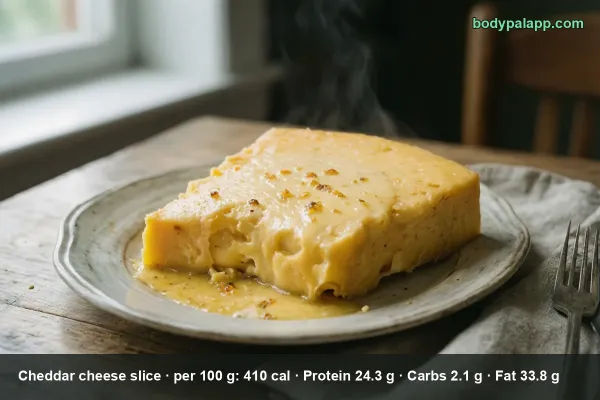
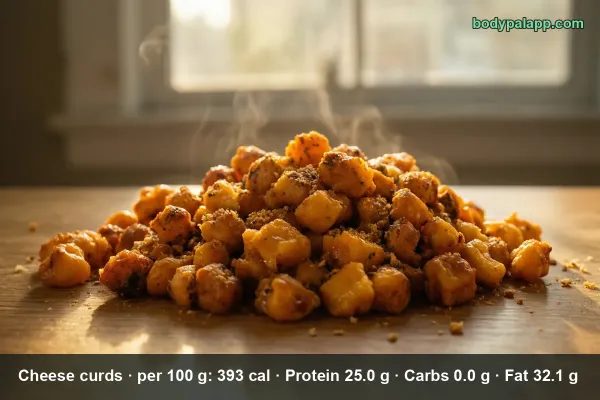
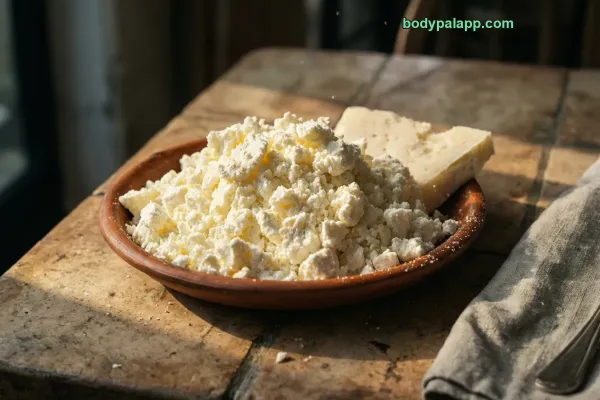
Verdict: For the fewest calories pick cotija at 366 per 100 g, but its 1,400 mg of sodium is more than double cheddar's 654 mg, so it only wins if salt is not a concern. For the most protein per calorie, cheese curd edges out cubes with 25 g of protein at 393 calories, while a cheddar slice at 410 is essentially the same cheese in a different shape.
Most popular cheese cube brands in the United States
Packaged cubes are mild cheddar or colby jack, so their labels read 393 to 400 calories per 100 g instead of the 408 above. Source: manufacturer labels / USDA FoodData Central.
Cheese cube FAQs
How many calories are in one cheese cube?
A 1 inch cheddar cube weighs about 17 g and has 69 calories. A 1 oz portion (28 g), roughly five to seven of the smaller packaged cubes, is 114 calories.
Are cheese cubes good for weight loss?
A 1 oz portion is 114 calories with 6.5 g protein and 9.5 g fat, and a single 17 g cube is 69 calories. Cheese is calorie dense at 408 calories per 100 g, so the portion size decides how it fits a daily target.
Cheese cubes or cheese slices: which has fewer calories?
They are nearly identical: cubed cheddar is 408 calories per 100 g and sliced sharp cheddar 410. A 1 oz slice is 115 calories against 114 for the same weight in cubes.
How much protein is in cheese cubes?
Cheddar has 23.3 g protein per 100 g, so one 17 g cube gives about 4 g and a 1 oz portion (28 g) about 6.5 g.
How many calories are in 5 cheese cubes?
Five cheddar cubes (85 g) have 347 calories. They also bring 19.8 g of protein and 556 mg of sodium, so a handful this size is closer to a light meal than a quick bite.
How many calories are in 1 oz of cheese cubes?
A 1 oz portion (28 g) of cheddar cubes has 114 calories, about 6% of the daily value. It provides 6.5 g of protein, 9.5 g of fat and 183 mg of sodium.
How much sodium is in one cheese cube?
One 17 g cheddar cube has 111 mg of sodium, about 5% of the daily value. Sodium adds up with each cube: three cubes reach 334 mg and five reach 556 mg.
Are cheese cubes low in carbs?
Yes. One cheddar cube has just 0.4 g of carbs, and 100 g has 2.4 g. Carbs supply only 2% of the calories, while fat supplies 75% and protein 23%.
How much saturated fat is in cheddar cheese cubes?
Cheddar has 19.2 g of saturated fat per 100 g, nearly the full daily value of 20 g. That makes saturated fat the main reason to keep cube portions small.