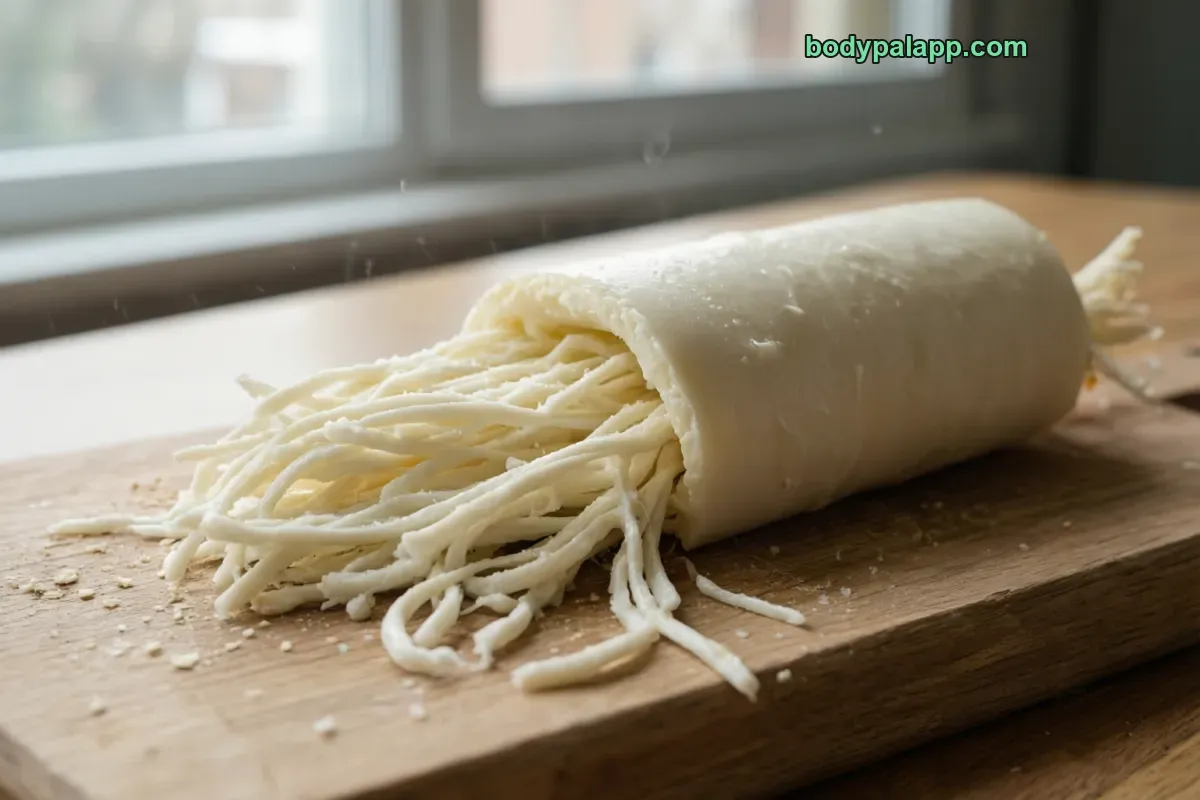
String cheese calories come to 80 for one 28 g stick and 286 per 100 g. Each stick also carries 6 g of protein, 12% of the daily value, for just 4% of a day's calories. The catch is fat: it supplies 66% of the energy, so the stick satisfies in small doses and adds up fast in multiples.
80kcal
1 stick · 28 g, packaged, per label
29%protein
6 gProtein
1 gCarbs
6 gFat
How to burn off 80 kcal
—Walking, brisk
—Jogging
—Cycling, moderate
—Swimming
Skip the math. BodyPal counts these calories from your steps and workouts automatically.
Nutrition facts
Packaged, per label · per 28 g
Calories
80 kcal
Protein
6 g
Carbohydrate
1 g
Fat
6 g
Saturated fat
3.5 g
Cholesterol
15 mg
Sodium
200 mg
Source: USDA FoodData Central
🛡️
Verified nutrition data
Numbers on this page come from USDA FoodData Central, the U.S. Department of Agriculture’s food composition database, and from manufacturer labels where a branded product is named. Last verified September 2026. How we verify our data →
String cheese: calories, protein and sodium by serving
Percent of daily value uses the FDA reference of 2,000 kcal a day.
Serving
kcal
Protein
Carbs
Fat
Sodium
% DV kcal
1 stick (28 g)
80
6 g
1 g
6 g
200 mg
4%
Small stick (24 g)
70
6 g
1 g
5 g
170 mg
4%
100 g
286
21.4 g
3.6 g
21.4 g
714 mg
14%
3 × 1 stick (28 g)
240
18 g
600 mg
5 × 1 stick (28 g)
400
30 g
1,000 mg
One stick is 80 calories, five sticks are 400
String cheese comes pre-portioned, and that is its biggest strength. The standard 28 g stick lands at 80 calories, 6 g of protein and 200 mg of sodium. Some packs use a smaller 24 g stick, which drops the count to 70 calories and 170 mg of sodium while the label still shows 6 g of protein.
The trouble starts when one stick becomes a handful. Two sticks (56 g) are 160 calories with 12 g of protein. Three sticks (84 g) reach 240 calories. Five sticks, 140 g of cheese, hit 400 calories and 1,000 mg of sodium, which is a light meal's worth of energy eaten standing at the fridge.
If you are counting, check which stick size your brand uses. Polly-O, Sargento, Kraft and Great Value all sell string cheese, and light versions exist, so the wrapper is the final word on your exact pack. Read the serving line before you read the calorie line.
Fat supplies two thirds of the calories
Per 100 g, string cheese holds 21.4 g of protein and 21.4 g of fat, an even split by weight. The calories tell a different story. Fat carries more energy per gram, so it accounts for 66% of the calories, protein for 29% and carbs for just 5%.
Carbs are close to zero: 3.6 g per 100 g, with 0 g of sugar and 0 g of fiber. That makes the stick an easy fit for low-carb eating, but it also means nothing in it adds bulk. Whatever fullness you get comes from protein and fat, not volume.
Saturated fat is the part worth noticing. There are 12.5 g per 100 g, against a daily value of 20 g. One stick is a modest share of that; a stack of sticks is not. Cholesterol sits at 54 mg per 100 g, against a daily value of 300 mg.
Sodium is the row to watch
A single 28 g stick carries 200 mg of sodium, 9% of the daily value. The small 24 g stick has 170 mg, or 7%. Per 100 g the figure is 714 mg, which works out to 31% of the daily value in a portion that is only 14% of a day's calories.
That still makes string cheese one of the milder cheeses on the salt front. Brined and processed cheeses run much higher, so swapping a slice or a crumble for a stick is a real sodium saving, not a rounding error.
The risk is volume. Five sticks deliver 1,000 mg of sodium, and the rest of the day still has to happen. If you watch sodium, keep it to one or two sticks, where two add up to 400 mg, and pair them with unsalted foods rather than crackers, chips or deli meat.
Pair the stick with fiber and crunch
With 0 g of fiber and almost no carbs, string cheese on its own is a protein-and-fat snack. It pairs well with foods that bring what it lacks: an apple, grapes, baby carrots or whole-grain crackers. The cheese supplies the protein; the partner supplies crunch, fiber and bulk.
It also works as a building block. Tear a stick over a salad, fold it into a wrap or melt it into an omelet. At 80 calories and 6 g of protein per stick, it adds protein to a meal without a big jump in calories.
For lunchboxes, the individual wrapping is the real advantage: the portion is decided before you open it. If you log what you eat, BodyPal can log string cheese from a photo, which helps when the snack happens on the go.
How does string cheese compare?
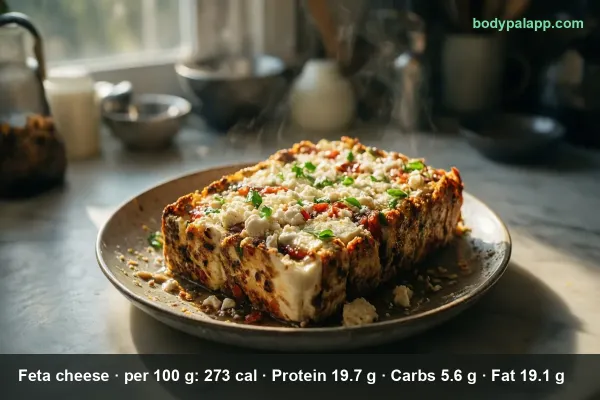
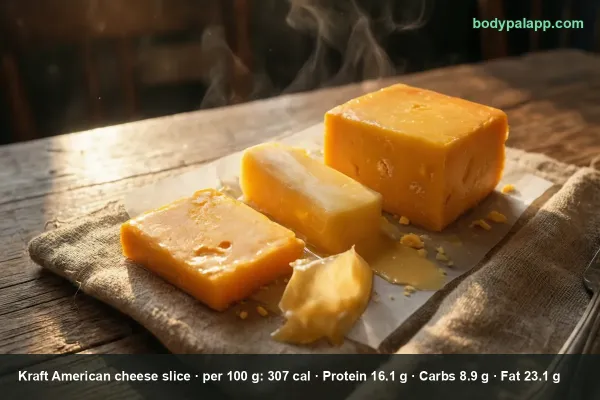
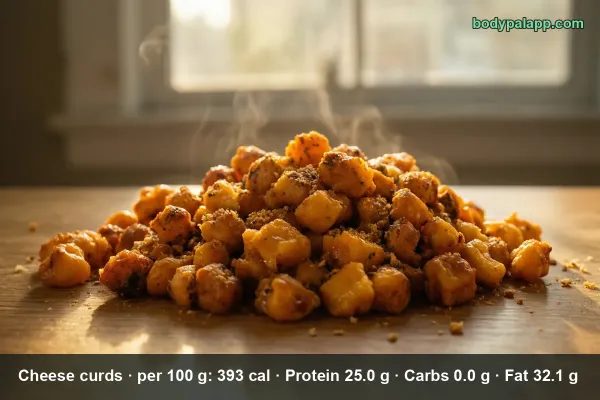
Here is how string cheese stacks up against feta, Kraft American slices and cheese curds, per 100 g and per usual serving.
Verdict: For the fewest calories, string cheese at 286 per 100 g and feta at 273 are close, but string cheese brings far less sodium, 714 mg against 1,034 mg. Cheese curds give the most protein at 25 g, yet they cost 393 calories per 100 g, so they suit bigger appetites rather than tight calorie budgets.
Most popular string cheese brands in the United States
A 28 g stick is 80 calories. The smaller 24 g sticks come to 70 calories each.
Is string cheese good for weight loss?
One stick is 80 calories with 6 g of protein and about 1 g of carbs, so it is a fixed portion that is easy to count.
String cheese vs feta cheese: which has fewer calories?
Per 100 g string cheese is 286 calories and feta cheese is 273, so feta is 13 calories lower.
How much protein is in string cheese?
About 6 g per 28 g stick, from 21.4 g of protein per 100 g. Light sticks list 28.6 g per 100 g.
How many calories are in two string cheese sticks?
Two 28 g sticks contain 160 calories, with 12 g of protein and 400 mg of sodium. That is a filling snack for the calories, but the sodium doubles along with everything else.
How much sodium is in a string cheese stick?
One 28 g stick has 200 mg of sodium, 9% of the daily value. A smaller 24 g stick has 170 mg. Per 100 g, string cheese carries 714 mg, so multiple sticks add up quickly.
Does string cheese have carbs or sugar?
Barely. One stick has 1 g of carbs and 0 g of sugar. Per 100 g it is 3.6 g of carbs, so carbs supply only 5% of the calories.
How much fat is in string cheese?
One 28 g stick has 6 g of fat. Per 100 g there are 21.4 g of fat, including 12.5 g saturated, and fat supplies 66% of the calories.
How many calories are in a small string cheese stick?
A small 24 g stick has 70 calories, 6 g of protein, 5 g of fat and 170 mg of sodium. Stick sizes vary by brand, so check the label on your pack.