
How many calories are in chicken fries?
A 7-piece serving of frozen breaded chicken fries weighs 90 g and carries 216 calories. Per 100 g the same product runs 240 calories, with 13.2 g of protein and 474 mg of sodium in that serving. The fast-food version is heavier: 271 calories per 100 g, because the fryer adds what the oven does not.
On this page
- Chicken fries quick facts
- US servings from one fry to a full plate
- Fast-food restaurant and school-lunch versions
- Sodium is the row to watch
- How do chicken fries compare?
- Most popular chicken fries brands
- Chicken fries FAQs
Chicken fries quick facts
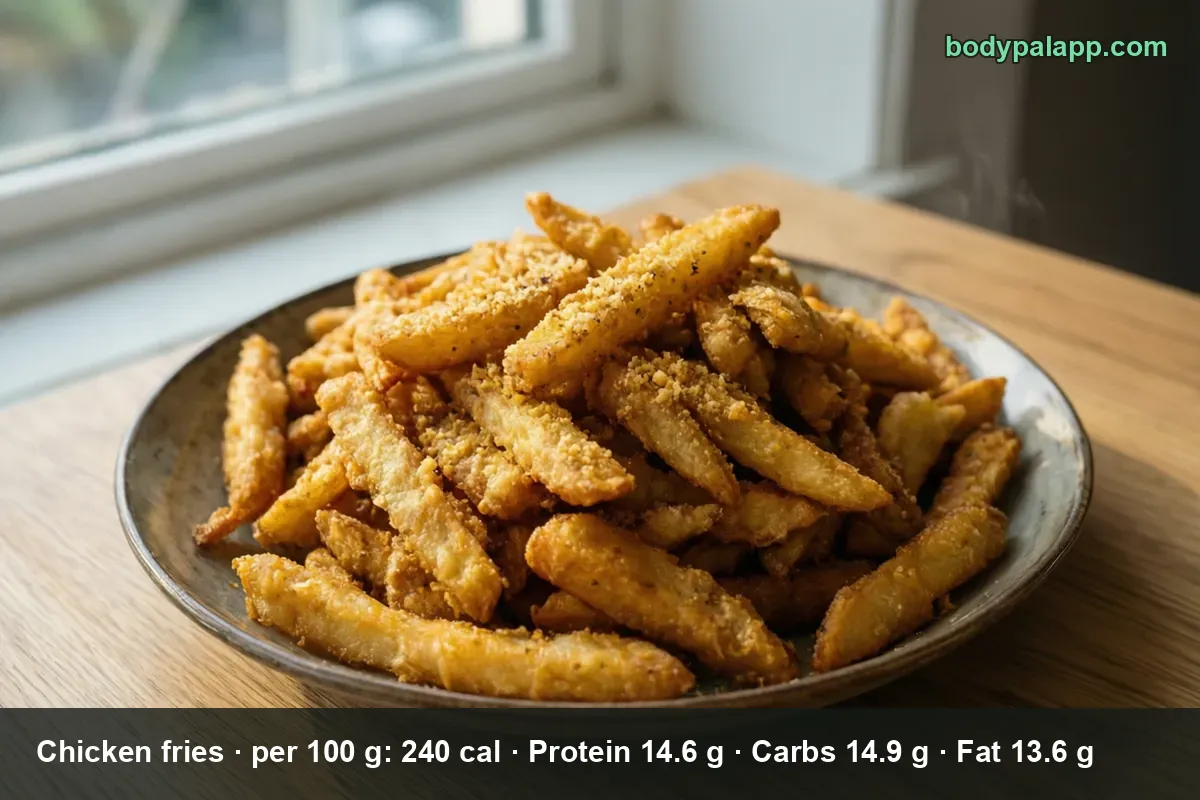
The record that matches what most people actually eat is FNDDS 2706102, "Chicken tenders or strips, breaded, from frozen" — the bag from the freezer aisle, spread on a sheet pan and baked at home. That is the food in the picture, and its numbers line up with the boxes on the shelf: Tyson Homestyle, Kroger and Great Value labels sit between 247 and 256 calories per 100 g with about 14 g of protein.
USDA keeps four other breaded-strip records, split by where the food was cooked rather than by what it is. Those are in the variants table further down. The difference between them is the frying, not the chicken.
| Nutrient | Per 100 g | Per 7 pieces (90 g) | % Daily Value |
|---|---|---|---|
| Calories | 240 | 216 | — |
| Total fat | 13.58 g | 12.2 g | 16% |
| Saturated fat | 2.44 g | 2.2 g | 11% |
| Carbohydrate | 14.86 g | 13.4 g | 5% |
| Dietary fiber | 1.7 g | 1.5 g | 5% |
| Total sugars | 0.57 g | 0.5 g | — |
| Protein | 14.62 g | 13.2 g | 26% |
| Sodium | 527 mg | 474 mg | 21% |
% Daily Value is based on a 2,000-calorie diet.
Verified nutrition data
Numbers on this page come from USDA FoodData Central, the U.S. Department of Agriculture’s food composition database, and from manufacturer labels where a branded product is named. Last verified September 2026. How we verify our data →
Added sugars and trans fat have no row here because the FNDDS edition does not publish either value for this record, and a blank is more honest than a guess. Cholesterol comes in at 36 mg per 100 g, so 32 mg in the serving — 11% of the FDA Daily Value. Potassium is 281 mg per 100 g, or 253 mg per serving, which is 5%.
US servings from one fry to a full plate
| Serving | Weight | Calories |
|---|---|---|
| 1 chicken fry | 13 g | 31 kcal |
| 1 oz | 28 g | 68 kcal |
| 3 oz serving | 85 g | 204 kcal |
| 5 fries | 88 g | 211 kcal |
| 7 pieces | 90 g | 216 kcal |
| Per 100 g | 100 g | 240 kcal |
Here is the trap nobody prints on the box. "Seven pieces" is the most common label serving, and it is not a fixed weight. Tyson Homestyle calls 7 pieces 90 g. Earth's Best Organic calls 7 pieces 56 g. Same count, 34 g apart, and the calorie gap follows: 230 against 130. Counting pieces only works once you know how big your brand's pieces are.
The 7-piece and 5-fry rows come from retail labels rather than from an FNDDS household measure, so they are the weights you will see on your own bag. The 1-fry and 1 oz rows are our own arithmetic from the USDA 100 g figure, not USDA servings — useful when you eat four off the pan while they cool.
Fast-food restaurant and school-lunch versions

| Version | Per 100 g | Typical serving | Calories |
|---|---|---|---|
| Frozen, baked at home | 240 kcal | 7 pieces, 90 g | 216 kcal |
| From fast food | 271 kcal | 4 oz, 113 g | 306 kcal |
| From a restaurant | 283 kcal | 4 oz, 113 g | 320 kcal |
| From school lunch | 270 kcal | 7 pieces, 90 g | 243 kcal |
| From other sources | 262 kcal | 7 pieces, 90 g | 236 kcal |
| Frozen chicken nuggets | 298 kcal | 7 pieces, 90 g | 268 kcal |
| Breaded boneless chicken pieces, plain | 307 kcal | 3 oz, 85 g | 261 kcal |
The home version is the lightest of the seven, by 22 calories per 100 g over the next one up. Deep frying is why: the fast-food record adds 31 calories per 100 g on identical shape, and the restaurant record adds 43, mostly as fat and a thicker coat.
School-lunch strips are the odd one. At 270 calories per 100 g they sit near the fast-food number, but the split is different — 22.86 g of carbohydrate against 17.25 g, and only 15.67 g of protein. More breading, less chicken, for about the same money in calories.
Retail brands cluster tightly around the USDA figure. Tyson Homestyle is 256 calories per 100 g, Kroger and Banquet both 250, Great Value 247, and Earth's Best Organic the lightest at 232. Six-piece and 5-piece label servings land between 200 and 220 calories, which makes 200 to 230 a fair planning number for one adult portion straight from the bag.
Sodium is the row to watch
Most people open this page worried about fat. The bigger number is salt. One 90 g serving carries 474 mg of sodium — 21% of the Daily Value — while the fat comes to 16% and the saturated fat to 11%. That serving is roughly a fifth of a teaspoon of table salt, before any dipping sauce, and sauce is where the rest usually arrives.
Order the fast-food version instead and sodium jumps to 769 mg per 100 g against 527 at home. On a 4 oz portion that is 869 mg, more than a third of a day's allowance from a side item. If you are watching sodium, the freezer bag is the better pick by a wide margin, and it is the one variable you control.
Protein is the honest positive. 13.2 g in 216 calories is 26% of the Daily Value, enough to make these count as a protein food at lunch. Just notice the 13.4 g of carbohydrate sitting next to it: chicken has none, so all of it is coating. That is the price of the crunch, and it is why the protein per calorie here lands well below plain cooked chicken.
How do chicken fries compare?
| Food | Per 100 g | US serving | Calories |
|---|---|---|---|
| Chicken fries, from frozen | 240 kcal | 7 pieces, 90 g | 216 kcal |
| Chicken strips, from fast food | 271 kcal | 7 pieces, 90 g | 244 kcal |
| Chicken nuggets, from frozen | 298 kcal | 7 pieces, 90 g | 268 kcal |
| Chicken patty, frozen, cooked | 287 kcal | one patty, 85 g | 244 kcal |
Our take: chicken fries are the lightest of these four per 100 g and per serving, and it is not close on the nugget comparison — 52 calories separate seven fries from seven nuggets at the same 90 g, because nuggets are ground meat bound with more fat (19.23 g against 13.58 g per 100 g). For weight loss, bake the frozen strips and skip the drive-through: 216 calories versus 244 for the same count. For fullness per calorie, the fast-food strips actually win on protein at 19.22 g per 100 g, so if you are eating out anyway, strips beat a patty on protein and match it on calories. The one thing none of them fix is sodium.
Most popular chicken fries brands in the United States
Ranked by how widely each product appears among foods sold in the United States, from the BodyPal food database of over 3.3 million products. Calories are the figures printed on each Nutrition Facts label, checked against USDA FoodData Central.
| Product | Calories (per 100 g) |
|---|---|
| Tyson Homestyle Chicken Fries | 256 cal |
| Tyson Fully Cooked Breaded Chicken Fries | 264 cal |
| Kroger Chicken Fries | 250 cal |
| Great Value Chicken Fries | 247 cal |
| Banquet Original Chicken Fries | 250 cal |
| Earth's Best Organic Chicken Fries | 232 cal |
Brand popularity: BodyPal food database. Nutrition: manufacturer labels / USDA FoodData Central.
Chicken fries FAQs
How many calories are in chicken fries?
216 calories in a 7-piece serving of 90 g, which works out to 240 calories per 100 g for frozen breaded chicken fries baked at home. That serving also carries 13.2 g of protein, 12.2 g of fat and 474 mg of sodium. Deep-fried versions from a counter run higher.
What is a serving size of chicken fries?
90 g is the most common label serving, printed as 7 pieces, and it comes to 216 calories. Some brands call a serving 6 pieces at 85 g or 5 fries at 88 g, landing between 210 and 220 calories. Weigh the bag once and you will know which yours is.
How many calories in one chicken fry?
About 31 calories for a single 13 g fry, which is our own arithmetic from the USDA figure of 240 calories per 100 g rather than a USDA serving. Four of them off the pan is roughly 124 calories. Pieces vary by brand, so heavier fries push that number up.
How much protein is in chicken fries?
13.2 g of protein per 90 g serving, or 26% of the Daily Value, from 14.62 g per 100 g. Fast-food chicken strips are higher at 19.22 g per 100 g. The breading is why the home version trails: 13.4 g of the serving is carbohydrate, and chicken itself has none.
How much sodium is in a serving of chicken fries?
474 mg in a 90 g serving, or 21% of the Daily Value, from 527 mg per 100 g. That is about a fifth of a teaspoon of table salt before any dip. Fast-food strips carry 769 mg per 100 g, so eating out lifts the salt by nearly half for the same food.
Are chicken fries healthier than chicken nuggets?
Seven chicken fries are 216 calories against 268 for seven frozen nuggets, a 52-calorie gap at the same 90 g. Fries also carry more protein, 14.62 g per 100 g versus 13.36 g, and less fat, 13.58 g versus 19.23 g. Nuggets are ground meat, so more fat gets bound in.
Do air-fried chicken fries have fewer calories?
The 240 calories per 100 g in the frozen record already assume no added oil, which is what an air fryer does. USDA does not publish a separate record for air-fried chicken fries, so there is no verified number. The saving is against deep frying at 271 to 283 calories per 100 g.
How many calories in fast-food chicken fries?
306 calories in a 4 oz portion of 113 g, at 271 calories per 100 g. A restaurant version is heavier still, 283 per 100 g, or 320 calories for the same 4 oz. Both bring far more sodium than the frozen kind, 769 and 791 mg per 100 g respectively.
Similar foods
- Chicken Nachos — 605 cal per order
- Asada taco — 243 cal per taco
- Taco Meat — 243 cal per taco
- Cheese Hot Dog — 110 cal per cheese dog link
- Pizza Pocket — 317 cal per pocket
- Chicken Burger — 339 cal per burger
Count it without the math
Point the camera at the plate and BodyPal counts the fries for you, breading and all.


How long does it take to burn off chicken fries?
A 7-piece serving (90 g) is 216 kcal. Enter your weight and the amount you ate to see how long it takes you to burn that off:
lb
| Activity | Time to burn 216 kcal |
|---|---|
| Walking, brisk | 43 min |
| Cycling, moderate | 27 min |
| Swimming, moderate | 31 min |
| Jogging | 25 min |
| Weight training, moderate | 48 min |
Times are for a 155 lb adult at a steady pace; change the weight to see yours. The amount is set to the portion in the text (90 g); change it to what you actually ate. BodyPal works this out from your steps automatically.
One food is easy to picture; a whole day is harder. See how many calories you need a day and what a deficit actually looks like.