
How many calories are in a chocolate cookie?
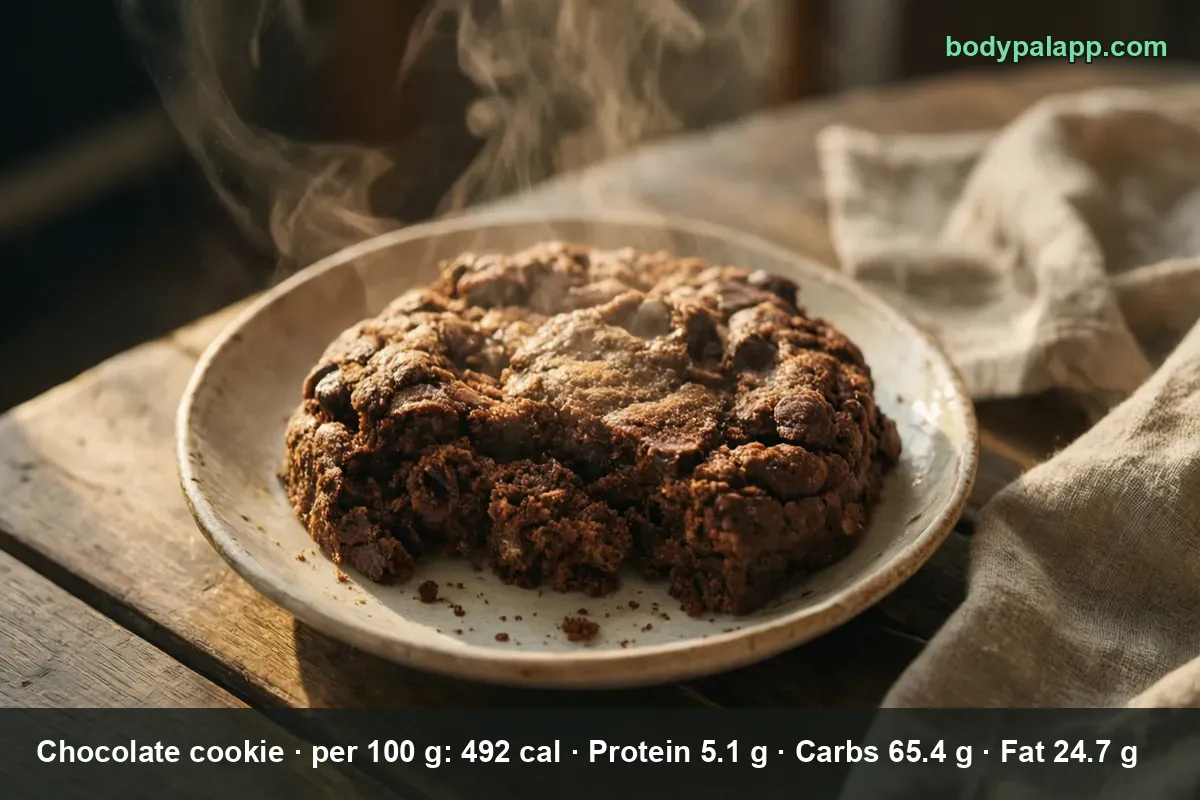
One large chocolate cookie weighs 45 g and carries 221 calories. Per 100 g the same cookie runs 492 calories, which puts it among the densest things in a lunchbox. A medium one is 148, a small 98. The chocolate is not what makes it heavy. The size is.
On this page
- Chocolate cookie quick facts
- US servings from one bite to a full cup
- Sandwich cookies coated cookies and the reduced-fat option
- Saturated fat is the row to watch
- How does a chocolate cookie compare?
- Most popular chocolate cookie brands
- Chocolate cookie FAQs
Chocolate cookie quick facts
The record behind every number here is FNDDS 2707909, "Cookie, chocolate chip". That is the plain chocolate chip cookie most people mean when they type the search: baked, commercially made or bakery style, chips through the dough rather than a coating on top. It is also the only chocolate cookie record that carries a full set of household portions, from a 20 g small one up to a cup of bite-size pieces, so the serving math below comes straight from USDA rather than from guesswork.
The SR Legacy version of the same cookie lands at 492 calories per 100 g too, so choosing between the two records does not move the answer by a single calorie.
| Nutrient | Per 100 g | Per 1 large cookie (45 g) | % Daily Value |
|---|---|---|---|
| Calories | 492 | 221 | — |
| Total fat | 24.72 g | 11.1 g | 14% |
| Saturated fat | 8.09 g | 3.6 g | 18% |
| Carbohydrate | 65.36 g | 29.4 g | 11% |
| Dietary fiber | 2 g | 0.9 g | 3% |
| Total sugars | 32.9 g | 14.8 g | — |
| Protein | 5.1 g | 2.3 g | 5% |
| Sodium | 311 mg | 140 mg | 6% |
% Daily Value is based on a 2,000-calorie diet.
Verified nutrition data
Numbers on this page come from USDA FoodData Central, the U.S. Department of Agriculture’s food composition database, and from manufacturer labels where a branded product is named. Last verified September 2026. How we verify our data →
Two rows you would expect on a package are missing on purpose. USDA does not publish added sugars or trans fat for this FNDDS code, so neither can be shown honestly and both are left out. Total sugars have no Daily Value at all, which is why that cell stays empty. Cholesterol is the surprise: the record lists 0 mg, because this style of cookie is built on vegetable shortening rather than butter. Potassium comes in at 77 mg per cookie, about 2% of the daily target.
US servings from one bite to a full cup
| Serving | Weight | Calories |
|---|---|---|
| 1 small cookie | 20 g | 98 kcal |
| 1 oz | 28.4 g | 139 kcal |
| 1 medium cookie | 30 g | 148 kcal |
| 1 large cookie | 45 g | 221 kcal |
| 1 cup, bite size | 81 g | 399 kcal |
| Per 100 g | 100 g | 492 kcal |
Small, medium, large and the cup of bite-size pieces are USDA household measures attached to the record itself. The 1 oz line is our own arithmetic from the USDA 100 g figure, not a USDA serving, and it is the one worth memorizing: a single ounce of chocolate cookie is 139 calories, more than an ounce of most cheeses.
The cup is the line that catches people. Bite-size cookies feel like a snack you grab rather than a dessert you sit down with, but 81 g of them is 399 calories, roughly the same as one and four-fifths of the big bakery-style cookie. Two large cookies come to 442 calories, again our own scaling from the USDA number rather than a listed serving. If you are logging by eye, count pieces before you start, not after.
Bakery cookies sold individually often run heavier than the 45 g USDA large. A 70 g cookie from a coffee shop case works out to roughly 344 calories at this record's density, which is our arithmetic rather than a USDA serving, and it explains why a single cookie can quietly cost more than a slice of pizza.
Sandwich cookies coated cookies and the reduced-fat option
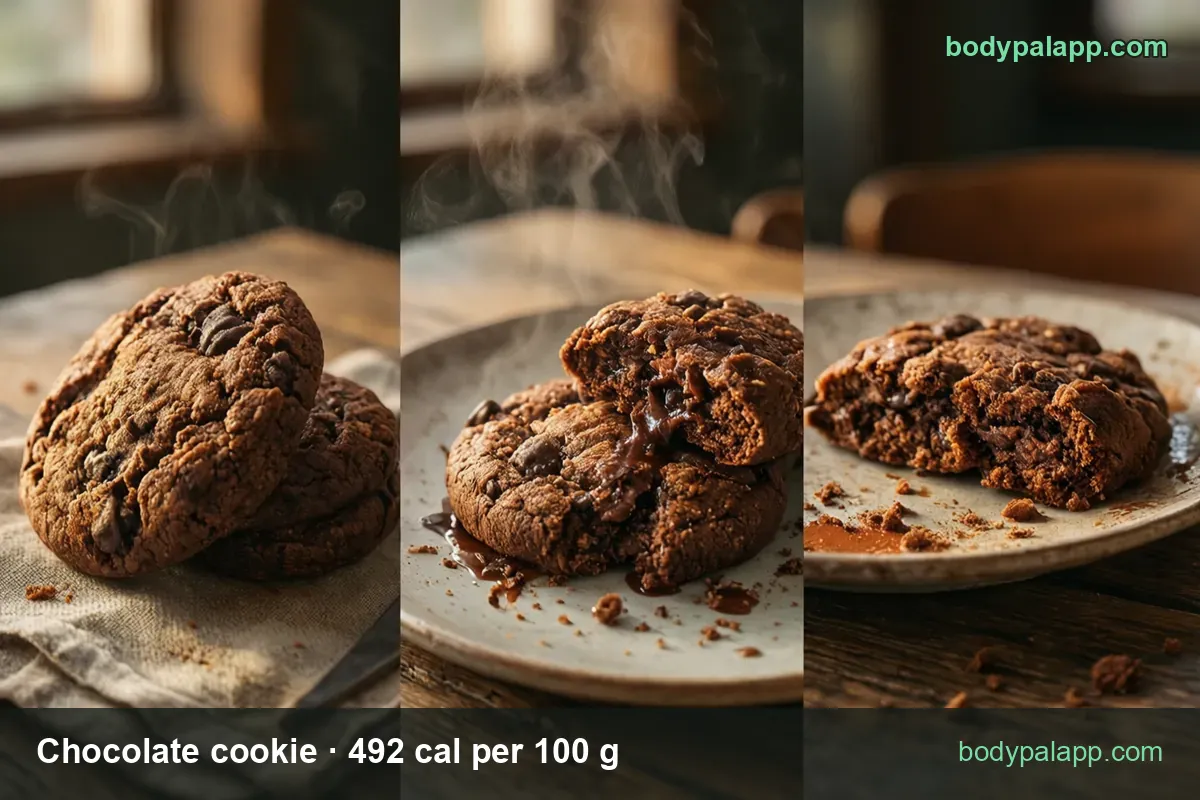
Every version below is a separate USDA record, and the spread between them per 100 g is narrower than most people expect. What changes the total is the piece you actually pick up.
| Version | Per 100 g | Typical piece | Calories |
|---|---|---|---|
| Chocolate chip cookie | 492 kcal | 1 large cookie, 45 g | 221 kcal |
| Chocolate sandwich cookie, Oreo style | 464 kcal | 1 sandwich, 11 g | 51 kcal |
| Chocolate cookie with icing or coating | 507 kcal | 1 medium, 42 g | 213 kcal |
| Reduced-fat chocolate chip cookie | 451 kcal | 1 medium, 30 g | 135 kcal |
| Chocolate-coated peanut butter cookie | 562 kcal | 1 medium, 42 g | 236 kcal |
| Cookie-filled chocolate candy | 510 kcal | 1 piece, 8 g | 41 kcal |
The sandwich cookie is the cheapest way into a chocolate cookie habit, and not because it is a light food. At 464 calories per 100 g it is barely below the chip cookie. It just weighs 11 g. Three of them come to 153 calories by our arithmetic, still under one large chip cookie.
Reduced fat is the one label that pays off, but modestly. Dropping the fat from 24.72 g to 17.91 g per 100 g takes the density from 492 to 451, an 8% cut, while sodium climbs from 311 mg to 418 mg per 100 g. You save about 13 calories on a medium cookie and take on more salt. That is a fair trade for some people and a pointless one for others.
Coated cookies look like the indulgent choice and, per 100 g, they are the densest of the plain cookie records at 507. The chocolate-coated peanut butter version goes further at 562. Cookie-filled chocolate candy sits at 510 per 100 g but arrives in 8 g pieces, so one costs 41 calories.
Store brands land in the same band. Among USDA's branded records, Pepperidge Farm Milano Double Dark Chocolate is 500 calories per 100 g with a 28 g serving at 140, Milano Milk Chocolate is 515 per 100 g with a 33 g serving at 170, and Hershey's Milk Chocolate Cookie Bites are 500 per 100 g with a 30 g serving of 26 pieces at 150. Cadbury Milk Chocolate Cookie Fingers are the densest of the group at 516 per 100 g, though the 31 g serving of six fingers comes to 160.
Saturated fat is the row to watch
One large cookie delivers 3.6 g of saturated fat, which is 18% of the FDA Daily Value of 20 g. The same cookie is only 11% of the carbohydrate Daily Value. That inversion is the useful fact on this page: if you are steering by one number, the limiting nutrient in a chocolate cookie is the fat, not the sugar or the starch.
It matters more at volume. A cup of bite-size cookies carries about 6.6 g of saturated fat by our scaling of the USDA figure, roughly 33% of the day's value, alongside 52.9 g of carbohydrate. The Dietary Guidelines for Americans suggest keeping saturated fat under 10% of daily calories, which is about 22 g on a 2,000-calorie day. One casual handful of bite-size cookies uses close to a third of that.
The bakery-style record made with butter instead of shortening makes the point sharply. It is 505 calories per 100 g, only 13 more than the standard cookie, but its saturated fat is 12.01 g per 100 g against 8.09 g. Nearly the same calories, half again the saturated fat. If you want a cookie inside a balanced day, MyPlate treats it as the small discretionary slice of the plate rather than a snack you repeat.
Fiber and protein are not why anyone eats this. A large cookie gives 0.9 g of fiber and 2.3 g of protein, 3% and 5% of the Daily Values. It will not hold you, which is worth knowing before you plan a 3 p.m. cookie as an appetite fix.
How does a chocolate cookie compare?
| Cookie | Per 100 g | US serving | Calories |
|---|---|---|---|
| Chocolate chip cookie | 492 kcal | one large, 45 g | 221 kcal |
| Chocolate sandwich cookie | 464 kcal | one sandwich, 11 g | 51 kcal |
| Chocolate cookie with icing or coating | 507 kcal | one medium, 42 g | 213 kcal |
| Reduced-fat chocolate chip cookie | 451 kcal | one medium, 30 g | 135 kcal |
Our take: pick by piece size, not by name. Of these four records only the icing-coated cookie is denser per 100 g than the standard chip cookie, and the gap across the whole group is 56 calories per 100 g, small enough that swapping styles barely moves the day. What moves it is that one large chip cookie is 4.3 times the calories of one sandwich cookie. If you are cutting calories, the sandwich cookie or a medium reduced-fat cookie gets you the same ritual for 51 to 135. If you want to be genuinely full, none of them will do it, and 221 calories of yogurt and fruit will.
Most popular chocolate cookie brands in the United States
Ranked by how widely each product appears among foods sold in the United States, from the BodyPal food database of over 3.3 million products. Calories are the figures printed on each Nutrition Facts label, checked against USDA FoodData Central.
| Product | Calories (per 100 g) |
|---|---|
| Pepperidge Farm Milano Double Dark Chocolate | 500 cal |
| Cadbury Milk Chocolate Cookie Fingers | 516 cal |
| Pepperidge Farm Milano Milk Chocolate | 515 cal |
| Pepperidge Farm Milano Double Milk Chocolate | 464 cal |
| Pepperidge Farm Captiva Dark Chocolate | 419 cal |
| Hershey's Milk Chocolate Cookie Bites | 500 cal |
Brand popularity: BodyPal food database. Nutrition: manufacturer labels / USDA FoodData Central.
Chocolate cookie FAQs
How many calories are in one chocolate cookie?
221 calories for a large 45 g chocolate chip cookie, at 492 calories per 100 g. A medium 30 g cookie is 148 calories and a small 20 g one is 98. All three come from the same USDA record, so the only thing separating them is weight. Weigh once and you will recognize your usual size afterward.
How many calories in a large bakery chocolate cookie?
221 calories at the USDA large size of 45 g, but bakery cookies are often bigger than that. A 70 g cookie from a coffee shop case works out to about 344 calories, which is our own arithmetic from the USDA 100 g figure rather than a listed serving. Weight drives it, not the number of chips.
How many calories in 2 chocolate cookies?
442 calories for two large 45 g cookies, our own scaling of the USDA 221-calorie figure. Two medium cookies come to 296 and two small ones to 196. Two large cookies also bring 7.2 g of saturated fat, which is 36% of the Daily Value, so the pair costs more on that row than on carbohydrate.
How much sugar is in a chocolate cookie?
14.8 g of total sugars in a large 45 g cookie, from 32.9 g per 100 g. That is nearly four teaspoons. Total sugars have no Daily Value on the US label, so no percentage can be given, and USDA does not publish added sugars for this FNDDS record, which is why that row is absent from the table above.
How many carbs are in a chocolate cookie?
29.4 g of carbohydrate in a large 45 g cookie, which is 11% of the Daily Value, with 0.9 g of that as fiber. Per 100 g the figure is 65.36 g. A cup of bite-size cookies, 81 g, carries about 52.9 g of carbohydrate by our scaling of the same USDA number.
Are reduced-fat chocolate cookies actually lower in calories?
451 calories per 100 g against 492 for the standard cookie, so yes, but only by 8%. A medium 30 g reduced-fat cookie is 135 calories versus 148 for the regular one. Sodium goes the other way, rising from 311 mg to 418 mg per 100 g, so the saving is real but small and comes with more salt.
Do homemade chocolate cookies have more calories than store-bought?
505 calories per 100 g for the USDA home recipe or bakery record, against 492 for the commercial one. That is a 3% difference in calories. The real gap is saturated fat: 12.01 g per 100 g versus 8.09 g, because butter replaces shortening. Same calories, noticeably different fat profile.
How many calories in a Pepperidge Farm Milano cookie?
140 calories in the 28 g label serving of Milano Double Dark Chocolate, which is 500 calories per 100 g. Milano Milk Chocolate is 170 per its 33 g serving and Double Milk Chocolate is 130 per 28 g. Check the pack, since a Milano serving is usually two or three cookies rather than one.
Similar foods
- Chocolate Chip Cookie — 148 cal per medium cookie
- Cookie — 148 cal per medium cookie
- Sugar Cookie — 112 cal per cookie
- Pie Crust — 121 cal per piece of 9-inch crust
- Cake Donut With Icing — 194 cal per medium doughnut
- Chocolate glazed donut — 303 cal per donut
Count it without the math
Point the camera at the plate and BodyPal counts the cookies for you, chips and all.


How long does it take to burn off 221 kcal of chocolate cookie?
One large cookie (45 g) is 221 kcal. Enter your weight and the amount you ate to see how long it takes you to burn that off:
lb
| Activity | Time to burn 221 kcal |
|---|---|
| Walking, brisk | 44 min |
| Cycling, moderate | 28 min |
| Swimming, moderate | 32 min |
| Jogging | 26 min |
| Weight training, moderate | 49 min |
Times are for a 155 lb adult at a steady pace; change the weight to see yours. The amount is set to the portion in the text (45 g); change it to what you actually ate. BodyPal works this out from your steps automatically.
Burning it off is one side of it. The other is knowing your number: work out how many calories you need a day, with macros and a goal date.