Chocolate ice cream calories come to 143 for a 1/2 cup (66 g) serving and 216 per 100 g. What matters most is the scoop size. One 120 g scoop already reaches 259 calories, and fat supplies 44% of the energy while sugar accounts for most of the carbs.
143kcal
1 half cup · 66 g, regular, ready-to-eat
7%protein
2.5 gProtein
19 gCarbs
7.3 gFat
How to burn off 143 kcal
—Walking, brisk
—Jogging
—Cycling, moderate
—Swimming
Skip the math. BodyPal counts these calories from your steps and workouts automatically.
Nutrition facts
Regular, ready-to-eat · per 66 g
Calories
143 kcal
Protein
2.5 g
Carbohydrate
18.6 g
Fat
7.3 g
Saturated fat
4.5 g
Cholesterol
22 mg
Sodium
50 mg
Potassium
164 mg
Iron
0.6 mg
Source: USDA FoodData Central
🛡️
Verified nutrition data
Numbers on this page come from USDA FoodData Central, the U.S. Department of Agriculture’s food composition database, and from manufacturer labels where a branded product is named. Last verified September 2026. How we verify our data →
Chocolate ice cream: calories, protein and sodium by serving
Percent of daily value uses the FDA reference of 2,000 kcal a day.
Serving
kcal
Protein
Carbs
Fat
Sodium
% DV kcal
1/2 cup (66 g)
143
2.5 g
18.6 g
7.3 g
50 mg
7%
1 scoop (120 g)
259
4.6 g
33.8 g
13.2 g
91 mg
13%
1 cup (135 g)
292
5.1 g
38.1 g
14.9 g
103 mg
15%
100 g
216
3.8 g
28.2 g
11 g
76 mg
11%
3 × 1/2 cup (66 g)
428
7.5 g
150 mg
5 × 1/2 cup (66 g)
713
12.5 g
251 mg
A scoop is nearly double the half-cup label
The nutrition label uses 1/2 cup (66 g), which gives 143 calories, or 7% of the daily value. Most people don't serve that. A typical 1 scoop (120 g) serving comes to 259 calories, 13% of the daily value, and a full 1 cup (135 g) bowl comes to 292, or 15%. The flavor is the same, but the number roughly doubles depending on the spoon.
Bowls get refilled, so the totals keep climbing. Two half-cup servings (132 g) come to 285 calories. Three (198 g) come to 428. Five half cups, 330 g, which is about what a person eats when finishing a container on the couch, come to 713 calories with 251 mg of sodium and just 12.5 g of protein.
If you track your intake, weigh it once. Put the bowl on a kitchen scale, scoop the way you normally do, and note the grams. Most people find their usual scoop is closer to 120 g than 66 g, and knowing that one figure makes every later log more accurate.
Sugar and fat split almost all the calories
Carbs supply 50% of the calories in chocolate ice cream, fat supplies 44%, and protein only 7%. Per 100 g that works out to 28.2 g of carbs, 11 g of fat and 3.8 g of protein. Most of the carbs are sugar: 25.4 g of the 28.2 g.
In a 1/2 cup serving that means 16.7 g of sugar and 7.3 g of fat, with 2.5 g of protein, or 5% of the daily value. A 120 g scoop raises the sugar to 30.4 g and the fat to 13.2 g. The cocoa adds a little fiber, 0.8 g per half cup and 1.2 g per 100 g, which is more than plain dairy desserts usually carry but not enough to change how full you feel.
The takeaway is simple. This is a dessert built on cream and sugar, and its protein is too low to count as a protein source. Treat it as the treat it is and keep track of the scoop, rather than looking for a nutritional reason to justify it.
Saturated fat is the row to watch
Of the 11 g of fat per 100 g, 6.8 g is saturated. The daily value for saturated fat is 20 g, so 100 g of chocolate ice cream uses about a third of it. A generous 1 cup (135 g) bowl uses even more, and if you also eat cheese, butter or fatty meat that day, this row fills up faster than the calorie total does.
Cholesterol is moderate at 34 mg per 100 g, against a daily value of 300 mg. Sodium is not a concern. A 1/2 cup has 50 mg, 2% of the daily value, and even a scoop has only 91 mg, or 4%. Potassium comes in at 249 mg per 100 g, a small amount from the milk and cocoa.
If you watch saturated fat, portion size is the only real lever. Brands vary with recipe, and premium pints like Baskin Robbins Chocolate Ice Cream tend to be richer than store-brand cartons such as Heinen's Neapolitan, so check the label of the one in your freezer.
One measured scoop fits easily into a planned day
At 143 calories, a measured half cup is about as costly as a small snack. It fits most eating days if you plan it instead of grazing on it. Serving it in a small bowl instead of eating from the carton is the easiest way to keep the portion close to the label.
Pair it with fruit to make the bowl look bigger without much added fat. Berries or sliced banana work well. Skip heavy toppings like fudge sauce, cookie pieces and whipped cream, because each one adds sugar and saturated fat to a dessert that already carries plenty of both.
Timing matters less than the total. If dessert is part of your evening, lighter earlier meals leave room for a full scoop of 259 calories. If you log meals, BodyPal can log chocolate ice cream from a photo of the bowl, which makes it easier to see when a half cup has quietly become a cup.
How does chocolate ice cream compare?
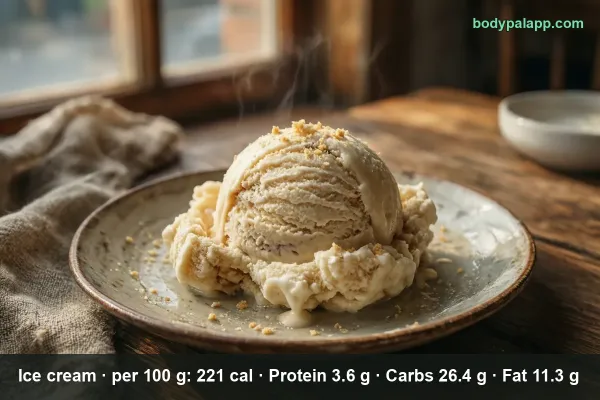
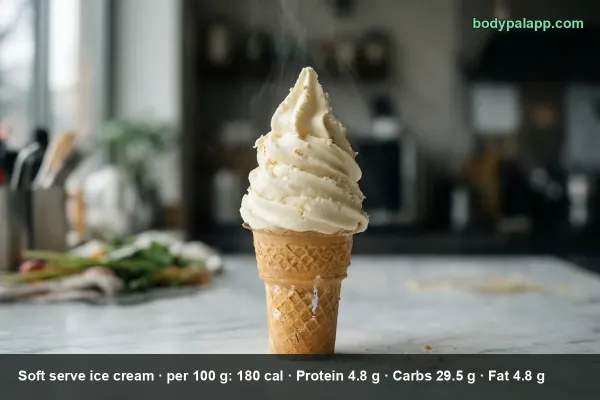
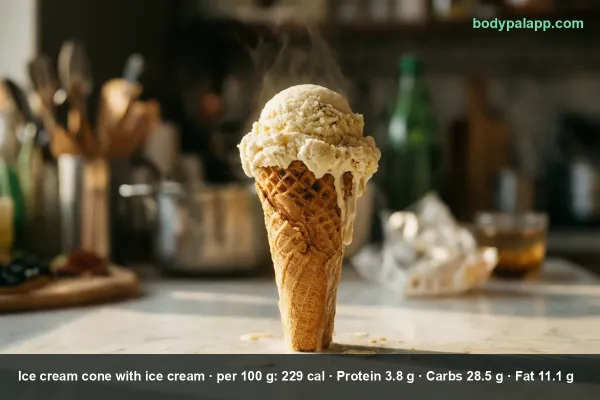
Here is chocolate ice cream next to plain ice cream, soft serve and a filled cone, compared per 100 g and per usual serving.
Verdict: For the fewest calories pick soft serve, at 180 per 100 g with 4.8 g of fat against 11 g here. Chocolate and plain ice cream are a near tie at 216 and 221, so choose the flavor you actually want and control the scoop instead.
Most popular chocolate ice cream brands in the United States
Ranked by popularity in the BodyPal database
# Productkcal / 100 g
1Baskin Robbins Chocolate Ice Cream1/2 cup · 88 g239 kcal
2Heinen's Neapolitan Strawberry-Vanilla-Chocolate Ice Cream2/3 cup · 91 g187 kcal
How many calories are in a scoop of chocolate ice cream?
A 120 g scoop has 259 calories. A half cup (66 g) has 143 calories.
Is chocolate ice cream good for weight loss?
It has 216 calories per 100 g, with 11 g of fat and 25.4 g of sugar. A half cup comes to 143 calories.
Chocolate ice cream vs regular ice cream: which has more calories?
They are close: chocolate ice cream has 216 calories per 100 g and regular ice cream 221.
How much sugar is in chocolate ice cream?
A half cup (66 g) has 16.7 g of sugar out of 18.6 g of carbs. Per 100 g that is 25.4 g of sugar.
How many calories are in a cup of chocolate ice cream?
A 1 cup (135 g) serving of chocolate ice cream has 292 calories, which is 15% of the daily value. It also has 34.2 g of sugar and 14.9 g of fat, about double the half-cup label serving.
How much fat is in a half cup of chocolate ice cream?
A 1/2 cup (66 g) serving has 7.3 g of fat. Fat supplies 44% of the calories in chocolate ice cream, and 6.8 g of every 11 g of fat per 100 g is saturated.
Does chocolate ice cream have much protein?
Not really. A 1/2 cup has 2.5 g of protein, 5% of the daily value, and 100 g has 3.8 g. Protein supplies only 7% of the calories, so it does little to keep you full.
Is chocolate ice cream high in sodium?
No. A 1/2 cup has 50 mg of sodium, just 2% of the daily value, and 100 g has 76 mg. Even a full 120 g scoop stays at 91 mg, or 4%.
Does chocolate ice cream contain fiber?
A little, from the cocoa. A 1/2 cup has 0.8 g of fiber and 100 g has 1.2 g, against a daily value of 28 g. That is too little to count as a meaningful fiber source.