
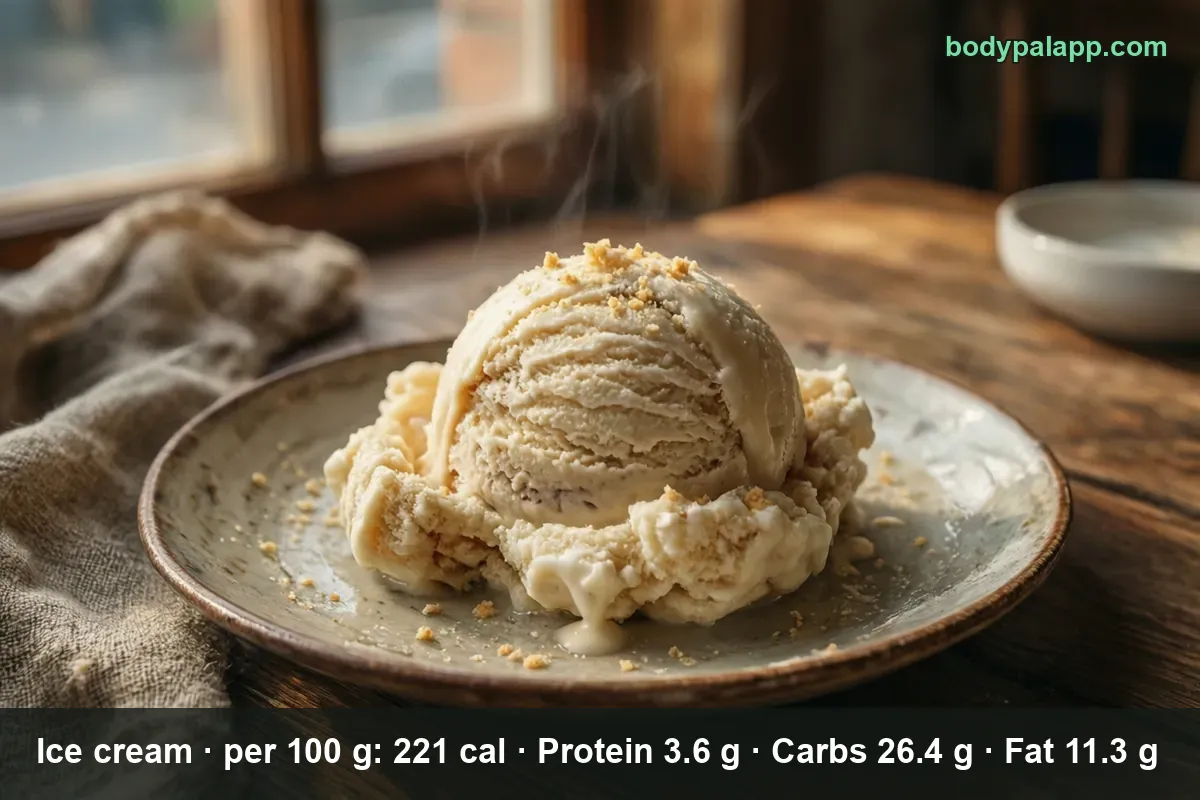
How many calories are in a scoop of ice cream?
One rounded scoop of ice cream, 120 g out of the tub, is 265 calories. Per 100 g the generic USDA record runs 221 calories. A cup pushes it to 298, and the two-scoop cup at the counter lands at 530. Same dessert, three very different numbers.
On this page
- Ice cream quick facts
- US servings, from a single-serve cup to a two-scoop bowl
- Vanilla, chocolate, soft serve and light
- Saturated fat is the row that moves first
- How does ice cream compare?
- Most popular ice cream brands
- FAQ
Ice cream quick facts
The row on this page is FNDDS 2705629, "Ice cream, NFS" — the generic entry for scooped ice cream out of a tub, with no flavor specified. That is what most people are holding when they look this up: a scoop in a bowl or on a cone, from a half-gallon in the freezer or a shop case. Flavor-specific records exist, from 207 calories per 100 g for plain vanilla up to 249 for the rich version, and they are further down the page.
Everything below is per 100 g and per one 120 g scoop, the household portion USDA lists for this record.
| Nutrient | Per 100 g | Per 1 scoop (120 g) | % Daily Value |
|---|---|---|---|
| Calories | 221 | 265 | — |
| Total fat | 11.3 g | 13.6 g | 17% |
| Saturated fat | 6.86 g | 8.2 g | 41% |
| Carbohydrate | 26.36 g | 31.6 g | 12% |
| Dietary fiber | 0.8 g | 1.0 g | 3% |
| Total sugars | 22.86 g | 27.4 g | — |
| Protein | 3.57 g | 4.3 g | 9% |
| Sodium | 90 mg | 108 mg | 5% |
| Cholesterol | 42 mg | 50 mg | 17% |
| Potassium | 203 mg | 244 mg | 5% |
% Daily Value is based on a 2,000-calorie diet.
Verified nutrition data
Numbers on this page come from USDA FoodData Central, the U.S. Department of Agriculture’s food composition database, and from manufacturer labels where a branded product is named. Last verified September 2026. How we verify our data →
Two rows you will see on a carton are missing here: added sugars and trans fat. USDA does not publish either value for this generic record, so nothing is guessed in their place. Total sugars have no Daily Value on the FDA label, which is why that cell is a dash — the 27.4 g in a scoop mixes lactose from the milk and cream with the sugar stirred in before freezing, and USDA does not split them for this entry.
US servings, from a single-serve cup to a two-scoop bowl
| Serving | Weight | Calories |
|---|---|---|
| 1 oz | 28.4 g | 63 kcal |
| One single-serve container | 75 g | 166 kcal |
| One scoop | 120 g | 265 kcal |
| 1 cup | 135 g | 298 kcal |
| Medium shop cup, two scoops | 240 g | 530 kcal |
| Per 100 g | 100 g | 221 kcal |
The scoop, the cup, the two-scoop cup and the single-serve container are USDA household measures for this record. The 1 oz line is our own arithmetic from the USDA 100 g figure, not a USDA serving — useful when you are logging a spoonful off someone else's plate.
Here is the trap. A scoop and a cup feel like the same thing, and people log them interchangeably. They are 15 g apart, which is 33 calories, every time. Fill a cereal bowl to the cup line twice a week for a year and that gap alone is a few thousand calories you never counted. The bigger jump is the shop cup: two scoops is 240 g, double the single scoop, but it does not look double in a wide paper cup — it looks like one dessert. At 530 calories it is the size of a light meal.
Vanilla, chocolate, soft serve and light
| Version | Per 100 g | Typical scoop | Calories |
|---|---|---|---|
| Vanilla | 207 kcal | 120 g | 248 kcal |
| Chocolate | 216 kcal | 120 g | 259 kcal |
| Vanilla with mix-ins | 242 kcal | 125 g | 303 kcal |
| Soft serve vanilla | 180 kcal | 120 g | 216 kcal |
| Light ice cream | 174 kcal | 120 g | 209 kcal |
| Fat-free vanilla | 138 kcal | 120 g | 166 kcal |
The scoop figures for soft serve, light and fat-free are our own arithmetic from each record's 100 g value, since USDA does not list a scoop for them.
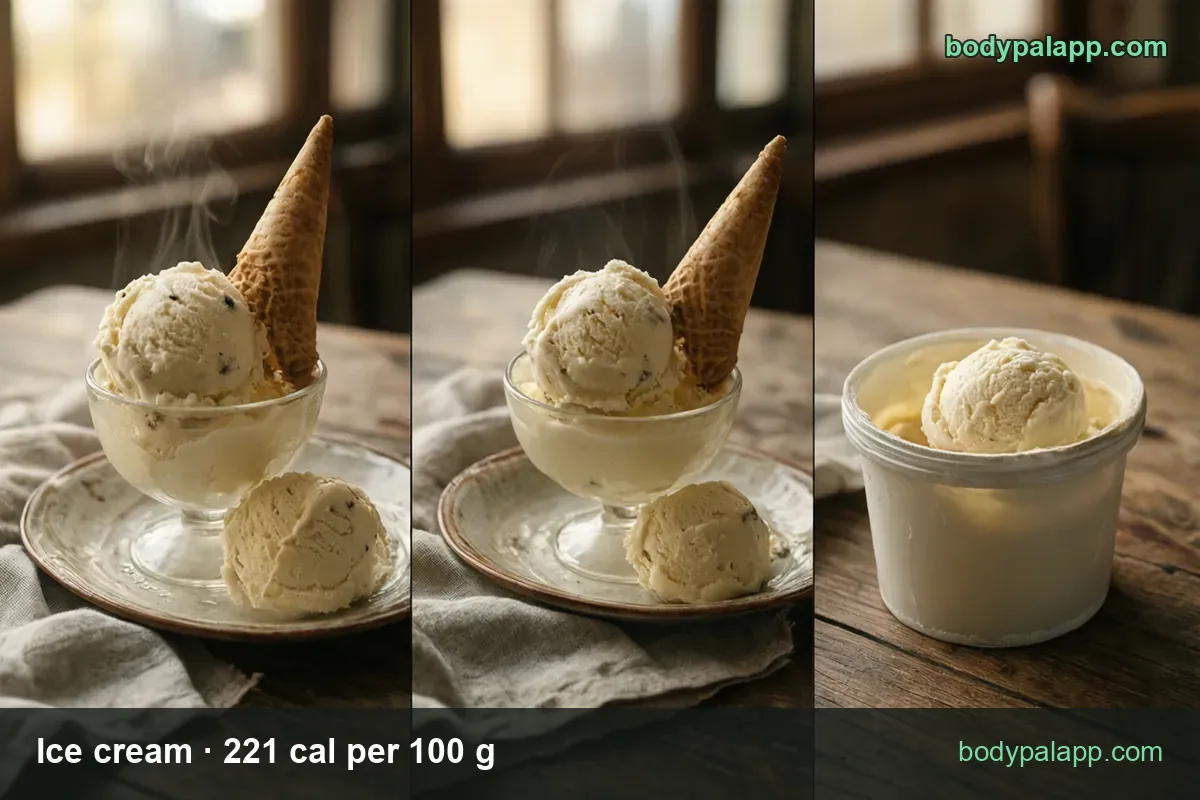
Plain vanilla is the lightest of the full-fat flavors at 207 calories per 100 g, and chocolate is barely above it at 216 — the cocoa brings more sugar, 25.36 g against 21.22 g per 100 g, plus a little fiber, 1.2 g against 0.7 g. Nobody ever gained weight over the 11-calorie gap between a scoop of one and a scoop of the other.
What actually moves the number is what is suspended in the ice cream. The record for vanilla with additional ingredients — cookie pieces, ribbons of sauce, candy — is 242 calories per 100 g, and it usually scoops heavier too. A 125 g scoop of it is 303 calories, 44 more than a 120 g scoop of plain chocolate and 137 more than the same scoop of fat-free vanilla. Premium, high-butterfat tubs are heavier again; the SR Legacy record for rich vanilla is 249 calories per 100 g with 16.2 g of fat, so a 120 g scoop would be about 299 calories by our own scaling.
Soft serve and light pull in different directions, and this is the part most people get backwards. Soft serve vanilla is 180 calories per 100 g because the machine whips in air and the mix is milkier: fat drops to 4.83 g per 100 g. Its sugar barely moves, 22.12 g against 22.86 g. Light ice cream, at 174, gets there the other way — sugars fall to 14.29 g and fat to 6.14 g. So if you are watching sugar, light is the better pick; if you are watching saturated fat, soft serve does more for you. Only fat-free vanilla, at 138 calories per 100 g, is lighter than either, and it pays for it with 30.06 g of carbohydrate per 100 g and no fat at all to slow it down.
Store tubs tell the same story with different names. US branded records run roughly 209 to 265 calories per 100 g, from a cake-flavored supermarket tub near the bottom to small-batch cartons at the top — the ingredient list matters less than the butterfat. Watch their label serving, though: these cartons are declared at half a cup, somewhere between 67 g and 102 g depending on how dense the ice cream is. That is smaller than a real scoop, and there are three to four of them in a small carton.
Saturated fat is the row that moves first
Calories are not the interesting number on this label. Saturated fat is.
One 120 g scoop delivers 8.2 g of saturated fat, which is 41% of the 20 g Daily Value, while its 265 calories are only about 13% of a 2,000-calorie day. That ratio is unusual — most desserts spend calories faster than they spend saturated fat, and ice cream does the opposite. The two-scoop shop cup takes it to 16.5 g, or 82% of the day, before dinner has been counted. The Dietary Guidelines for Americans put the ceiling at 10% of calories from saturated fat, which is where that 20 g figure comes from.
Cholesterol behaves the same way: 50 mg in a scoop, 17% of the Daily Value, from a food that is mostly sugar and air. Sodium is a non-event at 108 mg, about 5% of the day.
Protein is the row that disappoints. A scoop gives 4.3 g, 9% of the Daily Value — real, but thin for 265 calories. Soft serve is the best of the bunch at 4.78 g per 100 g because it carries more milk and less cream. Ice cream does count in the dairy group on MyPlate, but a cup of plain yogurt gets you the same protein for a fraction of the calories, which is exactly why the guidelines treat it as a treat rather than a dairy serving to rely on.
How does ice cream compare?
| Ice cream | Per 100 g | US serving | Calories |
|---|---|---|---|
| Ice cream, NFS | 221 kcal | one scoop, 120 g | 265 kcal |
| Vanilla | 207 kcal | one scoop, 120 g | 248 kcal |
| Chocolate | 216 kcal | one scoop, 120 g | 259 kcal |
| Light ice cream | 174 kcal | one scoop, 120 g | 209 kcal |
Our take: the flavor argument is a rounding error and the portion argument is the whole game. Vanilla to chocolate is 11 calories a scoop — not worth a decision. Regular to light is 56 calories a scoop, and switching the shop cup back to a single scoop at home is 265. If you are cutting calories, buy light and serve it in a small bowl rather than a cup. If you want the real thing and want to stay full, one scoop of the full-fat version does more for satisfaction than two scoops of fat-free, which is 332 calories for 60.12 g of carbohydrate and nothing to slow it down.
Most popular ice cream brands in the United States
Ranked by how widely each product appears among foods sold in the United States, from the BodyPal food database of over 3.3 million products. Calories are the figures printed on each Nutrition Facts label, checked against USDA FoodData Central.
| Product | Calories (per 100 g) |
|---|---|
| Phin & Phebe's Mucho Vanilla | 239 cal |
| Blue Bunny Cake & Frosting | 209 cal |
| Jeni's Splendid Ice Creams | 250 cal |
| Jeni's The Buckeye State | 265 cal |
| Dr. Bob's Handcrafted Ice Creams | 250 cal |
Brand popularity: BodyPal food database. Nutrition: manufacturer labels / USDA FoodData Central.
Ice cream FAQs
How many calories are in one scoop of ice cream?
A 120 g scoop of regular ice cream has 265 calories, based on the USDA figure of 221 calories per 100 g. That is one rounded scoop from a tub, not a shop portion. Two scoops in a medium cup weigh about 240 g and reach 530 calories.
How many calories are in a cup of ice cream?
One cup of ice cream weighs 135 g and carries 298 calories, along with 30.9 g of sugars and 9.3 g of saturated fat. A cup holds 15 g more than a rounded scoop, so a bowl filled to the cup line costs 33 calories more than you may be counting.
Is vanilla or chocolate ice cream higher in calories?
Chocolate, by a small margin: 216 calories per 100 g against 207 for vanilla, or 259 versus 248 calories in a 120 g scoop. Chocolate carries more sugar, 25.36 g per 100 g against 21.22 g, and a little more fiber from the cocoa, 1.2 g against 0.7 g.
How much sugar is in ice cream?
A 120 g scoop has 27.4 g of total sugars, from 22.86 g per 100 g. That figure mixes the sugar added before freezing with the lactose already in the milk and cream. USDA does not publish an added sugars value for this generic record, so the split is not shown here.
Is light ice cream actually lower in calories?
Yes: 174 calories per 100 g against 221, so a 120 g scoop is 209 calories instead of 265, our own arithmetic from the USDA 100 g figure. The saving is mostly sugar, 14.29 g against 22.86 g, plus 6.14 g of fat rather than 11.3 g.
How many calories in soft serve ice cream?
Soft serve vanilla runs 180 calories per 100 g, so a 120 g serving is 216 calories by our own scaling of the USDA figure. The machine whips in more air and the mix is milkier, which cuts fat to 4.83 g per 100 g while sugars stay high at 22.12 g.
Does ice cream have protein?
A little: 3.57 g per 100 g, or 4.3 g in a 120 g scoop, which is 9% of the Daily Value. Soft serve is the strongest of these records at 4.78 g per 100 g. Ice cream counts toward the dairy group, but milk and yogurt carry protein at a far lower calorie cost.
How much saturated fat is in a scoop of ice cream?
One 120 g scoop has 8.2 g of saturated fat, 41% of the 20 g Daily Value, while its 265 calories are only about 13% of a 2,000-calorie day. Two scoops take you to 16.5 g, or 82% of the day's limit, before anything else is eaten.
Similar foods
- French Fries — 185 cal per 3 oz
- Peach Pie — 262 cal per slice
- Chocolate Mousse — 455 cal per half cup
- Peach Cobbler — 271 cal per serving
- Ice Cream Cone — 286 cal per cone
- Fruit Pizza — 220 cal per piece
Count it without the math
Point the camera at the bowl and BodyPal counts the scoop for you, mix-ins and all.


How long does it take to burn off ice cream?
One scoop (120 g) is 265 kcal. Enter your weight and the amount you ate to see how long it takes you to burn that off:
lb
| Activity | Time to burn 265 kcal |
|---|---|
| Walking, brisk | 53 min |
| Cycling, moderate | 33 min |
| Swimming, moderate | 38 min |
| Jogging | 31 min |
| Weight training, moderate | 59 min |
Times are for a 155 lb adult at a steady pace; change the weight to see yours. The amount is set to the portion in the text (120 g); change it to what you actually ate. BodyPal works this out from your steps automatically.
One food is easy to picture; a whole day is harder. See how many calories you need a day and what a deficit actually looks like.