Chocolate malt calories come to 350 for a 10 fl oz (280 g) malt and 125 per 100 g. The number to notice is the balance: fat and carbs each supply 44% of the calories, and most of those carbs are sugar, with 33.7 g in a single malt. Protein is a modest 10.5 g.
350kcal
1 10 fl oz malt · 280 g, malted milkshake
12%protein
10.5 gProtein
38 gCarbs
17.1 gFat
How to burn off 350 kcal
—Walking, brisk
—Jogging
—Cycling, moderate
—Swimming
Skip the math. BodyPal counts these calories from your steps and workouts automatically.
Nutrition facts
Malted milkshake · per 280 g
Calories
350 kcal
Protein
10.5 g
Carbohydrate
38 g
Fat
17.1 g
Saturated fat
10.2 g
Cholesterol
64 mg
Sodium
185 mg
Potassium
532 mg
Iron
0.2 mg
Source: USDA FoodData Central
🛡️
Verified nutrition data
Numbers on this page come from USDA FoodData Central, the U.S. Department of Agriculture’s food composition database, and from manufacturer labels where a branded product is named. Last verified September 2026. How we verify our data →
Chocolate malt: calories, protein and sodium by serving
Percent of daily value uses the FDA reference of 2,000 kcal a day.
Serving
kcal
Protein
Carbs
Fat
Sodium
% DV kcal
10 fl oz (280 g)
350
10.5 g
38.2 g
17.1 g
185 mg
18%
Powder with 1% milk (251 g)
143
8.3 g
22.1 g
2.4 g
151 mg
7%
100 g
125
3.8 g
13.6 g
6.1 g
66 mg
6%
3 × 10 fl oz (280 g)
1,050
31.6 g
554 mg
5 × 10 fl oz (280 g)
1,750
52.6 g
924 mg
One malt is a 350-calorie drink, and refills add up fast
A standard 10 fl oz (280 g) malted milkshake lands at 350 calories, which is 18% of the daily value for energy. That is meal territory for something most people treat as a side to a burger or a late treat. Sip it slowly and it still counts the same.
The total climbs in a straight line. Two malts come to 700 calories with 370 mg of sodium, three reach 1,050, and five hit 1,750 calories with 924 mg of sodium. Diner and fountain cups often run bigger than 10 fl oz, so if your glass looks generous, assume the higher end of these rows rather than the lower one.
The cheapest swap is the base. A home version made from chocolate malt powder with 1% milk (251 g) comes to 143 calories with 2.4 g of fat and 8.3 g of protein. You keep the malty flavor and drop the ice cream, which is where most of the fat in a shop malt lives.
Fat and carbs split the calories almost evenly
The calorie split is 44% fat, 44% carbs and 12% protein. Per 100 g that works out to 6.1 g of fat, 13.6 g of carbs and 3.8 g of protein. In other words, this is a dessert with a dairy base, not a dairy drink with a little sweetener.
Look at the carbs closely. Of the 13.6 g per 100 g, 12 g are sugars, and fiber barely registers at 0.2 g. Across a full 10 fl oz malt that means 38.2 g of carbs, 33.7 g of them sugar, and only 0.6 g of fiber. There is little in the glass to slow down how quickly it goes down.
The fat side leans saturated. Of the 6.1 g of fat per 100 g, 3.7 g is saturated, against a daily value of 20 g. A full malt carries 17.1 g of fat in total. If you track saturated fat, the malt will take a visible bite out of your day.
Sugar is the row to watch, sodium is not
With 33.7 g of sugars in one 10 fl oz malt, sugar is the line that stands out on the label. Nearly all of the carbohydrate is sugar from the milk, the ice cream and the chocolate syrup, so there is no meaningful starch or fiber to balance it.
Sodium, by contrast, stays modest. One malt has 185 mg, or 8% of the daily value, and 100 g has 66 mg. Malted milk powder adds a slightly salty edge to the flavor, but the numbers show it is not a sodium problem unless you drink several. Cholesterol sits at 23 mg per 100 g, which reflects the dairy base.
Potassium is a small plus at 190 mg per 100 g, though it does not change the overall picture. If you watch sugar, the powder with 1% milk version at 19.6 g of sugars is the clearer improvement.
Treat a malt as dessert, not as your protein
A full malt gives 10.5 g of protein, 21% of the daily value. That sounds useful until you set it against 350 calories. Protein is only 12% of the energy here, so a malt will not do the job of a protein shake or a glass of milk.
The practical approach is to count it as the dessert of the meal it comes with. If you order one alongside fries and a burger, skip something else rather than adding it on top. If you want the taste more often, a lighter option like Dairymens Chocolate Malt Lowfat Milk or a homemade glass made with powder and 1% milk keeps the malt flavor at a fraction of the fat.
Pair it with a meal that brings fiber and lean protein, since the malt supplies neither in any real amount. And if you want to keep tabs without measuring cups, BodyPal can log a malt from a photo of the glass.
How does chocolate malt compare?
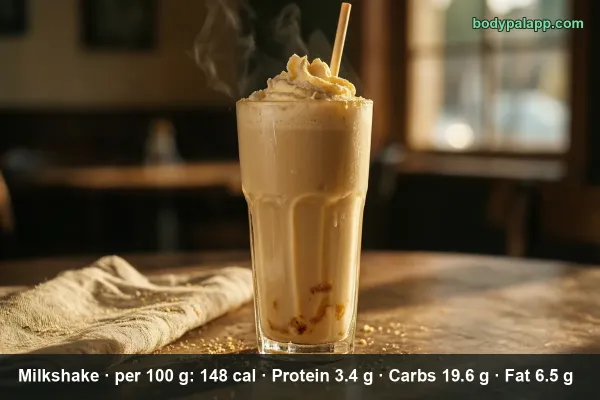
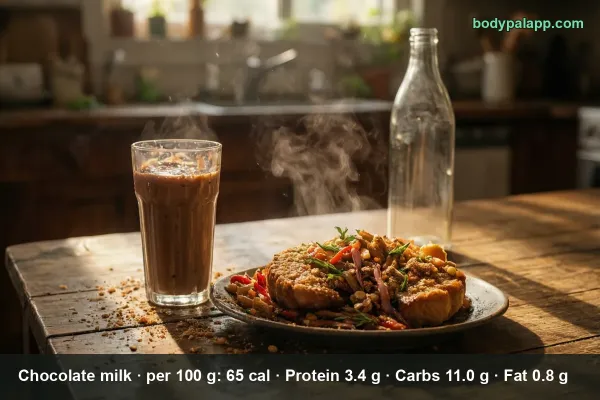
Here is how a chocolate malt stacks up against a milkshake, a chocolate shake and chocolate milk, per 100 g and per usual serving.
Verdict: If you want the lightest chocolate drink, pick chocolate milk at 65 calories per 100 g, about half of the malt's 125. Between the treats, a chocolate shake at 357 per 300 g shake lands about even with a 350-calorie malt, while a plain milkshake runs higher at 148 per 100 g.
Most popular chocolate malt brands in the United States
Ranked by popularity in the BodyPal database
# Productkcal / 100 g
1Dairymens Chocolate Malt Lowfat Milk1 cup · 240 ml88 kcal
The bottled chocolate malt drink is flavored lowfat milk rather than an ice cream malt, so its label number per 100 g is far lower. Source: manufacturer labels / USDA FoodData Central.
Chocolate malt FAQs
How many calories are in a chocolate malt?
A 10 fl oz chocolate malt has about 350 calories, which works out to 125 calories per 100 g.
Is a chocolate malt good for weight loss?
It is a dense drink: 350 calories and 33.7 g of sugars in 10 fl oz, against 143 calories for a cup mixed from chocolate malt powder and 1% milk.
Chocolate malt vs milkshake: which has more calories?
Per 100 g a malt is 125 calories and a plain milkshake 148, so the same size cup of milkshake is a little higher.
How much protein and fat are in a chocolate malt?
A 10 fl oz malt has 10.5 g of protein and 17.1 g of fat, plus 38.2 g of carbs.
How much sugar is in a chocolate malt?
A 10 fl oz (280 g) chocolate malt has 33.7 g of sugars out of 38.2 g of carbs. Per 100 g it is 12 g of sugars, so nearly all of the carbohydrate is sugar.
How many calories are in chocolate malt powder made with 1% milk?
Chocolate malt powder mixed with 1% milk comes to 143 calories for 251 g. It has 8.3 g of protein, 2.4 g of fat and 19.6 g of sugars, far lighter than a 350-calorie shop malt.
How much sodium is in a chocolate malt?
A 10 fl oz chocolate malt has 185 mg of sodium, which is 8% of the daily value. Per 100 g it is 66 mg, so sodium is modest unless you drink several.
How many calories are in two chocolate malts?
Two 10 fl oz malts add up to 700 calories, with 21.1 g of protein and 370 mg of sodium. Three come to 1,050 calories, so a second round doubles the hit quickly.