
How many calories are in a milkshake?
A small fast-food milkshake weighs 405 g and carries 599 calories. Per 100 g the shake runs 148 calories, which sounds mild until you see how big a small actually is. Order a large and you are at 1,021 calories — more than half a day, drunk through a straw.
On this page
- Milkshake quick facts
- US servings, from one ounce to a large
- Chocolate, bottled, homemade and malted
- Saturated fat is the row that bites
- How does a milkshake compare?
- Most popular milkshake brands
- FAQ
Milkshake quick facts
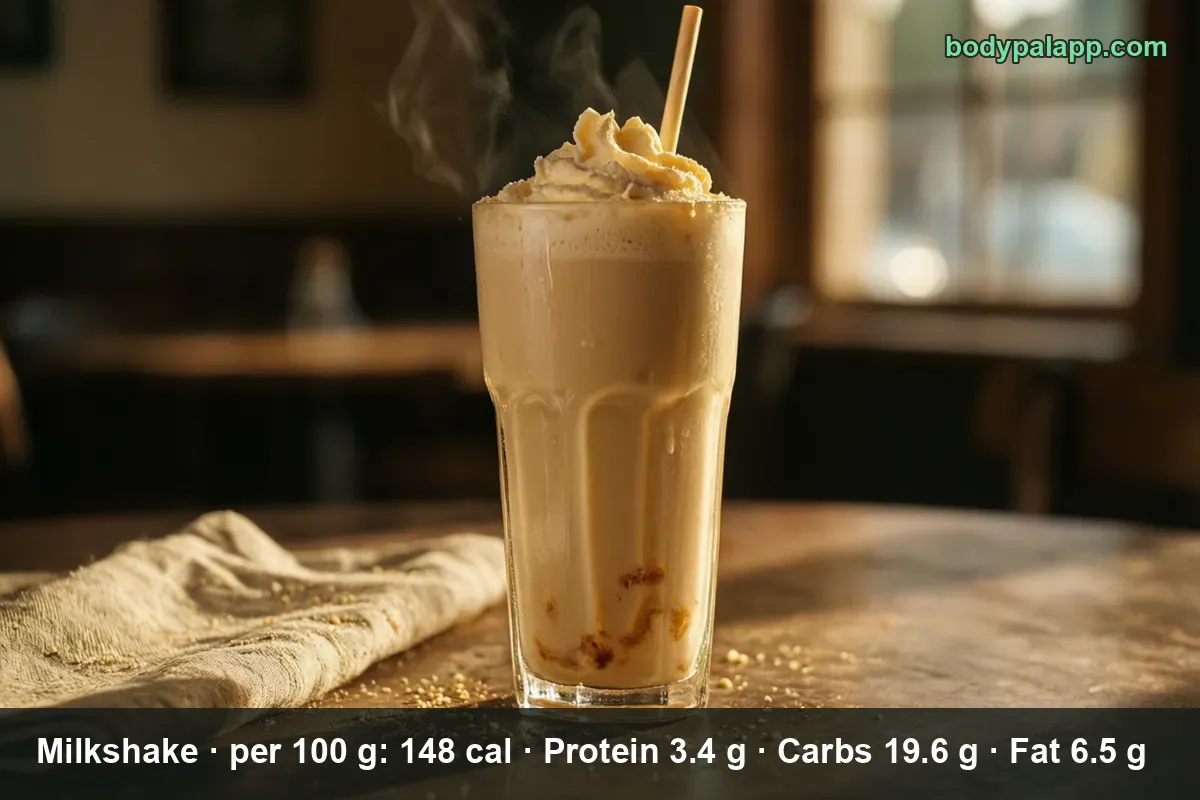
The record that matches what most people are holding is FNDDS 2705509, "Milk shake, fast food, flavors other than chocolate" — the vanilla or fruit shake handed over a counter, whipped cream and all. It is the version in the photo above, and it is the one USDA describes in the three sizes Americans actually order: small, medium and large. A homemade shake and a bottled shake are separate records, and both get their own sections below.
USDA does not publish added sugars or trans fat for this survey food, so those rows are left out rather than guessed. Cholesterol and potassium are included, since a shake is a real contributor to both: a small carries 93 mg of cholesterol (31% DV) and 672 mg of potassium (14% DV).
| Nutrient | Per 100 g | Per 1 small (405 g) | % Daily Value |
|---|---|---|---|
| Calories | 148 | 599 | 30% |
| Total fat | 6.52 g | 26.4 g | 34% |
| Saturated fat | 3.96 g | 16.0 g | 80% |
| Carbohydrate | 19.59 g | 79.3 g | 29% |
| Dietary fiber | 0.9 g | 3.6 g | 13% |
| Total sugars | 13.63 g | 55.2 g | — |
| Protein | 3.37 g | 13.6 g | 27% |
| Sodium | 81 mg | 328 mg | 14% |
% Daily Value is based on a 2,000-calorie diet.
Verified nutrition data
Numbers on this page come from USDA FoodData Central, the U.S. Department of Agriculture’s food composition database, and from manufacturer labels where a branded product is named. Last verified September 2026. How we verify our data →
One row deserves a warning label of its own. Total sugars in a survey food include the lactose that came in with the milk, so the 55.2 g in a small cannot be read against the 50 g Daily Value for added sugars — those are two different measurements, and USDA simply does not split them here. The 328 mg of sodium is about a seventh of a day; if you want it in kitchen terms, that is roughly a seventh of a teaspoon of table salt.
US servings, from one ounce to a large
| Serving | Weight | Calories |
|---|---|---|
| 1 oz | 28.4 g | 42 kcal |
| 1 cup | 224 g | 332 kcal |
| 1 small | 405 g | 599 kcal |
| 1 medium | 526 g | 778 kcal |
| 1 large | 690 g | 1021 kcal |
| Per 100 g | 100 g | 148 kcal |
Small, medium, large and the 1-cup measure all come straight from the USDA portion list for this record. The 1 oz line is our own arithmetic from the USDA 100 g figure, not a USDA serving — it is there because people scale shakes by sips and shares.
Here is the trap that costs the most calories. A cup of milkshake is 224 g and 332 calories, but the smallest cup a drive-through will sell you is 405 g and 599 calories. That is 1.8 times the volume under the same friendly word, and 267 extra calories you never chose. Log the size on the cup, not the measuring cup in your kitchen.
The jump from small to large is bigger still: 690 g against 405 g, 1,021 calories against 599. A large shake alone is more than half of a 2,000-calorie day, before the burger it usually arrives with.
Chocolate, bottled, homemade and malted
| Version | Per 100 g | Typical serving | Calories |
|---|---|---|---|
| Chocolate, fast food | 150 kcal | 1 small, 405 g | 608 kcal |
| Bottled chocolate | 150 kcal | 1 bottle, 12 fl oz (372 g) | 558 kcal |
| Bottled vanilla | 148 kcal | 1 bottle, 12 fl oz (372 g) | 551 kcal |
| Homemade chocolate | 120 kcal | 1 shake, 10 fl oz (280 g) | 336 kcal |
| Homemade vanilla | 113 kcal | 1 shake, 10 fl oz (280 g) | 316 kcal |
| Malted | 125 kcal | 1 cup, 224 g | 280 kcal |
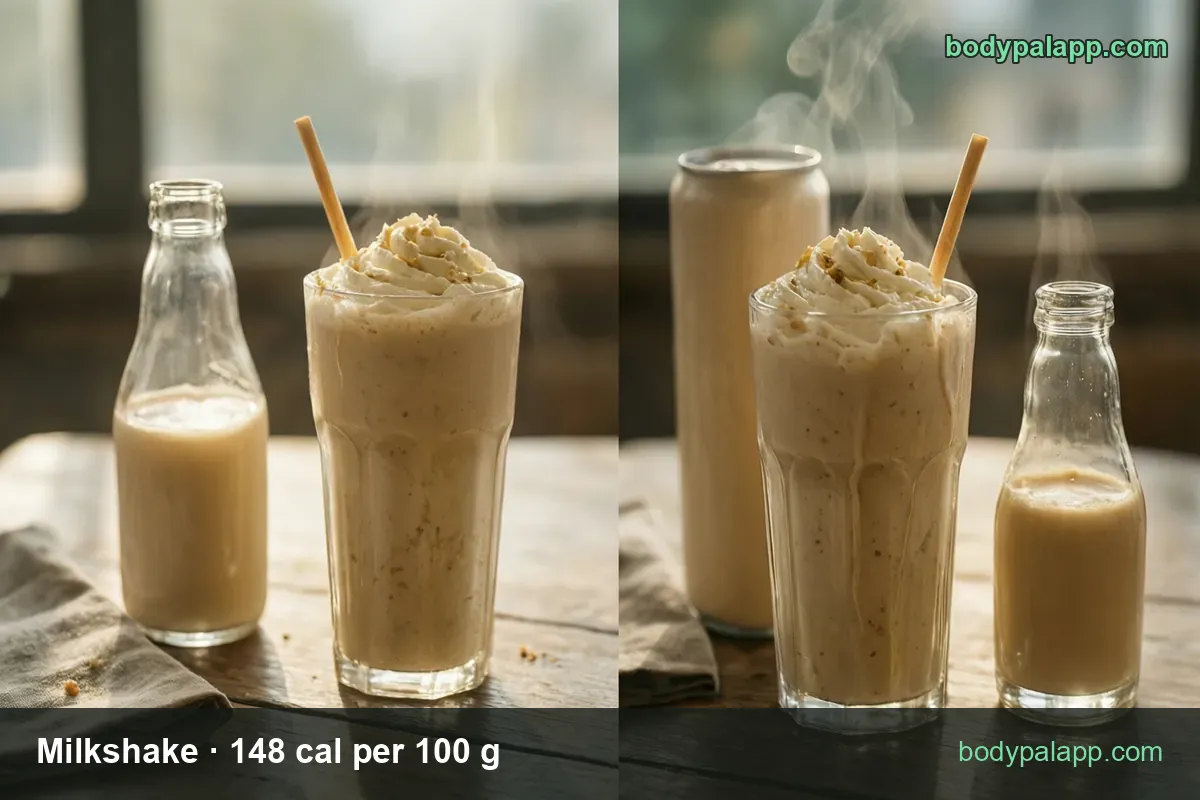
Chocolate versus everything else is the question people expect to matter, and it barely does: 150 calories per 100 g against 148, which is nine calories across a whole small shake. What cocoa does change is fiber — 1.6 g per 100 g instead of 0.9 g — and that is a rounding error you can enjoy guilt-free.
Homemade is the real lever. Blend milk and ice cream at home and you land at 113 calories per 100 g for vanilla, because there is no syrup base doing the sweetening. Pour the fast-food shake and the homemade one into the same 224 g cup and it is 332 calories against 253. Same glass, same straw, 79 calories apart, and the gap widens with every ounce.
Malted shakes are quietly lighter. Malt powder brings less sugar than syrup, so the record sits at 125 calories per 100 g and a 224 g cup is 280 calories — 52 below the standard shake in the same cup. Both the 1-cup malted figure and the 12 fl oz bottle weights are our own arithmetic from the USDA 100 g values, not USDA servings.
Bottled shakes are the same formula in USDA's eyes, so a 12 fl oz chocolate bottle is 558 calories. Store brands run richer than the survey average: Steak 'n Shake's bottled strawberry is 165 calories per 100 g, or 421 for an 11.5 oz (255 g) bottle, and the vanilla is 169 per 100 g. Carvel's 9 oz (149 g) chocolate bottle is smaller and lands at 230. A 16 fl oz f'real glazed donut shake, at 120 calories per 100 g, works out near 569 by our own arithmetic — the low density is undone by the cup size. There is also an older SR Legacy record for thick vanilla shakes at 112 calories per 100 g with 3.03 g of fat and 17.75 g of sugars, a leaner, sweeter profile than today's fast-food formula. It is a useful reminder that "milkshake" is a recipe, not a constant.
Saturated fat is the row that bites
Calories get the attention; saturated fat is where a shake actually stands out. A small delivers 16.0 g, which is 80% of the FDA Daily Value of 20 g. A medium is about 20.8 g and a large about 27.3 g by our own arithmetic from the 100 g figure — 104% and 137% of the day, from one cup.
The Dietary Guidelines for Americans put the target at less than 10% of daily calories from saturated fat, and a single large shake clears it on its own. If saturated fat is the number you are watching, the homemade version is the honest fix: 3.62 g per 100 g against 3.96, and served in a 280 g glass instead of a 690 g cup.
There is a nutritional upside worth naming. A small carries 13.6 g of protein and 672 mg of potassium, so it is not empty — MyPlate counts shakes in the dairy group, just with a lot of company. Per 100 g, though, protein is only 3.37 g, which is a poor trade for 148 calories. Drink one because you want one, not because of the protein.
How does a milkshake compare?
| Drink | Per 100 g | US serving | Calories |
|---|---|---|---|
| Milkshake, fast food | 148 kcal | 1 cup, 224 g | 332 kcal |
| Eggnog | 88 kcal | 1 cup, 240 g | 211 kcal |
| Ice cream soda, chocolate | 87 kcal | 1 cup, 240 g | 209 kcal |
| Chocolate milk drink | 49 kcal | 1 cup, 240 g | 118 kcal |
The 240 g cup weights for the three neighbors are our own arithmetic from their USDA 100 g figures, not USDA servings.
Our take: cup for cup, a milkshake is the heaviest thing on this list — 332 calories against 211 for eggnog, a drink with a holiday reputation for excess, and nearly three times a cup of chocolate milk. But the per-100-g column understates the real problem, because nobody drinks a shake by the cup. If you want the flavor and not the damage, an ice cream soda gives you a cold sweet drink at 209 calories a cup, and homemade at 253 gets you closest to the real thing. If you are ordering at a counter, order the small and count 599 — the size, not the flavor, is what decides your day.
Most popular milkshake brands in the United States
Ranked by how widely each product appears among foods sold in the United States, from the BodyPal food database of over 3.3 million products. Calories are the figures printed on each Nutrition Facts label, checked against USDA FoodData Central.
| Product | Calories (per 100 g) |
|---|---|
| Steak 'n Shake Milkshake Strawberry | 165 cal |
| Carvel Milkshake Chocolate | 154 cal |
| Steak 'n Shake Milkshake Chocolate | 173 cal |
| Steak 'n Shake Milkshake Vanilla | 169 cal |
| f'real Milkshake Glazed Donut | 120 cal |
Brand popularity: BodyPal food database. Nutrition: manufacturer labels / USDA FoodData Central.
Milkshake FAQs
How many calories are in a milkshake?
599 calories for a small fast-food shake, the 405 g size USDA lists first. That works out to 148 calories per 100 g. A medium (526 g) is 778 and a large (690 g) is 1,021. Homemade versions made with milk and ice cream land lower, near 113 calories per 100 g.
How many calories in a small milkshake?
A small is 599 calories at 405 g, the smallest of the three ordered sizes in the USDA fast-food record and already 30% of a 2,000-calorie day. It also brings 16.0 g of saturated fat, which is 80% of the Daily Value, plus 328 mg of sodium. A 224 g cup pour would be 332.
How many calories in a large milkshake?
A large is 1,021 calories at 690 g, more than half of a 2,000-calorie day. Saturated fat scales with it: about 27.3 g by our own arithmetic from the USDA 100 g figure, roughly 137% of the Daily Value. Total sugars reach about 94.0 g, most of it from the syrup base.
Is a chocolate milkshake higher in calories than vanilla?
Barely. Chocolate is 150 calories per 100 g against 148 for other flavors, so a small chocolate shake is 608 calories and a vanilla one 599. That nine-calorie gap is noise next to the size difference. Chocolate does carry more fiber, 1.6 g per 100 g versus 0.9 g, thanks to the cocoa.
How much sugar is in a milkshake?
A small holds 55.2 g of total sugars, and a large about 94.0 g by our own arithmetic from the 100 g value of 13.63 g. USDA publishes only total sugars for these survey foods, so part of that is lactose from the milk and it cannot be read against the added-sugars Daily Value.
How many calories in a homemade milkshake?
A homemade vanilla shake is 113 calories per 100 g, so a 10 fl oz (280 g) glass is 316 calories; the chocolate version is 120 per 100 g, or 336. Poured into the same 224 g cup, homemade vanilla is 253 calories against 332 for the fast-food shake. The syrup base is the difference.
Does a milkshake have protein?
Yes, 13.6 g in a small, which is 27% of the Daily Value, from the milk and ice cream in the base. Per 100 g it is only 3.37 g, a little under the 4.55 g in eggnog. A medium carries about 17.7 g and a large about 23.3 g by our own arithmetic.
How many calories in a bottled milkshake?
A 12 fl oz bottle is 558 calories for chocolate and 551 for vanilla, since USDA treats bottled shakes as the same formula as fast-food ones, at 150 and 148 calories per 100 g. Brand labels run richer: Steak 'n Shake strawberry is 165 per 100 g, or 421 for an 11.5 oz bottle.
Similar foods
- Pina Colada — 340 cal per drink
- Coffee With Cream — 41 cal per fl oz
- Chocolate Malt — 350 cal per malt
- Chocolate Shake — 357 cal per shake
- Banana Milkshake — 540 cal per shake
- Long Island Iced Tea — 241 cal per drink
Count it without the math
Point the camera at the cup and BodyPal counts the shake for you, whipped cream and all.


How long does it take to burn off a milkshake?
One small shake (405 g) is 599 kcal. Enter your weight and the amount you ate to see how long it takes you to burn that off:
lb
| Activity | Time to burn 599 kcal |
|---|---|
| Walking, brisk | 2 hr |
| Cycling, moderate | 1 hr 15 min |
| Swimming, moderate | 1 hr 26 min |
| Jogging | 1 hr 10 min |
| Weight training, moderate | 2 hr 13 min |
Times are for a 155 lb adult at a steady pace; change the weight to see yours. The amount is set to the portion in the text (405 g); change it to what you actually ate. BodyPal works this out from your steps automatically.
One food is easy to picture; a whole day is harder. See how many calories you need a day and what a deficit actually looks like.