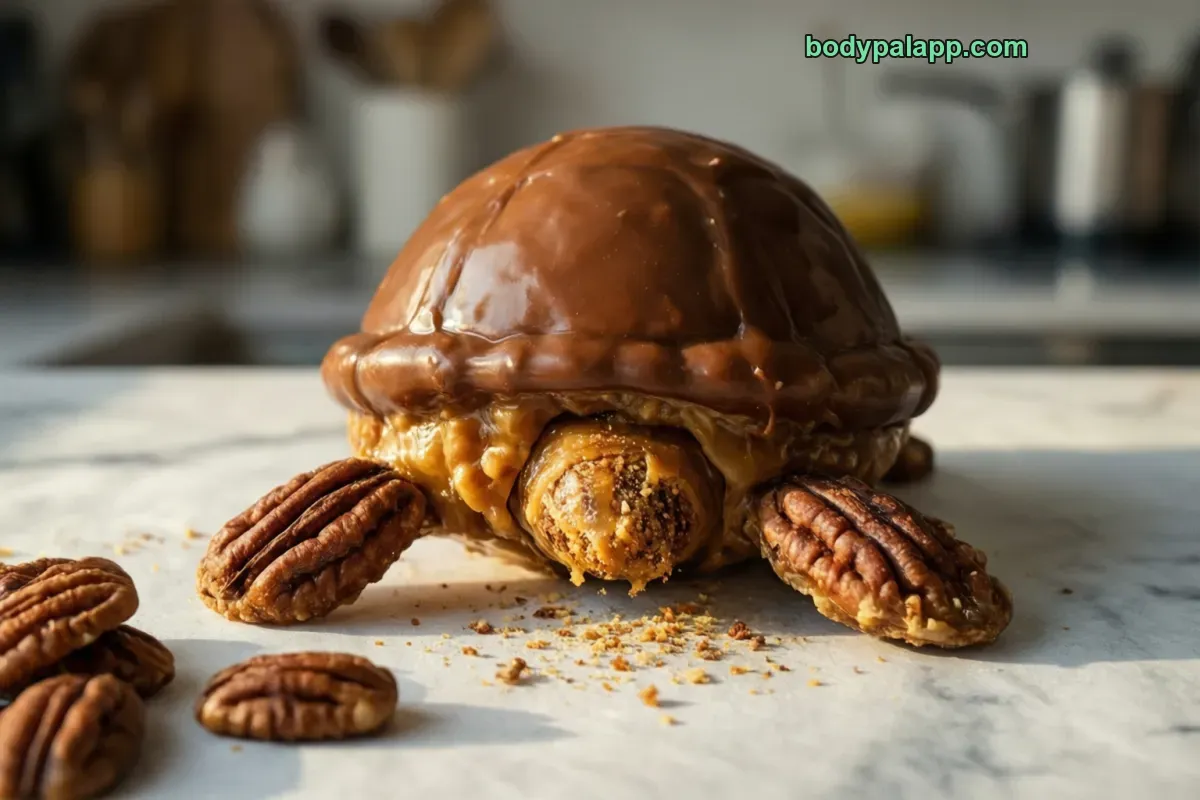
Chocolate turtle calories come to 300 for one 54 g piece and 556 per 100 g. Fat supplies 62% of those calories and each piece carries 23 g of sugar. A single turtle is a manageable treat. The total climbs fast because the pieces are small, rich and easy to stack.
300kcal
1 piece · 54 g, packaged, per label
4%protein
3 gProtein
26 gCarbs
21 gFat
How to burn off 300 kcal
—Walking, brisk
—Jogging
—Cycling, moderate
—Swimming
Skip the math. BodyPal counts these calories from your steps and workouts automatically.
Nutrition facts
Packaged, per label · per 54 g
Calories
300 kcal
Protein
3 g
Carbohydrate
26 g
Fat
21 g
Saturated fat
9 g
Cholesterol
15 mg
Sodium
85 mg
Source: USDA FoodData Central
🛡️
Verified nutrition data
Numbers on this page come from USDA FoodData Central, the U.S. Department of Agriculture’s food composition database, and from manufacturer labels where a branded product is named. Last verified September 2026. How we verify our data →
Chocolate turtle: calories, protein and sodium by serving
Percent of daily value uses the FDA reference of 2,000 kcal a day.
Serving
kcal
Protein
Carbs
Fat
Sodium
% DV kcal
1 piece (54 g)
300
3 g
26 g
21 g
85 mg
15%
1 oz portion (28 g)
156
1.6 g
13.5 g
10.9 g
44 mg
8%
100 g
556
5.6 g
48.2 g
38.9 g
157 mg
28%
3 × 1 piece (54 g)
901
9 g
254 mg
5 × 1 piece (54 g)
1,501
15 g
424 mg
One turtle is 300 calories, and the second doubles it
A packaged milk chocolate turtle weighs about 54 g and lands at 300 calories. That is 15% of the daily calorie value in one bite-sized candy. A 1 oz portion (28 g), roughly half a piece, comes to 156 calories, which is 8% of the daily value.
The jump between pieces is where the numbers get serious. Two turtles (108 g) reach 600 calories. Three (162 g) hit 901. Five pieces, 270 g of candy, add up to 1,501 calories, which is most of a day's worth of energy from a box you might finish during a movie.
If you want the treat without the climb, decide on the count before the box opens. Cutting a turtle in half is a practical move: the 1 oz portion still gives you caramel, pecan and chocolate in the same bite, at about half the calories of a whole piece.
Fat is close to two thirds of every turtle
The calorie split is 62% fat, 34% carbs and 4% protein. Per 100 g that works out to 38.9 g of fat, 48.2 g of carbs and just 5.6 g of protein. The pecans and milk chocolate supply most of the fat, while the caramel and chocolate carry most of the sugar.
Protein barely registers. One piece gives 3 g, which is 6% of the daily value, so a turtle does little to hold off hunger compared with its calorie load. Fiber is also low at 1 g per piece, or 1.9 g per 100 g, despite the nuts.
That combination matters. Calories dense in fat and sugar, with little protein or fiber, go down quickly and do not stay with you long. A turtle reads better as dessert than as a snack meant to carry you to the next meal.
Sugar and saturated fat are the rows to watch
Sugar is the standout number. One piece holds 23 g, and per 100 g the figure is 42.6 g, which means sugar makes up nearly all of the carbohydrate. The 1 oz portion still carries 11.9 g.
Saturated fat comes next at 16.7 g per 100 g, against a daily value of 20 g. Most of the fat in a turtle is the saturated kind from milk chocolate and butter-rich caramel. If you watch saturated fat, two or three pieces will take up a large share of your day's limit.
Sodium, by contrast, is not a concern. One piece has 85 mg, only 4% of the daily value, and even five pieces stay at 424 mg. Cholesterol is modest at 28 mg per 100 g. The reasons to keep portions small are sugar and saturated fat, not salt.
A turtle works best as a planned dessert
Because a single turtle covers 15% of daily calories while giving only 6% of daily protein, it fits most easily after a meal that already supplied protein and fiber. Eating it on an empty stomach makes it easier to reach for a second piece.
Pairing helps. A turtle next to a cup of coffee or tea, or after a dinner with vegetables and a lean protein, feels like a finished dessert rather than the start of a snacking run. Varieties such as Lil' Turtles Peanut Butter or Marshmallow, Larabar Dark Chocolate Turtle, or chocolate turtle apples from Tastee or Giant Eagle change the format, so check each label instead of assuming the same numbers.
If you track your intake, log the exact count of pieces, since one turtle is 300 calories and three are 901. BodyPal can log a turtle from a photo, which makes it harder for the extra piece to disappear from the record.
How does chocolate turtle compare?
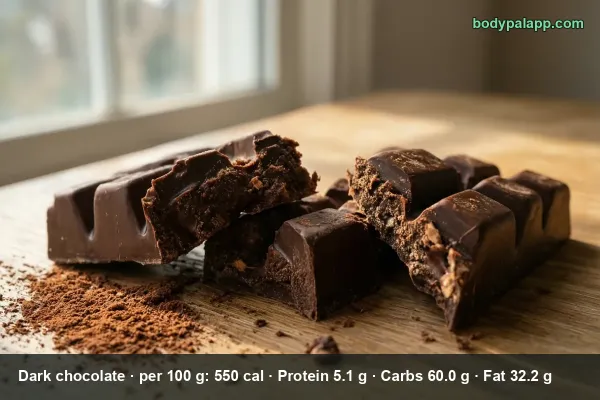
Here is how a chocolate turtle compares with chocolate truffles, chocolate almonds and dark chocolate, per 100 g and per usual serving.
Verdict: Per 100 g the four sit close together, from 510 calories for a truffle to 560 for chocolate almonds, so the serving size decides the damage: a 12 g truffle is 61 calories against 300 for a turtle. For portion control pick the truffle; for more protein per bite pick chocolate almonds at 13 g per 100 g versus 5.6 g in a turtle.
Most popular chocolate turtle brands in the United States
One 54 g piece is 300 calories. The candy runs 556 calories per 100 g.
Is a chocolate turtle good for weight loss?
One piece brings 300 calories with 23 g of sugar and 21 g of fat. A smaller 28 g portion comes to 156 calories.
Chocolate turtle vs chocolate truffle: which has more calories?
Per 100 g a chocolate turtle has 556 calories and a chocolate truffle 510, so the turtle is 46 calories higher.
How much sugar is in a chocolate turtle?
A 54 g piece has 23 g of sugar, from 42.6 g per 100 g. The same piece has 3.0 g of protein.
How many calories are in half a chocolate turtle?
A 1 oz portion (28 g), about half a piece, has 156 calories. It also carries 11.9 g of sugar and 10.9 g of fat, so splitting a turtle roughly halves everything.
How many calories are in 3 chocolate turtles?
Three pieces (162 g) come to 901 calories, with 9 g of protein and 254 mg of sodium. Two pieces are 600 calories, and five reach 1,501.
How much fat is in a chocolate turtle?
One 54 g piece has 21 g of fat, and fat supplies 62% of its calories. Per 100 g there are 38.9 g of fat, of which 16.7 g is saturated.
Does a chocolate turtle have much protein?
Not much. One piece gives 3 g of protein, 6% of the daily value, and protein accounts for only 4% of its calories. Per 100 g the figure is 5.6 g.
Is a chocolate turtle high in sodium?
No. One piece has 85 mg of sodium, 4% of the daily value. Per 100 g it is 157 mg, so sugar and fat matter far more than salt here.