
How Many Calories Are in Dark Chocolate?
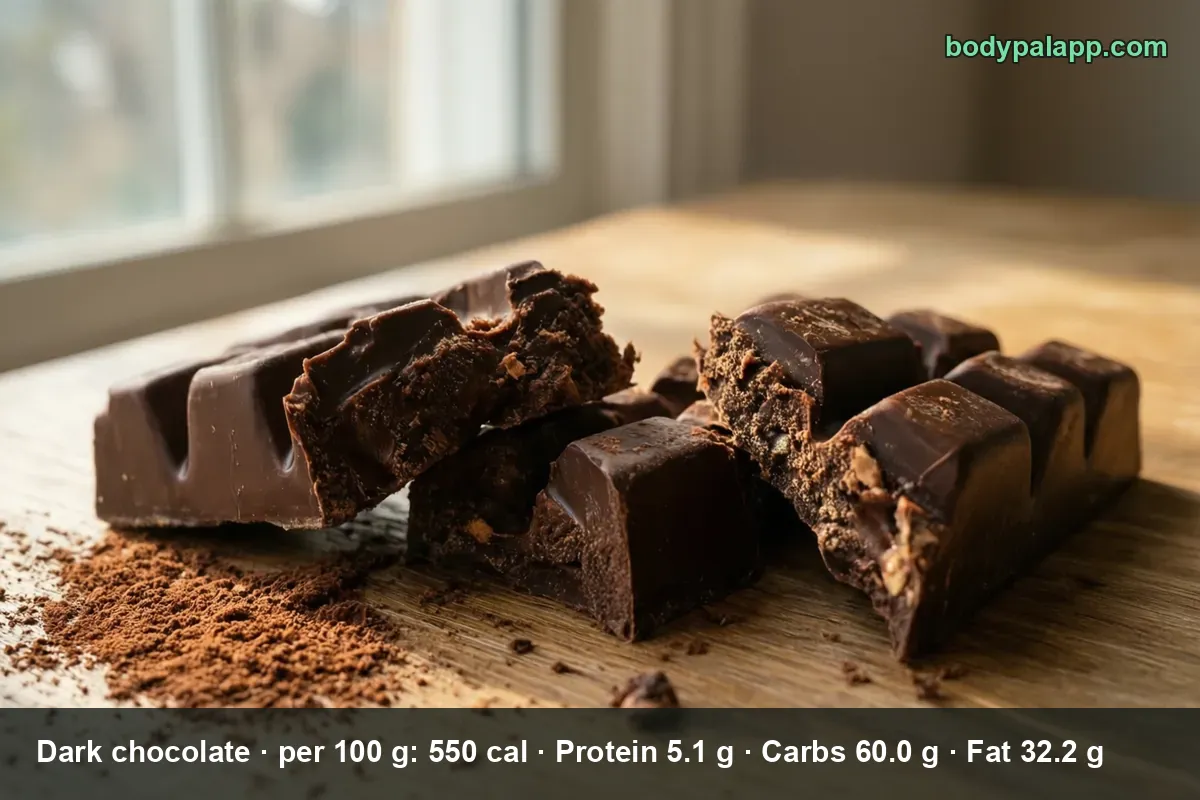
A regular-size bar of dark chocolate weighs 45 g and carries 248 calories. Per 100 g the same candy runs 550 calories, which puts it near the top of the candy aisle. Break that bar into squares and each 8 g piece costs 44 calories — the number most people actually need.
On this page
- Dark chocolate quick facts
- US servings, from one square to a whole bar
- With nuts, Special Dark, Dove and coffee beans
- Saturated fat is the row to watch
- How does dark chocolate compare?
- Most popular dark chocolate brands
- Dark chocolate FAQs
Dark chocolate quick facts
The numbers below come from the generic USDA record FNDDS 2710336, "Dark chocolate candy". That is the plain bar or block with nothing inside it — no caramel, no nuts, no cream center — which is what most people mean when they type the question. Branded bars such as Special Dark and Dove sit in the variants section further down, because those are specific products rather than the category.
One thing that record does not do is split dark chocolate by cocoa percentage. There is no separate USDA row for 70%, 85% or 90%, so a single set of numbers has to cover the whole shelf. In practice the higher-cocoa bars trade sugar for cocoa butter and land within a few calories of the figures here.
| Nutrient | Per 100 g | Per 1 regular-size bar (45 g) | % Daily Value |
|---|---|---|---|
| Calories | 550 | 248 | 12% |
| Total fat | 32.2 g | 14.5 g | 19% |
| Saturated fat | 18.99 g | 8.5 g | 43% |
| Carbohydrate | 59.97 g | 27.0 g | 10% |
| Dietary fiber | 7.2 g | 3.2 g | 12% |
| Total sugars | 46.14 g | 20.8 g | — |
| Protein | 5.09 g | 2.3 g | 5% |
| Sodium | 23 mg | 10 mg | 0% |
% Daily Value is based on a 2,000-calorie diet.
Verified nutrition data
Numbers on this page come from USDA FoodData Central, the U.S. Department of Agriculture’s food composition database, and from manufacturer labels where a branded product is named. Last verified September 2026. How we verify our data →
Two rows you would see on a wrapper are missing here: USDA does not publish added sugars or trans fat for this record, so we leave both out rather than guess at them. Cholesterol is 7 mg per 100 g (3 mg in a bar, 1% DV) and potassium 568 mg per 100 g (256 mg in a bar, 5% DV), which is more potassium than most candy carries. The %DV column follows the FDA reference amounts printed on every Nutrition Facts label.
US servings, from one square to a whole bar
| Serving | Weight | Calories |
|---|---|---|
| 1 piece or square | 8 g | 44 kcal |
| 1 miniature, bite size | 10 g | 55 kcal |
| 1 fun or snack size | 15 g | 83 kcal |
| 1 oz | 28 g | 154 kcal |
| 1 regular-size bar or pouch | 45 g | 248 kcal |
| Per 100 g | 100 g | 550 kcal |
The square, the miniature, the snack size and the regular bar are all USDA household measures for this record. The ounce is our own arithmetic from the USDA 100 g figure, not a USDA serving, and it is the number to use when you are reading a wrapper that lists nutrition per ounce.
Here is the trap. Recipes and some trackers offer dark chocolate by the cup, and a cup of pieces is about 160 g — 880 calories by our own scaling from the 100 g figure. That is three and a half bars in one measuring cup. Dark chocolate is a squares food, not a cup food, and the 8 g square at 44 calories is the unit that keeps the math honest.
Two squares after dinner is 88 calories. Four is 176. A whole 45 g bar in one sitting is 248, roughly what a medium banana and a cup of milk cost together, so it is not a disaster — it is just bigger than the "one or two squares" story people tell themselves.
With nuts, Special Dark, Dove and coffee beans
| Version | Per 100 g | Typical piece | Calories |
|---|---|---|---|
| Dark chocolate with nuts | 560 kcal | 1 piece (8 g) | 45 kcal |
| Special Dark bar | 556 kcal | 1 bar, 1.45 oz (41 g) | 228 kcal |
| Dove dark chocolate | 520 kcal | 1 bar, 1.3 oz (37 g) | 192 kcal |
| Dark chocolate coated coffee beans | 540 kcal | 1 oz (28 g) | 151 kcal |
| Caramel bar, dark chocolate covered | 458 kcal | 1 oz (28 g) | 128 kcal |
| Milk chocolate candy | 535 kcal | 1 oz (28 g) | 150 kcal |
With nuts is the surprise of the group. Adding almonds or hazelnuts lifts the density by only 10 calories per 100 g, but protein climbs from 5.09 g to 8.26 g and total sugars fall from 46.14 g to 37.88 g, because the nuts are taking up room the sugar used to occupy. Same calories, more to chew on.
Special Dark and Dove show how little daylight there is between name brands. The Special Dark record runs 556 calories per 100 g and Dove 520, a spread of 36 calories across 100 g, or about 3 calories per square. The Special Dark row in USDA's older SR Legacy set carries no saturated fat value at all, so treat it as a calorie and sugar comparison only.
The caramel bar is the lightest thing in the table at 458 calories per 100 g, and that is not a health win — it is dilution. Caramel replaces cocoa butter with sugar and water, so sugars rise to 54.08 g per 100 g, fiber drops to 2.8 g, and sodium jumps to 246 mg per 100 g against 23 mg for plain dark chocolate. More than ten times the sodium, for a bar that tastes sweeter.
Retail bars land in the same band. A Godiva dark chocolate bar is 557 calories per 100 g, so the whole 79 g bar is 440 calories; Ghirardelli mint dark squares are lighter at 467 per 100 g, which makes the two-square 30 g serving 140 calories. Schogetten's dark bar is 531 per 100 g, or 207 calories for the 39 g seven-piece serving on the label.
Saturated fat is the row to watch
Calories are not the interesting number on this label. Saturated fat is. One 45 g bar carries 8.5 g, which is 43% of the Daily Value in a single sitting, and the fat comes from cocoa butter rather than anything added at the factory. The Dietary Guidelines for Americans put the ceiling at less than 10% of daily calories from saturated fat — about 22 g on a 2,000-calorie day — so a bar is close to 40% of that allowance.
Sodium goes the other way. Ten milligrams in a bar is 0% of the Daily Value, so if you are watching salt, dark chocolate is a non-event next to a handful of pretzels. And the fiber is real: 3.2 g per bar, 12% DV, which is more fiber than a slice of white bread.
Sugar is the row people argue about. Total sugars are 46.14 g per 100 g, or 20.8 g in a bar. USDA does not break that into added versus naturally occurring for this record, so we will not pretend to know the split — but MyPlate's guidance on added sugars is worth reading before you decide how much of the bar is a treat budget.
How does dark chocolate compare?
| Candy | Per 100 g | US serving | Calories |
|---|---|---|---|
| Dark chocolate | 550 kcal | 1 oz (28 g) | 154 kcal |
| Milk chocolate | 535 kcal | 1 oz (28 g) | 150 kcal |
| Chocolate covered peanuts | 556 kcal | 1 oz (28 g) | 156 kcal |
| Chocolate covered almonds | 560 kcal | 1 oz (28 g) | 157 kcal |
Our take: dark chocolate is not the light option, and the table says so plainly — milk chocolate is 15 calories lighter per 100 g, and the whole group sits within 25 calories of each other per 100 g. Choose dark for the fiber (7.2 g per 100 g) and for the fact that a square is easier to stop at than a handful of coated nuts. If you want the most protein per calorie in this group, the chocolate covered peanuts win at 14.33 g per 100 g. If you want the smallest honest serving, dark chocolate wins, because it comes pre-scored into 44-calorie squares and nothing else here does.
Most popular dark chocolate brands in the United States
Ranked by how widely each product appears among foods sold in the United States, from the BodyPal food database of over 3.3 million products. Calories are the figures printed on each Nutrition Facts label, checked against USDA FoodData Central.
| Product | Calories (per 100 g) |
|---|---|
| Schogetten Dark Chocolate | 531 cal |
| Godiva Double Dark Chocolate Domes | 548 cal |
| Ghirardelli Mint Dark Chocolate Squares | 467 cal |
| Ghirardelli Winter Mint Minis Dark Chocolate | 467 cal |
| Godiva Dark Chocolate Bar | 557 cal |
| Godiva Dark Chocolate Blocks | 489 cal |
Brand popularity: BodyPal food database. Nutrition: manufacturer labels / USDA FoodData Central.
Dark chocolate FAQs
How many calories are in one square of dark chocolate?
One square is 44 calories at USDA's 8 g piece size, based on 550 calories per 100 g. Two squares after dinner cost 88 calories, four cost 176. Squares vary by brand, so weigh one bar once and you will know your own number for good.
How many calories in a dark chocolate bar?
A regular-size 45 g bar is 248 calories. Smaller branded bars come in lower: a 41 g Special Dark bar is 228 and a 37 g Dove bar is 192. A large 79 g Godiva bar runs 440. Bar weight, not cocoa content, drives the difference.
How many calories in 70% dark chocolate?
Use 550 calories per 100 g, or 44 per 8 g square. USDA publishes one generic dark chocolate record and does not split it by cocoa percentage, so 70%, 85% and 90% bars all share these figures. Higher-cocoa bars swap sugar for cocoa butter and land in the same range.
Dark chocolate vs milk chocolate: which has fewer calories?
Milk chocolate is slightly lighter: 535 calories per 100 g against 550 for dark, or 150 per ounce against 154. The gap is four calories an ounce, which is nothing. Dark wins on fiber, 7.2 g per 100 g, and on the fact that it is usually eaten by the square.
How much sugar is in dark chocolate?
Total sugars are 46.14 g per 100 g, so a 45 g bar carries 20.8 g and one square about 3.7 g. USDA does not publish an added sugars figure for this record, so the split between added and naturally occurring sugar is not something we can report here.
How much fiber is in dark chocolate?
Dark chocolate has 7.2 g of fiber per 100 g, which works out to 3.2 g in a 45 g bar, or 12% of the Daily Value. That fiber comes from the cocoa solids, which is why the caramel-filled version drops to 2.8 g per 100 g.
Does dark chocolate have protein?
There is 5.09 g of protein per 100 g, or 2.3 g in a bar, which is 5% of the Daily Value. The version with nuts does better at 8.26 g per 100 g. Chocolate covered peanuts lead the category at 14.33 g, though they are also 556 calories per 100 g.
Is dark chocolate high in saturated fat?
Yes: 18.99 g per 100 g, and 8.5 g in a 45 g bar, which is 43% of the Daily Value in one bar. The Dietary Guidelines suggest keeping saturated fat under 10% of daily calories, roughly 22 g at 2,000 calories, so a bar uses a large share of that.
Similar foods
- Beef Stick — 110 cal per stick
- Pringles — 153 cal per oz
- Chocolate Turtle — 300 cal per piece
- Pork Rinds — 152 cal per oz
- Chocolate Almonds — 157 cal per oz
- Corn Chips — 151 cal per oz
Count it without the math
Point the camera at the board and BodyPal counts the squares for you, bar or broken pieces.


How long does it take to burn off dark chocolate?
One regular-size bar (45 g) is 248 kcal. Enter your weight and the amount you ate to see how long it takes you to burn that off:
lb
| Activity | Time to burn 248 kcal |
|---|---|
| Walking, brisk | 50 min |
| Cycling, moderate | 31 min |
| Swimming, moderate | 35 min |
| Jogging | 29 min |
| Weight training, moderate | 55 min |
Times are for a 155 lb adult at a steady pace; change the weight to see yours. The amount is set to the portion in the text (45 g); change it to what you actually ate. BodyPal works this out from your steps automatically.
This table assumes you know your daily total. If you do not, the daily calorie calculator works it out from five numbers.