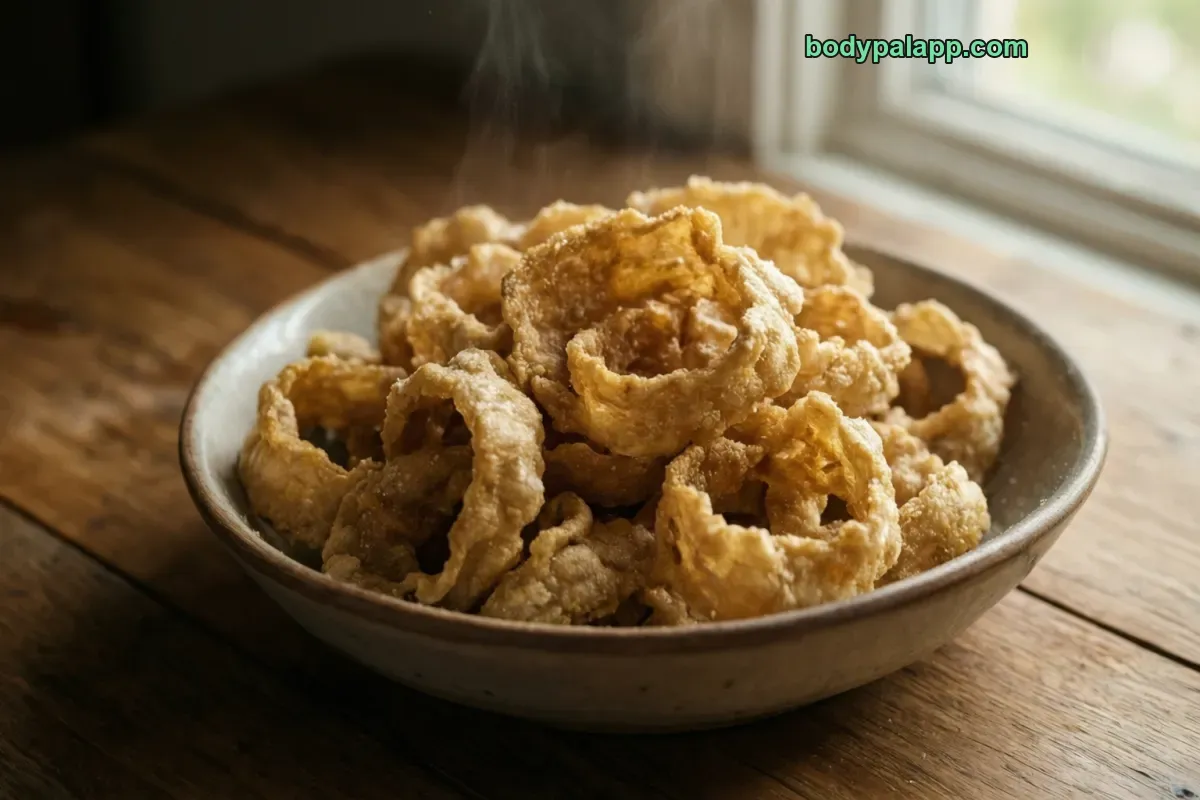
Pork rinds calories come to 152 for a 1 oz (28 g) serving and 544 per 100 g. The thing to notice is the balance: 0 g of carbs, 17.2 g of protein per ounce, and 509 mg of sodium, already 22% of the daily value before you reach the bottom of the bag.
152kcal
1 ounce · 28 g, plain, ready to eat
47%protein
17.2 gProtein
0 gCarbs
8.8 gFat
How to burn off 152 kcal
—Walking, brisk
—Jogging
—Cycling, moderate
—Swimming
Skip the math. BodyPal counts these calories from your steps and workouts automatically.
Nutrition facts
Plain, ready to eat · per 28 g
Calories
152 kcal
Protein
17.2 g
Carbohydrate
0 g
Fat
8.8 g
Saturated fat
3.2 g
Cholesterol
27 mg
Sodium
509 mg
Potassium
36 mg
Iron
0.2 mg
Source: USDA FoodData Central
🛡️
Verified nutrition data
Numbers on this page come from USDA FoodData Central, the U.S. Department of Agriculture’s food composition database, and from manufacturer labels where a branded product is named. Last verified September 2026. How we verify our data →
Pork rinds: calories, protein and sodium by serving
Percent of daily value uses the FDA reference of 2,000 kcal a day.
Serving
kcal
Protein
Carbs
Fat
Sodium
% DV kcal
1 oz (28 g)
152
17.2 g
0 g
8.8 g
509 mg
8%
1 cup (30 g)
163
18.4 g
0 g
9.4 g
545 mg
8%
Single serving bag (57 g)
310
34.9 g
0 g
17.8 g
1,036 mg
16%
Barbecue flavor (28 g)
151
16.2 g
0.4 g
8.9 g
747 mg
8%
3 × 1 oz (28 g)
457
51.5 g
1,527 mg
5 × 1 oz (28 g)
762
85.8 g
2,545 mg
A single-serve bag is a 310-calorie snack
The standard label serving is 1 oz (28 g), which works out to 152 calories, 17.2 g of protein and 8.8 g of fat. A 1 cup (30 g) scoop lands at 163 calories, so a cup and an ounce are close enough to treat as the same portion. Either one uses about 8% of the daily calorie value.
The trouble is the bag. A single serving bag (57 g) holds 310 calories and 34.9 g of protein, roughly double the label serving, and most people finish it as one snack. Rinds are light and airy, so the pile looks small for the energy it carries.
Keep eating and the totals climb fast. Two ounces come to 305 calories, three reach 457, and five ounces, about 140 g, hit 762 calories. If you snack from a larger bag, pouring one ounce into a bowl is the simplest way to keep the number near 152.
Zero carbs, and almost half the calories come from protein
Plain pork rinds have 0 g of carbs, 0 g of sugars and 0 g of fiber per 100 g. Every calorie comes from protein or fat: 47% from protein and 53% from fat. For a crunchy bagged snack, that is an unusual profile.
Per 100 g you get 61.3 g of protein and 31.3 g of fat, of which 11.4 g is saturated, more than half of the 20 g daily value. In a 1 oz serving the protein comes to 17.2 g, or 34% of the daily value. Cholesterol sits at 95 mg per 100 g.
If you follow a low-carb plan, rinds fit the numbers cleanly. If you count calories, the protein does not cancel out the fat. At 544 calories per 100 g, this is a dense snack, and the fat side of the label deserves as much attention as the protein side.
Sodium is the row to watch
Plain pork rinds carry 1,818 mg of sodium per 100 g. One ounce delivers 509 mg, or 22% of the daily value, while using only 8% of the daily calorie value. Sodium runs well ahead of calories at every serving size.
The single serving bag brings 1,036 mg, which is 45% of the daily value in one snack. Barbecue flavor pushes it higher per ounce: 747 mg, or 32% of the daily value, against 509 mg for plain. Flavored versions such as Utz Pork Rinds Hot & Spicy or Utz Pork Rinds BBQ are worth a label check for the same reason.
Volume makes it worse. Three ounces reach 1,527 mg and five ounces reach 2,545 mg, more than a full day's daily value from one snacking session. If you watch sodium, plain rinds in a single ounce keep the total limited, and the rest of the day's meals can go easy on salt.
Pair rinds with produce, not more salt
With 0 g of fiber and 127 mg of potassium per 100 g, pork rinds bring protein and crunch but little else. That makes them a better side than a whole snack. A handful next to raw vegetables, fruit or a salad adds texture and protein while the produce supplies the fiber the rinds lack.
Rinds also work as a crunchy topping. Crumbled over a salad or soup, or used as a coating in place of breadcrumbs, a 1 oz portion goes further than it does eaten from the bag. Skip pairing them with salty dips, cured meats or cheese if your sodium is already high for the day.
If you track snacks, BodyPal can log pork rinds from a photo, which helps when the bag is open and the portion is guesswork.
How does pork rinds compare?
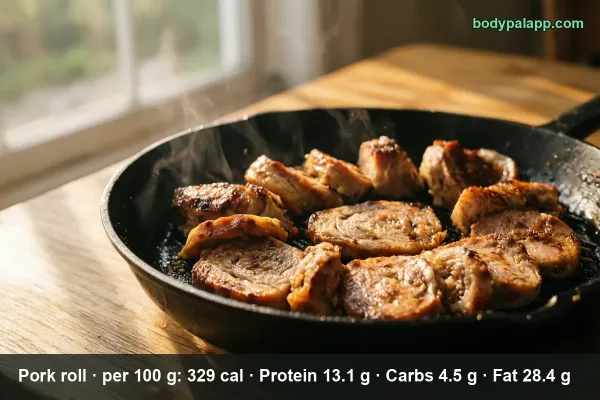
Here is how pork rinds stack up against pork roll and a jelly donut, per 100 g and per usual serving.
Verdict: Per 100 g, pork rinds carry the most calories at 544, against 340 for jelly donut and 329 for pork roll, but they also bring 61.3 g of protein and no carbs. To cut carbs or add protein, pick the rinds in a measured 1 oz portion; for the fewest calories per 100 g, pork roll wins, though its 1,377 mg of sodium is no bargain either.
Most popular pork rinds brands in the United States
Ranked by popularity in the BodyPal database
# Productkcal / 100 g
1Utz Pork Rinds1/2 oz · 14 g571 kcal
2Utz Pork Rinds Hot & Spicy1/2 oz · 14 g571 kcal
3Utz Pork Rinds BBQ1/2 oz · 14 g571 kcal
4Utz Chicharrones Original Fried Pork Rinds1/2 oz · 14 g571 kcal
5Utz Original Pork Rinds Chicharrones1/2 oz · 14 g571 kcal
Brand figures are rounded to the small 14 g label serving, so they read a little higher per 100 g than the plain reference value above. Source: manufacturer labels / USDA FoodData Central.
Pork rinds FAQs
How many calories are in pork rinds?
A 1 oz serving (28 g) has 152 calories and a 57 g single serving bag has 310. Per 100 g plain pork rinds are 544 calories.
Are pork rinds good for weight loss?
An ounce is 152 calories with 17.2 g protein, 8.8 g fat and 0 g carbs, so all of the calories come from fat and protein. The same ounce carries 509 mg sodium.
Pork rinds vs pork roll: which has fewer calories?
Per 100 g pork rinds are 544 calories and pork roll is 329, but the usual 28 g serving of rinds works out to 152 calories.
How much protein is in pork rinds?
Plain pork rinds have 61.3 g protein per 100 g, which is 17.2 g in a 1 oz (28 g) serving.
Do pork rinds have carbs?
Plain pork rinds have 0 g of carbs per 100 g, along with 0 g of sugars and 0 g of fiber. Their calories split 47% protein and 53% fat. Barbecue flavor adds only a trace, 0.4 g per ounce.
How many calories are in a bag of pork rinds?
A single serving bag (57 g) of plain pork rinds has 310 calories, 34.9 g of protein and 17.8 g of fat. It also carries 1,036 mg of sodium, 45% of the daily value. Larger bags scale at 544 calories per 100 g.
How much is 1 oz of pork rinds?
One ounce of pork rinds weighs 28 g and holds 152 calories, 17.2 g of protein, 8.8 g of fat and 509 mg of sodium. That is about 8% of the daily calorie value and 22% of the sodium value.
How many calories are in 1 cup of pork rinds?
A 1 cup (30 g) serving of pork rinds has 163 calories, 18.4 g of protein and 9.4 g of fat. It carries 545 mg of sodium, 24% of the daily value, so a cup is close to a standard ounce.
Do pork rinds have a lot of calories?
By weight, yes: 544 calories per 100 g, more than pork roll at 329 or jelly donut at 340. Rinds are so light that a 1 oz serving is only 152 calories, so the total depends on how much of the bag you eat.
What is the nutrition of BBQ pork rinds?
Barbecue flavor pork rinds have 151 calories per 28 g, with 16.2 g of protein, 8.9 g of fat and 0.4 g of carbs. Sodium is the difference: 747 mg, or 32% of the daily value, versus 509 mg for plain.