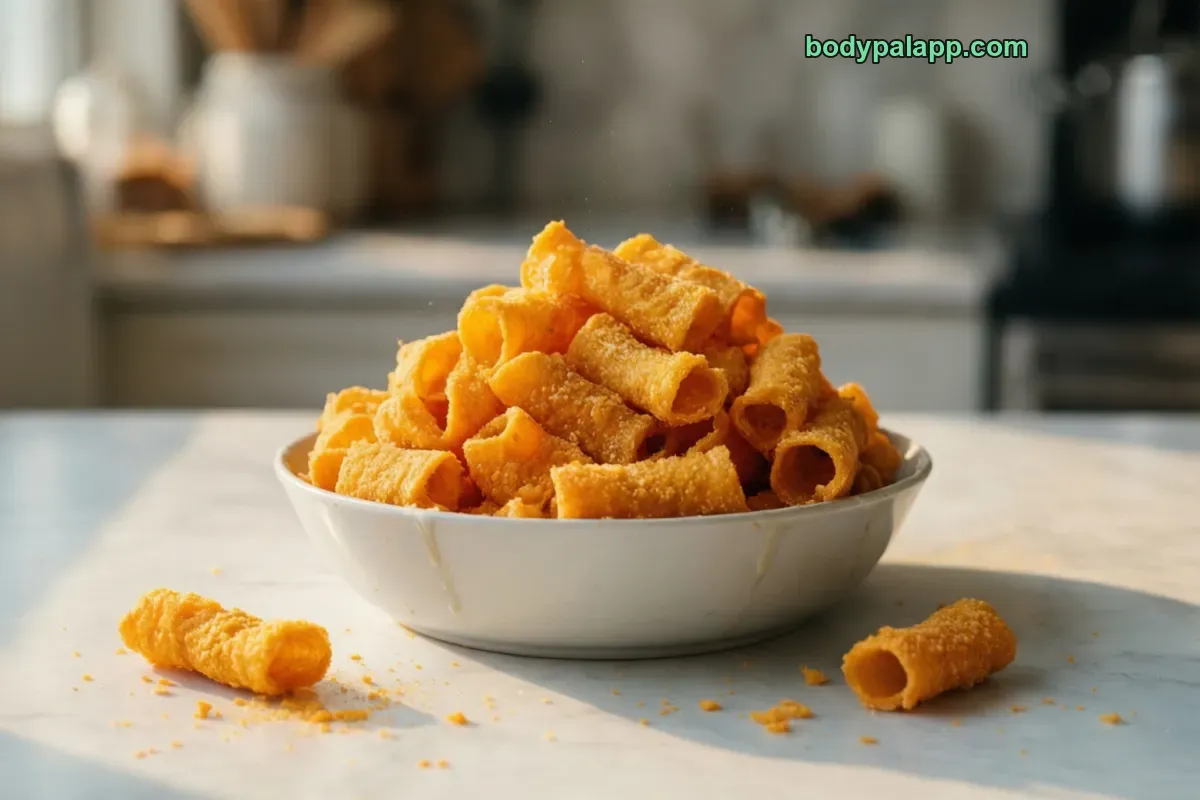
Cheese puff calories come to 159 for a 1 oz serving (28 g) and 567 per 100 g. Notice where they come from: fat supplies 58% of the calories and protein just 4%. That makes the bag size the real decision, because a 2 oz bag already lands at 323 calories and 529 mg of sodium.
159kcal
1 1 oz serving · 28 g, corn-based, cheese flavored
4%protein
1.5 gProtein
15 gCarbs
10.2 gFat
How to burn off 159 kcal
—Walking, brisk
—Jogging
—Cycling, moderate
—Swimming
Skip the math. BodyPal counts these calories from your steps and workouts automatically.
Nutrition facts
Corn-based, cheese flavored · per 28 g
Calories
159 kcal
Protein
1.5 g
Carbohydrate
15.3 g
Fat
10.2 g
Saturated fat
1 g
Cholesterol
2 mg
Sodium
260 mg
Potassium
50 mg
Iron
0.5 mg
Source: USDA FoodData Central
🛡️
Verified nutrition data
Numbers on this page come from USDA FoodData Central, the U.S. Department of Agriculture’s food composition database, and from manufacturer labels where a branded product is named. Last verified September 2026. How we verify our data →
Cheese puff: calories, protein and sodium by serving
Percent of daily value uses the FDA reference of 2,000 kcal a day.
Serving
kcal
Protein
Carbs
Fat
Sodium
% DV kcal
1 oz serving (28 g)
159
1.5 g
15.3 g
10.2 g
260 mg
8%
2 oz bag (57 g)
323
3.1 g
31.1 g
20.8 g
529 mg
16%
Baked low fat (28 g)
121
2.4 g
20.3 g
3.4 g
236 mg
6%
100 g
567
5.5 g
54.5 g
36.5 g
928 mg
28%
3 × 1 oz serving (28 g)
476
4.6 g
780 mg
5 × 1 oz serving (28 g)
794
7.6 g
1,299 mg
A 2 oz bag is a 323-calorie snack
The label serving is 1 oz, or 28 g, and it costs 159 calories. That is 8% of a 2,000-calorie day, which sounds modest until you see how light the puffs are. An ounce is a loose handful, and the air in each puff makes it easy to reach for a second one without noticing.
The common 2 oz bag (57 g) holds 323 calories, 20.8 g of fat and 529 mg of sodium. That is 16% of daily calories in a single grab-and-go pack. Two measured ounces from a bigger bag come to 318 calories, so the snack bag and a double handful are effectively the same thing.
The total keeps climbing in a straight line. Three servings, about 84 g and the size of a generous bowl, reach 476 calories. Five servings, or 140 g, reach 794 calories, which is a full meal's worth of energy with only 7.6 g of protein. If you snack from the family-size bag, portion into a bowl first and put the bag away.
Fat is more than half of every bite
Per 100 g, cheese puffs carry 36.5 g of fat, 54.5 g of carbs and 5.5 g of protein. Because fat is so energy dense, it ends up supplying 58% of the calories, with carbs at 38% and protein at only 4%. The cheese flavor is a coating; the puff itself is extruded corn fried or baked in oil.
Saturated fat is lower than the cheesy color suggests, at 3.7 g per 100 g. Fiber is close to absent at 0.8 g per 100 g, and sugars are small at 3.6 g. So the calories are mostly oil and refined corn starch, with very little that slows you down.
That matters for fullness more than for any single number. A 1 oz serving gives 1.5 g of protein and 0.2 g of fiber, which is 3% of the daily protein value. Foods built this way tend to be eaten past the point of hunger, so the plan you make before opening the bag counts for more than the label.
Sodium is the row to watch
Cheese puffs have 928 mg of sodium per 100 g, which is 40% of the daily value. A single 1 oz serving holds 260 mg, or 11%. That alone is manageable; the problem is that hardly anyone stops at one ounce.
The 2 oz bag brings 529 mg, which is 23% of the daily value. Three servings reach 780 mg, and five servings reach 1,299 mg, more than half a day's sodium from a snack. If you watch sodium, the bowl size decides almost everything here.
The salt also works on appetite and thirst. Pairing puffs with sparkling water or plain water, rather than a salty dip or a cured-meat platter, keeps the day's sodium total from stacking up without you noticing.
Baked low-fat puffs trim fat, not habit
The USDA baked low-fat version comes in at 121 calories per 28 g, against 159 for the regular puff. Fat drops from 10.2 g to 3.4 g, protein rises slightly to 2.4 g and fiber reaches 1 g. Sodium barely moves, at 236 mg compared with 260 mg.
So baked puffs are a real saving on fat and a modest saving on calories, but not a different kind of snack. Carbs actually go up, to 20.3 g per serving, because something has to replace the oil. The fullness problem stays the same.
Brands on this page range from Cheetos and Terry's to smaller makers like Troyer Farms and Middleswarth, so check your own bag's label for the exact style. If you want puffs to fit a day of eating, pair a single measured ounce with something that has protein and fiber, such as fruit with yogurt or vegetables with a bean dip. BodyPal can log your bowl from a photo if you would rather not weigh it.
How does cheese puff compare?
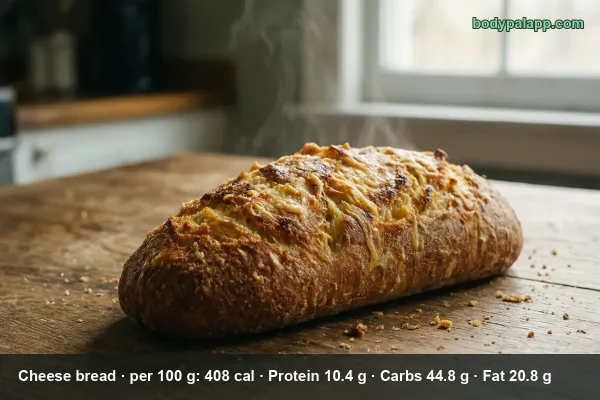
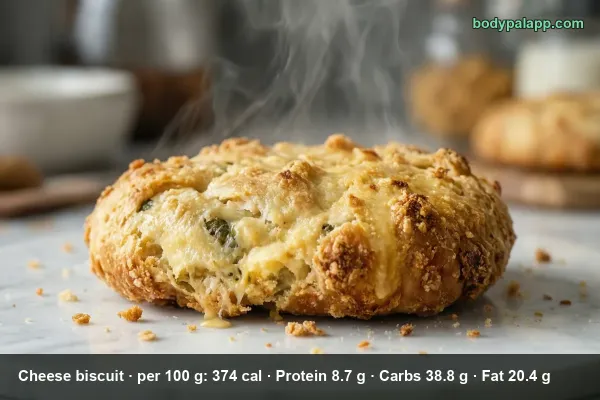
Here is how cheese puffs stack up against other cheesy snacks and breads on our pages, per 100 g and per usual serving.
Verdict: Cheese puffs are the most calorie dense of the group at 567 per 100 g, while cheese ball has 441 with 17.9 g of protein, so pick the cheese ball if you want something that fills you up. For the lowest calories per 100 g, cheese biscuit at 374 wins, though its 946 mg of sodium is even higher than the puffs.
Most popular cheese puff brands in the United States
Ranked by popularity in the BodyPal database
# Productkcal / 100 g
1Terry's Cheese Puffs1 bag · 28 g607 kcal
2Cheetos Cheese Puffs Snacks1 oz · 28 g536 kcal
3Nature's Place Cheese Puffs, White Cheddar28 g464 kcal
4El Paraiso Cheese Puffs30 pieces · 29 g456 kcal
5Troyer Farms White Cheddar Cheese Puffs1 oz · 28 g536 kcal
8Cheetos Winter White Cheese Puffs, Cheddar Cheese1 oz · 28 g571 kcal
Baked puffs carry less oil than fried ones, so brand labels run from 456 to 607 calories per 100 g around the 567 average above. Source: manufacturer labels / USDA FoodData Central.
Cheese puff FAQs
How many calories are in a serving of cheese puffs?
A 1 oz serving (28 g) has 159 calories. A 2 oz bag (57 g) comes to 323 calories.
Are cheese puffs good for weight loss?
One ounce is 159 calories with 10.2 g fat and only 1.5 g protein. The baked low-fat version is 121 calories and 3.4 g fat per ounce.
Cheese puffs vs cheese bread: which has more calories?
Per 100 g cheese puffs have 567 calories and cheese bread 408, so puffs are the denser snack by weight.
How much sodium is in cheese puffs?
A 1 oz serving has about 260 mg sodium, which is 928 mg per 100 g.
What are the nutrition facts for cheese puffs?
A 1 oz serving (28 g) of cheese puffs has 159 calories, 10.2 g of fat, 15.3 g of carbs, 1.5 g of protein and 260 mg of sodium. Per 100 g, that becomes 567 calories and 928 mg of sodium.
Are cheese puffs fattening?
Cheese puffs are calorie dense at 567 calories per 100 g, with 58% of those calories from fat. No food is fattening by itself, but large bowls add up fast, since five servings reach 794 calories.
How many calories are in a bowl of cheese puffs?
A generous bowl of about 84 g, or three 1 oz servings, has 476 calories and 780 mg of sodium. A bigger bowl of 140 g reaches 794 calories, so measuring the bowl makes a big difference.
Are cheese puffs bad for you?
Cheese puffs give 159 calories per ounce with only 1.5 g of protein and 0.2 g of fiber, plus 260 mg of sodium. They fit as an occasional measured snack, but they offer little nutrition for their calories.
Do baked cheese puffs have fewer calories?
Yes. Baked low-fat cheese puffs have 121 calories per 28 g, compared with 159 for regular puffs. Fat falls from 10.2 g to 3.4 g, while sodium stays similar at 236 mg.