
How many calories are in a cheese biscuit?
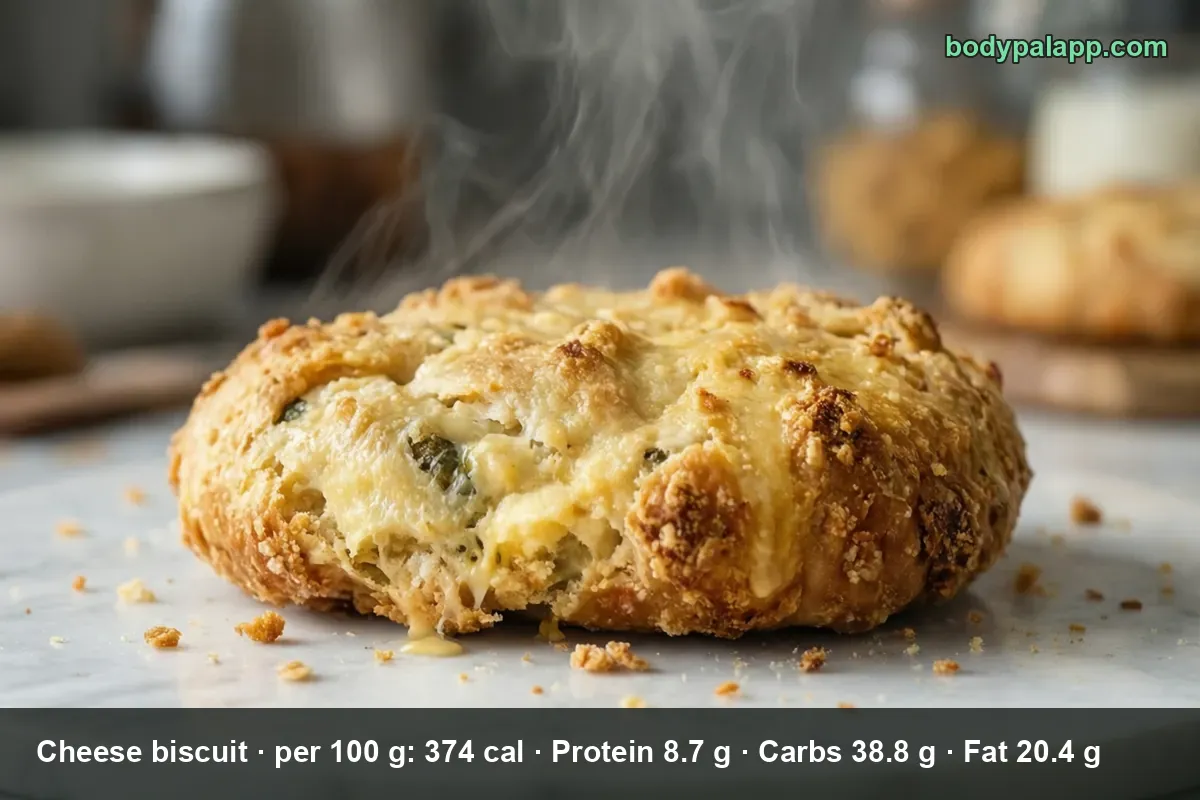
One cheese biscuit weighs 45 g and carries 168 calories. Per 100 g the same baked biscuit runs 374 calories, the densest figure in the whole USDA cheese-biscuit file. Two on a plate come to 337. Sodium moves faster than the calories do here: one biscuit is 426 mg, 19% of a day.
On this page
- Cheese biscuit quick facts
- US servings, from one ounce to three biscuits
- Breakfast sandwiches built on the same biscuit
- Saturated fat and sodium outrun the calories
- How does a cheese biscuit compare?
- Most popular cheese biscuit brands
- Cheese biscuit FAQs
Cheese biscuit quick facts
The row behind every number here is FNDDS 2707806, Biscuit, cheese, from the 2021-2023 survey release. It is the only USDA record for a baked cheese biscuit with nothing inside it. Every other match in the file is a breakfast sandwich, with egg, sausage or bacon stacked between the halves.
The household measure attached to the record is one biscuit at 45 g, about the size of a drop biscuit that comes in a basket at a diner. That is the number a person holds in their hand, so it leads the table.
| Nutrient | Per 100 g | Per 1 biscuit (45 g) | % Daily Value |
|---|---|---|---|
| Calories | 374 | 168 | — |
| Total fat | 20.43 g | 9.2 g | 12% |
| Saturated fat | 12.54 g | 5.6 g | 28% |
| Carbohydrate | 38.78 g | 17.5 g | 6% |
| Dietary fiber | 2.2 g | 1.0 g | 4% |
| Total sugars | 3.52 g | 1.6 g | — |
| Protein | 8.7 g | 3.9 g | 8% |
| Sodium | 946 mg | 426 mg | 19% |
% Daily Value is based on a 2,000-calorie diet.
Verified nutrition data
Numbers on this page come from USDA FoodData Central, the U.S. Department of Agriculture’s food composition database, and from manufacturer labels where a branded product is named. Last verified September 2026. How we verify our data →
Two rows you would see on a package are missing above: added sugars and trans fat. FNDDS does not publish either nutrient for survey foods, so guessing at them would be worse than leaving them out. Cholesterol is small, 12 mg per 100 g and 5 mg in one biscuit, 2% of the Daily Value. Potassium is 126 mg per 100 g, 57 mg per biscuit, about 1%. The FDA Daily Value reference sets every percentage in that column.
One gap worth naming: USDA has no record for a restaurant garlic-cheddar biscuit, the kind that arrives hot in a basket before dinner. The plain baked row is the closest honest stand-in, and those restaurant biscuits are usually heavier, so the calories climb with the weight rather than the recipe.
US servings, from one ounce to three biscuits
| Serving | Weight | Calories |
|---|---|---|
| 1 oz | 28 g | 105 kcal |
| One biscuit, diner size | 45 g | 168 kcal |
| Two biscuits | 90 g | 337 kcal |
| Three biscuits, a shared basket | 135 g | 505 kcal |
| Per 100 g | 100 g | 374 kcal |
Only the 45 g biscuit is a USDA household measure. The ounce and the two- and three-biscuit rows are our own arithmetic from the USDA 100 g figure, not USDA servings, which matters if you are comparing against a label.
Weight is the whole game with biscuits, because they are baked by eye and not portioned by machine. A bigger bakery biscuit at 60 g works out to 224 calories, again our own scaling from the 374 per 100 g figure. Put a tablespoon of butter into the split and you are adding roughly another 100 calories on top of whatever the biscuit itself weighs, which is why two biscuits with butter can quietly outrun a fast-food breakfast sandwich.
Breakfast sandwiches built on the same biscuit
| Version | Per 100 g | Typical serving | Calories |
|---|---|---|---|
| Plain cheese biscuit | 374 kcal | 1 biscuit (45 g) | 168 kcal |
| Sausage, egg and cheese biscuit | 316 kcal | 1 regular (190 g) | 600 kcal |
| Bacon, egg and cheese biscuit | 315 kcal | 1 regular (160 g) | 504 kcal |
| Sausage biscuit with cheese | 370 kcal | 1 regular (135 g) | 500 kcal |
| McDonald's bacon, egg & cheese biscuit | 304 kcal | 1 item, 4.9 oz (142 g) | 432 kcal |
| Frozen sausage, egg & cheese biscuit | 324 kcal | 1 biscuit (126 g) | 408 kcal |
Here is the trap that catches people who log by density. Per 100 g the plain cheese biscuit is the heaviest thing in that table at 374, higher than the McDonald's sandwich at 304. Per actual serving the order flips completely: 168 against 432, because the sandwich weighs 142 g and the biscuit weighs 45 g. Egg and meat carry water, and water dilutes calories per gram while adding grams.
Adding an egg is the cheapest upgrade in the group. The sausage biscuit with cheese, no egg, is 500 calories in 135 g; the sausage, egg and cheese version is 600 calories but spreads them over 190 g, and the protein runs close to six times that of the plain biscuit. The packaged aisle is all sandwiches too. There is no branded row for a plain baked cheese biscuit in USDA's US Branded file, only frozen breakfast sandwiches from names like Jimmy Dean and Bob Evans. The unprepared frozen Jimmy Dean sausage, egg and cheese biscuit reads 328 per 100 g, higher than the 324 of the generic frozen row, mostly because the water has not cooked off yet.
Saturated fat and sodium outrun the calories
A single biscuit is 168 calories, 8% of a 2,000-calorie day. Its saturated fat is 5.6 g, which is 28% of the 20 g Daily Value. Those two percentages should be roughly equal in a balanced food, and they are not close. Butter or shortening plus cheese does that, and the Dietary Guidelines for Americans put the ceiling at less than 10% of daily calories from saturated fat. Two biscuits push past half of the day's saturated fat while supplying about a sixth of the day's calories.
Sodium tells the same story from a different angle. One biscuit is 426 mg, 19% of the 2,300 mg Daily Value, roughly a fifth of a teaspoon of table salt baked into something that disappears in four bites. Two biscuits are 852 mg, 37%, before any gravy, ham or extra cheese joins in. If you are watching blood pressure, the biscuit is the item to count, not the eggs next to it.
There is a modest upside. At 2.2 g of fiber per 100 g, the biscuit is not empty flour, and 1.0 g per biscuit is 4% of the Daily Value. Total sugars are only 1.6 g in a biscuit, which is low for a baked good. On the MyPlate grains guidance this still sits with refined grains, so it works better as the small side to eggs and fruit than as the base of the meal.
How does a cheese biscuit compare?
| Item | Per 100 g | US serving | Calories |
|---|---|---|---|
| Cheese biscuit | 374 kcal | one biscuit, 45 g | 168 kcal |
| Sausage biscuit with cheese | 370 kcal | one regular, 135 g | 500 kcal |
| McDonald's Bacon Egg & Cheese Biscuit | 304 kcal | one item, 4.9 oz (142 g) | 432 kcal |
| Frozen sausage, egg & cheese biscuit | 324 kcal | one biscuit, 126 g | 408 kcal |
Our take: for weight loss, the plain biscuit wins by a mile on the plate, 168 against 408 to 500 for anything with meat in it, provided you stop at one and skip the butter. For staying full until lunch, the sandwich is the better buy, because 3.9 g of protein in a biscuit will not hold anyone and the bacon-egg build carries roughly 19 g in one item. What we would not do is eat two or three plain biscuits as a side: 505 calories and 84% of a day's saturated fat is a worse trade than one whole breakfast sandwich.
Most popular cheese biscuit brands in the United States
Ranked by how widely each product appears among foods sold in the United States, from the BodyPal food database of over 3.3 million products. Calories are the figures printed on each Nutrition Facts label, checked against USDA FoodData Central.
| Product | Calories (per 100 g) |
|---|---|
| Red Lobster Cheddar Bay Biscuits | 273 cal |
| Pillsbury Cheddar Garlic Biscuits | 311 cal |
| Mason Dixie Biscuit Co. Cheddar Biscuits | 312 cal |
| Callie's Sharp Cheddar Biscuits | 273 cal |
| Pepperidge Farm Garlic & Cheese Biscuits | 333 cal |
| Taste of Inspirations Cheddar & Chive Biscuits | 347 cal |
Brand popularity: BodyPal food database. Nutrition: manufacturer labels / USDA FoodData Central.
Cheese biscuit FAQs
How many calories are in one cheese biscuit?
168 calories for one 45 g biscuit, at 374 calories per 100 g. That is the plain baked cheese biscuit with nothing stacked on it. Two put you at 337, three at 505. If your biscuit is bigger than 45 g, scale from the 374 figure by weight.
How many calories in a cheddar biscuit?
The same 168 calories per 45 g biscuit. USDA files one survey record for a baked cheese biscuit, and it covers cheddar versions as well, since the file does not split them by cheese type. A restaurant garlic cheddar biscuit is usually heavier, so weigh it and scale from 374 per 100 g.
How much sodium is in a cheese biscuit?
426 mg in one 45 g biscuit, or 19% of the 2,300 mg Daily Value. Per 100 g the number is 946 mg. Two biscuits reach 852 mg, 37% of a day, and that is before butter, gravy or a slice of cheese goes on top.
Are cheese biscuits high in saturated fat?
Yes — one biscuit carries 5.6 g of saturated fat, 28% of the 20 g Daily Value, from 12.54 g per 100 g. The calories are only 168, so the saturated fat runs far ahead of them. Two biscuits cover more than half a day's limit.
How many carbs are in a cheese biscuit?
17.5 g of carbohydrate in one 45 g biscuit, 6% of the Daily Value, with 1.0 g of fiber and 1.6 g of total sugars inside that number. Per 100 g it is 38.78 g. For a baked good the sugar is low; the flour does almost all of the work.
How much protein is in a cheese biscuit?
3.9 g per 45 g biscuit, 8% of the Daily Value, from 8.7 g per 100 g. That is modest for a breakfast built around it. A sausage, egg and cheese version on the same biscuit runs about 12 g per 100 g, roughly 23 g in a 190 g sandwich.
How many calories in a sausage, egg and cheese biscuit?
600 calories for a regular 190 g sandwich, at 316 calories per 100 g. The bacon, egg and cheese build is lighter only because it is smaller: 315 per 100 g, 504 calories for a 160 g sandwich. Both are at least triple the plain 45 g biscuit.
How many calories in two cheese biscuits?
337 calories for two 45 g biscuits, 90 g in total, which is our own arithmetic from the USDA 100 g figure rather than a USDA serving. They also bring 11.2 g of saturated fat, 56% of a day, and 852 mg of sodium, 37%. Three reach 505 calories.
Similar foods
- Blueberry Scone — 262 cal per scone
- Cake Mix — 161 cal per serving dry mix
- Zebra Cake — 157 cal per cake
- Biscotti — 119 cal per cookie
- Blueberry Muffin — 424 cal per medium muffin
- Corn Chex Cereal — 145 cal per cup
Count it without the math
Point the camera at the plate and BodyPal counts the biscuit for you, butter and all.


How long does it take to burn off 168 kcal of cheese biscuit?
One biscuit (45 g) is 168 kcal. Enter your weight and the amount you ate to see how long it takes you to burn that off:
lb
| Activity | Time to burn 168 kcal |
|---|---|
| Walking, brisk | 34 min |
| Cycling, moderate | 21 min |
| Swimming, moderate | 24 min |
| Jogging | 20 min |
| Weight training, moderate | 37 min |
Times are for a 155 lb adult at a steady pace; change the weight to see yours. The amount is set to the portion in the text (45 g); change it to what you actually ate. BodyPal works this out from your steps automatically.
This table assumes you know your daily total. If you do not, the daily calorie calculator works it out from five numbers.