
How many calories are in cake mix?
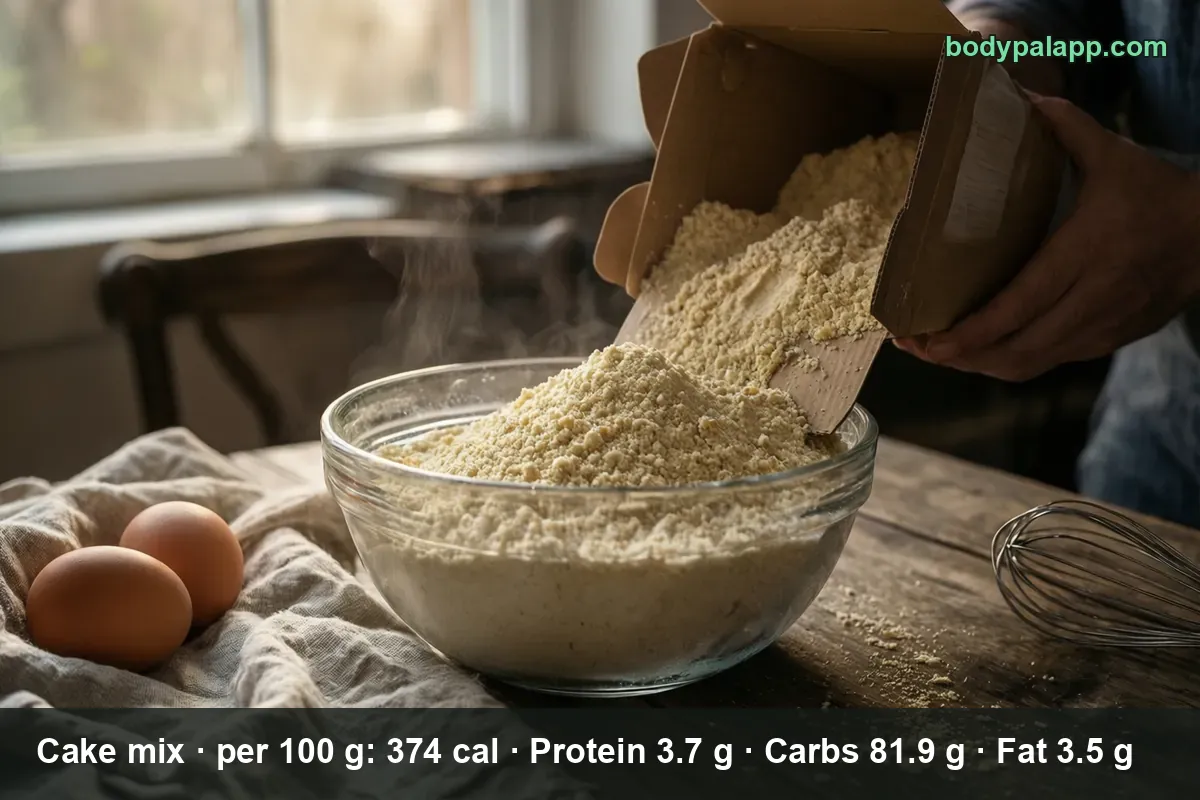
One USDA serving of dry cake mix is 43 g and 161 calories, and the powder itself runs 374 calories per 100 g. That is the box, not the cake. Yellow enriched mix is the American default, and the eggs and oil the back of the box asks for land on top of that number.
On this page
- Cake mix quick facts
- Servings from one ounce to the whole box
- Pudding chocolate light and gingerbread mixes
- Dry mix versus the baked cake
- Sodium is the row to watch
- How does cake mix compare?
- Most popular cake mix brands
- Cake mix FAQs
Cake mix quick facts
The record that matches what you are holding is SR Legacy 174947, "Cake, yellow, enriched, dry mix". It is the plain yellow box that sits on every supermarket shelf, and its USDA serving of 43 g is the same portion the label on the side of the box uses. USDA also publishes rows for cake baked from a mix, but those are a finished dish with eggs, oil and frosting folded in. If the powder is still in the bowl, this is your row.
| Nutrient | Per 100 g | Per 1 serving dry mix (43 g) | % Daily Value |
|---|---|---|---|
| Calories | 374 | 161 | — |
| Total fat | 3.5 g | 1.5 g | 2% |
| Saturated fat | 1.62 g | 0.7 g | 3% |
| Carbohydrate | 81.92 g | 35.2 g | 13% |
| Dietary fiber | 1.2 g | 0.5 g | 2% |
| Total sugars | 43.29 g | 18.6 g | — |
| Protein | 3.7 g | 1.6 g | 3% |
| Sodium | 728 mg | 313 mg | 14% |
% Daily Value is based on a 2,000-calorie diet.
Verified nutrition data
Numbers on this page come from USDA FoodData Central, the U.S. Department of Agriculture’s food composition database, and from manufacturer labels where a branded product is named. Last verified September 2026. How we verify our data →
There is no added sugars row here because the SR Legacy edition of this record does not publish one, so nothing on this page tells you how much of the 18.6 g of total sugars in a serving would count against the added sugars advice in the Dietary Guidelines. For a dry cake mix the honest guess is "most of it," but a guess is not a number and we do not print guesses. Cholesterol is 0 mg, dry mix being a flour-and-sugar product with no egg in it yet. Potassium is 47 mg per 100 g, 20 mg in a serving, which rounds to 0% of the Daily Value.
Servings from one ounce to the whole box
| Serving | Weight | Calories |
|---|---|---|
| 1 oz dry mix | 28 g | 106 kcal |
| One serving, label and USDA | 43 g | 161 kcal |
| Half a package | 262 g | 980 kcal |
| One package, 18.5 oz box | 524 g | 1960 kcal |
| Per 100 g | 100 g | 374 kcal |
Only the 43 g line is a USDA household serving. The ounce, the half box and the full box are our own arithmetic from the USDA 100 g figure, not USDA servings, and the box weight is the standard 18.5 oz size most yellow mixes are sold in. Brand labels slice the same box differently: Duff Goldman's Red Velvet mix calls 43 g "0.3 cup," Betty Crocker's Super Moist Vanilla calls the same 43 g one tenth of a package, and a gluten-free box goes to one ninth at 47 g.
The number worth staring at is the last one. A whole box is 1,960 calories of powder before a single egg goes in. That is why the "I only had a small slice" arithmetic so often fails: a two-layer cake starts at roughly two thousand calories, then gains everything you stir into it.
Pudding chocolate light and gingerbread mixes
| Version | Per 100 g | Serving | Calories |
|---|---|---|---|
| Yellow, enriched (the main row) | 374 kcal | 43 g dry | 161 kcal |
| Pudding-type yellow | 423 kcal | 43 g dry | 182 kcal |
| Pudding-type white | 423 kcal | 43 g dry | 182 kcal |
| Pudding-type chocolate | 391 kcal | 43 g dry | 168 kcal |
| Yellow, light | 404 kcal | 43 g dry | 174 kcal |
| Gingerbread | 437 kcal | 43 g dry | 188 kcal |
Every 43 g figure in that table except the main row is our own arithmetic from each record's 100 g value, since USDA gives those mixes no household serving of their own.
Pudding in the mix costs you 49 calories per 100 g, and the reason is fat: 9.8 g per 100 g against 3.5 g in plain yellow. Same box, same scoop, 21 more calories. Pudding-type chocolate is the exception in the group at 391 per 100 g, because cocoa displaces some of the sugar (39.53 g against 44.21 g in the yellow) and pushes fiber up to 2.3 g.
The row labeled "light" is the trap. Light yellow mix is 404 calories per 100 g, thirty more than the plain yellow it is meant to improve on, and it carries 5.5 g of fat against 3.5 g. USDA does not report sugars for that record at all, so it stays out of any sugar comparison here. Gingerbread tops the group at 437 per 100 g on the strength of molasses and shortening in the powder.
Dry mix versus the baked cake
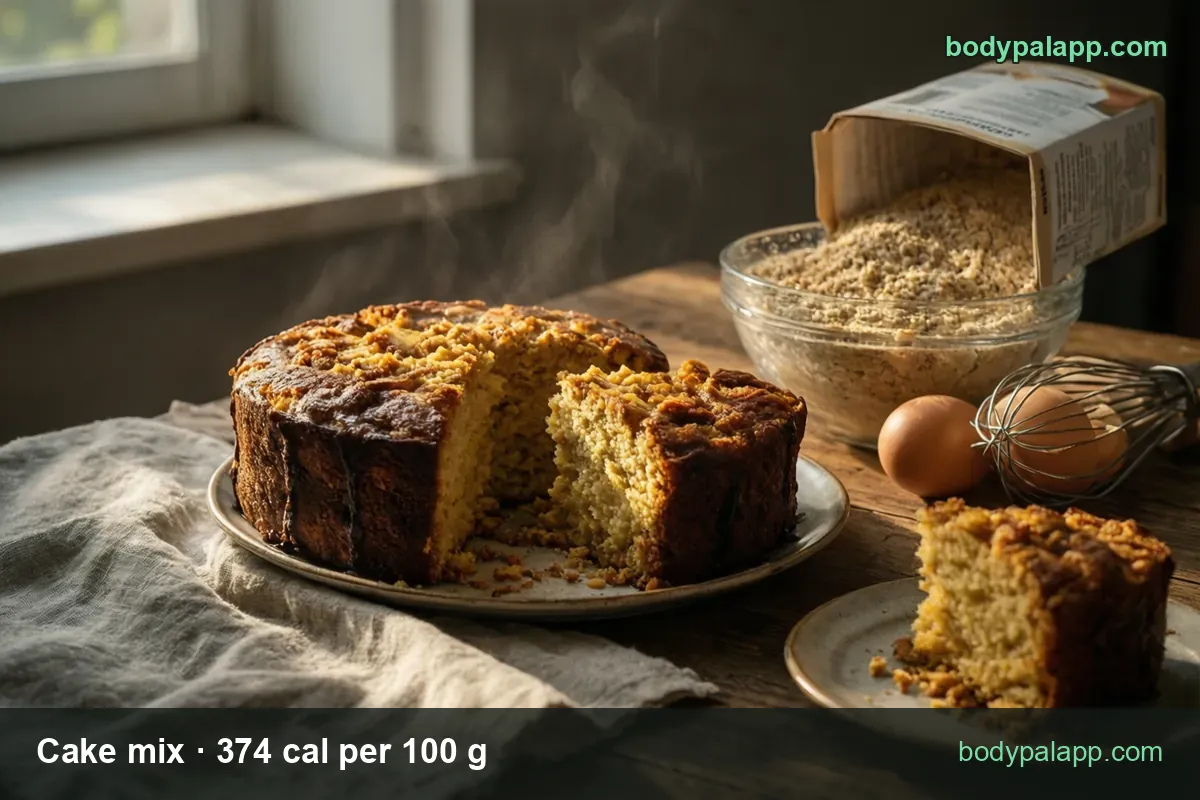
Here is the comparison people get backwards. Per gram, the dry mix is the more concentrated food: 374 calories per 100 g against 353 calories per 100 g for a white cake with white icing baked from a mix. Baking does not burn calories off; it adds water and air, and water weighs something. So the finished cake is diluted per gram even after eggs, oil and frosting go in.
Per portion the picture flips hard. A 43 g scoop of powder is 161 calories. A regular 100 g slice of that finished cake is 353. A generous 150 g slice is about 530 calories by our own arithmetic from the 353 per 100 g figure. Nobody eats cake by the 43 g scoop, which is exactly why the box number feels reassuring and the plate number does not.
| What you are logging | Per 100 g | Portion | Calories |
|---|---|---|---|
| Dry yellow mix | 374 kcal | 43 g serving | 161 kcal |
| Cake from mix, white with icing | 353 kcal | 1 regular slice, 100 g | 353 kcal |
| Cake from mix, white with icing | 353 kcal | 1 large slice, 150 g | 530 kcal |
The angel food route is the genuine shortcut. USDA's angel food cake from mix, prepared is 257 calories per 100 g with 0.3 g of fat, because it is built on egg whites with no yolk and no oil. That is about a quarter less per gram than a frosted white cake, and it comes from the recipe, not from a "light" claim on the front of the box.
Sodium is the row to watch
A 43 g serving of dry cake mix delivers 313 mg of sodium. That is 14% of the 2,300 mg Daily Value the FDA sets, or a shade more than an eighth of a teaspoon of table salt, from something that tastes purely sweet. Set it against the energy: the same serving is 161 calories, about 8% of a 2,000-calorie day. Sodium is arriving at nearly twice the rate of calories.
Baking powder and baking soda are the culprits, not the sugar. Scale it to the container and the whole 524 g box works out to roughly 3,815 mg of sodium, about 166% of a day's Daily Value, spread across a cake that usually feeds ten or twelve people. If you are tracking sodium closely, this is a food that will quietly show up in your daily total in a way you did not plan for.
Protein is the other quiet row: 1.6 g per serving, 3% of the Daily Value. Cake mix is essentially refined grain and sugar, and MyPlate treats that kind of grain as something to keep to a minority of your day's servings. If you are choosing between a slice and a snack that has to hold you until dinner, this one will not.
How does cake mix compare?
| Mix or cake | Per 100 g | US serving | Calories |
|---|---|---|---|
| Yellow cake mix, dry | 374 kcal | 43 g dry | 161 kcal |
| Pudding-type yellow mix, dry | 423 kcal | 43 g dry | 182 kcal |
| Pudding-type chocolate mix, dry | 391 kcal | 43 g dry | 168 kcal |
| Cake from mix, white with icing | 353 kcal | 1 slice, 100 g | 353 kcal |
Our take: plain yellow is the lightest dry mix in this group per gram, and the differences between the boxes are small enough that the choice barely matters — 21 calories separate plain yellow from pudding-type at the same scoop. What matters is the slice. The baked, frosted cake is 353 calories in a modest piece and around 530 in a big one, so the finished portion moves your day two to three times more than any decision in the baking aisle. If you want the mix to work in your favor, buy whichever box you like and cut smaller pieces. If you want a real calorie cut, go angel food at 257 per 100 g and skip the frosting.
Most popular cake mix brands in the United States
Ranked by how widely each product appears among foods sold in the United States, from the BodyPal food database of over 3.3 million products. Calories are the figures printed on each Nutrition Facts label, checked against USDA FoodData Central.
| Product | Calories (per 100 g) |
|---|---|
| Halo Top Birthday Cake Light Cake Mix | 340 cal |
| Betty Crocker Pineapple Upside-Down Cake Mix | 351 cal |
| Betty Crocker Confetti Angel Food Cake Mix | 372 cal |
| Betty Crocker Gluten Free Yellow Cake Mix | 381 cal |
| Duff Goldman Red Velvet Premium Cake Mix | 395 cal |
| Betty Crocker Super Moist Vanilla Cake Mix | 376 cal |
Brand popularity: BodyPal food database. Nutrition: manufacturer labels / USDA FoodData Central.
Cake mix FAQs
How many calories are in one serving of dry cake mix?
One USDA serving of dry yellow cake mix is 43 g and 161 calories, from a mix that runs 374 calories per 100 g. That is the powder only. The eggs, oil or butter and any frosting you add on top are counted separately, and they are not small.
How many calories are in a whole box of cake mix?
A standard 18.5 oz box holds 524 g of dry mix, which is 1,960 calories by our own arithmetic from the USDA 100 g figure. Half a box is 980. Nobody eats that in one sitting, but it is the floor the finished cake is built on, before eggs and oil.
Does cake mix have more calories dry or baked?
Per gram the dry mix is higher: 374 calories per 100 g against 353 for a baked white cake with icing. Water is the reason, since baking adds weight rather than energy. Per portion the baked cake wins easily, because a 100 g slice is 353 calories and a 43 g scoop is 161.
How many calories does a Betty Crocker cake mix have?
Betty Crocker Super Moist Vanilla lists 162 calories per 43 g of dry mix, at 376 per 100 g. The Gluten Free Yellow is 179 per 47 g serving, the Confetti Angel Food 149 per 40 g, and the Pineapple Upside-Down 358 per 102 g of mix and topping combined.
Is pudding-in-the-mix cake higher in calories?
Yes. Pudding-type yellow dry mix is 423 calories per 100 g against 374 for plain yellow, so the same 43 g scoop goes from 161 to 182 calories. The gap is fat: 9.8 g per 100 g versus 3.5 g. Pudding-type chocolate sits lower at 391 per 100 g.
How much sodium is in cake mix?
A 43 g serving of dry yellow mix carries 313 mg of sodium, 14% of the 2,300 mg Daily Value, roughly an eighth of a teaspoon of table salt. That is a lot for something sweet, and the leavening does it rather than the sugar. The whole 524 g box comes to about 3,815 mg.
How many calories are in angel food cake mix?
USDA lists angel food cake from mix, prepared, at 257 calories per 100 g, the lowest cake on this page, because there is no yolk and almost no fat at just 0.3 g per 100 g. Betty Crocker's Confetti Angel Food mix is 149 calories per 40 g of dry powder.
Does gluten-free cake mix have fewer calories?
No. Betty Crocker Gluten Free Yellow Cake Mix is 381 calories per 100 g, slightly above the 374 of the standard USDA yellow mix, and its serving is bigger at 179 calories per 47 g against 161 per 43 g. Going gluten free changes the flour, not the calorie count.
Similar foods
- Blueberry Scone — 262 cal per scone
- Cheese Biscuit — 168 cal per biscuit
- Zebra Cake — 157 cal per cake
- Biscotti — 119 cal per cookie
- Blueberry Muffin — 424 cal per medium muffin
- Corn Chex Cereal — 145 cal per cup
Count it without the math
Point the camera at the bowl or the slice and BodyPal counts it for you, mix and frosting alike.


How long does it take to burn off cake mix?
One serving of dry mix (43 g) is 161 kcal. Enter your weight and the amount you ate to see how long it takes you to burn that off:
lb
| Activity | Time to burn 161 kcal |
|---|---|
| Walking, brisk | 32 min |
| Cycling, moderate | 20 min |
| Swimming, moderate | 23 min |
| Jogging | 19 min |
| Weight training, moderate | 36 min |
Times are for a 155 lb adult at a steady pace; change the weight to see yours. The amount is set to the portion in the text (43 g); change it to what you actually ate. BodyPal works this out from your steps automatically.
This table assumes you know your daily total. If you do not, the daily calorie calculator works it out from five numbers.