
How many calories are in a blueberry muffin?
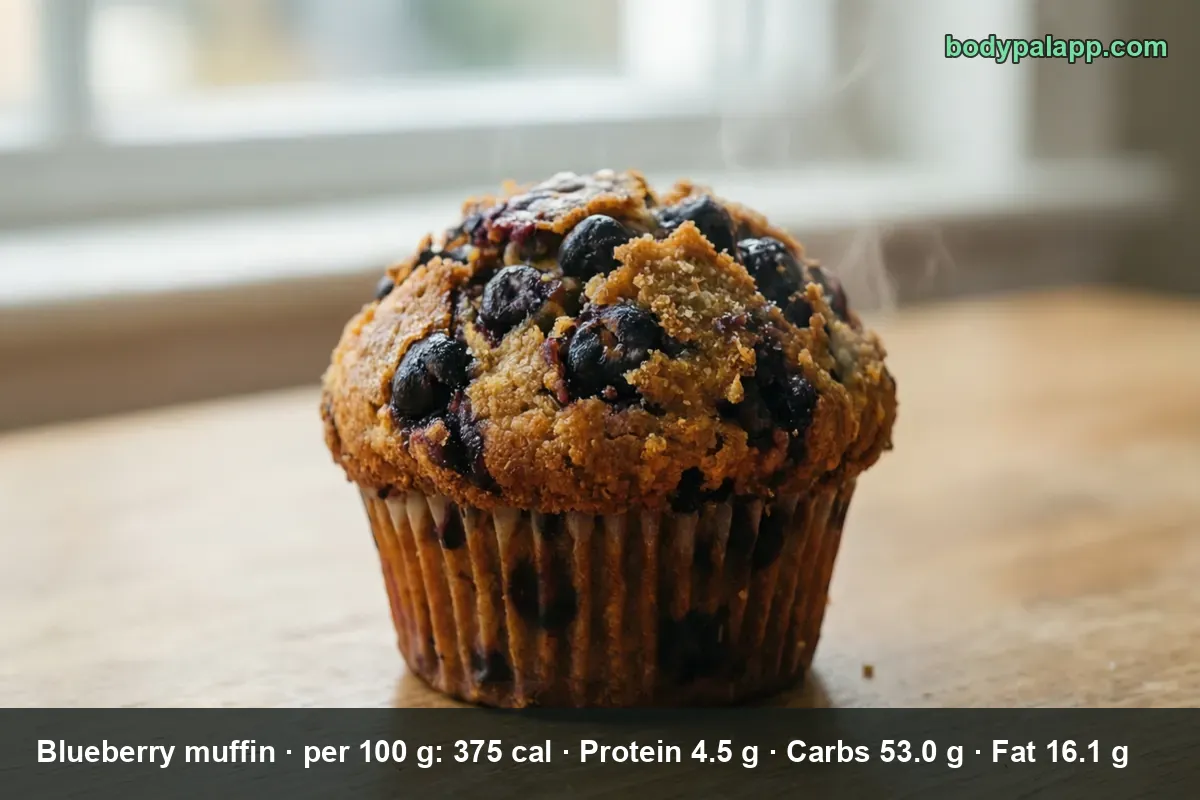
One medium blueberry muffin from a supermarket bakery case weighs 113 g and carries 424 calories. Per 100 g the muffin runs 375 calories, which puts it in doughnut territory rather than breakfast-bread territory. A large one, 139 g, is 521. The blueberries are not what is driving that number.
On this page
- Blueberry muffin quick facts
- US servings, from a mini to a coffee-shop large
- Low-fat, homemade, toaster-type and dry mix
- Sodium and sugar are the rows to watch
- How does a blueberry muffin compare?
- Most popular blueberry muffin brands
- Blueberry muffin FAQs
Blueberry muffin quick facts
The record that matches what most people are actually holding is SR Legacy 172765, "Muffins, blueberry, commercially prepared (Includes mini-muffins)". That is the bakery-case, gas-station, office-tray muffin: made with oil or shortening, sweetened hard, and sold in one piece. It is also the only blueberry muffin record carrying a full ladder of household sizes, from mini all the way up to large, which is what makes it usable for counting rather than admiring.
The column below is a medium muffin at 113 g. If your muffin came out of a paper liner the size of a fist, that is your row.
| Nutrient | Per 100 g | Per 1 medium muffin (113 g) | % Daily Value |
|---|---|---|---|
| Calories | 375 | 424 | — |
| Total fat | 16.07 g | 18.2 g | 23% |
| Saturated fat | 2.84 g | 3.2 g | 16% |
| Carbohydrate | 53 g | 59.9 g | 22% |
| Dietary fiber | 1.1 g | 1.2 g | 4% |
| Total sugars | 31.47 g | 35.6 g | — |
| Protein | 4.49 g | 5.1 g | 10% |
| Sodium | 336 mg | 380 mg | 17% |
% Daily Value is based on a 2,000-calorie diet.
Verified nutrition data
Numbers on this page come from USDA FoodData Central, the U.S. Department of Agriculture’s food composition database, and from manufacturer labels where a branded product is named. Last verified September 2026. How we verify our data →
There is no added-sugars row here, because the SR Legacy edition of this record does not publish added sugars — only total sugars, which have no Daily Value of their own. Two more rows worth knowing: cholesterol is 34 mg per medium muffin (11% DV) and potassium is 137 mg (3% DV), so the muffin gives you a real cholesterol hit and almost no potassium back.
US servings, from a mini to a coffee-shop large
| Serving | Weight | Calories |
|---|---|---|
| 1 mini muffin (1-1/4 in) | 17 g | 64 kcal |
| 1 oz | 28.4 g | 106 kcal |
| 1 small muffin (2-3/4 in) | 66 g | 248 kcal |
| 1 medium muffin | 113 g | 424 kcal |
| 1 large muffin (3-1/4 in) | 139 g | 521 kcal |
| Per 100 g | 100 g | 375 kcal |
Every line in that table is a USDA household measure for record 172765, so the sizes come with the data rather than from us. What they show is the trap: the word "muffin" covers a 17 g bite and a 139 g dome, and the two differ by 457 calories.
The gap gets wider once you leave the grocery aisle. A big coffee-shop muffin at 168 g would land near 630 calories, which is our own arithmetic from the USDA 100 g figure, not a USDA serving. And the reference muffin used in older nutrition tables is only 31 g — 116 calories. The muffin in the display case can be four and a half times that, for the same three words on the label.
Blueberry muffins are one of the most-logged breakfast pastries in BodyPal, and the size picked is where nearly all the error lives. Weigh one on a kitchen scale once and you will know which row is yours forever.
Low-fat, homemade, toaster-type and dry mix
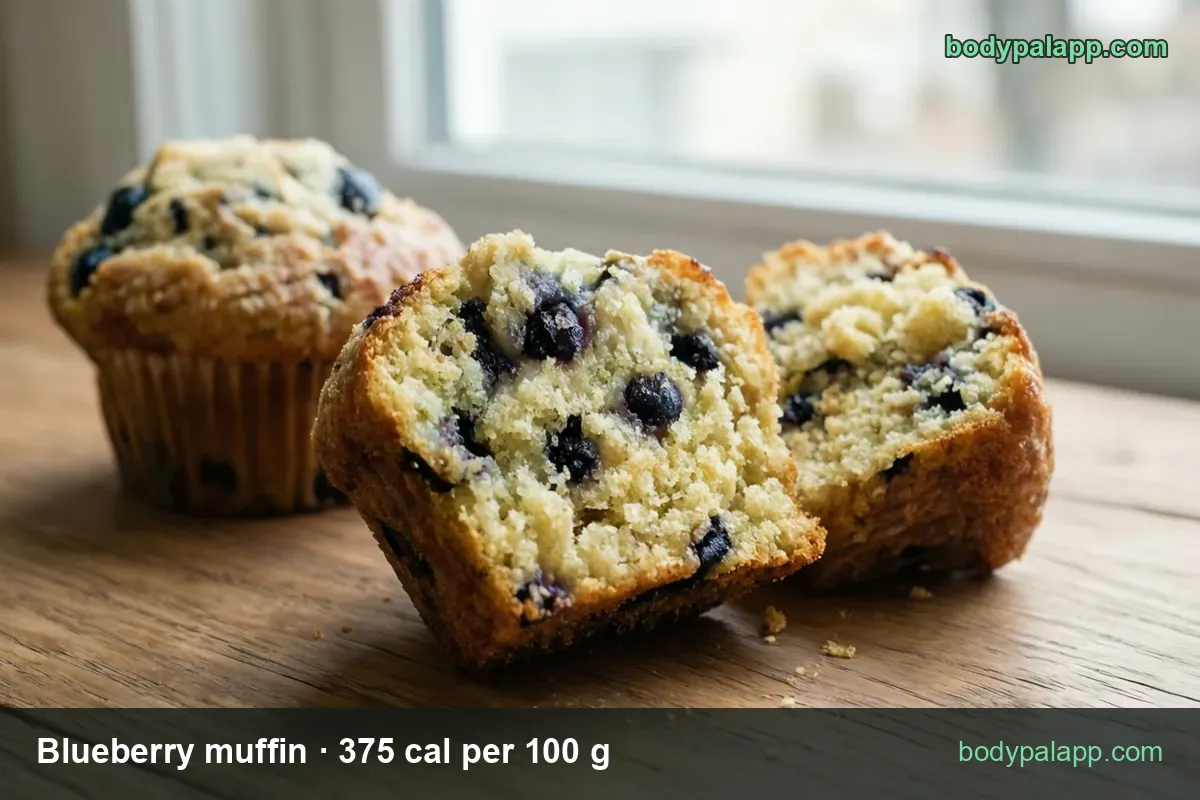
USDA keeps six other blueberry muffin records, and they are not small variations on the same thing — they are different foods that happen to share a name.
| Version | Per 100 g | Typical piece | Calories |
|---|---|---|---|
| Commercially prepared (main record) | 375 kcal | 1 medium muffin (113 g) | 424 kcal |
| Low-fat, commercially prepared | 255 kcal | 1 medium muffin (113 g, our arithmetic) | 288 kcal |
| Homemade, made with 2% milk | 285 kcal | 1 medium muffin (113 g, our arithmetic) | 322 kcal |
| Toaster-type, toasted | 333 kcal | 1 toaster muffin (31 g) | 103 kcal |
| Toaster-type, untoasted | 313 kcal | 1 toaster muffin (33 g) | 103 kcal |
| Blueberry muffin dry mix | 293 kcal | 1 serving of mix (43 g) | 126 kcal |
| Artificial blueberry muffin mix, dry | 407 kcal | 1 muffin's worth of mix (31 g) | 126 kcal |
The low-fat version is the most interesting line. It drops 120 calories per 100 g against the standard muffin, and that saving comes almost entirely from fat: 4.22 g versus 16.07 g. Sugar barely moves, from 31.47 g down to 27.05 g. Low-fat here means less oil, not less dessert.
The from-recipe record — a muffin baked at home with 2% milk — sits in the middle at 285 per 100 g, with more protein (6.5 g) than the store version. USDA does not publish total sugars or fiber for that record, so it stays out of any sugar comparison on this page.
Toaster muffins look like a bargain at 103 calories, but that is because the piece is 31–33 g, a quarter of a bakery muffin. Toasting one does not add calories; it removes water, which is why the toasted record reads higher per 100 g (333) than the untoasted one (313) while the piece stays at the same 103. Same rule as toast, same rule as jerky: dry the food, concentrate the number.
Branded muffins track the main record closely. Otis Spunkmeyer's wild blueberry muffin is 410 calories for its 113 g muffin, and Udi's gluten-free version is 260 for a smaller 85 g muffin — the gluten-free one is lighter mostly because the muffin is a quarter smaller, and a little lighter per gram too (306 against 363).
Sodium and sugar are the rows to watch
A medium muffin carries 380 mg of sodium, which is 17% of the FDA Daily Value of 2,300 mg — about a sixth of a teaspoon of table salt baked into something you think of as sweet. Set that next to protein, which comes in at 5.1 g, or 10% DV. The muffin delivers more of your sodium budget than of your protein budget, which is a strange trade for a breakfast.
Fiber is the other thin row: 1.2 g, or 4% of the 28 g DV. MyPlate's grains guidance is built around whole grains, and a commercial blueberry muffin is refined flour with berries in it. If you want the muffin to be breakfast rather than dessert, the fix is not a smaller muffin — it is something with protein and fiber next to it.
Saturated fat is milder than you would guess: 3.2 g, 16% DV. For a 424-calorie pastry that is a reasonable showing.
How does a blueberry muffin compare?
| Food | Per 100 g | US serving | Calories |
|---|---|---|---|
| Blueberry muffin | 375 kcal | 1 medium muffin (113 g) | 424 kcal |
| Butter croissant | 406 kcal | 1 oz (28.4 g) | 115 kcal |
| Pecan pie, commercially prepared | 407 kcal | 1 oz (28.4 g) | 115 kcal |
| Croutons, plain | 407 kcal | 0.5 oz (14.2 g) | 58 kcal |
Our take: per gram, the blueberry muffin is the lightest thing in that table — 375 against 406 and 407 for all three neighbors. Per plate it is the heaviest by a mile, because nobody eats an ounce of muffin. Matched at 113 g, a butter croissant would be 459 calories and pecan pie 460, both our own arithmetic from the USDA 100 g figures. So the honest verdict is that the muffin is not an unusually rich pastry; it is an unusually large one. If you are cutting calories, halve the muffin or buy the small size — that single decision is worth more than switching pastries.
Most popular blueberry muffin brands in the United States
Ranked by how widely each product appears among foods sold in the United States, from the BodyPal food database of over 3.3 million products. Calories are the figures printed on each Nutrition Facts label, checked against USDA FoodData Central.
| Product | Calories (per 100 g) |
|---|---|
| Otis Spunkmeyer Wild Blueberry Muffin | 363 cal |
| Schwartz Brothers Bakery Blueberry Muffins | 366 cal |
| Hill & Valley Blueberry Muffins | 338 cal |
| Fresh & Easy Wild Blueberry Muffins | 370 cal |
| Udi's Gluten Free Blueberry Muffins | 306 cal |
| Harvest Bakery Blueberry Muffins | 354 cal |
Brand popularity: BodyPal food database. Nutrition: manufacturer labels / USDA FoodData Central.
Blueberry muffin FAQs
How many calories are in a blueberry muffin?
424 calories for a medium commercially prepared muffin weighing 113 g, at 375 calories per 100 g. A small 66 g muffin is 248 and a large 139 g one is 521. Weight decides the number more than recipe does, so check the size before you log it.
How many calories in a large bakery blueberry muffin?
521 calories for USDA's large size, 139 g and 3-1/4 inches across. Coffee-shop muffins often run bigger still; at 168 g the same food would be about 630 calories, which is our own arithmetic from the USDA 100 g figure rather than a USDA serving.
How many carbs are in a blueberry muffin?
59.9 g of carbohydrate in a medium 113 g muffin, or 22% of the Daily Value, with only 1.2 g of that as fiber. Per 100 g the figure is 53 g. A small 66 g muffin brings that to a little over half as much.
How much sugar is in a blueberry muffin?
35.6 g of total sugars in a medium 113 g muffin, and 31.47 g per 100 g. USDA does not split out added sugars for this record, so there is no clean way to say how much came from the batter versus the fruit. Total sugars carry no Daily Value.
Are blueberry muffins healthy?
One medium muffin is 424 calories with 5.1 g protein and 1.2 g fiber, so it eats like dessert rather than breakfast. It also carries 380 mg sodium, 17% of the Daily Value. If you are watching sodium or sugar, the small size with some protein alongside is the better call.
How many calories in a mini blueberry muffin?
64 calories for USDA's mini muffin, 17 g and about 1-1/4 inches across. Six of them come to 384, still under a single medium muffin at 424. Bakery minis are often larger than the USDA reference, so weigh a couple if the tray looks generous.
How many calories in a low-fat blueberry muffin?
255 calories per 100 g, so a 113 g muffin works out to 288 by our own arithmetic from that figure. The saving is fat: 4.22 g against 16.07 g in the standard muffin. Sugar only falls from 31.47 g to 27.05 g per 100 g, so it is still a sweet food.
How much protein is in a blueberry muffin?
5.1 g in a medium 113 g muffin, which is 10% of the 50 g Daily Value, or 4.49 g per 100 g. A homemade muffin made with 2% milk is a little better at 6.5 g per 100 g. Either way, the muffin gives you more sodium percentage than protein percentage.
Similar foods
- Cinnamon Roll — 335 cal plain, 407 frosted
- Scone — 267 cal per regular scone
- Garlic Bread — 143 cal per slice
- Chocolate chip muffin — 523 cal per medium muffin
- Apple Fritter — 455 cal per fritter
- Crescent roll — 114 cal per crescent roll
Count it without the math
Point the camera at the muffin and BodyPal counts it for you, size and all.


How long does it take to burn off 424 kcal of blueberry muffin?
One medium muffin (113 g) is 424 kcal. Enter your weight and the amount you ate to see how long it takes you to burn that off:
lb
| Activity | Time to burn 424 kcal |
|---|---|
| Walking, brisk | 1 hr 25 min |
| Cycling, moderate | 53 min |
| Swimming, moderate | 1 hr 1 min |
| Jogging | 50 min |
| Weight training, moderate | 1 hr 34 min |
Times are for a 155 lb adult at a steady pace; change the weight to see yours. The amount is set to the portion in the text (113 g); change it to what you actually ate. BodyPal works this out from your steps automatically.
One food is easy to picture; a whole day is harder. See how many calories you need a day and what a deficit actually looks like.