
How many calories in an apple fritter?
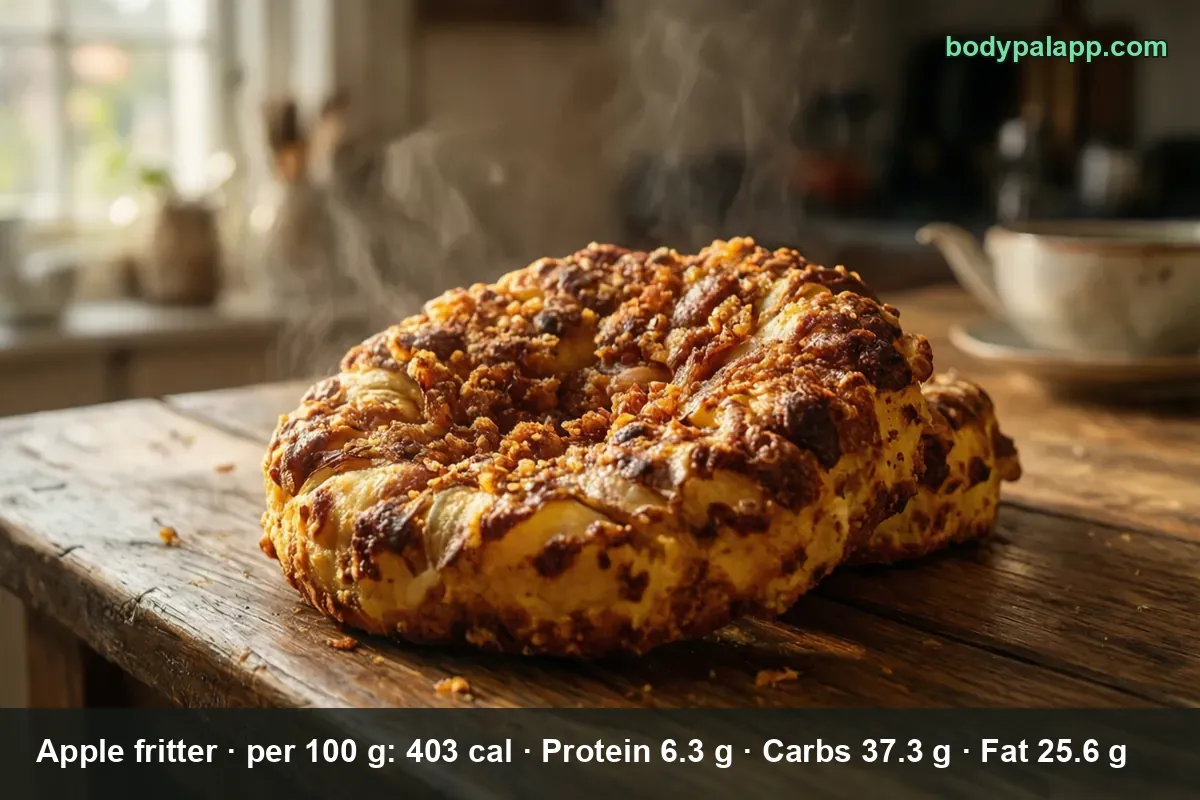
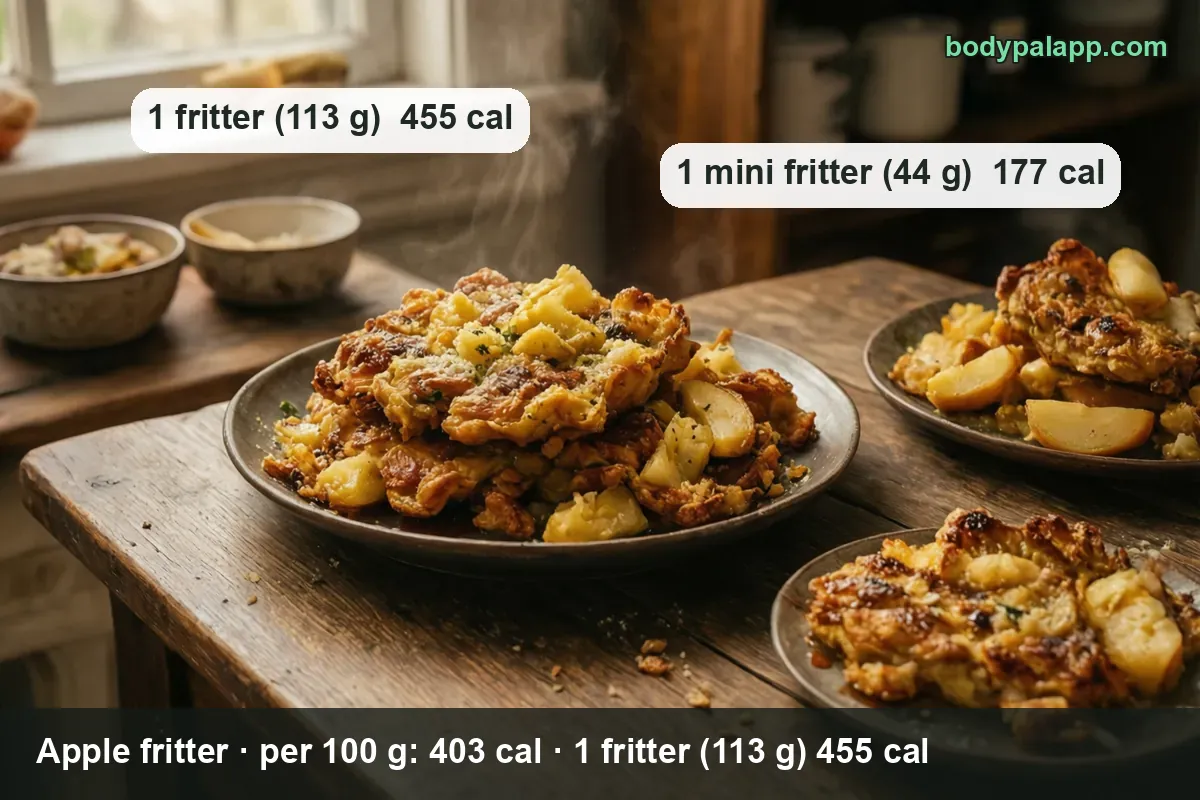
A bakery-size apple fritter of 113 g is 455 calories. Per 100 g the figure is 403, and a mini apple fritter donut of 44 g comes to 177. The calories in an apple fritter follow the size of the object far more than the recipe inside it: one dough, one fryer, numbers that range from 113 to 455 depending on what the counter hands you.
On this page
- Apple fritter quick facts
- US servings, from one ounce to a bakery fritter
- The fat is the number, not the sugar
- The apple adds sugar, not fiber
- Plain, mini and glazed fritters
- Apple fritter bread is a different food
- How does an apple fritter compare?
- Most popular apple fritter brands
- FAQ
Apple fritter quick facts
The record behind every number on this page is FNDDS 2708025, "Fritter, fruit", which USDA files under doughnuts, sweet rolls and pastries. USDA splits fritters three ways: plain, fruit and corn. An American apple fritter is fried dough with apple worked through it, so the fruit line is the right one, and the sugar column settles the argument on its own — 12.44 g per 100 g against 2.06 g for the plain version.
The serving column is one bakery-size fritter at 113 g, the weight printed on retail fritter packs.
| Nutrient | Per 100 g | Per 1 fritter (113 g) | % Daily Value |
|---|---|---|---|
| Calories | 403 | 455 | — |
| Total fat | 25.6 g | 28.9 g | 37% |
| Saturated fat | 5.3 g | 6.0 g | 30% |
| Carbohydrate | 37.3 g | 42.1 g | 15% |
| Dietary fiber | 1.2 g | 1.4 g | 5% |
| Total sugars | 12.4 g | 14.1 g | — |
| Protein | 6.3 g | 7.1 g | 14% |
| Sodium | 321 mg | 363 mg | 16% |
% Daily Value is based on a 2,000-calorie diet.
Verified nutrition data
Numbers on this page come from USDA FoodData Central, the U.S. Department of Agriculture’s food composition database, and from manufacturer labels where a branded product is named. Last verified September 2026. How we verify our data →
Two rows a packaged label would show are missing here, and both are missing for the same reason: USDA publishes no added sugars and no trans fat figure for any of its fritter lines. Estimating them from a store label would mean pasting one food's numbers onto another's record, so they are absent instead. Total sugars carry no Daily Value on a US label either, which is why that percentage cell is blank.
Two rows sit outside the core label but come from the same record. Cholesterol is 63 mg per 100 g, or 71 mg in a fritter, roughly a quarter of the 300 mg Daily Value. Potassium is 143 mg per 100 g, 162 mg in a fritter, about 3% of the day.
One thing to say plainly before the rest: these are numbers for an unglazed fried fritter. Glaze sits on top of them, and there is a label figure for a glazed one further down.
US servings, from one ounce to a bakery fritter
| Serving | Weight | Calories |
|---|---|---|
| 1 oz | 28 g | 113 |
| 1 mini fritter donut | 44 g | 177 |
| 1 fritter, USDA household measure | 100 g | 403 |
| 1 bakery-size fritter | 113 g | 455 |
USDA's own household measure for this record is "1 fritter, 100 g", which makes the per-100 g column and USDA's piece the same number. That is tidy, and it is also the trap. The fritter in a bakery case is not 100 g. Retail packs declare 113 g for a single fritter, and that extra 13 g of dough is 52 calories nobody logs.
So a person who taps "1 fritter" into a food log because USDA said so is short by roughly a tenth of the item every time. Not a disaster on one Sunday. A regular habit, though, and it always leans the same way.
The ounce row is worth keeping in your head for the torn-off corner and the shared half: an ounce of fritter is 113 calories. USDA lists no ounce portion for this record, so that row is our own scaling of the 403 figure. The coincidence that a whole fritter weighs 113 grams is just that, a coincidence, but it makes the arithmetic easy. Four bites of roughly an ounce each and you have eaten the fritter.
Raw against cooked does not apply here, unlike meat or rice. A fritter only exists after the fryer, so every figure on this page describes the finished thing.
The fat is the number, not the sugar
Break the 403 calories in 100 g of fritter into where they come from and the story stops being about apples.
Fat contributes about 230 of the 403 calories. Carbohydrate contributes about 149, and the sugars inside that carbohydrate account for only about 50. Protein rounds it out at roughly 25. Frying is what makes a fritter caloric; the fruit and the sugar are along for the ride.
That balance is why the percentage column reads the way it does. One fritter is 15% of the day's carbohydrate but 37% of the day's total fat and 30% of the saturated fat, against the FDA Daily Values of 78 g and 20 g. Federal advice puts saturated fat below 10% of daily calories, a limit the Dietary Guidelines for Americans restate in every edition; a single fritter uses more than a quarter of that room before breakfast is finished.
Then there is the row nobody expects on something sweet. 363 mg of sodium, 16% of the day, sits in one fritter. Fried dough is salted dough, and sugar hides salt well enough that most people would guess a tenth of that figure. If you are the kind of eater who checks sodium on soup and never on pastry, this is the page to change that habit on.
The apple adds sugar, not fiber
Set the fruit fritter beside USDA's plain fritter, same dough and no fruit, and you can measure exactly what the apple is doing.
Sugars go from 2.06 g to 12.44 g per 100 g. Carbohydrate goes from 27.46 g to 37.29 g. Fiber goes from 0.9 g to 1.2 g. Nearly the whole carbohydrate difference is sugar, and fiber barely moves: 1.4 g in a whole fritter, 5% of the Daily Value.
That is the honest reading of "it has apple in it". Diced apple plus the sugar it is cooked with behaves like a sweetener with texture, not like a piece of fruit. MyPlate counts fruit in cup-equivalents of the fruit itself, and the tablespoon or two of apple inside a fritter does not reach that bar. Enjoy the fritter as pastry. Count fruit somewhere else.
Fat, incidentally, is almost identical between the two: 25.59 g in the fruit version, 26.93 g in the plain one. The apple displaces a little of the dough that would otherwise soak up oil.
Plain, mini and glazed fritters
| Version | Per 100 g | Serving | Calories |
|---|---|---|---|
| Bakery-size fruit fritter (this page) | 403 | 1 fritter (113 g) | 455 |
| Plain fritter, no fruit | 378 | 1 fritter (100 g) | 378 |
| Mini fritter donut, USDA figure | 403 | 1 donut (44 g) | 177 |
| Mini fritter donut, package label | 318 | 1 donut (44 g) | 140 |
| Glazed fritter, package label | 385 | 1 fritter (78 g) | 300 |
The mini gets two rows on purpose, because the two sources describe two different objects. Run USDA's generic fritter down to 44 g and you get 177 calories. A packaged mini fritter donut declares 140 on its label, at 318 calories per 100 g. Neither number is wrong. Factory dough is lighter and less oily than the version USDA's survey recipe describes, and a bagged mini is not a fresh-fried one. Log the label when you have a bag in your hand, and the 177 when you do not.
The glazed row is the one most readers came for, and it does not behave the way people assume. A glazed supermarket fritter runs 385 calories per 100 g and 300 in a 78 g piece — below the generic 403 per gram, not above it. Across the packaged fritters in USDA's label database the range is 318 to 394 per 100 g, every one of them under the unglazed generic figure.
Glaze, in other words, does not push a fritter into a higher class of density. Piece weight does. A 78 g glazed fritter is 300 calories and a 113 g bakery fritter is 455, and the 155-calorie gap between them is size, not sugar coating.
The plain fritter is the quiet outlier worth naming: 378 calories in a 100 g piece against 403 for the fruit version. Dropping the apple saves about 25 calories per 100 g and just over 10 g of sugar.
Apple fritter bread is a different food
Search a store site for "apple fritter" and half the results are loaf cake. Apple fritter bread is baked, sliced and sold in a bag: one 47 g slice is 160 calories at 340 per 100 g.
The numbers prove they are separate foods rather than two sizes of one. The breads sit between 289 and 340 calories per 100 g with single-digit fat, while a real fritter carries 25.6 g of fat per 100 g. Same flavor idea, different process — nothing goes in a fryer. If your log says "apple fritter" and you ate a slice off a loaf, you are overcounting by nearly 300 calories a serving.
How does an apple fritter compare?
| Item | Per 100 g | Serving | Calories | Protein / Carbs / Fat |
|---|---|---|---|---|
| Apple fritter (this page) | 403 | 1 fritter (113 g) | 455 | 7.1 / 42.1 / 28.9 g |
| Plain fritter | 378 | 1 fritter (100 g) | 378 | 6.6 / 27.5 / 26.9 g |
| Sweet roll with fruit, frosted | 379 | 1 medium (90 g) | 341 | 4.7 / 48.2 / 14.7 g |
| Danish pastry with cheese | 374 | 1 medium (113 g) | 423 | 9.0 / 42.0 / 24.7 g |
| Funnel cake with sugar and fruit | 380 | 1 cake, 6 in (135 g) | 513 | 7.9 / 74.5 / 21.2 g |
All five are USDA survey records from the same pastry family, so this is a fair fight. Per 100 g they cover 374 to 403, a spread of under 8% — pastry is pastry, and the density argument between them is close to meaningless. Per piece they cover 341 to 513, a spread of 50%.
Our take: the frosted sweet roll is the smallest number on the counter at 341 calories, and it gets there by being a 90 g object with half the fat of a fritter, not by being a better food. The apple fritter is the one to pick if you want the most substantial pastry that still stays under 500, and the funnel cake is the one to share, because 513 calories with 74.5 g of carbohydrate in a single sitting is the outlier here by a wide margin. If fat is the number you watch, the frosted roll wins again at 14.7 g, and the fritter's 28.9 g is the largest figure in the table.
Most popular apple fritter brands in the United States
Ranked by how widely each product appears among foods sold in the United States, from the BodyPal food database of over 3.3 million products. Calories are the figures printed on each Nutrition Facts label, checked against USDA FoodData Central.
| Product | Calories (per 100 g) |
|---|---|
| CT Bakery Apple Fritter Mini Donuts | 318 cal |
| Sugar Bowl Bakery Apple Fritters | 327 cal |
| Favorite Day Apple Fritter | 352 cal |
| Country Treats Apple Fritter Glazed | 385 cal |
| Bake Crafters Apple Fritter | 376 cal |
| Ahold Apple Fritters | 336 cal |
Brand popularity: BodyPal food database. Nutrition: manufacturer labels / USDA FoodData Central.
Apple fritter FAQs
How many calories are in an apple fritter?
455 calories in a bakery-size fritter of 113 g, which is 403 calories per 100 g. That serving carries 28.9 g of fat, 42.1 g of carbohydrate, 14.1 g of sugars, 7.1 g of protein and 363 mg of sodium. USDA's own smaller 100 g fritter is 403 calories.
How many calories are in a mini apple fritter?
177 calories for a 44 g mini fritter donut using USDA's generic figure of 403 per 100 g. A packaged mini declares 140 on its label instead, because factory dough runs lighter at 318 calories per 100 g. Use the label when you have the bag, and 177 when you do not.
How many calories are in a glazed apple fritter?
300 calories for a 78 g glazed fritter from a package label, at 385 calories per 100 g. USDA publishes no generic glazed record, so this is a label figure rather than a survey one. Per gram it sits below the unglazed 403, so the glaze is not what makes a fritter heavy.
How much sugar is in an apple fritter?
14.1 g of total sugars in a 113 g fritter, from 12.44 g per 100 g. A plain fritter with no fruit holds only 2.06 g per 100 g, so almost all of the sugar arrives with the apple filling. USDA reports no added sugars figure for this record, so the split between fruit sugar and added sugar is not published.
How much fat is in an apple fritter?
28.9 g in one 113 g fritter, which is 37% of the 78 g Daily Value, plus 6.0 g of saturated fat at 30% of its 20 g Daily Value. Fat supplies roughly 230 of the 403 calories in 100 g. Frying, not the apple or the sugar, is what makes the number large.
Is an apple fritter healthier than a donut?
Not at 403 calories per 100 g, which is the densest line in the family. USDA groups fritters with doughnuts and sweet rolls, and inside that family the fritter sits above the 379 of a frosted fruit-filled sweet roll and the 374 of a cheese Danish. The apple inside does not move it into a different category.
Does the apple in an apple fritter count as fruit?
No — a whole fritter delivers 1.4 g of fiber, 5% of the 28 g Daily Value. The apple raises fiber only from 0.9 to 1.2 g per 100 g while raising sugar by 10 g. MyPlate counts fruit in cup-equivalents of fruit itself, and the diced apple in a fritter does not reach that.
How much sodium is in an apple fritter?
363 mg in a 113 g fritter, 16% of the 2,300 mg Daily Value, from 321 mg per 100 g. That is the row people miss on sweet food. Fried dough is salted dough, and the sugar covers the taste of it well enough that most eaters would guess far lower.
Similar foods
- Coconut — 283 cal per cup, shredded
- Coconut Flesh — 703 cal for 1/2 medium coconut
- Coconut Flakes — 388 cal per cup
- Apple Turnover — 269 cal per turnover
- Craisins — 123 cal for 1/4 cup
- Raisins — 120 cal per 1/4 cup
Count it without the math
Point the camera at the pastry box and BodyPal logs the fritter, the mini and the half somebody left on the plate without a scale.


How long does it take to burn off an apple fritter?
A bakery-size fritter (113 g) is 455 kcal. Enter your weight and the amount you ate to see how long it takes you to burn that off:
lb
| Activity | Time to burn 455 kcal |
|---|---|
| Walking, brisk | 1 hr 31 min |
| Cycling, moderate | 57 min |
| Swimming, moderate | 1 hr 5 min |
| Jogging | 54 min |
| Weight training, moderate | 1 hr 41 min |
Times are for a 155 lb adult at a steady pace; change the weight to see yours. The amount is set to the portion in the text (113 g); change it to what you actually ate. BodyPal works this out from your steps automatically.
Want the bigger picture? Calculate your daily calorie needs — your maintenance figure, a target for losing or gaining, and the date you get there.