
How many calories are in an apple turnover?
One bakery apple turnover weighs 85 g and carries 269 calories. Per 100 g the pastry runs 316 calories, denser than every savory turnover in the same USDA data set. Most of that is butter-laminated dough: 13.7 g of fat and 36.2 g of carbohydrate in a piece you finish in six bites.
On this page
- Apple turnover quick facts
- US servings, from one ounce to two turnovers
- Cherry, blueberry and the savory cousins
- Sodium is the row that surprises people
- How does an apple turnover compare
- Most popular apple turnover brands
- FAQ
Apple turnover quick facts
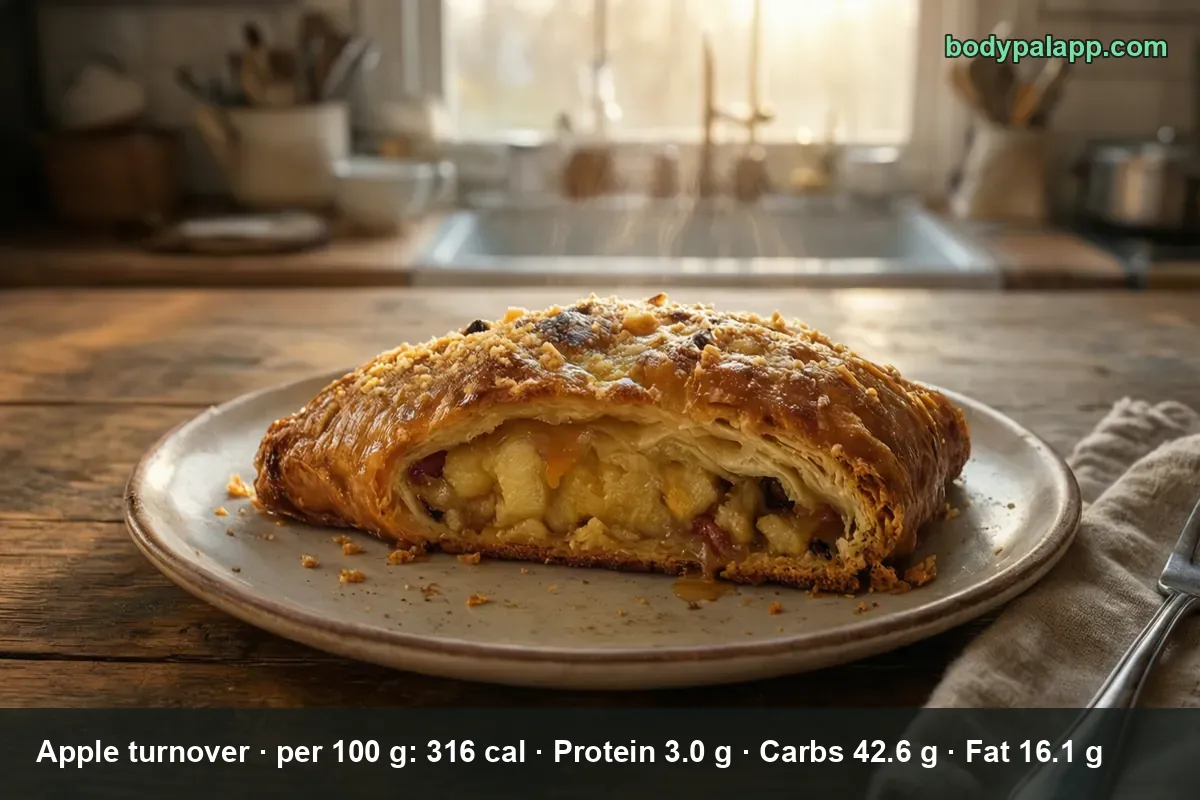
The record behind every number here is FNDDS 2708046, "Turnover, fruit". It is the only USDA entry for a sweet puff-pastry pocket with fruit inside, which is exactly the thing in the photo above. Every other "turnover" in the database is savory — hot pockets filled with beef, chicken, egg or cheese — and those are a different food with a different fat and sodium profile, so they stay in their own tables further down.
USDA does not separate apple from cherry or peach in this generic record. That is fine for calorie counting, because the filling moves the total far less than the pastry does, and the brand labels back that up: six US apple turnovers in the Branded database run from 270 to 380 calories per 100 g, all of them within reach of the 316 figure.
| Nutrient | Per 100 g | Per 1 turnover (85 g) | % Daily Value |
|---|---|---|---|
| Calories | 316 | 269 | — |
| Total fat | 16.1 g | 13.7 g | 18% |
| Saturated fat | 2.46 g | 2.1 g | 10% |
| Carbohydrate | 42.6 g | 36.2 g | 13% |
| Dietary fiber | 2.6 g | 2.2 g | 8% |
| Total sugars | 21.4 g | 18.2 g | — |
| Protein | 3 g | 2.6 g | 5% |
| Sodium | 333 mg | 283 mg | 12% |
% Daily Value is based on a 2,000-calorie diet.
Verified nutrition data
Numbers on this page come from USDA FoodData Central, the U.S. Department of Agriculture’s food composition database, and from manufacturer labels where a branded product is named. Last verified September 2026. How we verify our data →
Two rows you would see on a package are missing on purpose. USDA does not publish added sugars or trans fat for this record, so there is no honest way to say how much of the 18.2 g of total sugars was spooned in at the bakery — that split appears only on a specific brand's label. Cholesterol is 0 mg, since the fat is vegetable shortening or butter-style pastry margarine in most commercial dough, and potassium is 55 mg per turnover, about 1% of the Daily Value. The %DV framework itself comes from FDA.
US servings, from one ounce to two turnovers
| Serving | Weight | Calories |
|---|---|---|
| 1 oz | 28 g | 88 kcal |
| One small turnover, tray pack | 71 g | 224 kcal |
| One turnover, bakery standard | 85 g | 269 kcal |
| One large turnover, 4-count box | 89 g | 281 kcal |
| Two turnovers | 170 g | 537 kcal |
| Per 100 g | 100 g | 316 kcal |
The 85 g piece is the standard bakery size and the one most people mean when they log "an apple turnover." The 71 g and 89 g rows are real package sizes — a Walmart tray turnover and a turnover from a four-count freezer box — and the gap between them is 57 calories, which is more than most people expect from two pastries that look identical on a plate.
The 1 oz row and the two-turnover row are our own arithmetic from the USDA 100 g figure, not USDA servings. They are here because an ounce is the easiest mental unit for splitting a pastry with someone, and because two turnovers with coffee is a real breakfast: 537 calories before anything else on the plate.
If you have a kitchen scale, use it once. Bakery turnovers are hand-folded, and a heavy one at 89 g is 12 calories over the standard piece while a light one at 71 g is 45 under. Weighing a single turnover from your usual store is enough to fix the number for good.
Cherry, blueberry and the savory cousins
| Version | Per 100 g | Typical piece | Calories |
|---|---|---|---|
| Apple turnover | 316 kcal | 1 turnover (85 g) | 269 kcal |
| Cherry turnover | 294 kcal | 1 turnover (85 g) | 250 kcal |
| Blueberry puff pastry turnover | 353 kcal | 1 turnover (85 g) | 300 kcal |
| Pineapple turnover | 315 kcal | 1 serving (89 g) | 280 kcal |
| Savory hot pocket turnover | 260 kcal | 1 regular or large (130 g) | 338 kcal |
| Chicken turnover, empanada style | 269 kcal | 3.8 oz (108 g) | 291 kcal |
| Mushroom turnover, organic | 238 kcal | 4 turnovers (80 g) | 190 kcal |
Swapping fruit changes less than you would hope. Cherry comes in 19 calories under apple at the same 85 g, blueberry runs 31 over, and pineapple sits within 1 calorie of apple per 100 g. The pastry is doing the work in all three.
The savory versions tell the more useful story. A hot-pocket turnover is 260 calories per 100 g, a full 56 below the sweet one, yet the piece is 130 g instead of 85 g, so it lands at 338 calories — the biggest single item in this table. Density and portion pull in opposite directions, and portion wins.
Brand labels sit around the generic record rather than replacing it. Pepperidge Farm's four-count turnovers are the lightest of the six US apple turnovers in USDA's Branded data at 270 calories per 100 g and 240 per 89 g piece, while a Walmart Freshness Guaranteed turnover is the densest at 380 per 100 g and 270 for its smaller 71 g piece. Two products, nearly the same calories, very different pastries.
Sodium is the row that surprises people
283 mg of sodium in something that tastes only sweet is 12% of the Daily Value, and it is the row nobody checks. That is roughly an eighth of a teaspoon of table salt baked into the dough, where it does the same job as in bread: it controls the gluten and keeps the layers from tasting flat. Across brand labels in USDA's Branded database, apple turnovers range from 167 to 365 mg per 100 g, so a two-turnover breakfast can push past a quarter of the day's sodium.
Sugar is the other number worth pausing on. 18.2 g of total sugars in one turnover is about four and a half teaspoons, but USDA's record does not split that into naturally occurring fruit sugar and what the bakery added, so this page cannot tell you how it measures against the added-sugars advice in the Dietary Guidelines for Americans. Only the package label can. If you are tracking added sugars specifically, buy a branded turnover and read its panel.
What a turnover does not do is count as fruit. 2.2 g of fiber is 8% of the Daily Value, decent for a pastry and nowhere near a piece of whole fruit; MyPlate counts baked apple filling in syrup as a fruit source only in the loosest sense. If you want the turnover, have it as the pastry it is and put the apple somewhere else in the day.
How does an apple turnover compare
| Turnover | Per 100 g | US serving | Calories |
|---|---|---|---|
| Apple turnover | 316 kcal | 1 turnover, 85 g | 269 kcal |
| Hot pocket turnover, NFS | 260 kcal | 1 regular or large, 130 g | 338 kcal |
| Beef hot pocket turnover | 233 kcal | 1 regular or large, 130 g | 303 kcal |
| Seafood turnover | 207 kcal | 1 regular or large, 130 g | 269 kcal |
Our take: the apple turnover is the densest of these four per 100 g and still ties for the fewest calories per serving, because it is by far the smallest piece. For a controlled breakfast, the sweet turnover is the easier item to fit — 269 calories, done, no second half tempting you. For staying full until lunch, the savory rows win on protein, roughly 13 g in a 130 g piece against 2.6 g in the apple version, and that gap matters more than the 34 extra calories in the beef row. Pick by which problem you actually have.
Most popular apple turnover brands in the United States
Ranked by how widely each product appears among foods sold in the United States, from the BodyPal food database of over 3.3 million products. Calories are the figures printed on each Nutrition Facts label, checked against USDA FoodData Central.
| Product | Calories (per 100 g) |
|---|---|
| Freshness Guaranteed Apple Turnovers | 380 cal |
| World Class Bakery Apple Turnovers | 376 cal |
| Cafe Valley Bakery Apple Turnovers | 353 cal |
| Always Save Apple Turnovers | 344 cal |
| The Bakery Apple Turnover | 306 cal |
| Pepperidge Farm Apple Turnovers | 270 cal |
Brand popularity: BodyPal food database. Nutrition: manufacturer labels / USDA FoodData Central.
Apple turnover FAQs
How many calories are in one apple turnover?
269 calories in a standard bakery turnover of 85 g, based on USDA's fruit turnover record at 316 calories per 100 g. A small tray-pack turnover of 71 g is 224 calories, and a large one from a four-count box at 89 g is 281. Weigh yours once to know which you buy.
How many calories in a Pepperidge Farm apple turnover?
240 calories per turnover on the label, for an 89 g piece at 270 calories per 100 g. That makes it the lightest of the six US apple turnovers listed in USDA's Branded database, where the densest, a Walmart Freshness Guaranteed turnover, reaches 380 calories per 100 g. The difference is pastry, not filling.
How much sugar is in an apple turnover?
18.2 g of total sugars in one 85 g turnover, or 21.4 g per 100 g, which is about four and a half teaspoons. USDA does not publish added sugars for this record, so how much came from the apples and how much from the bakery is only readable on a specific brand's Nutrition Facts panel.
How many carbs are in an apple turnover?
36.2 g of carbohydrate in one 85 g turnover, 13% of the Daily Value, from 42.6 g per 100 g. Fiber accounts for 2.2 g of that, leaving roughly 34 g of available carbohydrate. Two turnovers with coffee put about 72 g of carbohydrate on the table before anything else in the meal.
How many calories in half an apple turnover?
About 134 calories for half a standard 85 g turnover, our own arithmetic from the USDA 100 g figure rather than a USDA serving. Half of a small 71 g turnover is around 112 calories, and half of a large 89 g one is about 140. Splitting one is the cheapest way to keep the pastry.
Why is there sodium in a sweet apple turnover?
283 mg per turnover, 12% of the Daily Value, because laminated pastry is salted dough. Salt controls the gluten and keeps butter-layered pastry from tasting flat, the same way it works in bread. Brand labels range from 167 to 365 mg per 100 g, so the store you buy from moves this number a lot.
Does an apple turnover count as a serving of fruit?
No — one turnover gives 2.2 g of fiber, 8% of the Daily Value, and 18.2 g of total sugars, which is a pastry profile rather than a fruit one. MyPlate counts whole and cut fruit toward the daily fruit group; cooked filling inside puff pastry is best logged as the dessert it is.
How many calories in a homemade apple turnover?
USDA publishes no separate homemade record, so use 316 calories per 100 g and weigh the finished pastry. Commercial versions span 270 to 380 calories per 100 g depending on the dough, and homemade turnovers made with all-butter puff pastry sit at the upper end of that range rather than below it.
Similar foods
- Craisins — 123 cal for 1/4 cup
- Raisins — 120 cal per 1/4 cup
- Coconut — 283 cal per cup, shredded
- Coconut Flesh — 703 cal for 1/2 medium coconut
- Date — 66 cal per date, pitted
- Dates — 66 cal per date
Count it without the math
Point the camera at the plate and BodyPal counts the turnover for you, pastry and filling together.


How long does it take to burn off 269 kcal of apple turnover?
One turnover (85 g) is 269 kcal. Enter your weight and the amount you ate to see how long it takes you to burn that off:
lb
| Activity | Time to burn 269 kcal |
|---|---|
| Walking, brisk | 54 min |
| Cycling, moderate | 34 min |
| Swimming, moderate | 38 min |
| Jogging | 32 min |
| Weight training, moderate | 1 hr |
Times are for a 155 lb adult at a steady pace; change the weight to see yours. The amount is set to the portion in the text (85 g); change it to what you actually ate. BodyPal works this out from your steps automatically.
Want the bigger picture? Calculate your daily calorie needs — your maintenance figure, a target for losing or gaining, and the date you get there.