
How many calories are in a date?
One pitted Medjool date weighs about 24 g and carries 66 calories. Per 100 g, dates run 277 calories, which makes them one of the lighter dried fruits by weight. The catch is the piece in your hand: a Deglet Noor date is less than a third the weight of a Medjool, and only 20 calories.
On this page
- Date quick facts
- US servings, from one date to a cup
- Medjool and Deglet Noor are not the same date
- Dates in bars, cookies and cereal
- Potassium and fiber are the rows that surprise people
- How do dates compare with other dried fruit?
- Most popular dates brands
- FAQ
Date quick facts
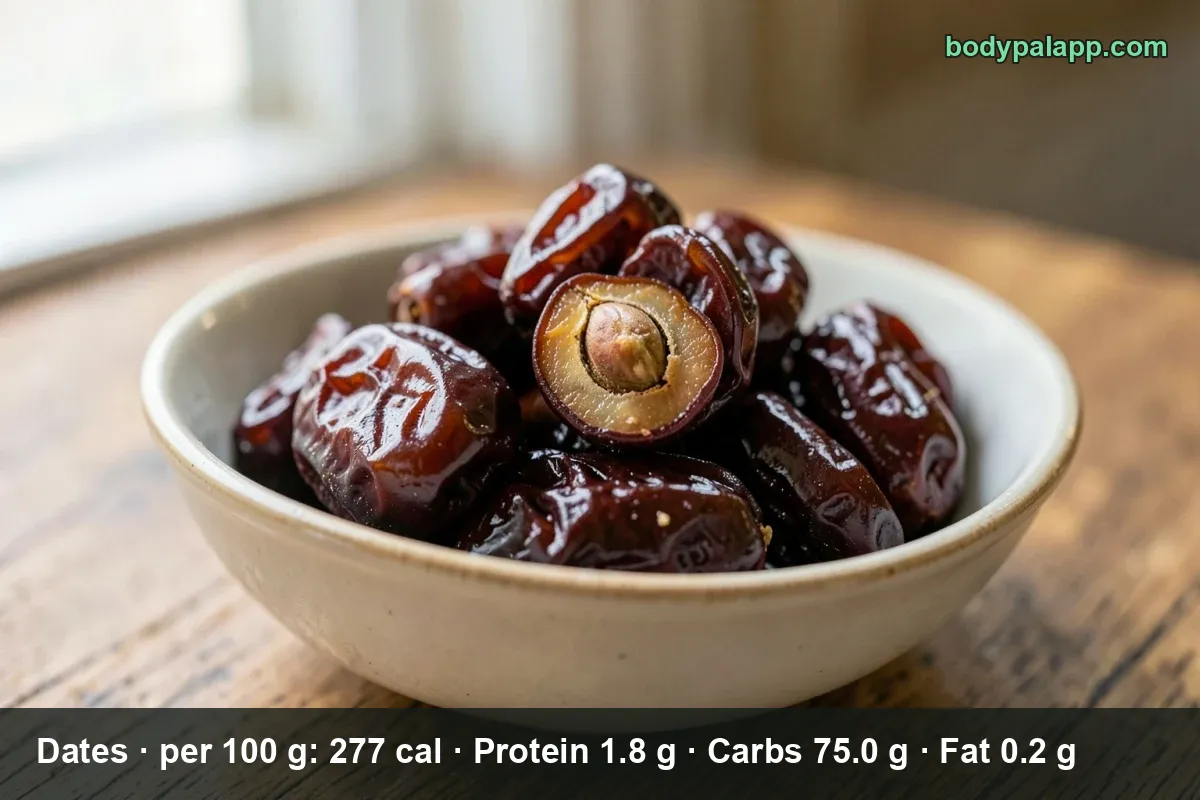
The record below is SR Legacy 168191, "Dates, medjool". That is the date most Americans actually buy: big, soft, sold loose or in a clamshell by the piece, the plump fruit you see split open in the photo. The generic USDA entry for "date" is built on the smaller Deglet Noor instead, so it answers a different question than the one you are asking with a Medjool in your hand. Deglet Noor gets its own numbers further down.
| Nutrient | Per 100 g | Per 1 date, pitted (24 g) | % Daily Value |
|---|---|---|---|
| Calories | 277 | 66 | — |
| Total fat | 0.15 g | 0.0 g | 0% |
| Carbohydrate | 74.97 g | 18.0 g | 7% |
| Dietary fiber | 6.7 g | 1.6 g | 6% |
| Total sugars | 66.47 g | 16.0 g | — |
| Protein | 1.81 g | 0.4 g | 1% |
| Sodium | 1 mg | 0 mg | 0% |
| Potassium | 696 mg | 167 mg | 4% |
% Daily Value is based on a 2,000-calorie diet.
Verified nutrition data
Numbers on this page come from USDA FoodData Central, the U.S. Department of Agriculture’s food composition database, and from manufacturer labels where a branded product is named. Last verified September 2026. How we verify our data →
Three rows you would see on a retail bag are missing here on purpose. USDA's SR Legacy edition of the Medjool record carries no values at all for added sugars, saturated fat or cholesterol, so there is nothing honest to print in those cells. In practical terms, a whole date has no added sugar in it and essentially no fat to divide into saturated and unsaturated: the entire fruit is 0.15 g of fat per 100 g, which is a rounding error on a single piece.
The row that does the work is total sugars, 66.47 g per 100 g. That is the fruit's own sugar, concentrated by drying, and it is why a date tastes like candy. It is also why the potassium row is worth reading before you decide dates are just sugar.
US servings, from one date to a cup
| Serving | Weight | Calories |
|---|---|---|
| 1 oz | 28 g | 78 kcal |
| 1 date, pitted | 24 g | 66 kcal |
| 2 dates, pitted | 48 g | 133 kcal |
| 3 dates, pitted | 72 g | 199 kcal |
| 5 dates, pitted | 120 g | 332 kcal |
| Per 100 g | 100 g | 277 kcal |
Only the single pitted date and the 100 g line come straight from USDA. The two-, three- and five-date rows, and the ounce, are our own arithmetic from the USDA 100 g figure, not USDA servings, which is exactly how most people eat dates anyway: by the handful, not by the gram.
An ounce is the sneaky one. It looks like a small measure, but at 28 g it is a fraction more than a whole Medjool date, so "an ounce of dates" and "a date" are close to the same thing. Five dates is where a snack quietly turns into a small meal at 332 calories, which is more than most granola bars.
Retail labels are close to USDA but not identical. Bags of Medjool dates from Natural Delights, Datepac and Bard Valley all print 2 dates (46 g) at 137 to 140 calories, while 46 g at the USDA rate of 277 per 100 g works out to 127 by our own arithmetic. Pitted Deglet Noor packs from Hadley, 365 Whole Foods Market and Natural Delights list 40 g of fruit at 110 to 120 calories. If your bag says 140 and this page says 127, neither is wrong: the label is rounded from the packer's own analysis of a slightly heavier average fruit.
Medjool and Deglet Noor are not the same date
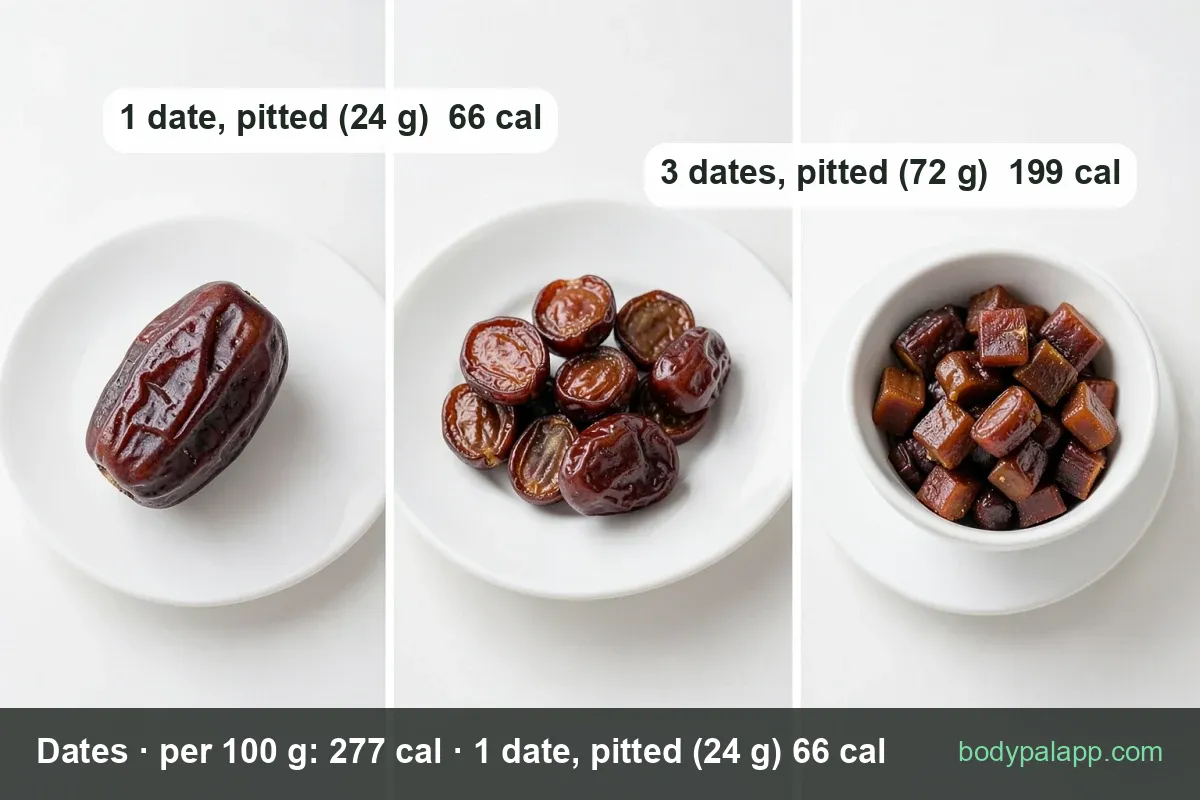
Per 100 g, the two varieties are almost twins: 277 calories for Medjool and 282 for Deglet Noor. Per piece they are not close at all. A pitted Medjool weighs about 24 g. A pitted Deglet Noor weighs about 7.1 g. That is 66 calories against 20, and it is the single most useful thing to know when you are counting dates rather than weighing them.
| Version | Per 100 g | Typical piece | Calories |
|---|---|---|---|
| Medjool dates | 277 kcal | 1 date, pitted (24 g) | 66 kcal |
| Deglet Noor dates | 282 kcal | 1 date, pitted (7.1 g) | 20 kcal |
| Chopped dates, 1 cup | 282 kcal | 1 cup, chopped (147 g) | 415 kcal |
Deglet Noor is the drier, chewier, cheaper date, the one that shows up pitted in a plastic tub and chopped into baking. It gives up a little sugar for a little more fiber: 63.35 g of sugars and 8 g of fiber per 100 g, against 66.47 g and 6.7 g for Medjool. USDA's generic "Date" entry uses these same Deglet Noor values, which is why a food app can show you 282 calories per 100 g when your bag clearly says Medjool.
The cup is the trap. Chopped dates pack tightly, so one cup weighs 147 g and comes to 415 calories, roughly the same as six whole Medjool dates at 396. Nothing about a measuring cup warns you that it holds most of a meal's worth of fruit. If a recipe calls for a cup of chopped dates and serves four, that is about 104 calories per portion from the dates alone, by our own arithmetic.
Dates in bars, cookies and cereal
Once a date is an ingredient, the flour, oil and salt around it move the number far more than the fruit does. These are separate USDA records, not dates.
| Product | Per 100 g | Typical serving | Calories |
|---|---|---|---|
| Date breakfast bar, yogurt coating | 348 kcal | 1 bar (45 g) | 157 kcal |
| Date-filled oatmeal cookies | 400 kcal | 1 serving (25 g) | 100 kcal |
| Raisin, Date and Pecan cereal | 378 kcal | 0.75 cup (55 g) | 208 kcal |
Sodium is the giveaway. Whole Medjool dates hold 1 mg per 100 g. The yogurt-coated breakfast bar holds 350 mg per 100 g, the date-filled cookies 331 mg, the cereal 247 mg. A bar with a date in the name is a cookie with better marketing: 7.3 g of fat per 100 g against 0.15 g for the fruit. Log the product you ate, not the fruit inside it.
Potassium and fiber are the rows that surprise people
Three Medjool dates weigh 72 g and cost you 199 calories. For that you get 501 mg of potassium, 11% of the FDA Daily Value of 4,700 mg, plus 4.8 g of fiber, 17% of the 28 g DV, and 0 mg of sodium. Very few sweet foods put up that combination.
Fiber is the reason dates behave differently from candy of the same calorie count. One date carries 1.6 g, so a small handful covers a meaningful slice of the day without any other high-fiber food on the plate. If you are watching sodium, dates are as close to free as food gets: a whole 100 g, or four dates and change, is 1 mg.
Dried fruit counts toward the fruit group in the MyPlate framework, but it counts by a much smaller volume than fresh fruit, because the water is gone and the sugar is not. That is the honest summary of a date: real fruit, real potassium and fiber, in a form dense enough that three of them cost 199 calories.
How do dates compare with other dried fruit?
| Dried fruit | Per 100 g | US serving | Calories |
|---|---|---|---|
| Dates, Medjool | 277 kcal | 1 oz (28 g) | 78 kcal |
| Figs, dried | 277 kcal | 1 oz (28 g) | 78 kcal |
| Raisins | 299 kcal | 1 oz (28 g) | 84 kcal |
| Cranberries, dried | 308 kcal | 1 oz (28 g) | 86 kcal |
Our take: dates and dried figs tie for the lightest of these four per 100 g, at 277, and dried cranberries are the heaviest at 308 with 82.8 g of carbohydrate against 74.97 g for dates. The spread is small, so no dried fruit is a low-calorie food, and per ounce they all land between 78 and 86 calories. What separates dates is that they come in countable pieces. Raisins and cranberries get poured, and a poured handful is impossible to estimate; a date is one object you can see on the plate. For weight loss, that countability is worth more than the eight calories per ounce between the lightest of these four and the heaviest. For satiety per calorie, three Medjool dates with their 4.8 g of fiber beat the same calories in cranberries handily.
Most popular dates brands in the United States
Ranked by how widely each product appears among foods sold in the United States, from the BodyPal food database of over 3.3 million products. Calories are the figures printed on each Nutrition Facts label, checked against USDA FoodData Central.
| Product | Calories (per 100 g) |
|---|---|
| Hadley Organic Pitted Deglet Noor Dates | 300 cal |
| Natural Delights Medjool Dates | 304 cal |
| Datepac Medjool Dates | 304 cal |
| 365 Whole Foods Market Pitted Dates | 275 cal |
| Bard Valley Organic Medjool Dates | 298 cal |
| Natural Delights Deglet Noor Dates | 275 cal |
Brand popularity: BodyPal food database. Nutrition: manufacturer labels / USDA FoodData Central.
Date FAQs
How many calories are in one Medjool date?
A pitted Medjool date of 24 g carries 66 calories, from a rate of 277 calories per 100 g. Three of them come to 199 calories and five to 332. Because dates are sold loose and vary in size, weighing a few of yours once tells you more than any average piece weight.
How many calories in a Deglet Noor date?
About 20 calories, because a pitted Deglet Noor date weighs roughly 7.1 g against 24 g for a Medjool. Per 100 g the two varieties are nearly identical, 282 against 277, so the gap you see between them in a bowl is size, not sweetness or processing.
How much sugar is in dates?
One Medjool date holds 16.0 g of total sugars, and 100 g holds 66.47 g. All of it is the fruit's own sugar, concentrated by drying. USDA's SR Legacy record for Medjool dates publishes no added sugars figure, and a whole date has nothing added to it.
How many carbs are in dates?
One Medjool date carries 18.0 g of carbohydrate, 7% of the Daily Value, and 100 g holds 74.97 g. Fiber accounts for 1.6 g of that single date. Deglet Noor dates are similar per 100 g at 75.03 g, but each small date is only about 5.3 g of carbohydrate.
Are dates high in potassium?
One Medjool date supplies 167 mg of potassium, 4% of the Daily Value; three dates reach 501 mg, or 11%. That is a real contribution from 199 calories of fruit, and it arrives with 0 mg of sodium, which matters if you are keeping an eye on salt.
How many dates should you eat a day?
There is no official number, so treat it as a budget: one date is 66 calories, three are 199, five are 332. Three Medjool dates also deliver 4.8 g of fiber, 17% of the Daily Value, so a small handful earns its place in the day.
How many calories in a cup of chopped dates?
A cup of chopped dates weighs 147 g and comes to 415 calories, using USDA's Deglet Noor rate of 282 calories per 100 g. That is roughly six whole Medjool dates, or 396 calories, from one measuring cup. Chopped dates pack tightly, which is why the cup climbs so fast.
Do dates have fiber?
Yes. 100 g of Medjool dates holds 6.7 g of fiber, and one 24 g date gives 1.6 g, 6% of the Daily Value. Deglet Noor dates are higher per 100 g at 8 g, though each small date contributes only about 0.6 g because the piece is so light.
Similar foods
- Dates — 66 cal per date
- Pitted Dates — 66 cal per date
- Medjool Date — 66 cal per date, pitted
- Raisins — 120 cal per 1/4 cup
- Avocado Toast — 190 cal per tray
- Craisins — 123 cal for 1/4 cup
Count it without the math
Point the camera at the bowl and BodyPal counts the dates for you, Medjool or Deglet Noor.


How long does it take to burn off dates?
One pitted Medjool date (24 g) is 66 kcal. Enter your weight and the amount you ate to see how long it takes you to burn that off:
lb
| Activity | Time to burn 66 kcal |
|---|---|
| Walking, brisk | 13 min |
| Cycling, moderate | 8 min |
| Swimming, moderate | 9 min |
| Jogging | 8 min |
| Weight training, moderate | 15 min |
Times are for a 155 lb adult at a steady pace; change the weight to see yours. The amount is set to the portion in the text (24 g); change it to what you actually ate. BodyPal works this out from your steps automatically.
This table assumes you know your daily total. If you do not, the daily calorie calculator works it out from five numbers.