
How many calories are in a Medjool date?
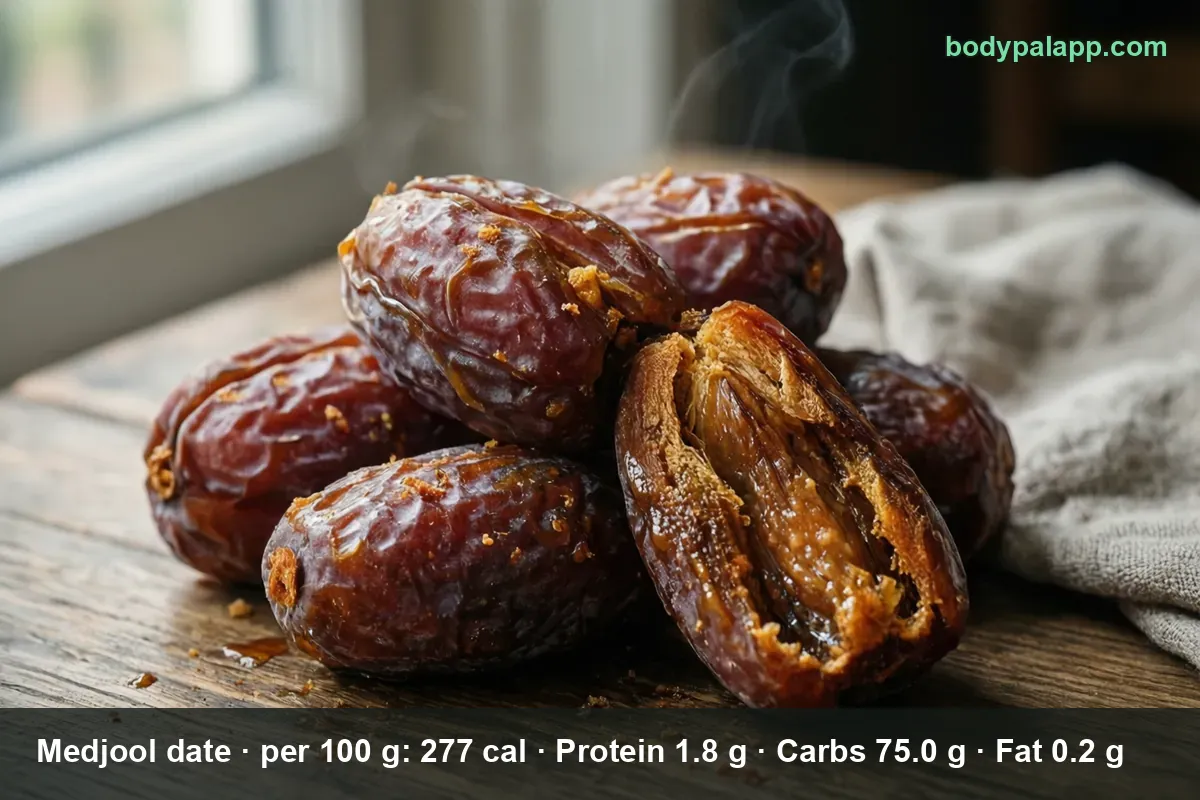
One pitted Medjool date weighs 24 g and carries 66 calories. Per 100 g the fruit runs 277 calories, which is dried-fruit territory rather than fresh-fruit territory. Two dates come to 133, four to 266. Nearly all of it is carbohydrate: 18.0 g in a single date, 16.0 g of that sugar.
On this page
- Medjool date quick facts
- US servings, from one date to a handful
- Deglet Noor, raisins and other dried fruit
- The sugar is all natural, and that changes the label
- How does a Medjool date compare?
- Most popular medjool date brands
- FAQ
Medjool date quick facts
The number below comes from SR Legacy record 168191, "Dates, medjool". It is the only USDA record written for the Medjool variety specifically, and it describes the form you actually hold: a whole date with the pit taken out. Branded records for bagged dates are the same fruit with label rounding on top, so they sit slightly higher per 100 g without being a different food.
The serving column uses the USDA household measure of one pitted date, 24 g. That is a real date, not a rounded pack weight, which matters once you compare it to the number printed on the bag further down the page.
| Nutrient | Per 100 g | Per 1 date, pitted (24 g) | % Daily Value |
|---|---|---|---|
| Calories | 277 | 66 | — |
| Total fat | 0.15 g | 0.0 g | 0% |
| Carbohydrate | 74.97 g | 18.0 g | 7% |
| Dietary fiber | 6.7 g | 1.6 g | 6% |
| Total sugars | 66.47 g | 16.0 g | — |
| Protein | 1.81 g | 0.4 g | 1% |
| Sodium | 1 mg | 0 mg | 0% |
| Potassium | 696 mg | 167 mg | 4% |
% Daily Value is based on a 2,000-calorie diet.
Verified nutrition data
Numbers on this page come from USDA FoodData Central, the U.S. Department of Agriculture’s food composition database, and from manufacturer labels where a branded product is named. Last verified September 2026. How we verify our data →
Three rows you would expect on a package are missing here, and the reason is the record rather than the fruit: the SR Legacy edition does not measure saturated fat, added sugars or cholesterol for whole dates, so those lines are left out instead of being guessed at. Sodium is the row nobody needs to think about. One date rounds to 0 mg, and even 100 g of dates carries a single milligram, far less than a rounding error against the 2,300 mg Daily Value.
US servings, from one date to a handful
| Serving | Weight | Calories |
|---|---|---|
| One pitted date | 24 g | 66 kcal |
| Two pitted dates | 48 g | 133 kcal |
| Four pitted dates | 96 g | 266 kcal |
| 1 oz | 28 g | 78 kcal |
| Per 100 g | 100 g | 277 kcal |
Only the single date is a USDA household measure. Two dates, four dates and the ounce are our own arithmetic from the USDA 100 g figure, scaled straight from 277 calories per 100 g rather than taken from a USDA serving line.
This is where dates trip people up. An ounce sounds like a small snack, and it is barely more than one date at 78 calories. But nobody eats one ounce of dates, because dates are eaten by the piece and the pieces are large and soft. Four of them off a plate is 266 calories, which is a full snack rather than a nibble, and it takes about a minute to get there.
US bags of Medjool dates set their serving at 2 dates, 46 g, and print 137 to 140 calories depending on the brand. Natural Delights, Sun Lit and Datepac all list 140; Bard Valley, Royal Organic and Majestic Palms list 137. Two real dates measured the USDA way weigh 48 g and come to 133 calories. The gap is packaging weight and the brand's own lab work, not a sweeter date.
Deglet Noor, raisins and other dried fruit
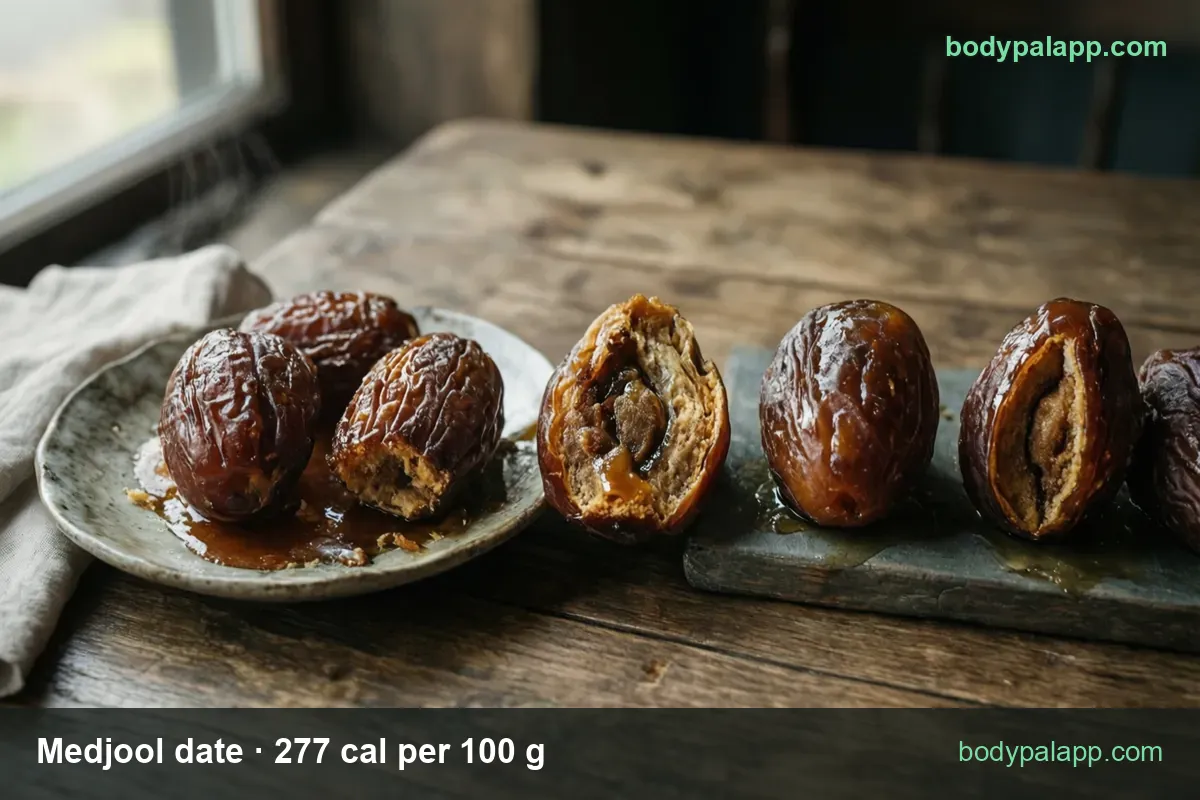
Medjool is not the only date on the shelf, and it is not the only dried fruit people reach for when they want something sweet without opening a candy wrapper. Here is the same ounce across the category, so the comparison is like for like.
| Version | Per 100 g | Typical serving | Calories |
|---|---|---|---|
| Medjool dates | 277 kcal | 1 oz (28 g) | 78 kcal |
| Deglet Noor dates | 282 kcal | 1 oz (28 g) | 79 kcal |
| Dried jujube | 281 kcal | 1 oz (28 g) | 79 kcal |
| Dried Japanese persimmon | 274 kcal | 1 oz (28 g) | 77 kcal |
| Zante currants, dried | 290 kcal | 1 oz (28 g) | 81 kcal |
| Raisins, seeded | 296 kcal | 1 oz (28 g) | 83 kcal |
Of these six, only dried Japanese persimmon is lighter per 100 g than Medjool, and only by 3 calories. Deglet Noor, the small firm date sold loose or chopped, is 282 calories per 100 g against 277 for Medjool, a difference of one calorie per ounce. Anyone choosing Deglet Noor to save calories is saving nothing measurable. What changes is the piece size: Medjool dates are big and soft and get counted one or two at a time, while Deglet Noor tends to get scattered by the handful into oatmeal or salad, and the handful is where the calories add up.
Raisins sit at the top of the table for a boring reason. They hold less water than a Medjool date, so per 100 g there is more fruit and less moisture, and 296 calories is the result. That is the whole story of dried fruit calories: the drier the fruit, the more of it fits on the scale.
The sugar is all natural, and that changes the label
At 66.47 g of sugar per 100 g, a Medjool date is about two-thirds sugar by weight. One date is 16.0 g of that, roughly the sugar in a small cookie. And yet the Nutrition Facts panel on a bag of dates shows no percentage next to the sugar line, which confuses a lot of people.
Two things are happening. Total sugars have no Daily Value at all under the FDA label rules, so that cell stays blank for every food in the country. Added sugars do have one, 50 g a day, but added sugars are the ones put in during processing, and a plain pitted date has had nothing put in. The Dietary Guidelines draw exactly that line. The sweetness in a date counts against your calories, not against your added-sugar budget.
The other half of the ledger is the part the sugar number hides. Four dates, 96 g, cost 266 calories and deliver 6.4 g of fiber, 23% of the 28 g Daily Value, along with 668 mg of potassium, 14% of the 4,700 mg Daily Value. That is a genuinely useful pair of numbers for a snack, and dates count toward the fruit group on MyPlate, with the standard caveat that a half cup of dried fruit counts as one cup of fruit because the water is gone. Protein is the row that stays empty: 0.4 g per date, 1% of the Daily Value, so a date sweetens a snack but does not anchor one.
If you are managing blood sugar or simply pacing your carbohydrates, the practical read is portion discipline rather than avoidance. Two dates is 133 calories and 36.0 g of carbohydrate. Six would be 400 calories, and six is easy.
How does a Medjool date compare?
| Dried fruit | Per 100 g | US serving | Calories |
|---|---|---|---|
| Medjool dates | 277 kcal | 1 oz (28 g) | 78 kcal |
| Deglet Noor dates | 282 kcal | 1 oz (28 g) | 79 kcal |
| Zante currants, dried | 290 kcal | 1 oz (28 g) | 81 kcal |
| Raisins, seeded | 296 kcal | 1 oz (28 g) | 83 kcal |
Our take: on a calorie basis these four are the same food, spread across five calories an ounce. Medjool is the lowest of them per 100 g, but the margin is too small to make it the smart choice on calories alone. What makes Medjool the better pick is the piece: one date is a countable 66 calories that satisfies a sweet craving on its own, while raisins and currants come by the scoop and a scoop is unmeasurable. For weight control, buy the fruit you can count. For topping oatmeal or baking, the cheaper Deglet Noor does the same job for one extra calorie an ounce.
Most popular medjool date brands in the United States
Ranked by how widely each product appears among foods sold in the United States, from the BodyPal food database of over 3.3 million products. Calories are the figures printed on each Nutrition Facts label, checked against USDA FoodData Central.
| Product | Calories (per 100 g) |
|---|---|
| Natural Delights Medjool Dates | 304 cal |
| Majestic Palms Medjool Dates | 298 cal |
| Bard Valley Organic Medjool Dates | 298 cal |
| Sun Lit Medjool Dates | 304 cal |
| Royal Organic Medjool Dates | 298 cal |
| Datepac Medjool Dates | 304 cal |
Brand popularity: BodyPal food database. Nutrition: manufacturer labels / USDA FoodData Central.
Medjool date FAQs
How many calories are in one Medjool date?
One pitted Medjool date of 24 g has 66 calories, from 277 calories per 100 g. Carbohydrate does nearly all of the work: 18.0 g per date, of which 16.0 g is sugar. Fat is essentially zero at 0.0 g, and protein is only 0.4 g.
How many calories are in 2 Medjool dates?
Two pitted dates weigh 48 g and come to 133 calories. Bags usually print a 2-date serving as 46 g and 137 to 140 calories, because the brand rounds the pack weight and runs its own analysis. The gap is packaging math, not a different fruit. Two dates also carry 3.2 g of fiber.
How much sugar is in a Medjool date?
One date carries 16.0 g of sugar, and 100 g of Medjool dates carry 66.47 g. That is high for a fruit, but total sugars have no Daily Value on the Nutrition Facts label, so no percentage ever appears beside that line. Four dates reach 63.8 g of sugar.
Do Medjool dates have added sugar?
No, the USDA record reports 66.47 g of total sugars per 100 g and publishes no added-sugars figure, because nothing is added to a whole pitted date. The 50 g Daily Value for added sugars does not apply here, and the sweetness is intrinsic to the dried fruit itself.
How much fiber is in a Medjool date?
One pitted date has 1.6 g of fiber, 6% of the 28 g Daily Value. Four dates reach 6.4 g, or 23% of a day's fiber, for 266 calories. Per 100 g the record lists 6.7 g, which is why dates feel more filling than their sugar number suggests.
Medjool vs Deglet Noor: which has fewer calories?
Medjool, barely: 277 calories per 100 g against 282 for Deglet Noor. At an ounce that is 78 calories against 79, a difference of one. Medjool dates are bigger and softer, so they get eaten one or two at a time, while Deglet Noor tends to go in by the handful.
How many Medjool dates is one serving?
US bags set the serving at 2 dates, 46 g, and list 137 to 140 calories. USDA measures one pitted date at 24 g and 66 calories, so two real dates weigh 48 g and come to 133. Either way, two dates is the standard portion on a US package.
Are Medjool dates good for potassium?
One pitted date supplies 167 mg of potassium, 4% of the 4,700 mg Daily Value. Four dates reach 668 mg, or 14%, for 266 calories. Per 100 g the record lists 696 mg. That makes dates a reasonable potassium source, as long as the calories fit your day.
Similar foods
- Date — 66 cal per date, pitted
- Dates — 66 cal per date
- Pitted Dates — 66 cal per date
- Raisins — 120 cal per 1/4 cup
- Avocado Toast — 190 cal per tray
- Craisins — 123 cal for 1/4 cup
Count it without the math
Point the camera at the plate and BodyPal counts the dates for you, pits out and all.


How long does it take to burn off a Medjool date?
One pitted date (24 g) is 66 kcal. Enter your weight and the amount you ate to see how long it takes you to burn that off:
lb
| Activity | Time to burn 66 kcal |
|---|---|
| Walking, brisk | 13 min |
| Cycling, moderate | 8 min |
| Swimming, moderate | 9 min |
| Jogging | 8 min |
| Weight training, moderate | 15 min |
Times are for a 155 lb adult at a steady pace; change the weight to see yours. The amount is set to the portion in the text (24 g); change it to what you actually ate. BodyPal works this out from your steps automatically.
Want the bigger picture? Calculate your daily calorie needs — your maintenance figure, a target for losing or gaining, and the date you get there.