
How Many Calories Are in Avocado Toast?
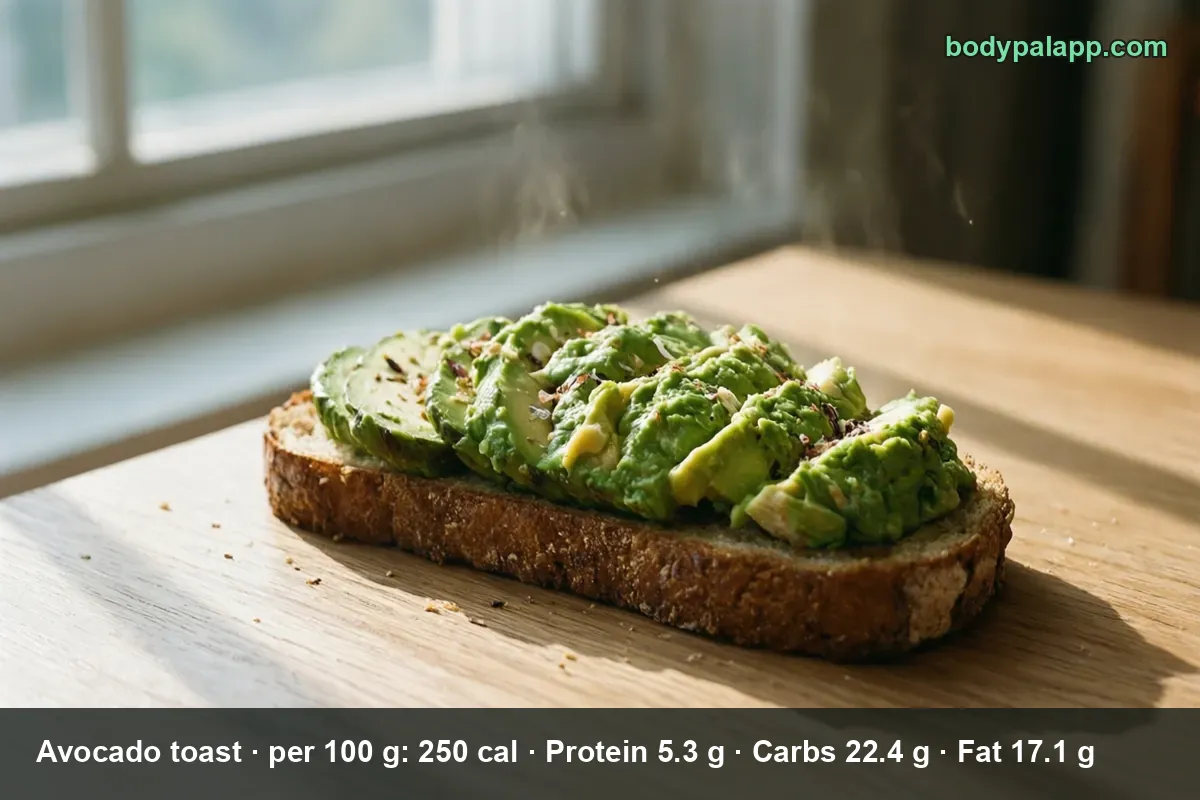
A store tray of avocado toast weighs 76 g and carries 190 calories. Per 100 g the same product runs 250 calories, which is dense for a breakfast that photographs like salad. Most of those calories are avocado fat: 13.0 g in the tray, against 4.0 g of protein and 5.0 g of fiber.
On this page
- Avocado toast quick facts
- US servings from one ounce to two trays
- Bread and avocado priced separately
- What a homemade slice really costs
- Fiber earns its keep and sodium sneaks in
- How does avocado toast compare?
- Most popular avocado toast brands
- Avocado toast FAQs
Avocado toast quick facts
There is one catch behind every avocado toast calorie count online: the government database does not have a recipe for it. USDA publishes bread, and it publishes avocado, but every entry for the finished plate is a packaged one — FDC 2564596, "Breakfast Avocado Toast" from Sabra, a 76 g tray with a label built from the real product. That is the row on this page, because it is the thing a shopper actually holds. The Foundation and FNDDS sets have no composite entry for the dish at all.
The trade-off is honest: a packaged tray is one manufacturer's build, and your own toast will differ. That is exactly why the section below rebuilds the plate from bread and fruit, so you can see both numbers side by side.
| Nutrient | Per 100 g | Per 1 tray (76 g) | % Daily Value |
|---|---|---|---|
| Calories | 250 | 190 | — |
| Total fat | 17.11 g | 13.0 g | 17% |
| Saturated fat | 3.29 g | 2.5 g | 13% |
| Carbohydrate | 22.37 g | 17.0 g | 6% |
| Dietary fiber | 6.6 g | 5.0 g | 18% |
| Total sugars | 1.32 g | 1.0 g | — |
| Added sugars | 1.3 g | 1.0 g | 2% |
| Protein | 5.26 g | 4.0 g | 8% |
| Sodium | 461 mg | 350 mg | 15% |
% Daily Value is based on a 2,000-calorie diet.
Verified nutrition data
Numbers on this page come from USDA FoodData Central, the U.S. Department of Agriculture’s food composition database, and from manufacturer labels where a branded product is named. Last verified September 2026. How we verify our data →
Cholesterol is 0 mg, which is what you expect from bread and fruit. One row was left out on purpose: the label lists potassium at 461 mg, the same figure as sodium down to the digit, and identical twin values in two unrelated fields read like a data-entry slip rather than a measurement. Rather than repeat it, we dropped it. The Daily Value percentages come from the FDA's Nutrition Facts reference amounts.
US servings from one ounce to two trays
| Serving | Weight | Calories |
|---|---|---|
| 1 oz | 28.3 g | 71 kcal |
| Half a tray | 38 g | 95 kcal |
| One tray, the label serving | 76 g | 190 kcal |
| Two trays | 152 g | 380 kcal |
| Per 100 g | 100 g | 250 kcal |
Only one line here is a USDA serving: the 76 g tray, which is the manufacturer's own label portion. The half tray, the two-tray line and the ounce are our own arithmetic from the USDA 100 g figure, not USDA servings, scaled straight off the 250 calories per 100 g.
The two-tray row is not a joke portion. A 76 g tray is a small piece of toast, roughly a slice and a topping, and people who log breakfast honestly often log two. That is 380 calories, which puts the same food from "light breakfast" into "brunch entree" without anything changing on the plate except how many times you reached.
Bread and avocado priced separately
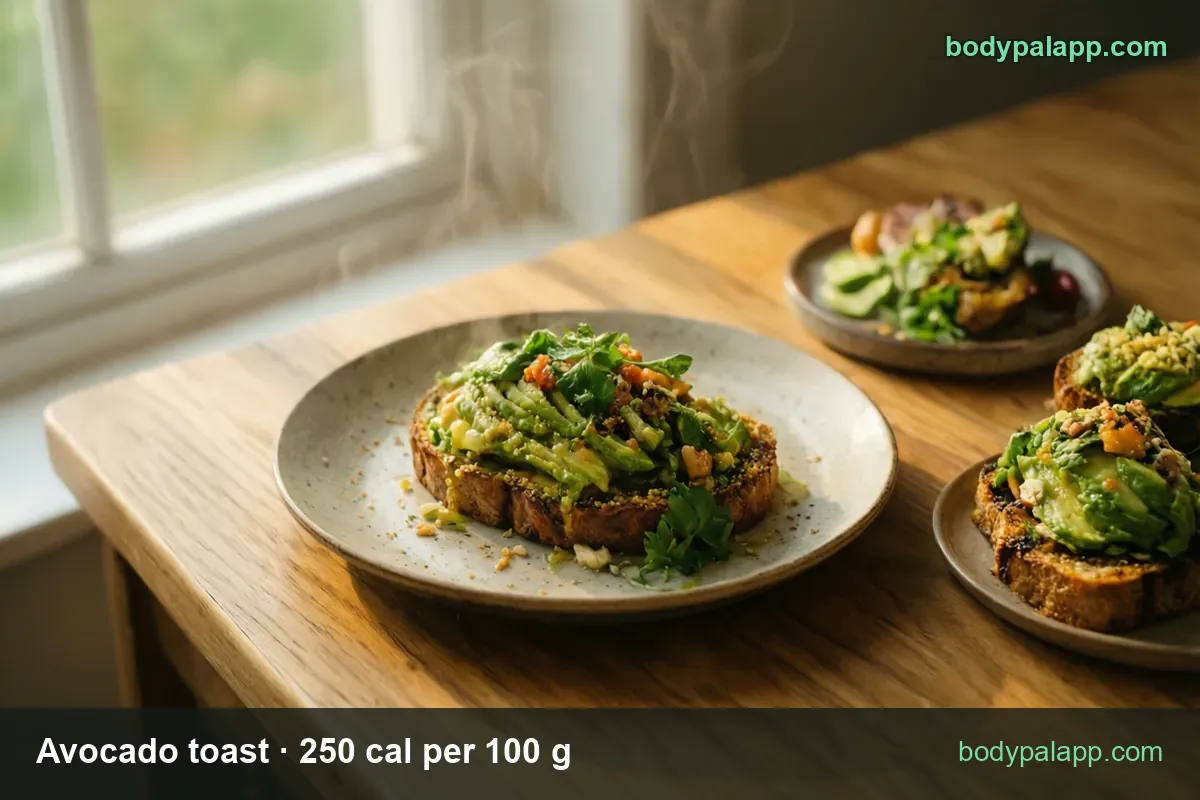
Take the dish apart and the calories stop being mysterious. The bread is cheap per slice and expensive per 100 g. The avocado is the reverse.
| Version | Per 100 g | Typical piece | Calories |
|---|---|---|---|
| Toasted whole wheat bread, no topping | 279 kcal | 1 medium slice (33 g) | 92 kcal |
| Avocado, mashed for a sandwich | 160 kcal | 1 oz (28.3 g) | 45 kcal |
| California (Hass) avocado, raw | 167 kcal | 1 oz (28.3 g) | 47 kcal |
| Florida avocado, raw | 120 kcal | 1 oz (28.3 g) | 34 kcal |
| Sabra Breakfast Avocado Toast tray | 250 kcal | 1 tray (76 g) | 190 kcal |
| MiniMeals2Go avocado toast pack | 136 kcal | 1 pack (191 g) | 260 kcal |
| Avocado toast chopped salad kit | 140 kcal | 1 cup (100 g) | 140 kcal |
Two things jump out. The first is the avocado variety. A Hass runs 167 calories per 100 g against 120 for a Florida avocado, so an ounce of the buttery dark-skinned fruit is 47 calories and an ounce of the big smooth green one is 34 — about 40 percent apart for something most recipes just call "avocado."
The second is the store pack. The MiniMeals2Go version looks lighter on paper at 136 calories per 100 g, just over half the tray's 250. Then you weigh it: 191 g against 76 g. The pack lands at 260 calories, 70 more than the tray. Density told you nothing; the box size told you everything.
The salad kit is a different animal wearing the same name. It is a chopped salad with small toast pieces mixed in, so its 11 g of carbohydrate per 100 g is a salad number, not a bread number. If you scanned it expecting toast, that is why the macros looked strange.
One version has no number here at all: avocado toast with a fried or poached egg on it. USDA publishes no composite record for that build, and adding an egg figure from a different source would mean mixing databases, so we leave it out rather than invent it.
What a homemade slice really costs
Now the number nobody publishes. One medium slice of toasted whole wheat is 92 calories at 33 g. One ounce of mashed avocado is 45 calories at 28.3 g. Together that is 137 calories, and it is our own arithmetic from the USDA 100 g figures rather than a USDA serving.
That is 53 calories under the packaged tray, for a plate that looks bigger. The rest of the homemade build, worked the same way: about 5.4 g of fat, 18.0 g of carbohydrate, 4.1 g of fiber, 5.1 g of protein and 158 mg of sodium.
Read those two columns against each other and the interesting line is protein. The homemade slice carries roughly 5.1 g against the tray's 4.0 g, even though it has fewer calories, because toasted whole wheat holds 13.52 g of protein per 100 g and does most of the work. Sodium is the other gap: 158 mg homemade against 350 mg in the tray, and the difference is packaging and seasoning, not avocado.
If you pile on half a large avocado instead of a measured ounce, the arithmetic scales with the fruit. Two ounces of Hass is 94 calories, which pushes the same slice to 186 — the tray's number, reached the long way.
Fiber earns its keep and sodium sneaks in
Fiber is the reason this breakfast earns its reputation. The tray delivers 5.0 g, 18% of the 28 g Daily Value, from a 190-calorie serving. Both halves contribute: toasted whole wheat carries 6.6 g of fiber per 100 g, raw avocado 6.7 g. It is unusual to hit almost a fifth of a day's fiber before you have spent 200 calories, and it is the honest answer to why avocado toast keeps people full longer than a same-calorie bagel.
Sodium is the row that surprises people, because avocado is not salty. Raw avocado has 7 mg of sodium per 100 g. Toasted whole wheat bread has 473 mg. The 350 mg in the tray — 15% of the 2,300 mg daily limit used on the Dietary Guidelines for Americans — is bread and seasoning, near enough. That is about a seventh of a teaspoon of table salt. If you are watching sodium, the lever is the bread you buy and the flaky salt you sprinkle, not the fruit.
Saturated fat stays quiet at 2.5 g, 13% DV, which is what you would expect when the fat source is a fruit rather than butter. And for anyone counting the plate against a meal pattern, MyPlate counts this as one ounce-equivalent of grains plus roughly a quarter cup of fruit — a real breakfast, but a small one.
How does avocado toast compare?
| Food | Per 100 g | US serving | Calories |
|---|---|---|---|
| Avocado toast, store tray | 250 kcal | 1 tray, 76 g | 190 kcal |
| Toasted whole wheat bread | 279 kcal | 1 medium slice, 33 g | 92 kcal |
| Raw avocado | 160 kcal | 1 cup cubes, 150 g | 240 kcal |
| MiniMeals2Go avocado toast pack | 136 kcal | 1 pack, 191 g | 260 kcal |
Our take: the bread is the densest food in this table per 100 g at 279 calories and the smallest serving at 92, which is the whole trick of toast — high density, tiny portion. Avocado is the opposite, the lightest fruit-based row per 100 g at 160 and the heaviest habit, because a cup of cubes is 240 calories and a cup of cubes is not hard to spread. For a lean breakfast, build it yourself and measure the avocado: one slice plus an ounce is 137 calories on our arithmetic. For staying full until lunch, the 190-calorie tray with 5.0 g of fiber does more per calorie than anything else on this list.
Most popular avocado toast brands in the United States
Ranked by how widely each product appears among foods sold in the United States, from the BodyPal food database of over 3.3 million products. Calories are the figures printed on each Nutrition Facts label, checked against USDA FoodData Central.
| Product | Calories (per 100 g) |
|---|---|
| Sabra Breakfast Avocado Toast | 250 cal |
| Simply Fresh MiniMeals2Go Avocado Toast | 136 cal |
Brand popularity: BodyPal food database. Nutrition: manufacturer labels / USDA FoodData Central.
Avocado toast FAQs
How many calories are in avocado toast?
190 calories for a 76 g store tray, one of two ready-made avocado toasts USDA publishes. That works out to 250 calories per 100 g. Build it yourself from one medium slice of toasted whole wheat and an ounce of mashed avocado and our arithmetic puts it at 137 calories.
How many calories in one slice of avocado toast?
137 calories for one medium slice of toasted whole wheat bread (33 g, 92 calories) carrying an ounce of mashed avocado (28.3 g, 45 calories). That is our own arithmetic from the USDA 100 g figures, not a USDA serving, and it lands 53 calories under the 190-calorie store tray.
How much fat is in avocado toast?
13.0 g in the 76 g tray, or 17% of the Daily Value. Almost all of it comes from the avocado, since a medium slice of toasted whole wheat contributes only 1.3 g. Saturated fat stays low at 2.5 g, 13% DV, because avocado fat is mostly unsaturated.
How many carbs are in avocado toast?
17.0 g in the tray, 6% of the Daily Value, and 5.0 g of that arrives as fiber. Total sugars are 1.0 g. The bread carries nearly all the carbohydrate: toasted whole wheat runs 47.36 g per 100 g, while mashed avocado has only 8.53 g per 100 g.
How much protein is in avocado toast?
4.0 g in the 76 g tray, only 8% of the Daily Value, so avocado toast is not a protein breakfast. A homemade slice does slightly better on our arithmetic, about 5.1 g, because toasted whole wheat bread carries 13.52 g of protein per 100 g and the fruit adds almost none.
How much fiber is in avocado toast?
5.0 g in the tray, 18% of the 28 g Daily Value, and the strongest number on this label. Bread and avocado both contribute: toasted whole wheat holds 6.6 g of fiber per 100 g and raw avocado 6.7 g per 100 g. Few 190-calorie breakfasts do better.
Is avocado toast good for weight loss?
At 190 calories a tray it fits most breakfast budgets, and the 5.0 g of fiber help it sit longer than a bagel would. The catch is portion drift: two trays are 380 calories and a 191 g store pack is 260. If you are watching calories, one measured piece is the pick.
Does whole wheat bread change the calories?
Toasted whole wheat runs 279 calories per 100 g, so one medium 33 g slice is 92 calories before anything goes on top. USDA has no record here for white or sourdough toast, so we cannot cost that swap. The avocado moves the total more: 34 calories an ounce for a Florida fruit, 47 for a Hass.
Similar foods
- Prune — 23 cal per prune
- Date — 66 cal per date, pitted
- Dates — 66 cal per date
- Pitted Dates — 66 cal per date
- Medjool Date — 66 cal per date, pitted
- Strawberry Shortcake — 375 cal per slice
Count it without the math
Point the camera at the plate and BodyPal counts the toast and the avocado on it for you.


How long does it take to burn off avocado toast?
One tray (76 g) is 190 kcal. Enter your weight and the amount you ate to see how long it takes you to burn that off:
lb
| Activity | Time to burn 190 kcal |
|---|---|
| Walking, brisk | 38 min |
| Cycling, moderate | 24 min |
| Swimming, moderate | 27 min |
| Jogging | 22 min |
| Weight training, moderate | 42 min |
Times are for a 155 lb adult at a steady pace; change the weight to see yours. The amount is set to the portion in the text (76 g); change it to what you actually ate. BodyPal works this out from your steps automatically.
Want the bigger picture? Calculate your daily calorie needs — your maintenance figure, a target for losing or gaining, and the date you get there.