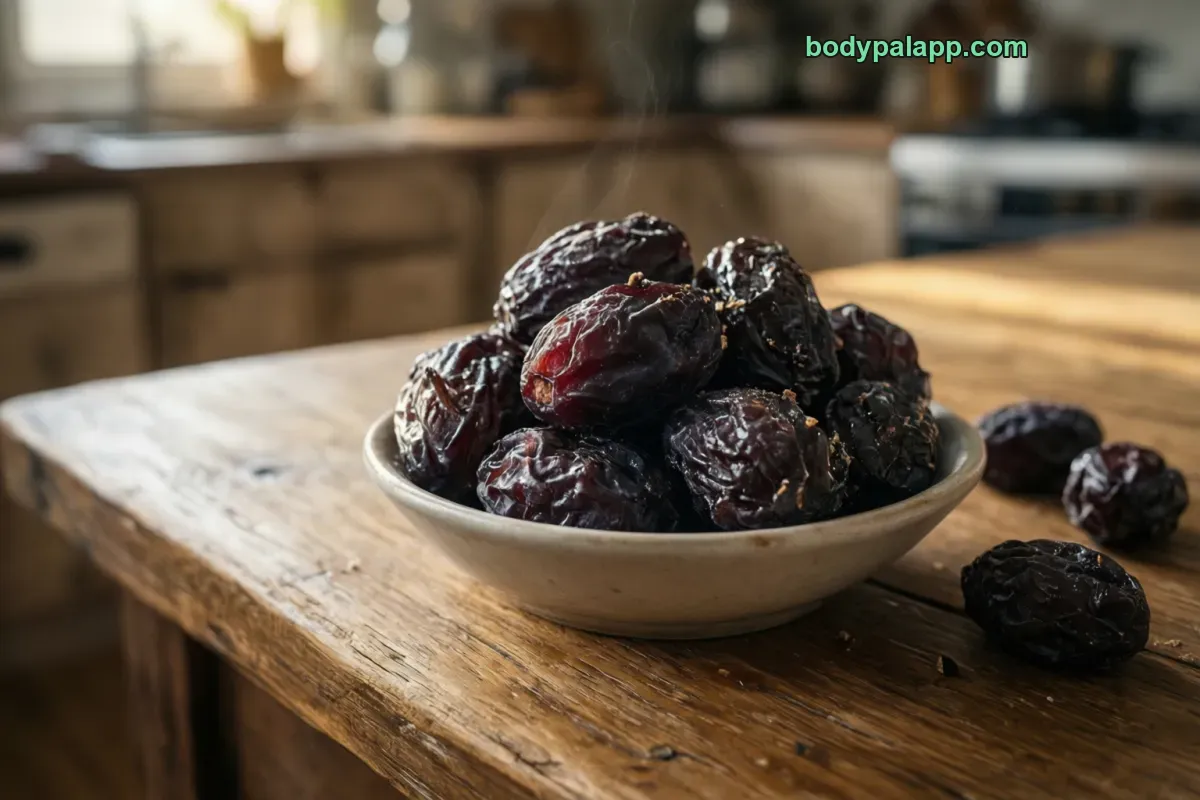
Prune calories come to 23 for one dried, pitted prune (9.5 g) and 240 per 100 g. The number to notice is how fast portions add up: five prunes are 114 calories, but a cup of pitted prunes reaches 418. Nearly all of that energy, 95%, comes from carbohydrate.
23kcal
1 prune · 9 g, dried, pitted
3%protein
0.2 gProtein
6 gCarbs
0 gFat
How to burn off 23 kcal
—Walking, brisk
—Jogging
—Cycling, moderate
—Swimming
Skip the math. BodyPal counts these calories from your steps and workouts automatically.
Nutrition facts
Dried, pitted · per 9 g
Calories
23 kcal
Protein
0.2 g
Carbohydrate
6.1 g
Fat
0 g
Saturated fat
0 g
Cholesterol
0 mg
Sodium
0 mg
Potassium
70 mg
Iron
0.1 mg
Source: USDA FoodData Central
🛡️
Verified nutrition data
Numbers on this page come from USDA FoodData Central, the U.S. Department of Agriculture’s food composition database, and from manufacturer labels where a branded product is named. Last verified September 2026. How we verify our data →
Prune: calories, protein and sodium by serving
Percent of daily value uses the FDA reference of 2,000 kcal a day.
Serving
kcal
Protein
Carbs
Fat
Sodium
% DV kcal
1 prune (9.5 g)
23
0.2 g
6.1 g
0 g
0 mg
1%
1 cup pitted (174 g)
418
3.8 g
111.2 g
0.7 g
3 mg
21%
1 oz portion (28 g)
67
0.6 g
17.9 g
0.1 g
1 mg
3%
100 g
240
2.2 g
63.9 g
0.4 g
2 mg
12%
3 × 1 prune (9.5 g)
68
0.6 g
1 mg
5 × 1 prune (9.5 g)
114
1 g
1 mg
Five prunes make a 114-calorie snack
A single dried prune weighs about 9.5 g and carries 23 calories, so the total climbs in small, predictable steps. Two prunes come to 46 calories, three to 68, and five to 114. That five-prune handful weighs only 48 g, which is why it is the portion most people actually reach for.
The jump comes when you stop counting pieces. A 1 oz portion (28 g) is 67 calories, roughly the same as three prunes. A cup of pitted prunes (174 g) reaches 418 calories, or 21% of a 2000-calorie daily value. Measured by the cup, prunes stop being a light snack and start acting like a meal.
If you are tracking, count prunes rather than pouring them. Pieces are easy to tally, while a loose scoop from the bag is not. Decide on two, three or five before you open the pouch, and the number on your log will match what you ate.
Nearly every calorie comes from carbohydrate
The calorie split is lopsided: 95% carbohydrate, 3% protein and 1% fat. Per 100 g, prunes hold 63.9 g of carbs against 2.2 g of protein and 0.4 g of fat. Saturated fat sits at 0.1 g and cholesterol at 0, so the fat rows barely register.
That makes prunes quick fuel, not a filling protein source. A full cup supplies 3.8 g of protein, only 8% of the daily value, while delivering 111.2 g of carbohydrate. Five prunes add just 1 g of protein. If protein is your priority, prunes are the side, never the main event.
Sodium is a non-issue. There are 2 mg per 100 g and 3 mg in a whole cup, both listed as 0% of the 2300 mg daily value. If you watch salt, prunes need no second thought. The rows that deserve attention are sugar and fiber.
Fiber and sugar arrive in the same bite
Per 100 g, prunes carry 38.1 g of sugars and 7.1 g of fiber. That fiber is the real selling point. One prune brings 0.7 g, and a 1 oz portion brings 2 g toward a daily value of 28 g, which is a solid return for 67 calories.
The sugar scales just as fast. One prune holds 3.6 g, an ounce 10.7 g, and a cup 66.3 g. That cup also supplies 12.4 g of fiber, but it is still a large sugar load for one sitting. Small portions get you the fiber without the heavy sugar total.
Potassium is the other row worth reading: 732 mg per 100 g, set against a daily value of 4700 mg. It is the largest mineral figure on the label, and one more reason prunes earn a place next to fresher fruit rather than next to candy.
Prunes work best as a measured add-on
Because prunes are almost all carbohydrate, they pair well with foods that bring the protein and fat they lack. A few chopped prunes stirred into plain yogurt or oatmeal, or eaten next to a handful of nuts, give a snack more staying power than the fruit alone.
They also slot into cooking. Prunes soften into stews and braises, and blended prunes can stand in for some of the sugar in baked goods. In each case, decide the number of prunes first and count them in, since a full cup adds 418 calories to the dish.
Prune juice is a different product from the whole fruit. Sunsweet sells several versions, including a light juice, so check the label rather than assuming the dried-fruit numbers apply. BodyPal can log prunes from a photo, which keeps the count honest on days you snack straight from the bag.
How does prune compare?
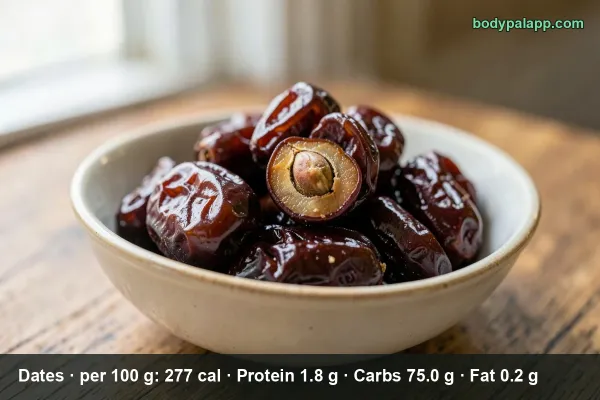
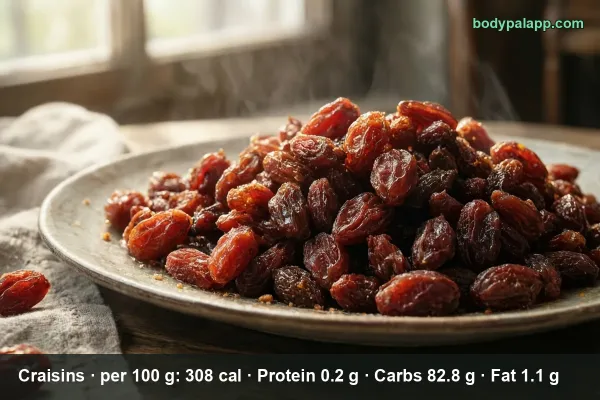
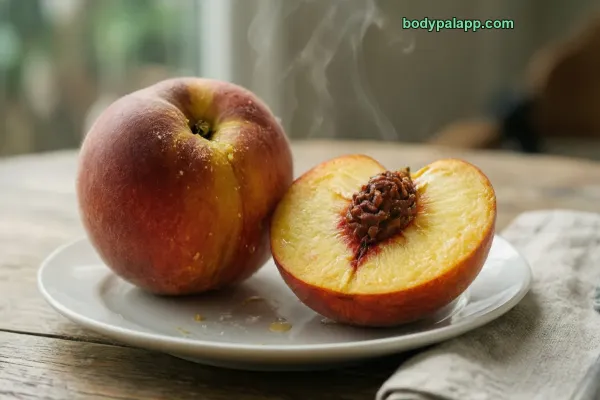
Here is how prunes stack up against dates, craisins and fresh peach, per 100 g and per usual serving.
Verdict: For the fewest calories, a fresh peach wins easily at 59 for a medium fruit and 39 per 100 g. Among dried fruit, prunes are the lighter pick at 240 per 100 g, ahead of dates at 277 and craisins at 308.
Most popular prune brands in the United States
Ranked by popularity in the BodyPal database
# Productkcal / 100 g
1Sunsweet Prune Juice8 fl oz · 240 ml75 kcal
2Sunsweet Amaz!n Prune Juice8 fl oz · 240 ml75 kcal
3Sunsweet Prune Juice With Pulp8 fl oz · 240 ml62 kcal
4Sunsweet Prune Light Juice8 fl oz · 240 ml42 kcal
The branded items shoppers buy most under this name are prune juice, so their numbers are per 100 ml of juice and read far lower than the dried fruit above. Source: manufacturer labels / USDA FoodData Central.
Prune FAQs
How many calories are in one prune?
One pitted dried prune (9.5 g) is about 23 calories. Five prunes come to 114 calories.
Are prunes good for weight loss?
A single prune is 23 calories and 0.7 g of fiber, so a 5-prune snack adds 114 calories and 3.4 g of fiber. A full cup of pitted prunes is 418 calories.
Prunes vs dates: which has fewer calories?
Prunes have 240 calories per 100 g and dates 277, so prunes are 37 calories lighter for the same weight.
How much sugar is in prunes?
100 g of prunes has 38.1 g of sugar, so one 9.5 g prune has about 3.6 g and five prunes about 18.1 g.
How many calories are in 5 prunes?
Five dried prunes have 114 calories. Together they weigh about 48 g, so this handful is a modest snack. If you want a smaller portion, three prunes come to 68 calories and two come to 46.
What nutrition do 5 prunes provide besides calories?
Five prunes supply 114 calories, 1 g of protein and 1 mg of sodium. Almost all of the energy comes from carbohydrate, which makes up 95% of the calories in prunes.
How much does one prune weigh?
A typical dried, pitted prune weighs about 9.5 g. At that size it carries 23 calories, 0.7 g of fiber and 3.6 g of sugars, so counting pieces is an easy way to track them.
How many calories are in a cup of prunes?
A cup of pitted prunes (174 g) has 418 calories, about 21% of a 2000-calorie daily value. The same cup brings 12.4 g of fiber and 66.3 g of sugars.
How many calories are in an ounce of prunes?
A 1 oz portion (28 g) of prunes has 67 calories, roughly the same as three prunes. It provides 2 g of fiber, 10.7 g of sugars and 0.6 g of protein.