
How many calories are in coconut flesh?
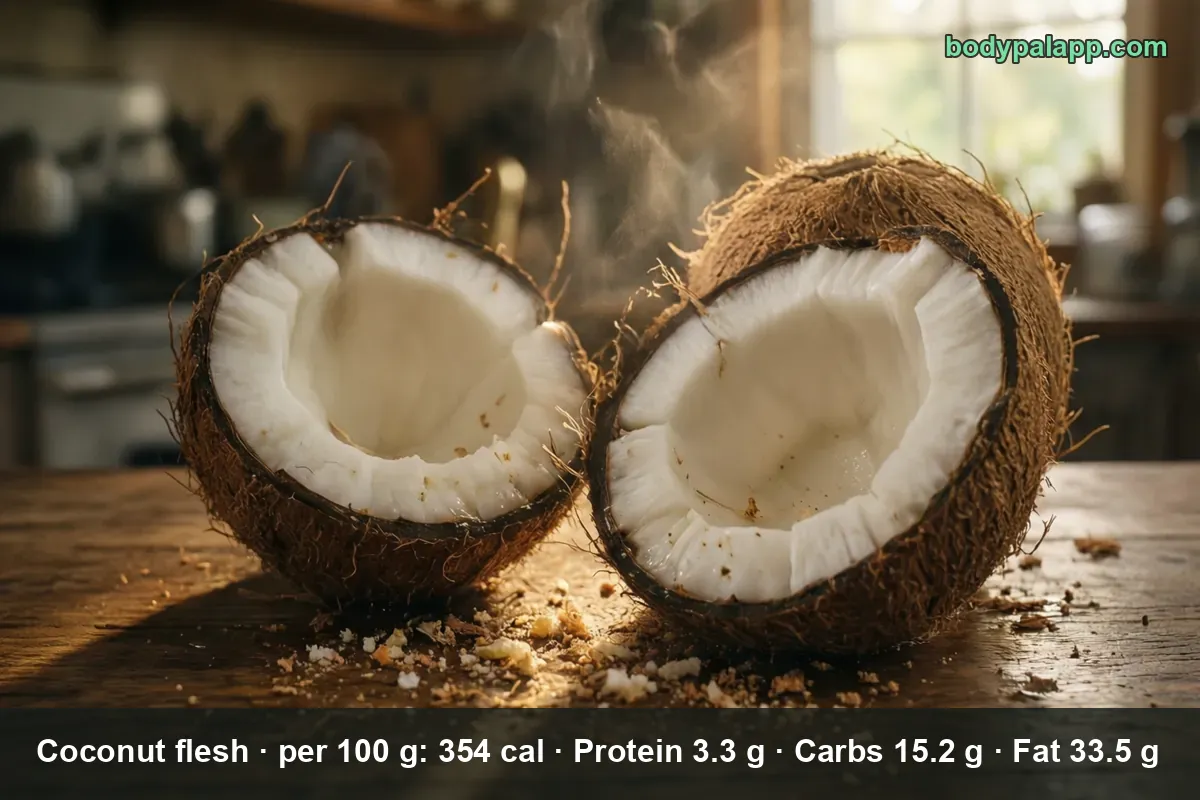
A 1-cup shredded serving of raw coconut flesh weighs 80 g and carries 283 calories. Per 100 g the white meat runs 354 calories, most of it fat: 33.49 g, of which 29.7 g is saturated. Scoop out half a mature coconut and you are holding roughly 703 calories of fruit.
On this page
- Coconut flesh quick facts
- US servings, from one ounce to half a coconut
- Dried, toasted and sweetened coconut
- Young coconut is not the same food
- Saturated fat is the row to watch
- How does coconut flesh compare?
- Most popular coconut flesh brands
- FAQ
Coconut flesh quick facts
The record behind every number on this page is SR Legacy 170169, "Nuts, coconut meat, raw". It is the only USDA entry for the fresh white meat you pry out of a mature brown coconut, which is exactly what someone searching for coconut flesh has in front of them. Every other SR Legacy coconut meat entry has been dried, toasted, creamed or sweetened first. The difference between them is the processing, not the source, so they live further down this page instead of being averaged in.
USDA files coconut under nuts rather than fruit, and the macro split explains why: fat outweighs carbohydrate two to one.
| Nutrient | Per 100 g | Per 1 cup shredded (80 g) | % Daily Value |
|---|---|---|---|
| Calories | 354 | 283 | — |
| Total fat | 33.49 g | 26.8 g | 34% |
| Saturated fat | 29.7 g | 23.8 g | 119% |
| Carbohydrate | 15.23 g | 12.2 g | 4% |
| Dietary fiber | 9 g | 7.2 g | 26% |
| Total sugars | 6.23 g | 5.0 g | — |
| Protein | 3.33 g | 2.7 g | 5% |
| Sodium | 20 mg | 16 mg | 1% |
% Daily Value is based on a 2,000-calorie diet.
Verified nutrition data
Numbers on this page come from USDA FoodData Central, the U.S. Department of Agriculture’s food composition database, and from manufacturer labels where a branded product is named. Last verified September 2026. How we verify our data →
Two label rows are missing here on purpose. USDA does not publish added sugars or trans fat for this record in the SR Legacy release, and in unprocessed flesh there is nothing to add sugar to, so both rows are left out rather than guessed at. Cholesterol is a clean zero, as it is in every plant food. Potassium is the quiet strong point: 356 mg per 100 g, or 285 mg in a cup, which is 6% of the Daily Value.
Sodium is negligible in the raw flesh at 20 mg per 100 g — less than a hundredth of a teaspoon of table salt. Hold that number, because the sweetened packaged flakes later on carry fourteen times as much.
US servings, from one ounce to half a coconut
| Serving | Weight | Calories |
|---|---|---|
| 1 oz | 28.35 g | 100 kcal |
| 1 piece, about 2" x 2" x 1/2" | 45 g | 159 kcal |
| 1 cup, shredded | 80 g | 283 kcal |
| Half a medium coconut | 198.5 g | 703 kcal |
| One medium coconut, flesh only | 397 g | 1405 kcal |
| Per 100 g | 100 g | 354 kcal |
The cup and the 45 g piece are USDA household measures for this record. The ounce and the half-coconut line are our own arithmetic from the USDA 100 g figure, not USDA servings — an ounce lands at almost exactly 100 calories, which is the most useful mental anchor on this page.
The medium-coconut row is flesh only, with the shell and the water left out. A whole nut in the produce aisle weighs far more than 397 g; the shell and the water come along for the ride. That is why "I ate half a coconut" and "I ate a cup of coconut" sit 420 calories apart.
One more trap worth naming: cups of shredded coconut are not interchangeable. A cup of the raw flesh is 80 g, a cup of sweetened shredded from a bag is 93 g, and a cup of canned sweetened flakes is 77 g. Same word, three different weights, three different calorie counts.
Dried, toasted and sweetened coconut
| Version | Per 100 g | Typical serving | Calories |
|---|---|---|---|
| Raw coconut flesh | 354 kcal | 1 cup shredded, 80 g | 283 kcal |
| Dried, unsweetened | 660 kcal | 1 oz, 28.35 g | 187 kcal |
| Creamed coconut | 684 kcal | 1 oz, 28.35 g | 194 kcal |
| Toasted coconut | 592 kcal | 1 oz, 28.35 g | 168 kcal |
| Sweetened, shredded | 501 kcal | 1 cup shredded, 93 g | 466 kcal |
| Sweetened flaked, packaged | 456 kcal | 1 cup, 85 g | 388 kcal |
| Sweetened flaked, canned | 443 kcal | 1 cup, 77 g | 341 kcal |
Drying is the single biggest move in the table, and it happens without a gram of anything being added. Unsweetened desiccated coconut is 660 calories per 100 g against 354 fresh, because the water leaves and the fat stays. Creamed coconut, which is the dried flesh ground into a solid paste, is denser still at 684. Toasted coconut reads lower at 592 only because its carbohydrate rises to 44.4 g while fat drops to 47 g.
Sweetening pulls in the opposite direction, and that surprises people. The sweetened shredded record is 501 calories per 100 g, well below the unsweetened 660, because sugar has displaced some of the fat by weight. Per cup, though, sweetened wins the calorie count outright: 466 against 283 for the same volume of raw flesh. Its carbohydrate load is 47.67 g per 100 g versus 15.23 g raw, and 43.17 g of that is sugar.
USDA does not publish sugar or fiber values for the creamed and toasted records, or sugar for the canned flakes, so those values are left out here rather than filled from a neighboring row. Sodium is the other thing sweetening drags along: 262 mg per 100 g in sweetened shredded and 285 mg in packaged flakes, against 20 mg in the raw flesh.
Young coconut is not the same food
If the label in front of you says coconut meat and the number reads 90 calories per 100 g, nothing is wrong — you have young Thai coconut, not mature flesh. One US branded product in USDA's database, Exotic Superfoods Young Thai Coconut Meat, is 90 calories per 100 g, which is a quarter of the 354 in the mature record. Young coconut meat is soft and jelly-like, closer in texture to a thick custard than to the firm white slab in a brown nut, because the fat has not finished laying down.
That gap is the biggest single source of logging errors for this food. Four times is not a rounding difference; it is the difference between a 90-calorie snack and a 354-calorie one for the identical weight.
Saturated fat is the row to watch
Coconut is one of the very few plant foods where saturated fat is the headline. Raw flesh carries 29.7 g per 100 g, so a single 80 g cup delivers 23.8 g — 119% of the FDA Daily Value of 20 g. One cup, one day's allowance, gone. The Dietary Guidelines for Americans put the same advice as a percentage: keep saturated fat under 10% of daily calories.
The 45 g piece is the sane middle ground at 159 calories and 13.4 g of saturated fat, and an ounce of dried unsweetened coconut sprinkled over oatmeal is 187 calories with about 16.2 g. If you are watching saturated fat for any reason, coconut is a garnish food rather than a bowl food.
The fiber row runs the other way and deserves credit. Nine grams per 100 g is a genuinely high figure — the cup alone covers 7.2 g, or 26% of the day, which is more than most nuts manage. Protein is the weak spot at 3.33 g per 100 g, so coconut does not do the job of the protein foods group no matter how filling it feels.
How does coconut flesh compare?
| Food | Per 100 g | US serving | Calories |
|---|---|---|---|
| Coconut flesh, raw | 354 kcal | 1 oz, 28.35 g | 100 kcal |
| Coconut cream, canned, sweetened | 357 kcal | 1 oz, 28.35 g | 101 kcal |
| Chestnuts, japanese, dried | 360 kcal | 1 oz, 28.35 g | 102 kcal |
| Ginkgo nuts, dried | 348 kcal | 1 oz, 28.35 g | 99 kcal |
Our take: these four foods are within 12 calories of each other per 100 g and within 3 calories per ounce, and yet they behave nothing alike. Dried chestnuts hit 360 calories on 81.43 g of carbohydrate and 1.24 g of fat; coconut hits 354 on 33.49 g of fat and 15.23 g of carbohydrate. Only ginkgo nuts come in lighter than coconut here, and only by 6 calories. If the calorie count is all you track, swap freely; if you are managing saturated fat or carbohydrate, these are opposite ends of the pantry and the ounce-for-ounce tie is a coincidence, not a match.
Most popular coconut flesh brands in the United States
Ranked by how widely each product appears among foods sold in the United States, from the BodyPal food database of over 3.3 million products. Calories are the figures printed on each Nutrition Facts label, checked against USDA FoodData Central.
| Product | Calories (per 100 g) |
|---|---|
| Exotic Superfoods Young Thai Coconut Meat | 90 cal |
Brand popularity: BodyPal food database. Nutrition: manufacturer labels / USDA FoodData Central.
Coconut flesh FAQs
How many calories are in coconut flesh?
Coconut flesh runs 354 calories per 100 g, and a standard 1-cup shredded serving of 80 g comes to 283 calories. That is fresh white meat from a mature coconut, raw, straight out of the shell. Most of those calories are fat: 33.49 g per 100 g.
How many calories in half a coconut?
Half a medium coconut holds about 703 calories, using 198.5 g of flesh, which is our own arithmetic from the USDA 100 g figure rather than a USDA serving. A whole medium coconut, flesh only and no shell, is 1,405 calories — more than most people expect from a fruit.
How many calories are in 1 cup of shredded coconut?
One cup of shredded raw coconut, 80 g, is 283 calories. It also carries 23.8 g of saturated fat, 119% of the Daily Value, and 7.2 g of fiber. Sweetened shredded coconut from a bag is a different food: 466 calories for a 93 g cup.
Is coconut meat good for weight loss?
At 354 calories per 100 g, coconut flesh is dense for a fruit, roughly the same per gram as dried chestnuts. The 9 g of fiber per 100 g helps it feel filling, but the portion is what decides. A 45 g piece is 159 calories; a full cup is 283.
Is coconut flesh high in saturated fat?
Yes: 29.7 g per 100 g, and 23.8 g in a single 80 g cup, which is 119% of the 20 g Daily Value. Coconut is one of the few plant foods where saturated fat dominates. If you are watching that number, keep the serving to a piece or two.
How much fiber is in coconut meat?
Raw coconut meat has 9 g of fiber per 100 g, so an 80 g cup delivers 7.2 g, which is 26% of the 28 g Daily Value. One cup covers roughly a quarter of the day's fiber, unusual for a food this high in fat, and it is why the flesh feels heavy.
Is dried coconut higher in calories than fresh coconut?
Yes, by a lot: 660 calories per 100 g for unsweetened dried coconut against 354 for fresh. Drying removes water, not fat, so the same flesh concentrates. An ounce of dried is 187 calories, while an ounce of fresh is 100 — nearly double for the same weight.
Is young Thai coconut meat lower in calories?
Much lower: one US branded product of young Thai coconut meat is 90 calories per 100 g, against 354 for mature coconut flesh. Young coconut is soft, jelly-like and mostly water, so the fat has not built up yet. Check the label, because one word covers both foods.
Similar foods
- Coconut — 283 cal per cup, shredded
- Apple Turnover — 269 cal per turnover
- Craisins — 123 cal for 1/4 cup
- Apple Fritter — 455 cal per fritter
- Raisins — 120 cal per 1/4 cup
- Date — 66 cal per date, pitted
Count it without the math
Point the camera at the bowl and BodyPal counts the coconut for you, shredded, dried or straight from the shell.


How long does it take to burn off coconut flesh?
A 1-cup shredded serving (80 g) is 283 kcal. Enter your weight and the amount you ate to see how long it takes you to burn that off:
lb
| Activity | Time to burn 283 kcal |
|---|---|
| Walking, brisk | 57 min |
| Cycling, moderate | 35 min |
| Swimming, moderate | 40 min |
| Jogging | 33 min |
| Weight training, moderate | 1 hr 3 min |
Times are for a 155 lb adult at a steady pace; change the weight to see yours. The amount is set to the portion in the text (80 g); change it to what you actually ate. BodyPal works this out from your steps automatically.
One food is easy to picture; a whole day is harder. See how many calories you need a day and what a deficit actually looks like.