
How many calories are in a scone?
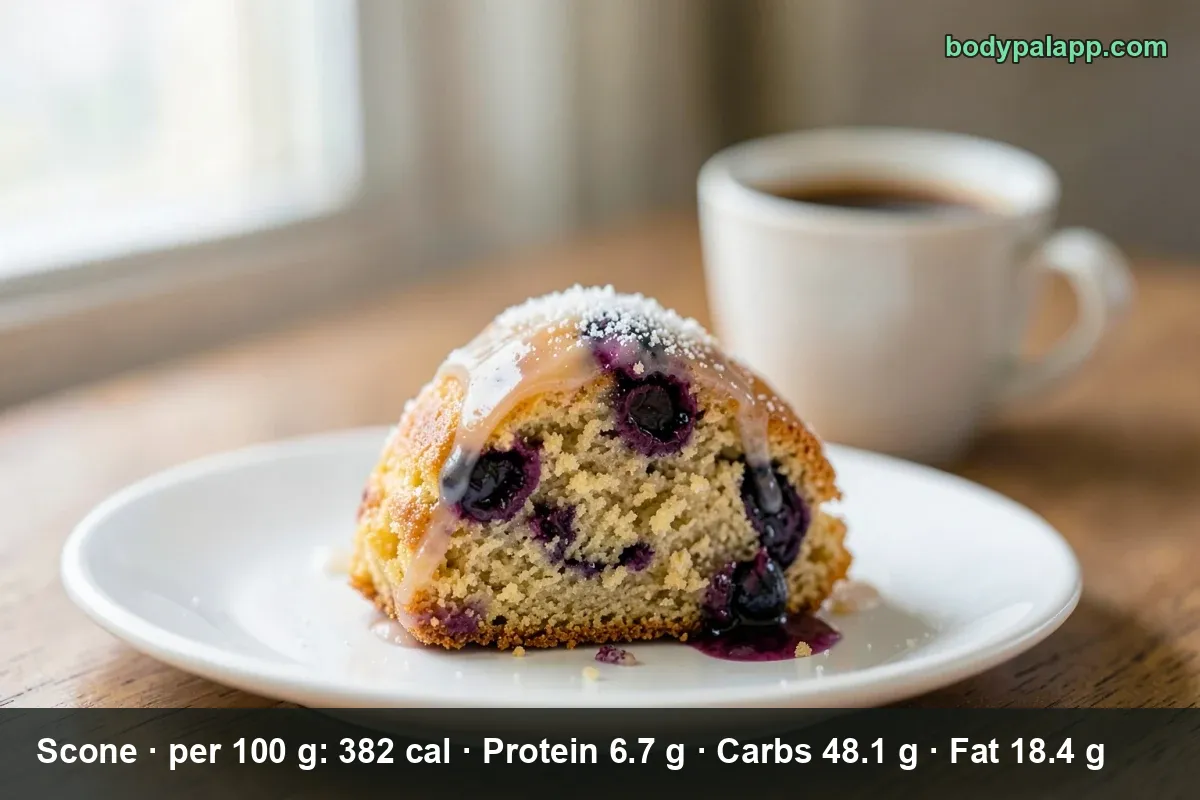
One regular scone weighs 70 g and carries 267 calories. Per 100 g a scone runs 382 calories, denser than a plain muffin at 374 or a cheese biscuit at 374. The surprise is not the calorie count, though. It is the saturated fat: 6.8 g in one scone, 34% of a day's worth.
On this page
- Scone quick facts
- US scone servings, from a mini to a full bakery scone
- Fruit, blueberry and iced scones
- Saturated fat, not calories, is the catch
- How does a scone compare?
- Most popular scone brands
- Scone FAQs
Scone quick facts
The row used here is FNDDS 2707808, "Scone", from the 2021-2023 survey release. It is the only USDA entry for a plain scone of the kind a person actually picks up, and the only one that comes with US household portions attached: one regular scone and one miniature. Everything below is scaled from it unless a different record is named.
Two label rows are missing on purpose. This FNDDS edition does not publish added sugars or trans fat for the record, so those lines are left out rather than guessed. Cholesterol and potassium do exist: a 70 g scone holds 52 mg of cholesterol, 17% of the Daily Value, and 83 mg of potassium, only 2%.
| Nutrient | Per 100 g | Per 1 regular scone (70 g) | % Daily Value |
|---|---|---|---|
| Calories | 382 | 267 | — |
| Total fat | 18.35 g | 12.8 g | 16% |
| Saturated fat | 9.74 g | 6.8 g | 34% |
| Carbohydrate | 48.07 g | 33.6 g | 12% |
| Dietary fiber | 1.2 g | 0.8 g | 3% |
| Total sugars | 13.4 g | 9.4 g | — |
| Protein | 6.67 g | 4.7 g | 9% |
| Sodium | 446 mg | 312 mg | 14% |
% Daily Value is based on a 2,000-calorie diet.
Verified nutrition data
Numbers on this page come from USDA FoodData Central, the U.S. Department of Agriculture’s food composition database, and from manufacturer labels where a branded product is named. Last verified September 2026. How we verify our data →
Total sugars carry no Daily Value on the US label, which is why that cell stays empty. The percentages come from the reference amounts the FDA publishes for the Nutrition Facts panel.
US scone servings, from a mini to a full bakery scone
| Serving | Weight | Calories |
|---|---|---|
| 1 miniature scone | 20 g | 76 kcal |
| 1 oz | 28 g | 108 kcal |
| Half a regular scone | 35 g | 134 kcal |
| 1 regular scone | 70 g | 267 kcal |
| Per 100 g | 100 g | 382 kcal |
Only two of those are USDA household measures: the regular scone at 70 g and the miniature at 20 g. The ounce and the half scone are our own arithmetic from the USDA 100 g figure, and the 100 g line is that USDA figure itself rather than a household serving, which matters if you are logging by eye rather than by scale.
The gap between the two real portions is the whole story of this food. A miniature is 76 calories, a regular is 267, and nothing about the recipe changed between them. That is a 191-calorie swing driven entirely by 50 g of dough. Coffee-shop scones are usually heavier still, often well past 100 g, and USDA does not publish a record at that size, so weigh one if you can rather than assuming the 70 g figure covers it.
Fruit, blueberry and iced scones
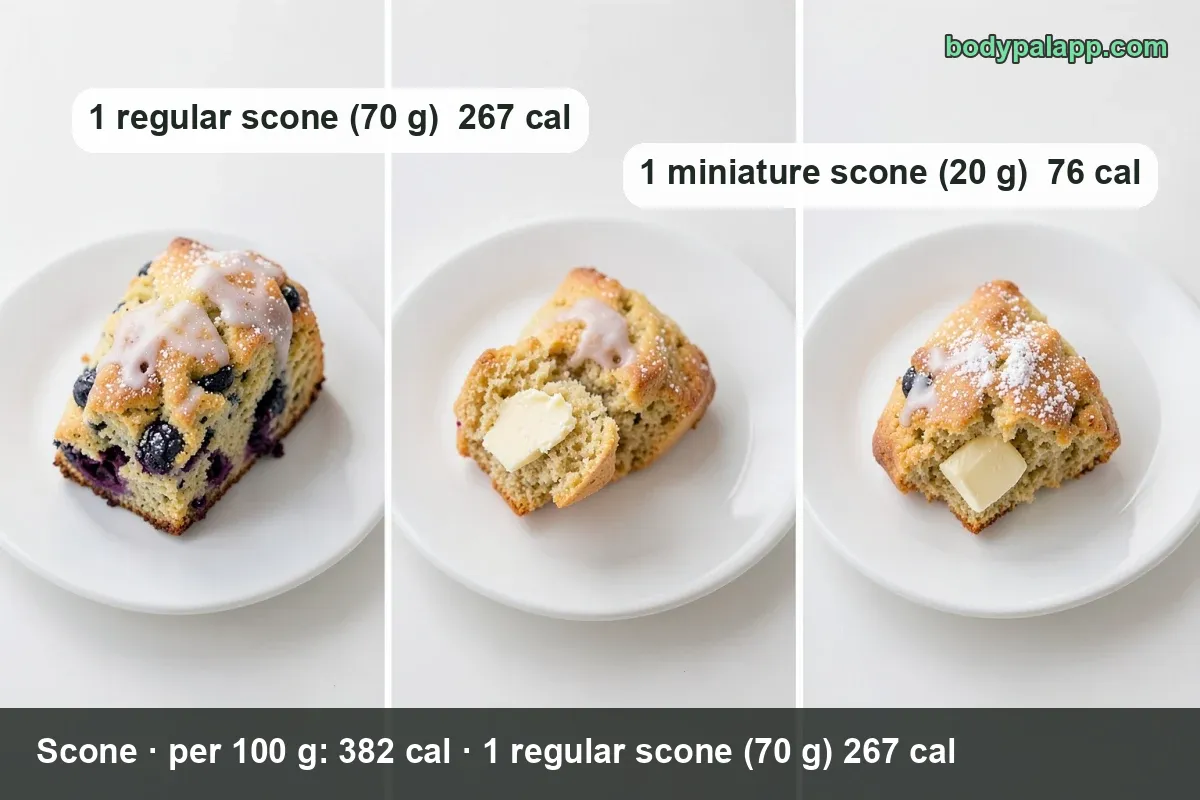
| Version | Per 100 g | Typical piece | Calories |
|---|---|---|---|
| Plain scone | 382 kcal | 1 regular, 70 g | 267 kcal |
| Scone with fruit | 374 kcal | 1 regular, 70 g | 262 kcal |
| Miniature scone | 382 kcal | 1 miniature, 20 g | 76 kcal |
| Bakery blueberry scone | 342 kcal | 1 scone, 38 g | 130 kcal |
| Supermarket scone with icing | 392 kcal | 1 scone with icing, 51 g | 200 kcal |
Adding fruit does almost nothing to the calorie count. The USDA fruit scone is 374 per 100 g against 382 for plain, because berries bring water and sugar while displacing a little butter: 18.58 g of sugars per 100 g instead of 13.4 g, but 16.54 g of fat instead of 18.35 g. Sweeter, marginally lighter, same ballpark.
Icing is the same non-event. A supermarket blueberry scone with icing sits at 392 per 100 g, ten calories above plain, and the piece itself comes in at 200 calories only because it weighs 51 g. Packaged bakery scones range from 342 to 421 per 100 g across the brands USDA lists, and a three-pack of two-bite blueberry scones weighing 60 g is 230 calories, so three small ones can cost nearly as much as one large one.
Saturated fat, not calories, is the catch
Look back at the percentage column. Calories aside, one 70 g scone delivers 34% of the Daily Value for saturated fat, against 14% for sodium, 12% for carbohydrate and 9% for protein. Nothing else on the panel comes close. The Daily Value used on US labels is 20 g of saturated fat, and the Dietary Guidelines for Americans advise keeping saturated fat under 10% of daily calories. One scone takes a third of that budget before anything is spread on it.
The sodium is easy to miss too. At 312 mg, a scone holds about an eighth of a teaspoon of table salt, more than most people expect from something sweet. Fiber runs the other way: 0.8 g per scone, 3% of the Daily Value, because refined flour is doing the work. If a pastry is the plan, MyPlate's guidance on grains is the useful counterweight, since it puts the emphasis on whole grains for the rest of the day rather than on the scone itself.
If you are watching saturated fat, the miniature is the honest pick at 1.9 g. If you want the full scone, treating it as the fat allowance for the morning rather than an add-on to it keeps the math straightforward.
How does a scone compare?
| Food | Per 100 g | Protein per 100 g | US serving | Calories |
|---|---|---|---|---|
| Scone | 382 kcal | 6.67 g | 1 oz (28 g) | 108 kcal |
| Muffin, plain | 374 kcal | 5.93 g | 1 oz (28 g) | 106 kcal |
| Biscuit, cheese | 374 kcal | 8.7 g | 1 oz (28 g) | 106 kcal |
| Muffin, NFS | 375 kcal | 4.49 g | 1 oz (28 g) | 106 kcal |
USDA lists a one-ounce household measure for all three neighbors, so the table compares them at the same weight. At a 70 g piece, our own arithmetic from those 100 g figures puts the plain muffin at 262 calories, the cheese biscuit at 262 and the unspecified muffin at 263, against 267 for the scone.
Our take: the scone is the densest of the four, but only by two calories an ounce, so swapping a scone for a muffin buys you almost nothing. What actually differs is what comes with the energy. The cheese biscuit brings the most protein at 8.7 g per 100 g and the fewest carbs at 38.78 g, but also the most fat at 20.43 g. The scone's real weakness against all three is the saturated fat and the fact that people eat 70 g of it in one sitting. If you want a smaller number rather than a different pastry, order the mini.
Most popular scone brands in the United States
Ranked by how widely each product appears among foods sold in the United States, from the BodyPal food database of over 3.3 million products. Calories are the figures printed on each Nutrition Facts label, checked against USDA FoodData Central.
| Product | Calories (per 100 g) |
|---|---|
| Two-Bite Scones, Blueberry | 383 cal |
| Two-Bite Blueberry Original Scones | 377 cal |
| Schwartz Brothers Bakery Scones | 421 cal |
| Schwartz Brothers Blueberry Scones | 342 cal |
| Wegmans Mini Scones | 403 cal |
| Giant Eagle Scones with Icing, Blueberry | 392 cal |
Brand popularity: BodyPal food database. Nutrition: manufacturer labels / USDA FoodData Central.
Scone FAQs
How many calories are in a scone?
A regular 70 g scone has 267 calories, and 100 g of scone runs 382. That density sits above most breakfast pastries, so the size of the scone in your hand decides the damage: a 20 g miniature is 76 calories, half a regular one 134.
How many calories in a blueberry scone?
A 38 g bakery blueberry scone is 130 calories, at 342 per 100 g, the lightest scone on this page per gram. A supermarket blueberry scone with icing is bigger at 51 g and 200 calories, and a three-pack of two-bite blueberry scones (60 g) is 230.
Are scones healthier than muffins?
By calories, barely: a plain muffin is 374 per 100 g against 382 for a scone, a gap of 8 calories. The scone carries more protein (6.67 g vs 5.93 g per 100 g) but also more fat, 18.35 g against 16.21 g. Portion size separates them more than recipe.
How many carbs are in a scone?
A 70 g scone has 33.6 g of carbohydrate, 12% of the Daily Value, of which 9.4 g is sugars and 0.8 g fiber. Per 100 g the figure is 48.07 g. A 20 g miniature drops that to about 9.6 g, our own arithmetic from the USDA 100 g figure.
How much sugar is in a scone?
A regular 70 g scone holds 9.4 g of total sugars, from 13.4 g per 100 g. A fruit scone is sweeter, 18.58 g per 100 g, which works out to 13.0 g in a 70 g piece. Total sugars have no Daily Value, so no percentage appears on that row.
How many calories in a mini scone?
A miniature scone weighs 20 g and carries 76 calories, a USDA household portion rather than our estimate. Three of them still land near a full scone: a supermarket pack of three mini scones weighing 62 g is 250 calories, because bakery minis run larger than the USDA 20 g piece.
How much saturated fat is in a scone?
A 70 g scone carries 6.8 g of saturated fat, 34% of the 20 g Daily Value, from 9.74 g per 100 g. That is the highest percentage on the label for this food, higher than sodium at 14% and cholesterol at 17%. Butter in the dough is the reason.
Do iced scones have more calories?
Per 100 g, barely: a supermarket blueberry scone with icing is 392 calories against 382 for a plain one. Per piece it is lower, 200 calories, because that scone weighs 51 g instead of 70 g. Icing changes the weight more than it changes the density.
Similar foods
- Bread With Peanut Butter — 176 cal per slice with peanut butter
- Rice Krispies Crisped Rice Cereal — 107 cal per cup
- Corn Flakes — 108 cal per cup
- Corn Flakes — 108 cal per cup
- Cake — 546 cal per slice (1/12 cake)
- Cake Ball — 87 cal per cake ball
Count it without the math
Point the camera at the plate and BodyPal counts the scone for you, icing and all.


How long does it take to burn off a scone?
One regular scone (70 g) is 267 kcal. Enter your weight and the amount you ate to see how long it takes you to burn that off:
lb
| Activity | Time to burn 267 kcal |
|---|---|
| Walking, brisk | 53 min |
| Cycling, moderate | 33 min |
| Swimming, moderate | 38 min |
| Jogging | 31 min |
| Weight training, moderate | 59 min |
Times are for a 155 lb adult at a steady pace; change the weight to see yours. The amount is set to the portion in the text (70 g); change it to what you actually ate. BodyPal works this out from your steps automatically.
Burning it off is one side of it. The other is knowing your number: work out how many calories you need a day, with macros and a goal date.