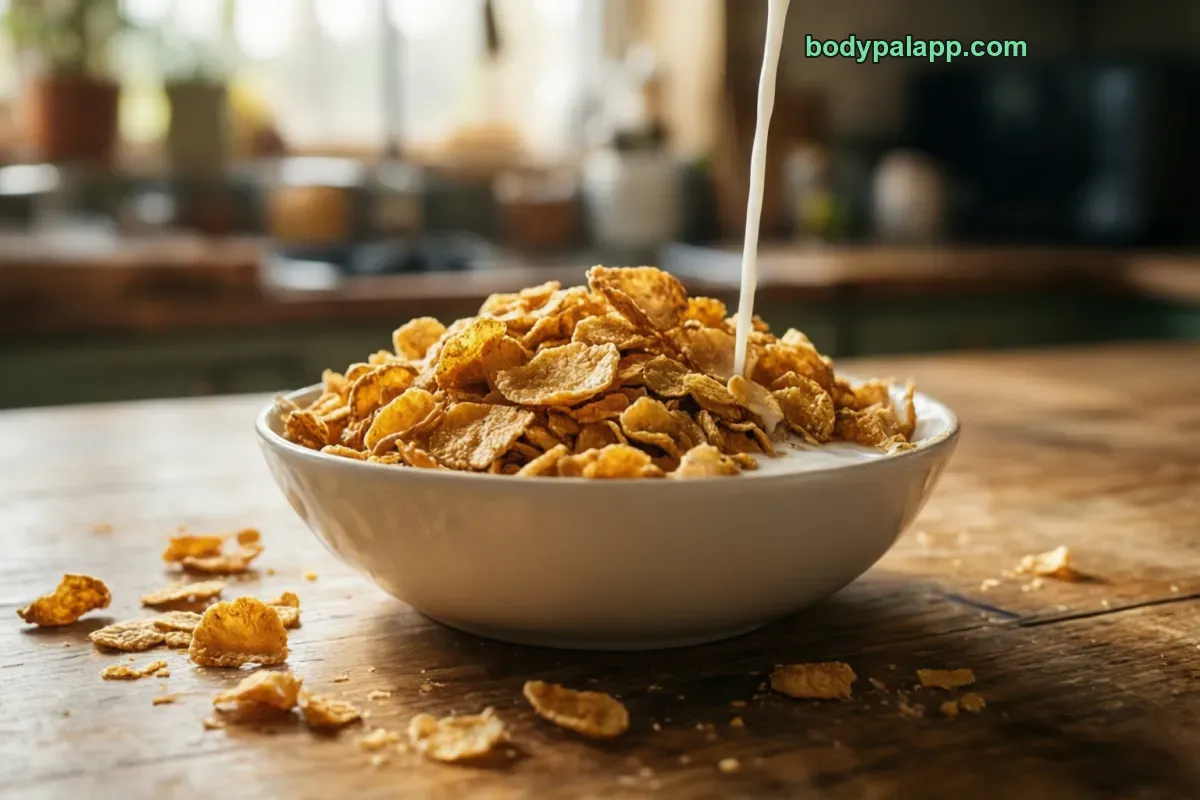
Corn flakes calories come to 108 for a 1 cup (28 g) serving and 384 per 100 g. Nearly all of that energy is carbohydrate: carbs supply 92% of the calories, protein 6% and fat 2%. The number most people miss is sodium, at 160 mg in a single plain cup.
108kcal
1 cup · 28 g, ready-to-eat, plain
6%protein
1.7 gProtein
25 gCarbs
0.3 gFat
How to burn off 108 kcal
—Walking, brisk
—Jogging
—Cycling, moderate
—Swimming
Skip the math. BodyPal counts these calories from your steps and workouts automatically.
Nutrition facts
Ready-to-eat, plain · per 28 g
Calories
108 kcal
Protein
1.7 g
Carbohydrate
25 g
Fat
0.3 g
Saturated fat
0.1 g
Cholesterol
0 mg
Sodium
160 mg
Potassium
30 mg
Iron
5.4 mg
Source: USDA FoodData Central
🛡️
Verified nutrition data
Numbers on this page come from USDA FoodData Central, the U.S. Department of Agriculture’s food composition database, and from manufacturer labels where a branded product is named. Last verified September 2026. How we verify our data →
Corn flakes: calories, protein and sodium by serving
Percent of daily value uses the FDA reference of 2,000 kcal a day.
Serving
kcal
Protein
Carbs
Fat
Sodium
% DV kcal
1 cup (28 g)
108
1.7 g
24.6 g
0.3 g
160 mg
5%
Frosted, 1 cup (40 g)
150
1.9 g
33.9 g
0.5 g
206 mg
8%
100 g
384
5.9 g
88 g
0.9 g
571 mg
19%
3 × 1 cup (28 g)
323
5 g
480 mg
5 × 1 cup (28 g)
538
8.3 g
799 mg
A cup is light, but nobody pours just one
One level cup of plain corn flakes weighs only 28 g and lands at 108 calories, about 5% of a daily value of 2000. That is a small number, and it is also why the total drifts upward so easily. Flakes are airy, so a cereal bowl filled to the rim often holds two or three cups without looking oversized.
Two cups (56 g) come to 215 calories. Three cups (84 g) reach 323 calories, and a large mixing-bowl serving of five cups (140 g) climbs to 538. The cereal did not change; only the pour did. Milk adds its own calories on top of every one of these figures.
If you track intake, weigh the flakes once on a kitchen scale and note what your usual bowl actually holds. Most people find their habit is closer to the two-cup row than the one-cup label. BodyPal can also log a bowl from a photo, which helps when you are eating away from the scale.
Carbs supply 92% of every calorie
Per 100 g, corn flakes carry 88 g of carbohydrate, 5.9 g of protein and just 0.9 g of fat. Translated into energy, that is 92% carbs, 6% protein and 2% fat. Few breakfast foods are this one-sided.
A single cup gives 24.6 g of carbs against 1.7 g of protein and 0.3 g of fat. Fiber is modest at 0.8 g per cup, or 2.7 g per 100 g. Saturated fat is close to nothing at 0.2 g per 100 g, and cholesterol is 0.
The practical result is fast, simple fuel with little to slow it down. Protein covers only 3% of the daily value per cup, so the cereal on its own does little for staying full. That is not a flaw if you plan for it; it simply means the rest of the bowl has to do that job.
Sodium outruns sugar in plain flakes
Plain corn flakes are not especially sweet, with 2.2 g of sugars per cup and 7.8 g per 100 g. Sodium is the more surprising row. Each cup holds 160 mg, which is 7% of the 2300 mg daily value, and 100 g carries 571 mg, or 25%.
Portions multiply this quickly. Two cups bring 320 mg, three cups 480 mg, and five cups 799 mg. For a food that tastes neutral, that is a meaningful share of a day's sodium before anything salty has been eaten.
The frosted version shifts the balance the other way. One frosted cup (40 g) has 150 calories, 13 g of sugars and 206 mg of sodium, so it adds sugar without lowering the salt. If you watch sodium, measuring the portion matters more than switching between these two.
Build the bowl around what flakes lack
Corn flakes give quick carbohydrate and little else, so the smart move is pairing them with foods that bring protein and fiber. Milk or yogurt adds protein, fresh fruit adds fiber and volume, and a few nuts add fat that slows the meal down.
Treat the flakes as the base rather than the whole meal. A measured cup at 108 calories leaves plenty of room for those additions while keeping the total predictable. Brands such as Wild Harvest Organic Corn Flakes and Family Gourmet Corn Flakes sit in the same plain category, though labels are worth checking for sugar and sodium.
Later in the day, the low fat and high carb profile makes corn flakes a light snack rather than a filling one. If you reach for a second bowl an hour later, that is the 1.7 g of protein per cup showing up, not a lack of willpower.
How does corn flakes compare?
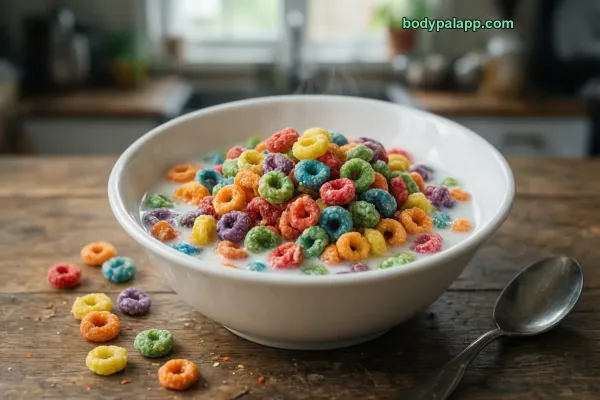
Here is how plain corn flakes stack up against Corn Chex, Froot Loops and beer bread per 100 g and per usual serving.
Verdict: Per 100 g the cereals are nearly level, with corn flakes at 384 calories, Corn Chex at 373 and Froot Loops at 370, so pick on sodium and portion rather than calories. If salt is your concern choose corn flakes at 571 mg over Corn Chex at 709 mg; if a fixed small portion helps you, the Froot Loops pouch stops at 93 calories.
Most popular corn flakes brands in the United States
4Wild Harvest Organic Corn Flakes1 cup · 30 g367 kcal
5Family Gourmet Corn Flakes1 cup · 32 g406 kcal
Frosted and chocolate-coated boxes carry added sugar and fat, so their label numbers read higher than the 384 calories per 100 g of plain flakes. Source: manufacturer labels / USDA FoodData Central.
Corn flakes FAQs
How many calories are in a cup of corn flakes?
One cup of plain corn flakes weighs 28 g and has 108 calories. Per 100 g that is 384 calories.
Are corn flakes good for weight loss?
A dry 28 g cup is 108 calories, but it carries only 1.7 g protein and 0.8 g fiber, so it fills less than a bowl of the same calories with more of both.
Corn flakes or frosted flakes: which has more calories?
Per 100 g plain corn flakes have 384 calories and frosted corn flakes 375. A cup of frosted flakes weighs 40 g and comes to 150 calories, against 108 for a 28 g cup of plain.
How much sugar is in corn flakes?
Plain corn flakes have 7.84 g of sugar per 100 g, so a 28 g cup holds 2.2 g, along with 160 mg of sodium. Frosted versions reach 32.5 g of sugar per 100 g.
How many calories are in 100 g of corn flakes?
100 g of plain corn flakes has 384 calories. That weight equals several cups, since one cup is only 28 g, and it also carries 88 g of carbs, 5.9 g of protein and 571 mg of sodium.
How many calories are in two cups of corn flakes?
Two cups (56 g) of plain corn flakes come to 215 calories, with 320 mg of sodium and 3.3 g of protein. A full bowl often holds this much, so it is a more realistic figure than the single-cup label.
How much protein is in corn flakes?
A cup of corn flakes has 1.7 g of protein, which is 3% of the daily value. Per 100 g it is 5.9 g. Protein supplies only 6% of the calories, so milk or yogurt does most of the protein work in the bowl.
How much sodium is in corn flakes?
One cup of plain corn flakes has 160 mg of sodium, 7% of the daily value. Per 100 g the figure is 571 mg, or 25%. Three cups reach 480 mg, so portion size drives the total.
Are corn flakes high in fiber?
No. Corn flakes have 0.8 g of fiber per cup and 2.7 g per 100 g. Adding fruit or a higher-fiber cereal to the bowl is the simplest way to raise it.