
How many calories are in a cake ball?
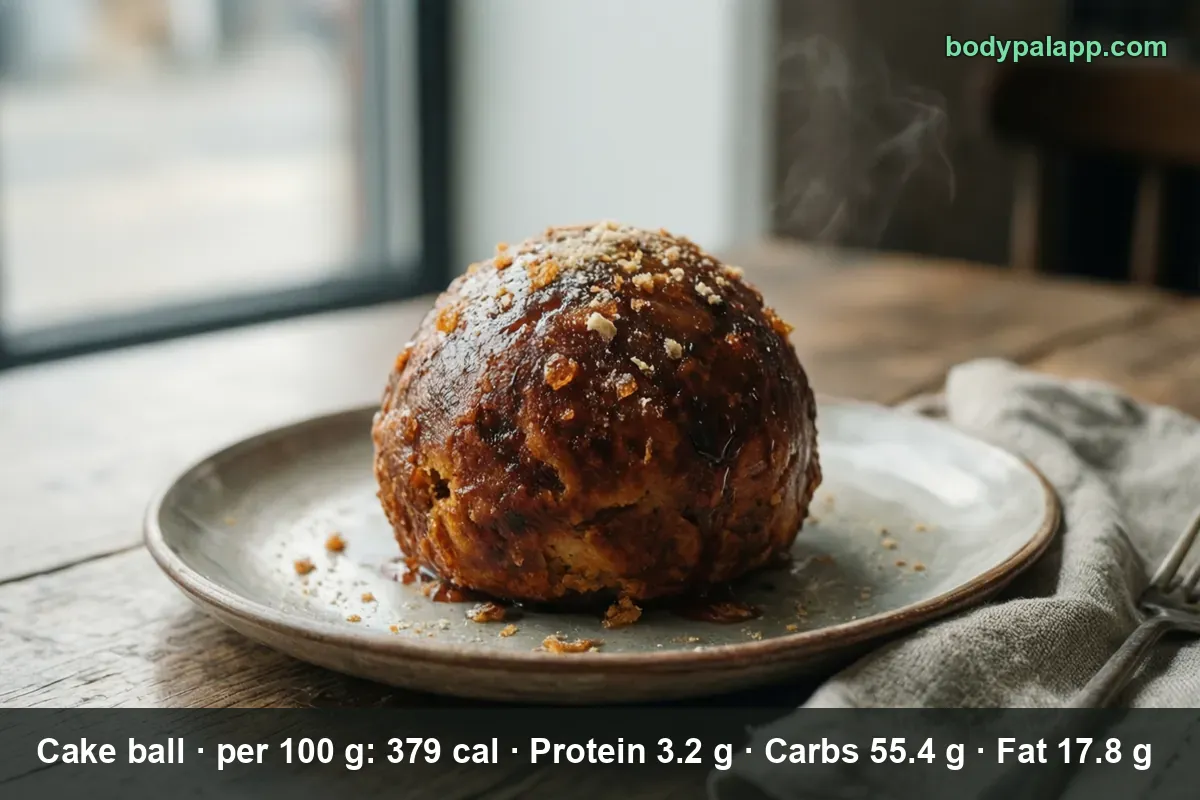
One cake ball of 23 g carries 87 calories. Per 100 g the same cake-and-frosting mixture runs 379 calories, which is where almost every dessert made of crumbs bound with icing lands. Two balls put you at 174, three at 262. The number moves with the scoop, not with the flavor on the box.
On this page
- Cake ball quick facts
- US servings, from one ball to a handful
- Chocolate, red velvet, birthday cake and the cake pop
- Saturated fat outruns sodium here
- How does a cake ball compare?
- Most popular cake ball brands
- FAQ
Cake ball quick facts
There is no USDA record called "cake ball," so the honest starting point is the record that matches what a cake ball actually is: baked cake crumbs mixed with frosting and coated in more of it. That record is SR Legacy 174944, "Cake, yellow, commercially prepared, with chocolate frosting, in-store bakery", at 379 calories per 100 g.
It sits neatly in the middle of the real thing. Packaged cake balls on US shelves label anywhere from 262 to 464 calories per 100 g, and 379 is close to the center of that spread. The 23 g weight for one ball comes from the retail label most shoppers hold, so the per-serving column below is our own arithmetic from the USDA 100 g figure rather than a USDA household measure.
| Nutrient | Per 100 g | Per 1 cake ball (23 g) | % Daily Value |
|---|---|---|---|
| Calories | 379 | 87 | — |
| Total fat | 17.75 g | 4.1 g | 5% |
| Saturated fat | 5.79 g | 1.3 g | 7% |
| Carbohydrate | 55.36 g | 12.7 g | 5% |
| Dietary fiber | 1.5 g | 0.3 g | 1% |
| Total sugars | 39.22 g | 9.0 g | — |
| Protein | 3.16 g | 0.7 g | 1% |
| Sodium | 310 mg | 71 mg | 3% |
% Daily Value is based on a 2,000-calorie diet.
Verified nutrition data
Numbers on this page come from USDA FoodData Central, the U.S. Department of Agriculture’s food composition database, and from manufacturer labels where a branded product is named. Last verified September 2026. How we verify our data →
There is no added sugars row here, because USDA does not publish added sugars for this record, and brand labels for cake balls report total sugars only. Cholesterol works out to 4 mg per ball (16 mg per 100 g) and potassium to 43 mg, both about 1% of the Daily Value, so neither is worth a row of its own. The FDA's Daily Value reference is what those percentages are measured against.
US servings, from one ball to a handful
Nobody eats a cake ball by the ounce, and nobody eats just one either. That is the whole problem with logging them.
| Serving | Weight | Calories |
|---|---|---|
| 1 oz | 28 g | 107 kcal |
| One cake ball, retail size | 23 g | 87 kcal |
| Two cake balls | 46 g | 174 kcal |
| Three cake balls | 69 g | 262 kcal |
| One large bakery cake ball | 38 g | 144 kcal |
| Per 100 g | 100 g | 379 kcal |
Only the 100 g row and the ounce are standard measures. Every ball weight here is our own arithmetic from the USDA 100 g figure, scaled to the gram weights printed on US cake ball labels, which run from 21 g for a small red velvet piece to 38 g for a bakery-counter ball. That range is the single biggest source of error when people log this food: the same three words on a menu can mean 80 calories or 144.
Here is the comparison that stops most people. USDA's own portion of frosted bakery cake, one eighth of an 18 oz cake, weighs 64 g and carries 243 calories. Three cake balls weigh 69 g and carry 262. You would notice the slice on a plate; you would not notice the three balls, because you ate them standing at a counter while talking. Six balls, 138 g, come to 523 calories, within striking distance of a generous 144 g restaurant slice at 546 by the same arithmetic.
Chocolate, red velvet, birthday cake and the cake pop
Flavor barely moves the number. Weight and coating do.
| Version | Per 100 g | Typical piece | Calories |
|---|---|---|---|
| Chocolate cake ball, store-made | 391 kcal | 1 cake ball (23 g) | 90 kcal |
| Red velvet cake ball | 381 kcal | 1 cake ball (21 g) | 80 kcal |
| Birthday cake ball | 391 kcal | 1 cake ball (23 g) | 90 kcal |
| Cake pop | 350 kcal | 1 cake pop (60 g) | 210 kcal |
| Bakery cake with vanilla frosting | 391 kcal | 1 oz (28.35 g) | 111 kcal |
| Yellow cake, no frosting | 361 kcal | 1 oz (28.35 g) | 102 kcal |
Chocolate and birthday cake balls are identical on paper: 391 calories per 100 g, 90 per 23 g piece. Red velvet looks lighter at 80 calories, but that is a 21 g ball, not a leaner recipe; per 100 g it is 381, a rounding error away from the other two. If you want a genuinely lighter cake, skip the frosting: plain yellow cake is 361 calories per 100 g against 391 with vanilla frosting, and the glaze is exactly what a cake ball is rolled in.
A cake pop is a different animal. At 60 g and 210 calories it outweighs two chocolate cake balls, which together come to 180. Yet per 100 g the pop is the lightest thing in the table at 350, because a stick and a thinner shell displace some of the dense crumb-and-frosting core. Logging a pop as "one cake ball" undercounts you by 120 calories.
Brand labels stretch the range further than any flavor does. Favorite Day birthday cake balls list 464 calories per 100 g while Better Bites double chocolate cake balls list 262 — a 1.8-fold gap between two products that look the same in a clamshell. When a package is in front of you, the package wins.
Saturated fat outruns sodium here
Cake balls are a fat-and-sugar food, and the row that climbs fastest is saturated fat. Three balls, 69 g and 262 calories, deliver 4.0 g of saturated fat, 20% of the Daily Value, against 214 mg of sodium, which is 9%. That sodium figure is just under a tenth of a teaspoon of table salt, so salt is not the issue on this page. The frosting is.
Sugar is the other half of the story. One ball holds 9.0 g of total sugars inside 12.7 g of carbohydrate, meaning roughly seven tenths of the carbs are sugar and only 0.3 g is fiber. USDA reports the total, not the split, so there is no way to separate the sugar baked into the crumb from the sugar in the coating. MyPlate's guidance on treats and portion size is the sane frame: build the day around real food and let a couple of these be the dessert, rather than treating them as small enough to ignore.
Protein does not rescue anything here. At 0.7 g per ball, you would need to eat twelve of them to reach 8 g of protein, and you would have eaten more than 1,000 calories doing it. The Dietary Guidelines for Americans put added sugars and saturated fat in the same short list of things to limit, and a cake ball is one of the few foods that hits both at once in 23 g.
How does a cake ball compare?
| Dessert | Per 100 g | US serving | Calories |
|---|---|---|---|
| Cake ball | 379 kcal | 1 ball, 23 g | 87 kcal |
| Chocolate cake with chocolate frosting | 389 kcal | 1 oz, 28 g | 110 kcal |
| Yellow cake with vanilla frosting | 391 kcal | 1 oz, 28 g | 111 kcal |
| Creme-filled chocolate snack cake | 399 kcal | 1 oz, 28 g | 113 kcal |
Our take: per 100 g the cake ball is the lightest of these four, and the margin is trivial — 20 calories separates the top and the bottom of the column. That means the food you pick barely matters and the amount you pick up decides everything. For weight loss, one or two balls at 87 or 174 calories is a dessert that fits almost any day; the same day falls apart at five, which is 435. For satiety, none of these work at all, because a cake ball gives you 0.7 g of protein and 0.3 g of fiber and leaves as fast as it arrived. Eat them because they taste good, count them honestly, and put the protein somewhere else in the day.
Most popular cake ball brands in the United States
Ranked by how widely each product appears among foods sold in the United States, from the BodyPal food database of over 3.3 million products. Calories are the figures printed on each Nutrition Facts label, checked against USDA FoodData Central.
| Product | Calories (per 100 g) |
|---|---|
| CAKEBALLZ Cake Balls Chocolate | 391 cal |
| CAKEBALLZ Cake Balls Red Velvet | 381 cal |
| CAKEBALLZ Cake Balls Birthday Cake | 391 cal |
| Favorite Day Birthday Cake Balls | 464 cal |
| Total Cluster Fudge Assorted Cake Balls | 447 cal |
| Better Bites Double Chocolate Cake Balls | 262 cal |
Brand popularity: BodyPal food database. Nutrition: manufacturer labels / USDA FoodData Central.
Cake ball FAQs
How many calories are in one cake ball?
One cake ball weighing 23 g carries 87 calories, based on USDA's figure of 379 calories per 100 g for bakery cake with chocolate frosting. Two balls put you at 174, three at 262. Larger bakery-counter balls near 38 g reach 144 calories each, so the size on the tray matters more than the flavor.
How many calories are in a chocolate cake ball?
A packaged chocolate cake ball lists 90 calories for one 23 g piece, or 391 calories per 100 g. That is three calories above the 87 our USDA-based math gives for a generic ball of the same weight. Two chocolate balls come to 180 calories, less than a single 210-calorie cake pop.
Is a cake ball the same as a cake pop?
No — a cake pop weighs about 60 g and carries 210 calories, while a cake ball runs 23 g and 87. Per 100 g the pop is actually lighter, 350 against 379, because a thinner shell and a stick replace some dense crumb. Logging a pop as one ball undercounts you badly.
How much sugar is in a cake ball?
One 23 g cake ball holds 9.0 g of total sugars inside 12.7 g of carbohydrate, so sugar is most of what you are eating. Three balls bring 27 g. USDA does not publish added sugars for this record, and US cake ball labels report total sugars only, without splitting crumb from coating.
How many carbs are in a cake ball?
One cake ball has 12.7 g of carbohydrate, 5% of the Daily Value, of which 9.0 g is sugars and only 0.3 g is fiber. Two balls come to 25.4 g. Per 100 g the figure is 55.36 g, which is a dense carbohydrate load for something that disappears in two bites.
Are cake balls healthy?
A cake ball is dessert in candy form: 87 calories, 4.1 g of fat, 9.0 g of sugars and 0.7 g of protein in 23 g. It is not a protein or fiber source. One or two fit a normal day at 87 or 174 calories; four or five, 348 to 435, is where a snack turns into a meal.
How many cake balls equal a slice of cake?
About three — USDA's piece of frosted bakery cake, one eighth of an 18 oz cake, weighs 64 g and carries 243 calories; three cake balls weigh 69 g and carry 262. Six balls, 523 calories, land close to a generous 144 g restaurant slice at 546 by the same arithmetic.
How many calories are in a red velvet cake ball?
A red velvet cake ball lists 80 calories for one 21 g piece, or 381 calories per 100 g. It is the lightest of the three common packaged flavors mainly because the ball is 2 g smaller, not because the recipe is leaner. Chocolate and birthday cake balls are both 90 calories at 23 g.
Similar foods
- Cake — 546 cal per slice (1/12 cake)
- Oats Dry — 307 cal per cup
- Rolled Oats — 307 cal per cup
- Fortune Cookie — 30 cal per cookie
- Bread With Peanut Butter — 176 cal per slice with peanut butter
- Scone — 267 cal per regular scone
Count it without the math
Point the camera at the tray and BodyPal counts the cake balls for you, coating and all.


How long does it take to burn off a cake ball?
One cake ball (23 g) is 87 kcal. Enter your weight and the amount you ate to see how long it takes you to burn that off:
lb
| Activity | Time to burn 87 kcal |
|---|---|
| Walking, brisk | 17 min |
| Cycling, moderate | 11 min |
| Swimming, moderate | 12 min |
| Jogging | 10 min |
| Weight training, moderate | 19 min |
Times are for a 155 lb adult at a steady pace; change the weight to see yours. The amount is set to the portion in the text (23 g); change it to what you actually ate. BodyPal works this out from your steps automatically.
Want the bigger picture? Calculate your daily calorie needs — your maintenance figure, a target for losing or gaining, and the date you get there.