
How many calories are in a crescent roll?
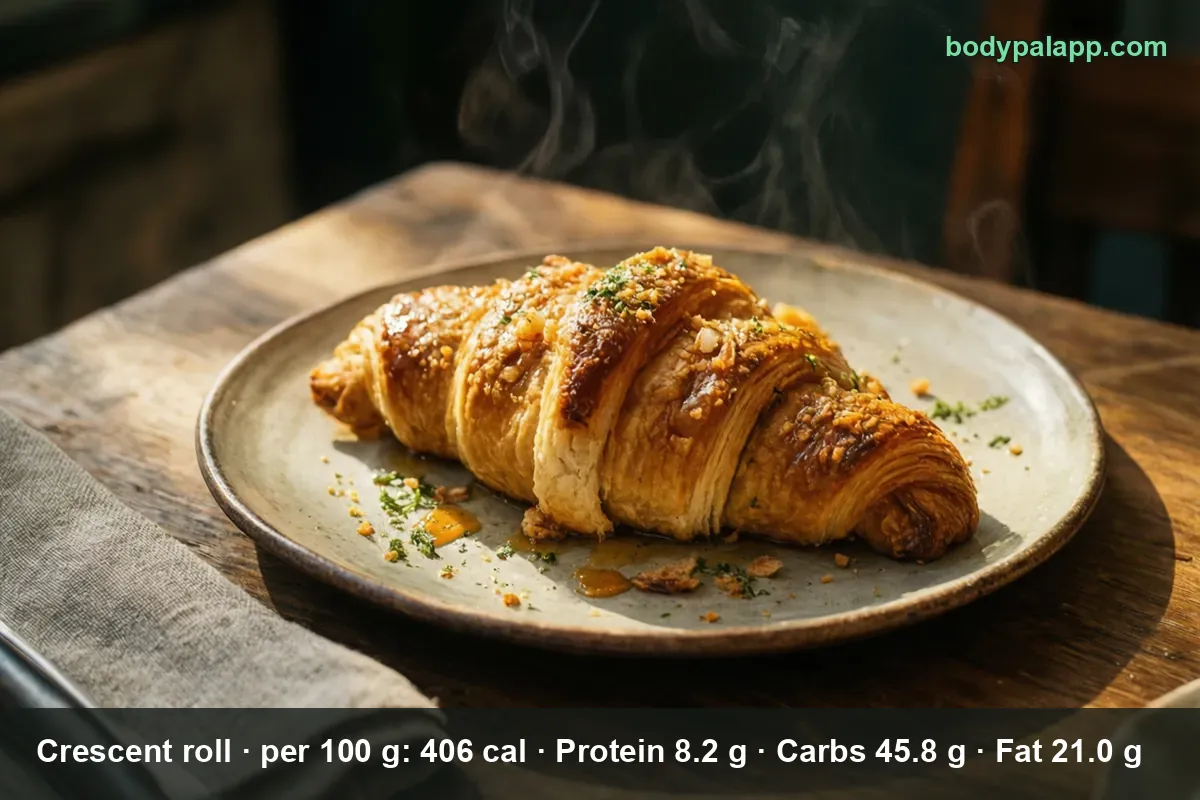
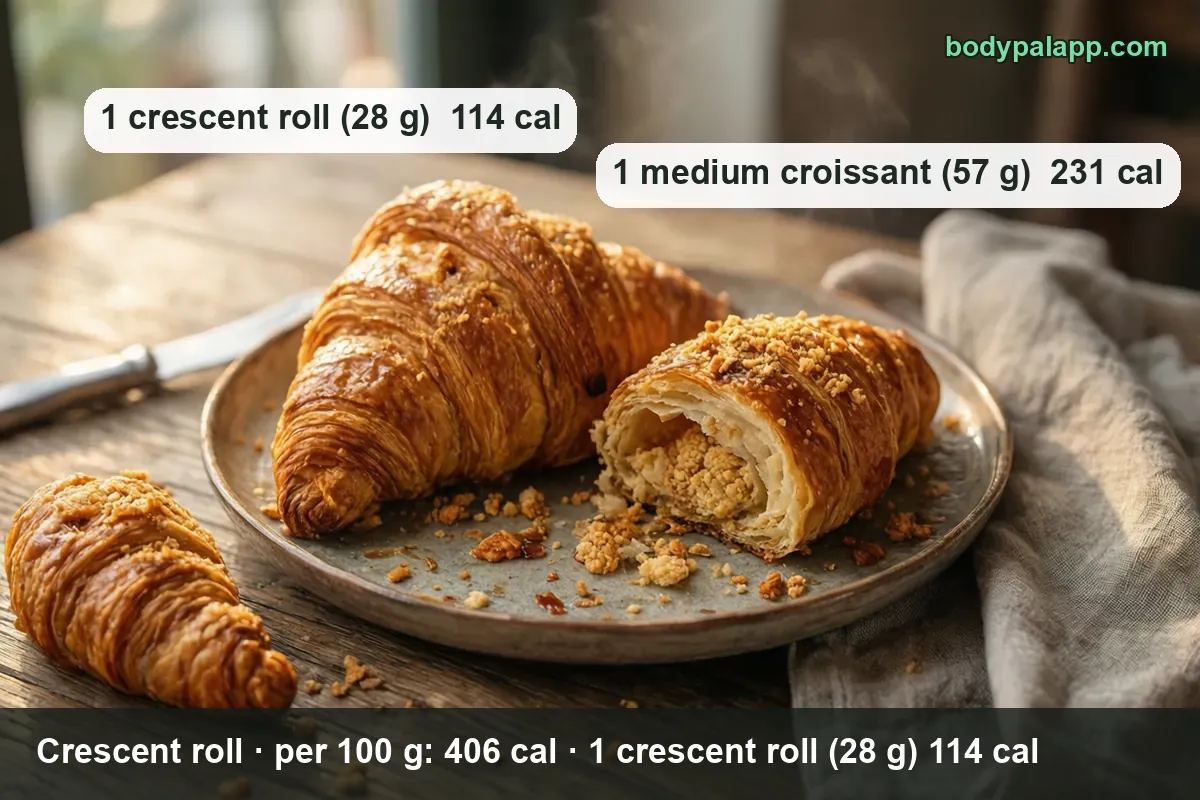
One crescent roll is 114 calories. That figure is USDA's own household measure for the food: 28 g of baked, buttery croissant dough, which runs 406 calories per 100 g. Bake the same size roll from a can of refrigerated dough and it lands at 100. A medium bakery croissant, 57 g of the same stuff, reaches 231.
On this page
- Crescent roll quick facts
- US servings, from one roll to a large croissant
- The can costs 14 calories less than the bakery case
- Sodium turns that 14 calories around
- Saturated fat runs at double the fat percentage
- Cheese, chocolate and fruit croissants
- How does a crescent roll compare?
- Most popular crescent roll brands
- FAQ
Crescent roll quick facts
The record underneath this page is FNDDS 2707678, "Croissant", from USDA's 2021–2023 survey release. It was chosen for one specific reason: of every whole-food record in the database, it is the only one whose portion file carries a household measure spelled out as 1 crescent roll, 28 g. USDA itself equates one crescent roll with 28 g of this food, so that is the serving column here.
| Nutrient | Per 100 g | Per 1 crescent roll (28 g) | % Daily Value |
|---|---|---|---|
| Calories | 406 | 114 | — |
| Total fat | 21.0 g | 5.9 g | 8% |
| Saturated fat | 11.7 g | 3.3 g | 16% |
| Carbohydrate | 45.8 g | 12.8 g | 5% |
| Dietary fiber | 2.6 g | 0.7 g | 3% |
| Total sugars | 11.3 g | 3.2 g | — |
| Protein | 8.2 g | 2.3 g | 5% |
| Sodium | 300 mg | 84 mg | 4% |
% Daily Value is based on a 2,000-calorie diet.
Verified nutrition data
Numbers on this page come from USDA FoodData Central, the U.S. Department of Agriculture’s food composition database, and from manufacturer labels where a branded product is named. Last verified September 2026. How we verify our data →
Two rows a printed label would show are missing here, and the reason is worth stating rather than papering over. FNDDS publishes no added sugars figure and no trans fat figure for this record. Pulling either off a store package would mean bolting one food's label onto another food's record, so both stay off the table. Total sugars carry no Daily Value on a US label at all, which is why that cell is blank.
Two more numbers come from the same record without appearing on the core label. Cholesterol is 67 mg per 100 g, so about 19 mg in one roll, 6% of the day. Potassium is 118 mg per 100 g, or 33 mg a roll, under 1%.
US servings, from one roll to a large croissant
| Serving | Weight | Calories |
|---|---|---|
| 1 crescent roll | 28 g | 114 |
| 1 oz | 28.35 g | 115 |
| 1 small croissant | 42 g | 171 |
| 2 crescent rolls | 56 g | 227 |
| 1 medium croissant | 57 g | 231 |
| 1 large croissant | 73 g | 296 |
Every row above comes out of the portion file for that one record, and the recipe never changes across them. Only the size does, and the size swings by a factor of 2.6 — from a 28 g roll at 114 calories to a 73 g one at 296.
That is the trap in this particular food, and it is a naming problem rather than a nutrition problem. "Crescent roll" describes a shape, not a weight. The dinner-table roll that comes eight to a tube is 28 g. The crescent-shaped thing in a bakery case, the one that shatters into flakes when you tear it, is routinely double or triple that. Both are correctly called crescent rolls, and logging the second as the first costs you up to 182 calories in a single entry.
There is no raw-against-cooked question here of the sort that dogs ground beef or rice, but there is a near cousin. The 28 g on a can of refrigerated dough is the weight of one raw triangle, and the calorie count on that label describes the roll after it comes out of the oven. Baking drives off water, not calories. The number holds.
The can costs 14 calories less than the bakery case
| Version | Per 100 g | Serving | Calories |
|---|---|---|---|
| Bakery crescent roll (this page) | 406 | 1 roll (28 g) | 114 |
| From the can, store brand | 357 | 1 roll (28 g) | 100 |
| Organic refrigerated dough | 350 | 1 roll (28 g) | 98 |
| Two bakery rolls | 406 | 56 g | 227 |
| Two rolls from the can | 357 | 56 g | 200 |
Most people expect the canned roll to be the light option by a wide margin. It is the light option by 14 calories, or 12%. A store-brand refrigerated crescent roll is 357 calories per 100 g against the bakery record's 406, and at the identical 28 g serving that is 100 against 114.
The macros behind those two numbers are not the same shape, though. The canned roll carries 1.0 g of protein, 11.0 g of carbohydrate and 6.0 g of fat. The bakery roll carries 2.3 g, 12.8 g and 5.9 g. So the version that saves you calories has slightly more fat and less than half the protein — the saving comes out of the flour and the protein, not out of the shortening.
One naming note for anyone hunting a specific tube. The best-known brand of refrigerated crescent dough has no record of its own in the USDA Branded release, so every canned figure on this page comes from store-brand equivalents that declare the same 1 roll (28 g) serving on the package. They cluster tightly: 321 to 357 calories per 100 g across every national and regional label in the database, with most of them at 357.
Sodium turns that 14 calories around
Calories are why people search for crescent rolls. Sodium is the row that decides which one to buy.
- Bakery crescent roll, 28 g: 84 mg, 4% of the Daily Value
- From the can, 28 g: 220 mg, 10%
- Organic refrigerated dough, 28 g: 274 mg, 12%
Per gram, canned dough is 2.6 times as salty as the bakery record — 786 mg per 100 g against 300 mg. That reverses the whole comparison. Save 14 calories on the swap and you spend 136 mg of sodium buying them.
Two rolls, the serving almost everyone actually takes at a table, makes the gap plain: 168 mg of sodium from the bakery version, 7% of the day, or 440 mg from the can, 19%. That is a fifth of the 2,300 mg FDA Daily Value spent on 200 calories of bread, before the gravy arrives. The organic version is the saltiest of the three at 980 mg per 100 g, which is a reminder that "organic" describes the farming and says nothing about the salt.
One honest caveat about the bakery figure. USDA's older SR Legacy edition lists the same butter croissant at 384 mg of sodium per 100 g, where the newer FNDDS release says 300 mg. Same food, same calories, same macros — a revision between editions. This page follows the newer number; on the older one the roll would read 5% of the day instead of 4%.
Saturated fat runs at double the fat percentage
Here is the row that does not scale the way the others do. One crescent roll is 5.9 g of total fat, which is 8% of the Daily Value. The same roll is 3.3 g of saturated fat, which is 16% — exactly twice the percentage, off half the grams.
The arithmetic is straightforward once you look at the record: 11.66 g of the 21 g of fat per 100 g is saturated, so 56% of the fat in a crescent roll is the kind laminated in as butter. That is what makes the layers. It is also what makes the number.
The Dietary Guidelines for Americans put the ceiling for saturated fat at under 10% of daily calories, about 22 g on a 2,000-calorie day. Two crescent rolls spend 6.6 g of that, roughly 30%, for 227 calories. Measured on calories alone, two rolls are a snack. Measured on saturated fat, they are closer to a third of the day.
Fiber does nothing to balance it: 0.7 g a roll, 3% of the 28 g Daily Value. MyPlate counts crescent rolls toward the refined side of the grain group, the same bucket as white dinner rolls, and protein at 2.3 g is too small to change how the roll behaves in a meal.
Cheese, chocolate and fruit croissants
At the same 57 g medium size, the filled versions barely move the calorie count.
| Version | Per 100 g | Serving | Calories |
|---|---|---|---|
| Butter croissant | 406 | 1 medium (57 g) | 231 |
| Cheese croissant | 414 | 1 medium (57 g) | 236 |
| Chocolate croissant | 421 | 1 medium (57 g) | 240 |
| Fruit croissant | 396 | 1 medium (57 g) | 226 |
Fourteen calories separate the lightest from the heaviest. Filling a croissant is close to a free decision on energy, which is not the answer most people expect from a chocolate one.
What the fillings do change is which row moves. Chocolate nearly doubles the sugars, 19.87 g per 100 g against 11.26 g, so a chocolate croissant carries 11.3 g of sugars where a plain one carries 6.4 g. Cheese pushes the sodium to 361 mg per 100 g, 206 mg in a medium croissant, and adds half a gram of protein. Fruit adds a little fiber, 1.7 g a croissant against 1.5 g for plain, and chocolate a shade more at 1.9 g.
A word on one outlier, since it turns up in calorie charts and looks like a bargain. SR Legacy carries an apple croissant line at 254 calories per 100 g, well under everything above. It is a genuinely leaner recipe with 8.7 g of fat per 100 g instead of 21 g, not a smaller croissant, and it is not what a bakery case in the US is selling. Treat it as a different food.
How does a crescent roll compare?
| Item | Per 100 g | Serving | Calories | Protein / Carbs / Fat |
|---|---|---|---|---|
| Crescent roll, bakery (this page) | 406 | 1 roll (28 g) | 114 | 2.3 / 12.8 / 5.9 g |
| Crescent roll, from the can | 357 | 1 roll (28 g) | 100 | 1.0 / 11.0 / 6.0 g |
| Croissant, cheese | 414 | 1 medium (57 g) | 236 | 5.2 / 26.8 / 11.9 g |
| Croissant, chocolate | 421 | 1 medium (57 g) | 240 | 4.2 / 28.2 / 13.0 g |
| Croissant, fruit | 396 | 1 medium (57 g) | 226 | 4.4 / 26.8 / 11.2 g |
Per 100 g the five sit inside a 64-calorie band, 357 to 421 — near enough to call a tie. Per item they run 100 to 240, a spread of nearly two and a half to one. The density column tells you almost nothing here and the weight column tells you everything.
Our take: if you want a bread on the plate for under a hundred calories, the roll from the can does it at 100, and the price is 220 mg of sodium. If sodium is the number you watch, the bakery roll wins outright at 84 mg for 14 calories more, and it brings twice the protein while it is at it. Skip the per-100 g comparison entirely when choosing between a dinner roll and a bakery croissant — one is 28 g and the other is 57 g, and that alone decides it.
Most popular crescent roll brands in the United States
Ranked by how widely each product appears among foods sold in the United States, from the BodyPal food database of over 3.3 million products. Calories are the figures printed on each Nutrition Facts label, checked against USDA FoodData Central.
| Product | Calories (per 100 g) |
|---|---|
| Immaculate Baking Organic Crescent Rolls | 350 cal |
| 365 Everyday Value Crescent Rolls | 357 cal |
| Market Pantry Crescent Rolls | 357 cal |
| Signature Select Crescent Rolls | 357 cal |
| Essential Everyday Crescent Rolls | 321 cal |
| Food Lion Crescent Rolls | 357 cal |
Brand popularity: BodyPal food database. Nutrition: manufacturer labels / USDA FoodData Central.
Crescent roll FAQs
How many calories are in a crescent roll?
114 calories in one crescent roll of 28 g, which is USDA's own household measure for this food, at 406 calories per 100 g. That roll carries 5.9 g of fat, 12.8 g of carbohydrate, 2.3 g of protein and 84 mg of sodium. A roll baked from canned refrigerated dough is 100 calories.
How many calories are in a crescent roll from the can?
100 calories for one 28 g roll, from 357 calories per 100 g in the USDA Branded record for store-brand refrigerated crescent dough. That is 14 fewer than a bakery crescent roll of the same weight, a difference of 12%. Two rolls come to 200 calories.
How many calories are in a Pillsbury crescent roll?
100 calories a roll is the figure to use. Pillsbury has no record of its own in the USDA Branded release, so this page uses store-brand refrigerated crescent dough, which declares the same 1 roll (28 g) serving and runs 321 to 357 calories per 100 g, with most labels at 357.
How much sodium is in a crescent roll?
84 mg in a 28 g bakery crescent roll, 4% of the 2,300 mg Daily Value, or 220 mg in one baked from canned dough, which is 10%. Canned dough is 2.6 times saltier per gram, 786 mg per 100 g against 300 mg. Two canned rolls reach 440 mg, 19% of the day.
Crescent roll or croissant — is there a calorie difference?
None per gram, and a large one per item. USDA files both under the same record at 406 calories per 100 g, so the only difference is size: a crescent roll is 28 g and 114 calories, a medium croissant 57 g and 231, a large one 73 g and 296.
How many carbs are in a crescent roll?
12.8 g of carbohydrate in one 28 g roll, 5% of the 275 g Daily Value, from 45.8 g per 100 g. Of that, 3.2 g is total sugars and 0.7 g is fiber. A roll from the can is slightly lower at 11.0 g, because canned dough is less dense overall.
How much protein is in a crescent roll?
2.3 g in a 28 g bakery roll, 5% of the Daily Value. The canned version has 1.0 g, under half as much. Neither is a protein food: a crescent roll is fat and refined flour, and at 8.2 g per 100 g the bakery record still puts most of its calories in the other two macros.
Are crescent rolls a healthy choice?
One roll is 114 calories, under 6% of a 2,000-calorie day, so size is not the issue. Saturated fat is: 3.3 g a roll is 16% of the Daily Value, double the 8% for total fat. Fiber is 0.7 g and MyPlate counts the roll as a refined grain, the same bucket as white bread.
Similar foods
- Butter Croissant — 231 cal per croissant
- Croissant — 231 cal per medium croissant
- Croissant With Butter — 231 cal per medium croissant
- Pecan Pie — 541 cal per slice
- Cheese Bread — 175 cal per large or thick slice
- Concha — 290 cal per concha
Count it without the math
Point the camera at the basket and BodyPal tells a 28 g dinner roll from a 57 g bakery croissant, and counts the second one you took.


How long does it take to burn off a crescent roll?
One crescent roll (28 g) is 114 kcal. Enter your weight and the amount you ate to see how long it takes you to burn that off:
lb
| Activity | Time to burn 114 kcal |
|---|---|
| Walking, brisk | 23 min |
| Cycling, moderate | 14 min |
| Swimming, moderate | 16 min |
| Jogging | 13 min |
| Weight training, moderate | 25 min |
Times are for a 155 lb adult at a steady pace; change the weight to see yours. The amount is set to the portion in the text (28 g); change it to what you actually ate. BodyPal works this out from your steps automatically.
Want the bigger picture? Calculate your daily calorie needs — your maintenance figure, a target for losing or gaining, and the date you get there.