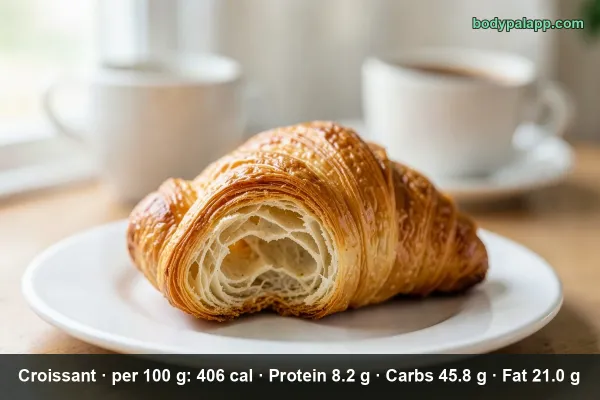
Butter croissant calories come to 231 for one medium (57 g) croissant and 406 per 100 g. Fat supplies 47% of those calories, more than carbs, while protein brings only 8%. Size matters most: the same pastry runs from 114 calories as a mini to 272 as a large.
231kcal
1 medium croissant · 57 g, made with butter
8%protein
4.7 gProtein
26 gCarbs
12 gFat
How to burn off 231 kcal
—Walking, brisk
—Jogging
—Cycling, moderate
—Swimming
Skip the math. BodyPal counts these calories from your steps and workouts automatically.
Nutrition facts
Made with butter · per 57 g
Calories
231 kcal
Protein
4.7 g
Carbohydrate
26 g
Fat
12 g
Saturated fat
6.6 g
Cholesterol
38 mg
Sodium
219 mg
Potassium
67 mg
Iron
1.2 mg
Source: USDA FoodData Central
🛡️
Verified nutrition data
Numbers on this page come from USDA FoodData Central, the U.S. Department of Agriculture’s food composition database, and from manufacturer labels where a branded product is named. Last verified September 2026. How we verify our data →
Butter croissant: calories, protein and sodium by serving
Percent of daily value uses the FDA reference of 2,000 kcal a day.
Serving
kcal
Protein
Carbs
Fat
Sodium
% DV kcal
1 medium (57 g)
231
4.7 g
26.1 g
12 g
219 mg
12%
1 large (67 g)
272
5.5 g
30.7 g
14.1 g
257 mg
14%
1 small (42 g)
171
3.4 g
19.2 g
8.8 g
161 mg
9%
1 mini (28 g)
114
2.3 g
12.8 g
5.9 g
108 mg
6%
3 × 1 medium (57 g)
694
14 g
657 mg
5 × 1 medium (57 g)
1,157
23.4 g
1,094 mg
Size swings a croissant from 114 to 272 calories
Bakery croissants are not standardized, and the size you pick moves the total more than anything else. A mini croissant (28 g) is 114 calories, a small (42 g) is 171, a medium (57 g) is 231 and a large (67 g) is 272. The gap between a mini and a large is bigger than a whole second mini.
Against the daily value for calories, a medium covers 12% and a large 14%. That sounds modest until croissants multiply. Two medium croissants (114 g) come to 463 calories, three (171 g) reach 694, and five (285 g), the count a shared brunch basket can hide, add up to 1,157.
If you are counting, judge by weight, not by name. When a croissant looks generous, log it as large: 272 is a safer estimate than 231. BodyPal can also log it from a photo if you would rather not guess the size yourself.
Fat supplies nearly half the calories
Per 100 g, a butter croissant carries 21 g of fat, 45.8 g of carbohydrate and 8.2 g of protein. Fat holds more than twice the energy of carbs gram for gram, so those 21 g supply 47% of the calories. Carbs supply 45% and protein just 8%.
That fat is the butter folded into the dough in thin layers, which is what makes the crumb flaky. It is also why the pastry is denser in calories than it looks. At 406 calories per 100 g, a light, airy croissant packs a lot of energy into very little weight.
Protein is the weak spot. A medium croissant gives 4.7 g, 9% of the daily value, and even a large gives only 5.5 g. Fiber is low too, at 1.5 g in a medium, so on its own a croissant does little to carry you to lunch.
Saturated fat is the row to watch
Of the 21 g of fat in 100 g of butter croissant, 11.7 g is saturated, more than half. Set that against the 20 g daily value for saturated fat and a croissant takes a real share of the day's allowance, more so at large size or when you have a second one.
Cholesterol is 67 mg per 100 g against a 300 mg daily value. Sugars are 11.3 g per 100 g, or 6.4 g in a medium croissant, which is modest for a pastry. The butter is the story here, not the sugar.
Sodium sits in the middle: 219 mg in a medium croissant, 10% of the daily value, and 257 mg in a large. It adds up quietly. If you watch sodium, note that two medium croissants already reach 438 mg before any ham or cheese goes inside.
Make it part of breakfast, not the whole breakfast
A croissant works best as one piece of a meal. Its 231 calories bring little protein and fiber, so pairing it with a protein source such as eggs, Greek yogurt or a glass of milk, plus some fruit, rounds out the plate and gives the meal more staying power.
Spreads change the math. The figures on this page cover the croissant as baked, made with butter. Extra butter, jam or chocolate spread on top are not included, so log them as separate items.
On a lighter day, a small (42 g) at 171 calories or a mini at 114 keeps the flaky pastry for less. Packaged options such as Kirkland Signature or Great Value butter croissants come in different sizes, so check the weight on the label and match it to the closest serving.
How does butter croissant compare?
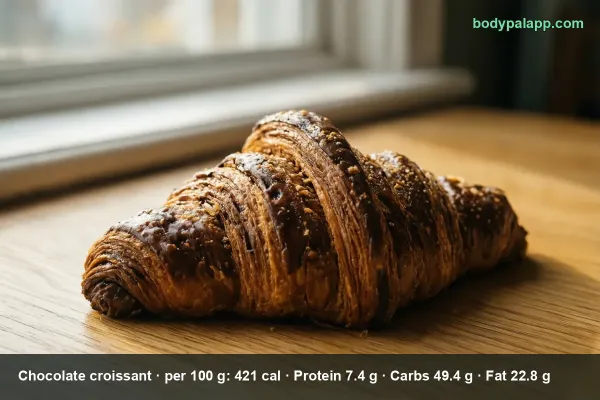
Here is how the butter croissant stacks up against a plain croissant, a chocolate croissant and a butter biscuit, per 100 g and per usual serving.
Verdict: For the fewest calories per 100 g, the butter biscuit wins at 353 versus 406, though it carries 580 mg of sodium against 384 mg. The chocolate croissant is the richest at 421 per 100 g, so if you want a croissant, the butter version is the leaner pick.
Most popular butter croissant brands in the United States
5Great Value Butter Croissants1 croissant · 43 g372 kcal
6Martin's Butter Croissant Single71 g380 kcal
7Ahold All Butter Croissants1 croissant · 45 g422 kcal
Store croissants range from 43 g to 77 g per piece, so a label serving can land well below or above the medium croissant above. Source: manufacturer labels / USDA FoodData Central.
Butter croissant FAQs
How many calories are in one butter croissant?
A medium butter croissant (57 g) has 231 calories. A large 67 g one has 272 calories and a mini 28 g one has 114.
Is a butter croissant good for weight loss?
A medium croissant is 231 calories with 12 g fat and 4.7 g protein, and per 100 g it is 406 calories, so the calories come mostly from flour and butter rather than protein.
Butter croissant vs plain croissant: which has more calories?
Both come out the same in the USDA data at 406 calories per 100 g, so a medium 57 g croissant is 231 calories either way.
How much protein and carbs are in a butter croissant?
A medium croissant has 4.7 g protein and 26.1 g carbs, of which 6.4 g are sugars. Per 100 g that is 8.2 g protein and 45.8 g carbs.
How many calories are in a large butter croissant?
A large butter croissant (67 g) has 272 calories. It also carries 14.1 g of fat, 30.7 g of carbs, 5.5 g of protein and 257 mg of sodium, about 14% of the daily value for calories.
How many calories are in two butter croissants?
Two medium butter croissants (114 g) come to 463 calories. Together they add 9.3 g of protein and 438 mg of sodium, so the pair lands closer to a full meal than a snack.
What are the nutrition facts for a butter croissant?
One medium butter croissant (57 g) has 231 calories, 12 g of fat, 26.1 g of carbs, 4.7 g of protein, 1.5 g of fiber, 6.4 g of sugars and 219 mg of sodium. Per 100 g it is 406 calories.
How much does a big croissant add compared with a small one?
Butter croissants range from 114 calories for a mini (28 g) to 272 for a large (67 g). A small (42 g) is 171 and a medium (57 g) is 231, so size it before logging.