
How many calories are in a chocolate croissant?
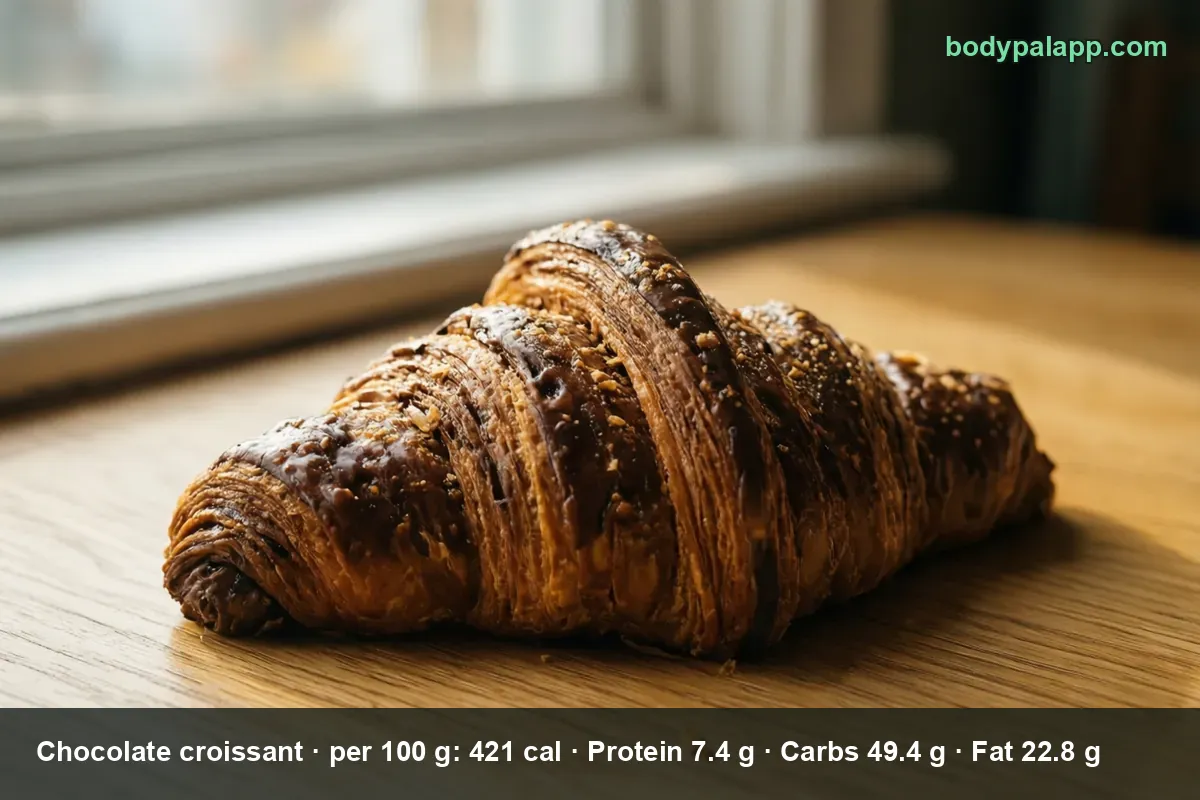
One chocolate croissant weighs 57 g and carries 240 calories. Per 100 g it runs 421 calories — gram for gram, exactly the same as a plain yeast doughnut. Size is what separates the two: a bakery-case croissant can hit 85 g, and the USDA record for that bakery version costs 320 calories.
On this page
- Chocolate croissant quick facts
- US servings, from one ounce to two croissants
- Bakery case, French butter, mini and frozen
- Saturated fat, not calories, is the row to watch
- How does a chocolate croissant compare?
- Most popular chocolate croissant brands
- Chocolate croissant FAQs
Chocolate croissant quick facts
The number below comes from FNDDS 2707680, "Croissant, chocolate". It is the only USDA record for the pastry itself rather than for a dough, a mix or a hybrid, and it is the only one that ships with a household measure of "1 croissant." That matters, because the person searching this is holding a finished croissant from a display case or a plastic clamshell, not a sheet of laminated dough.
| Nutrient | Per 100 g | Per 1 croissant (57 g) | % Daily Value |
|---|---|---|---|
| Calories | 421 | 240 | — |
| Total fat | 22.79 g | 13.0 g | 17% |
| Saturated fat | 12.87 g | 7.3 g | 37% |
| Carbohydrate | 49.4 g | 28.2 g | 10% |
| Dietary fiber | 3.3 g | 1.9 g | 7% |
| Total sugars | 19.87 g | 11.3 g | — |
| Protein | 7.4 g | 4.2 g | 8% |
| Sodium | 242 mg | 138 mg | 6% |
% Daily Value is based on a 2,000-calorie diet.
Verified nutrition data
Numbers on this page come from USDA FoodData Central, the U.S. Department of Agriculture’s food composition database, and from manufacturer labels where a branded product is named. Last verified September 2026. How we verify our data →
Two rows you would expect on a wrapper are missing here. Added sugars and trans fat are not published for this record — this edition of FNDDS does not carry either field for prepared foods — so rather than guess at them, they stay off the table. Cholesterol works out to 31 mg per croissant (10% DV) and potassium to 95 mg (2% DV), both minor next to the fat line.
The sodium figure surprises people who expect a sweet pastry to be salt-free. At 138 mg per croissant it is real but small: under a sixteenth of a teaspoon of table salt, and 6% of the FDA Daily Value of 2,300 mg.
US servings, from one ounce to two croissants
| Serving | Weight | Calories |
|---|---|---|
| 1 oz | 28 g | 118 kcal |
| Half a croissant | 28.5 g | 120 kcal |
| 1 croissant | 57 g | 240 kcal |
| 1 large bakery croissant | 70 g | 295 kcal |
| 2 croissants | 114 g | 480 kcal |
| Per 100 g | 100 g | 421 kcal |
Only two of those are USDA household measures: the 57 g croissant and the 70 g large bakery croissant. The ounce, the half and the pair are our own arithmetic scaled from the USDA 100 g figure, not USDA servings.
That half-croissant row is worth a second look. Splitting one with someone costs 120 calories, within 2 calories of an ounce of the thing — a useful reminder that a chocolate croissant is dense enough that an ounce is already a real snack. And the two-croissant line is the one that catches people at a weekend brunch: 480 calories before the coffee, and 26 g of fat.
Weigh yours if a scale is anywhere nearby. Between the 57 g USDA serving and an 85 g display-case pastry there is an 80-calorie spread, and no amount of eyeballing closes that gap reliably.
Bakery case, French butter, mini and frozen
| Version | Per 100 g | Typical piece | Calories |
|---|---|---|---|
| Bakery-case chocolate croissant | 376 kcal | 1 croissant (85 g) | 320 kcal |
| French all-butter (pain au chocolat) | 422 kcal | 1 croissant (45 g) | 190 kcal |
| Store-brand value croissant | 311 kcal | 1 croissant (74 g) | 230 kcal |
| Mini chocolate croissants | 413 kcal | 2 minis (46 g) | 190 kcal |
| Tiny-treat 3-pack | 367 kcal | 3 croissants (60 g) | 220 kcal |
| Frozen bake-at-home French | 325 kcal | 1 croissant (80 g) | 260 kcal |
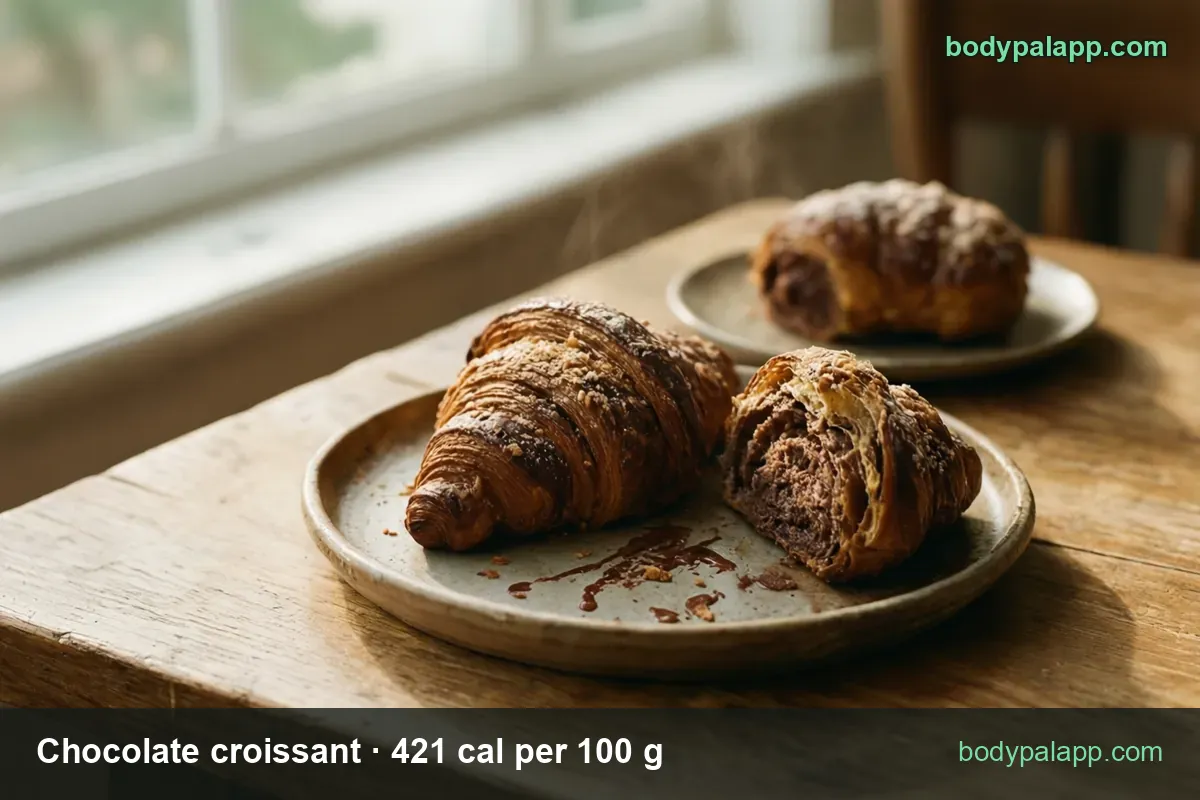
Here is the finding that no calorie counter tells you: "one chocolate croissant" is not one mass. The bakery-case version sold at Target weighs 85 g and costs 320 calories. The French all-butter croissant sold frozen by Bakerly weighs 45 g and costs 190. That is a 130-calorie gap between two things with the same name, the same shape and the same chocolate baton inside.
Per 100 g the store brands spread even wider than the pieces do. Great Value comes in at 311 calories per 100 g, while La Boulangere and Favorite Day both sit at 422 — a 36% difference in density. Marketside's all-butter croissants land in between at 383, and St Pierre's minis at 413. If you are choosing between two boxes in the freezer aisle, compare the per-100-g column, not the per-croissant column, because the per-croissant number is mostly telling you how big the croissant is.
Minis deserve their own note. Two St Pierre minis weigh 46 g together and come to 190 calories, roughly 95 each by our own arithmetic. That is genuinely lighter per piece, but at 413 calories per 100 g they are within 8 calories of a full-size croissant on a gram basis. They only save you calories if two minis actually stop you at two.
Saturated fat, not calories, is the row to watch
A chocolate croissant is not a calorie bomb by the standards of American breakfast pastries. One croissant is 240 calories, or 12% of a 2,000-calorie day — less than most muffins, less than most bagels with cream cheese.
The saturated fat is a different story. One croissant carries 7.3 g, which is 37% of the 20 g Daily Value. The butter that makes the dough flaky is the whole point of the pastry, and it is also the reason a single croissant eats three times more of your saturated-fat budget than of your calorie budget. The Dietary Guidelines for Americans put the target at less than 10% of daily calories from saturated fat; on 2,000 calories, one croissant plus a splash of cream is most of the way there before lunch.
Protein is the other weak row: 4.2 g, or 8% of the Daily Value, for a 240-calorie item. That ratio is why a croissant on its own tends not to hold anyone until noon. Fiber does a little better than expected at 1.9 g (7% DV), thanks to the chocolate, but this is still a refined-grain food in MyPlate terms rather than a whole-grain one.
If you want a position: eat the croissant, then build the rest of the day's fat around it. Two eggs and fruit alongside fixes the protein problem for about 200 more calories, and skipping the second croissant does more for your saturated fat than any swap on this page.
How does a chocolate croissant compare?
| Pastry | Per 100 g | US serving | Calories |
|---|---|---|---|
| Chocolate croissant | 421 kcal | 1 croissant, 57 g | 240 kcal |
| Chocolate doughnut | 417 kcal | 1 oz, 28 g | 117 kcal |
| Plain yeast doughnut | 421 kcal | 1 oz, 28 g | 118 kcal |
| Brioche | 427 kcal | 1 oz, 28 g | 120 kcal |
The ounce servings for the three neighbors are our own arithmetic from their USDA 100 g figures, not USDA servings, so the four rows can be read side by side.
Our take: on a per-gram basis these four are the same food. The spread across all of them is 10 calories per 100 g — 417 for the chocolate doughnut up to 427 for brioche — which is noise compared with the 130-calorie swing between a 45 g croissant and an 85 g one. Where the croissant does pull ahead is protein, 7.4 g per 100 g against 5.2 g for the chocolate doughnut, and it carries fewer carbohydrates, 49.4 g against 51.95 g. So stop choosing between pastries and start choosing the size. Halving one, at 120 calories, puts it in the same band as an ounce of any of them.
Most popular chocolate croissant brands in the United States
Ranked by how widely each product appears among foods sold in the United States, from the BodyPal food database of over 3.3 million products. Calories are the figures printed on each Nutrition Facts label, checked against USDA FoodData Central.
| Product | Calories (per 100 g) |
|---|---|
| Archer Farms Chocolate Croissants | 376 cal |
| La Boulangere Chocolate Croissants | 422 cal |
| Favorite Day Chocolate Croissants | 422 cal |
| Great Value Chocolate Croissants | 311 cal |
| Marketside All Butter Chocolate Croissants | 383 cal |
| St Pierre Mini Chocolate Croissants | 413 cal |
Brand popularity: BodyPal food database. Nutrition: manufacturer labels / USDA FoodData Central.
Chocolate croissant FAQs
How many calories are in a chocolate croissant?
240 calories in one 57 g croissant, the USDA household serving, at 421 calories per 100 g. That is 12% of a 2,000-calorie day. Bakery-case croissants are usually bigger: 70 g comes to 295 calories and 85 g to 320, so weigh yours if a scale is handy.
How many calories in a bakery chocolate croissant?
320 calories for the 85 g Archer Farms bakery croissant, a USDA record at 376 calories per 100 g. A 70 g croissant off the generic USDA record is 295. So a display-case pastry realistically lands between 295 and 320 calories, well above the 57 g USDA serving most apps default to.
Is a chocolate croissant the same as pain au chocolat?
Yes — pain au chocolat is the French name, and the French all-butter version in USDA data runs 422 calories per 100 g against 421 for the generic American record. One French croissant weighs only 45 g, so it lands at 190 calories. Same pastry, smaller piece.
How much saturated fat is in a chocolate croissant?
7.3 g of saturated fat in one 57 g croissant, or 37% of the 20 g Daily Value. Calories are only 12% of a 2,000-calorie day, so the butter in the laminated dough costs three times more of your saturated-fat budget than of your calorie budget.
How many carbs are in a chocolate croissant?
28.2 g of carbohydrate in one 57 g croissant, 10% of the Daily Value, of which 11.3 g are total sugars and 1.9 g are fiber. Per 100 g that is 49.4 g. Two croissants put you at 56.4 g, more than a fifth of a day's carbohydrate.
How much protein is in a chocolate croissant?
4.2 g of protein in one 57 g croissant, 8% of the Daily Value, and 7.4 g per 100 g. That is thin for a 240-calorie breakfast. Two eggs or a cup of Greek yogurt alongside is the easy fix if you want the meal to hold you until lunch.
Are mini chocolate croissants lower in calories?
190 calories for two mini croissants (46 g), so about 95 calories each by our own arithmetic. That is lower per piece but not per gram: minis run 413 calories per 100 g, within 8 of the 421 of a full-size croissant. They help only if two minis genuinely replace a whole one.
Is a chocolate croissant worse than a chocolate doughnut?
Not by calories: 421 per 100 g for the croissant against 417 for a chocolate doughnut, a 4-calorie gap. An ounce of each is 118 and 117 calories. The croissant carries more protein, 7.4 g against 5.2 g per 100 g, and fewer carbohydrates, 49.4 g against 51.95 g.
Similar foods
- Glazed Donut — 253 cal per glazed donut, medium
- Honey Bun — 358 cal per 3 oz bun
- Granola Cereal — 462 cal per cup
- Beignet — 188 cal per beignet
- Cake Cone — 17 cal per cake cone
- Chocolate Doughnut — 250 cal per doughnut
Count it without the math
Point the camera at the plate and BodyPal counts the croissant for you, chocolate and all.


How long does it take to burn off 240 kcal of chocolate croissant?
One croissant (57 g) is 240 kcal. Enter your weight and the amount you ate to see how long it takes you to burn that off:
lb
| Activity | Time to burn 240 kcal |
|---|---|
| Walking, brisk | 48 min |
| Cycling, moderate | 30 min |
| Swimming, moderate | 34 min |
| Jogging | 28 min |
| Weight training, moderate | 53 min |
Times are for a 155 lb adult at a steady pace; change the weight to see yours. The amount is set to the portion in the text (57 g); change it to what you actually ate. BodyPal works this out from your steps automatically.
This table assumes you know your daily total. If you do not, the daily calorie calculator works it out from five numbers.