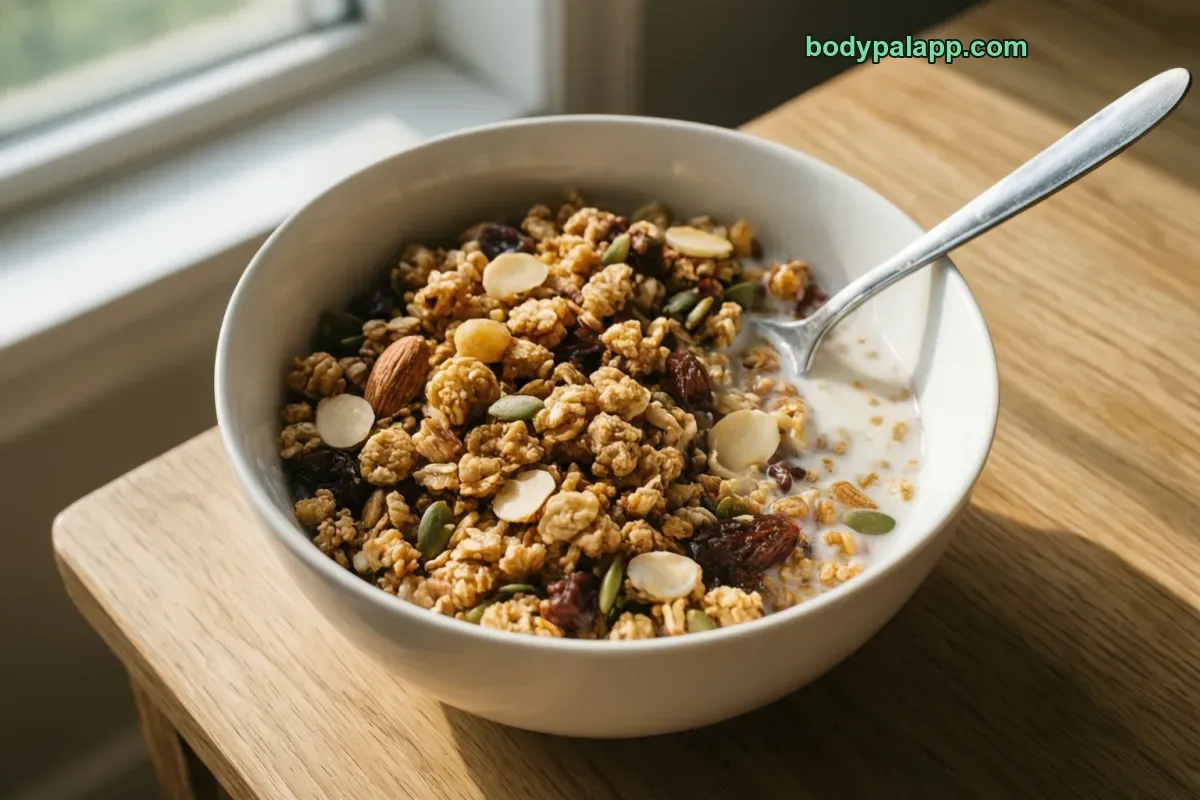
Granola cereal calories come to 462 for 1 cup (110 g) and 420 per 100 g. The number to notice is portion size. A single serving is only 30 g at 126 calories, so a freely poured bowl is often several servings. Sugar also runs high, at 22.2 g per 100 g.
462kcal
1 cup · 110 g, ready-to-eat, higher sugar
9%protein
10.8 gProtein
74 gCarbs
14.3 gFat
How to burn off 462 kcal
—Walking, brisk
—Jogging
—Cycling, moderate
—Swimming
Skip the math. BodyPal counts these calories from your steps and workouts automatically.
Nutrition facts
Ready-to-eat, higher sugar · per 110 g
Calories
462 kcal
Protein
10.8 g
Carbohydrate
74 g
Fat
14.3 g
Saturated fat
1.5 g
Cholesterol
0 mg
Sodium
177 mg
Potassium
341 mg
Iron
3.4 mg
Source: USDA FoodData Central
🛡️
Verified nutrition data
Numbers on this page come from USDA FoodData Central, the U.S. Department of Agriculture’s food composition database, and from manufacturer labels where a branded product is named. Last verified September 2026. How we verify our data →
Granola cereal: calories, protein and sodium by serving
Percent of daily value uses the FDA reference of 2,000 kcal a day.
Serving
kcal
Protein
Carbs
Fat
Sodium
% DV kcal
1 cup (110 g)
462
10.8 g
74.1 g
14.3 g
177 mg
23%
Single serving (30 g)
126
2.9 g
20.2 g
3.9 g
48 mg
6%
Homemade cup (122 g)
597
16.7 g
65.7 g
29.7 g
32 mg
30%
100 g
420
9.8 g
67.4 g
13 g
161 mg
21%
3 × 1 cup (110 g)
1,386
32.4 g
531 mg
5 × 1 cup (110 g)
2,310
54 g
886 mg
A full cup is 462 calories, not 126
The label serving for granola cereal is 30 g, which works out to 126 calories, 2.9 g of protein and 6.7 g of sugar. That is a small scatter, well short of a cup. Most people pour far more. A 1 cup (110 g) bowl lands at 462 calories, about 23% of a 2000-calorie daily value before any milk goes in.
Granola is dense, so the total climbs fast. Two cups (220 g) reach 924 calories and 21.6 g of protein. Three cups, or 330 g, come to 1,386 calories. Five cups (550 g), the kind of amount that disappears from a bag over a few days of handful snacking, add up to 2,310 calories, more than a full 2000-calorie reference day.
If you track portions, weigh the first few bowls. The gap between 30 g and 110 g is the gap between 126 and 462 calories, and eyeballing rarely gets it right. BodyPal can log a bowl from a photo, but a kitchen scale tells you what your usual pour really is. Once you know it, the rest of the day is much easier to plan.
Carbs supply 63% of the calories
Per 100 g, granola cereal carries 67.4 g of carbohydrate, 13 g of fat and 9.8 g of protein. Translated into calories, carbs make up 63%, fat 28% and protein just 9%. This is a grain-and-sugar food first, with nuts or oil adding a real layer of fat on top.
Little of that fat is saturated: 1.3 g per 100 g against 13 g of total fat. Cholesterol is 0. Potassium comes in at 310 mg per 100 g, a modest contribution against the 4700 mg daily value.
Protein is the weak spot. A 1 cup (110 g) bowl gives 10.8 g, which is 22% of the 50 g daily value. Protein-branded lines such as Nature Valley Oats & Honey Protein Granola Cereal exist for exactly that reason, and their figures sit in the brand table rather than here. Pairing granola with milk or plain yogurt is the simpler way to lift the protein of the whole bowl.
Sugar is the row to watch
This is the ready-to-eat style of granola, and it leans sweet: 22.2 g of sugars per 100 g. A 1 cup (110 g) bowl delivers 24.5 g of sugars, while the 30 g serving carries 6.7 g. Sweet coatings and flavored add-ins are what push the number up, so chocolate and honey versions deserve a look at the label.
Fiber softens the picture. Granola cereal has 7.4 g of fiber per 100 g, so a cup gives 8.1 g, close to a third of the 28 g daily value. Sodium is not a concern either: 177 mg per cup is 8% of the daily value, and the 30 g serving has just 48 mg.
If you want the crunch with less sugar, use granola as a topping instead of the base. A 30 g sprinkle over plain yogurt or fresh fruit keeps sugar at 6.7 g and calories at 126, and you still get the texture that makes granola worth eating.
Homemade granola runs 597 calories a cup
The USDA homemade granola row tells a different story. A homemade cup (122 g) comes to 597 calories, with 29.7 g of fat and 16.7 g of protein. More nuts, seeds and oil mean more fat and more protein than the boxed cereal, and a heavier cup on top of that.
It is not lower in sugar, though. A homemade cup has 24.2 g against 24.5 g for a cup of the ready-to-eat kind, which is practically a tie. Fiber is higher at 10.9 g, and sodium drops to 32 mg, just 1% of the daily value. Protein reaches 33% of the daily value per cup.
So homemade is the better pick for protein and fiber, and the worse pick if calories per bowl matter most. Making it yourself does give you control over the sweetener and the oil, which store-bought boxes do not. Whichever you choose, the portion decides more than the recipe.
How does granola cereal compare?
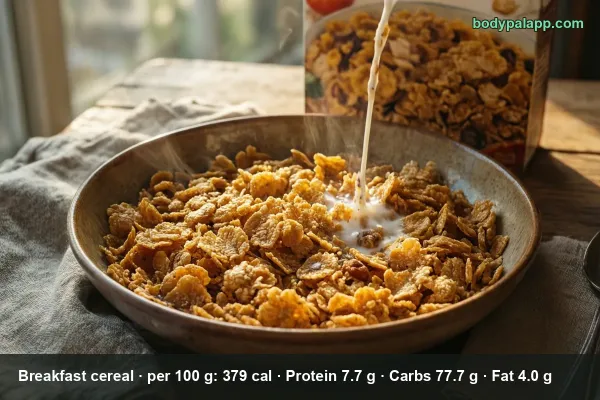
Here is granola cereal next to breakfast cereal, corn flakes and Corn Chex, per 100 g and per usual serving.
Verdict: For the fewest calories per bowl, pick corn flakes at 108 per 1 cup (28 g) or Corn Chex at 145 per 1 cup (39 g), since granola's 420 per 100 g packs into a much heavier cup. For staying full, granola wins with 9.8 g of protein per 100 g against 5.9 g for corn flakes, and it carries far less sodium at 161 mg versus 571 mg.
Most popular granola cereal brands in the United States
About 462 calories for a 1 cup (110 g) serving, or 126 calories for a 30 g single serving.
Is granola cereal good for weight loss?
A 1 cup serving has 462 calories, 24.5 g sugar and 8.1 g fiber, more calorie-dense than plain breakfast cereal at 379 calories per 100 g.
Granola cereal vs breakfast cereal: which has fewer calories?
Granola cereal is 420 calories per 100 g, while breakfast cereal is 379, a difference of 41 calories per 100 g.
How much protein is in granola cereal?
A 1 cup (110 g) serving has 10.8 g protein and a 30 g single serving has 2.9 g. Per 100 g that is 9.82 g protein.
How much sugar is in granola cereal?
A 1 cup (110 g) bowl of granola cereal has 24.5 g of sugars, and a 30 g serving has 6.7 g. Per 100 g that is 22.2 g, which puts ready-to-eat granola on the sweeter side of breakfast cereals.
Is homemade granola higher in calories than store-bought?
Yes. A homemade cup (122 g) has 597 calories versus 462 for a 1 cup (110 g) bowl of ready-to-eat granola cereal. The homemade cup is heavier and carries 29.7 g of fat.
How many calories are in a 30 g serving of granola cereal?
A 30 g serving of granola cereal has 126 calories, 2.9 g of protein, 3.9 g of fat and 20.2 g of carbs. That is about 6% of a 2000-calorie daily value, a sensible size for topping yogurt.
How much fiber does granola cereal have?
Granola cereal has 7.4 g of fiber per 100 g, so a 1 cup (110 g) bowl gives 8.1 g. Homemade granola is higher, at 10.9 g per 122 g cup.
Is granola cereal high in sodium?
No. A 1 cup (110 g) bowl has 177 mg of sodium, 8% of the 2300 mg daily value. Per 100 g it has 161 mg, far below corn flakes at 571 mg.