
How many calories are in a beignet?
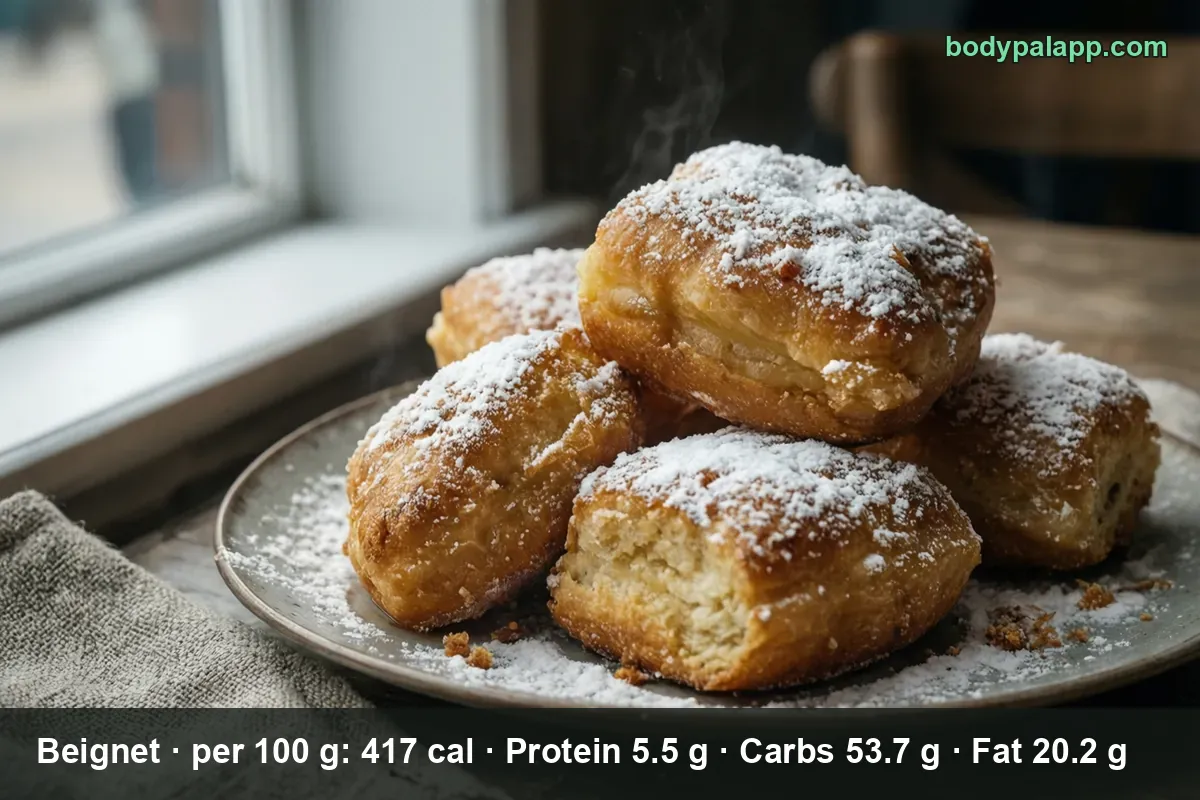
One beignet weighs 45 g and carries 188 calories. Per 100 g the figure is 417. The classic New Orleans order of three lands at 563 calories, and a five-high plate like the one below comes to 938. The number on a beignet moves with the count on the plate far more than with anything in the recipe.
On this page
- Beignet quick facts
- Why a beignet reads lighter than a donut
- US servings, from one to the whole plate
- The order of three
- Where the calories come from
- Filled and frozen beignets
- How does a beignet compare?
- Most popular beignet brands
- FAQ
Beignet quick facts
Every figure on this page comes from FNDDS 2708071, "Beignet", filed under doughnuts, sweet rolls and pastries. It is the only beignet USDA holds outside packaged goods: Foundation Foods has none and SR Legacy has none, so there is no second opinion to reconcile and nothing has been averaged. The serving column is USDA's own portion for that record, one beignet at 45 g — the size sitting in each panel of the photo further down.
| Nutrient | Per 100 g | Per 1 beignet (45 g) | % Daily Value |
|---|---|---|---|
| Calories | 417 | 188 | — |
| Total fat | 20.18 g | 9.1 g | 12% |
| Saturated fat | 8.4 g | 3.8 g | 19% |
| Carbohydrate | 53.69 g | 24.2 g | 9% |
| Dietary fiber | 1.9 g | 0.9 g | 3% |
| Total sugars | 31.09 g | 14.0 g | — |
| Protein | 5.46 g | 2.5 g | 5% |
| Sodium | 281 mg | 126 mg | 5% |
% Daily Value is based on a 2,000-calorie diet.
Verified nutrition data
Numbers on this page come from USDA FoodData Central, the U.S. Department of Agriculture’s food composition database, and from manufacturer labels where a branded product is named. Last verified September 2026. How we verify our data →
Two rows a packaged label would print are missing, and for one reason. This FNDDS edition publishes no added sugars and no trans fat value for 2708071, and borrowing either from a different pastry would mean pasting one food's numbers onto another food's record. They are absent rather than invented. Total sugars carry no Daily Value on a US label, which is why that cell is a dash.
Two more values ride along inside the same record without appearing on the label block: cholesterol at 27 mg per 100 g and potassium at 91 mg. Both are small, and neither changes how you should read the rest.
Why a beignet reads lighter than a donut
Put the two side by side per 100 g and there is nothing between them. A beignet is 417 calories. A yeast donut is 421. Four calories apart, out of the same fryer, in the same USDA category.
Per piece the gap opens to 65 calories: 188 against 253. All of it is weight. USDA's beignet serving is 45 g and its yeast donut is 60 g, so the donut is a third bigger object made of effectively the same dough. A beignet is not a lighter pastry. It is a smaller one.
That distinction matters because of how the two are sold. A donut is a single unit — you buy one, you eat one. A beignet arrives three to a plate, and three of them at 135 g is 563 calories, comfortably more than two yeast donuts at 506.
So the honest version of "beignets are lighter than donuts" is this: per gram, no; per piece, yes; per order, not even close.
US servings, from one to the whole plate
| Serving | Weight | Calories |
|---|---|---|
| 1 oz | 28.35 g | 118 |
| One beignet | 45 g | 188 |
| Order of three | 135 g | 563 |
| Plate of five | 225 g | 938 |
| Per 100 g | 100 g | 417 |
The ounce row is the trap, and calorie charts fall into it constantly. Priced by the ounce a beignet looks like a 118-calorie snack, and the number is perfectly correct — for an ounce. A real beignet is 45 g, a little over an ounce and a half. Log it as one ounce and you are 70 calories short on a single pastry, an undercount of 37% before the second one is touched.
Raw against cooked, the split that decides so many USDA pages, never comes up here. A beignet exists only fried, powdered and on the plate. The record is already the finished article, sugar and all, so there is no uncooked version to compare it against.
The order of three
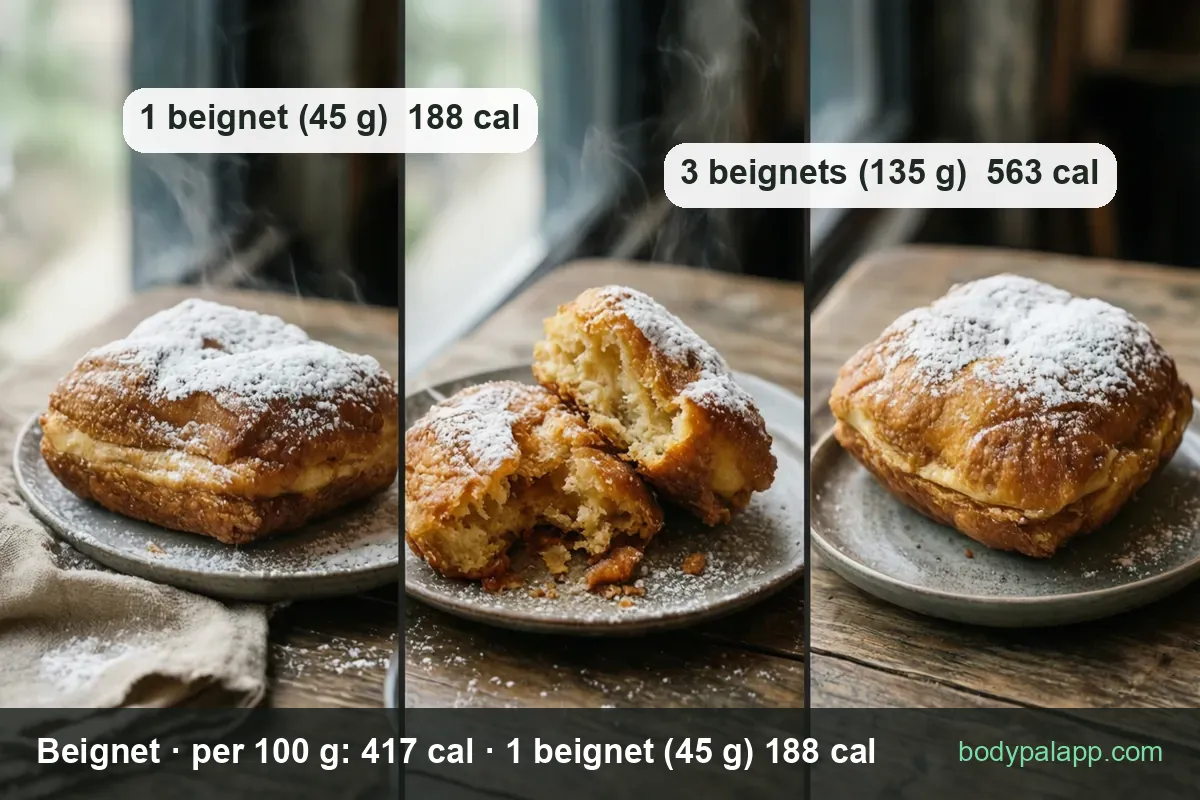
Three is the default order in New Orleans and the default photograph of the food. Here is what 135 g of it carries:
- 563 calories
- 27.2 g of fat
- 11.3 g of saturated fat
- 72.5 g of carbohydrate
- 42.0 g of total sugars
- 379 mg of sodium
The saturated fat is the row worth stopping on. The FDA's label Daily Value for saturated fat is 20 g, in line with the ceiling the Dietary Guidelines for Americans set at under 10% of daily calories. One order of beignets uses 11.3 g of that — 57% of the day, from a plate that most people treat as a coffee accompaniment rather than a course.
Calories are the thing everyone searches for. Saturated fat is the thing this particular order is genuinely heavy in, and it is the one number nobody puts on a beignet.
Where the calories come from
Fat, mainly. At 9 calories a gram, the 20.18 g in 100 g of beignet supplies about 182 calories — 44% of the 417. This is fried dough that happens to be sweet, not a sweet that happens to be fried, and the distinction shows up in the fat row long before it shows up in the sugar row.
The sugar row is still substantial: 31.09 g per 100 g, 14.0 g in a single beignet. The drift of powdered sugar in the photo is the obvious suspect, and the data cannot convict it. With no added sugars line published for this record, there is no way to split what came off the shaker from what was already in the batter. Anyone who tells you the dusting is "only a few calories" is guessing, and so is anyone who blames all 14 g on it.
Protein and fiber are along for the ride rather than doing any work — 2.5 g and 0.9 g in a beignet, 5% and 3% of their Daily Values. MyPlate treats pastries like this as calories to spend, not as a food group to fill, which is roughly what those two rows say in numbers.
Sodium is the quiet one. One beignet is 126 mg, 5% of the 2,300 mg Daily Value; an order of three reaches 379 mg, about 16%. Not alarming on its own, and not what anyone expects to find under a snowdrift of powdered sugar.
Filled and frozen beignets
The café version is one food and the freezer aisle sells another. US packages of mini beignets carry their own labels, and the interesting part is how little they differ per gram.
Marketside's frozen minis run 400 calories per 100 g for the apple version and 420 for mixed berry, both sold on a two-beignet, 50 g serving worth 200 and 210 calories. The imported filled ones sit lower per gram: Les Delices des 7 Vallees chocolate hazelnut filled beignet donuts at 388 per 100 g, 97 calories for a 25 g donut, and Delices de Lise mixed berries minis with a melty middle at 360, 90 calories for the same 25 g.
The whole spread runs 360 to 420 calories per 100 g, with the café record at 417 sitting near the top of it. Filling a beignet with chocolate hazelnut spread does not make it denser than plain dough under powdered sugar — the two filled products are the lightest per gram of the lot.
What the packages change is the object. A 25 g filled mini at 90 to 97 calories is half a café beignet, which is why it is easy to lose count of them; the 50 g two-beignet serving on a Marketside bag, at 200 to 210 calories, has already passed the 188 of the real thing. The serving printed on the bag is two, not two handfuls.
How does a beignet compare?
| Item | Per 100 g | Typical serving | Calories | Protein | Carbohydrate | Fat |
|---|---|---|---|---|---|---|
| Beignet | 417 | 1 beignet (45 g) | 188 | 2.5 g | 24.2 g | 9.1 g |
| Churros | 419 | 1 regular (45 g) | 189 | 2.7 g | 22.0 g | 10.0 g |
| Croissant, chocolate | 421 | 1 croissant (57 g) | 240 | 4.2 g | 28.2 g | 13.0 g |
| Doughnut, yeast type | 421 | 1 donut (60 g) | 253 | 3.7 g | 28.8 g | 13.6 g |
| Doughnut, chocolate | 417 | 1 donut (75 g) | 313 | 3.9 g | 39.0 g | 16.8 g |
Read the second column and the fried-pastry counter is one food in five costumes: 417 to 421 calories per 100 g, top to bottom, a spread of four calories. Read the fourth column and the ranking rearranges completely, because the objects weigh 45 g to 75 g. Density tells you nothing here. Size tells you everything.
Our take: if the size of the number is what you are managing, a beignet and a churro are the two smallest things on that counter at 188 and 189 calories, and choosing between them is a question of taste rather than arithmetic. The chocolate donut is the one to watch — identical to a beignet per 100 g at 417, yet 313 calories in the hand, two thirds more, purely because it is a 75 g object. And if three beignets is the order you actually place, none of the above applies: 563 calories beats every single item in the table.
Most popular beignet brands in the United States
Ranked by how widely each product appears among foods sold in the United States, from the BodyPal food database of over 3.3 million products. Calories are the figures printed on each Nutrition Facts label, checked against USDA FoodData Central.
| Product | Calories (per 100 g) |
|---|---|
| Marketside Mini Apple Flavored Beignets | 400 cal |
| Marketside Mini Mixed Berry Beignets | 420 cal |
| Les Delices des 7 Vallees Chocolate Hazelnut Filled Beignet Donuts | 388 cal |
| Delices de Lise Mixed Berries Mini Beignets with Melty Middle | 360 cal |
Brand popularity: BodyPal food database. Nutrition: manufacturer labels / USDA FoodData Central.
Beignet FAQs
How many calories are in a beignet?
188 calories in one 45 g beignet, which is 417 calories per 100 g. That single pastry carries 9.1 g of fat, 24.2 g of carbohydrate, 14.0 g of total sugars, 2.5 g of protein and 126 mg of sodium. The USDA record covers the finished café beignet, powdered sugar included.
How many calories are in 3 beignets?
563 calories for the standard order of three, 135 g of pastry in total. It brings 27.2 g of fat, 11.3 g of saturated fat, 72.5 g of carbohydrate, 42.0 g of total sugars and 379 mg of sodium. The saturated fat alone is 57% of the 20 g Daily Value.
Are beignets healthier than donuts?
Not per gram: a beignet is 417 calories per 100 g and a yeast donut 421. What differs is size. USDA weighs a beignet at 45 g and a yeast donut at 60 g, so one beignet is 188 calories against 253. Order the usual three and 563 calories passes two donuts.
How much sugar is in a beignet?
14.0 g of total sugars in one 45 g beignet, from 31.09 g per 100 g, and 42.0 g in an order of three. USDA publishes no added sugars figure for this record, so the powdered sugar on top cannot be separated from the sugar already in the dough.
How much fat is in a beignet?
9.1 g in one beignet, 12% of the 78 g Daily Value, including 3.8 g of saturated fat at 19% of its own. Fat supplies about 182 of the 417 calories in 100 g, or 44% of them. The fryer makes this number, not the sugar shaker.
How many calories are in a plate of five beignets?
938 calories for five beignets, 225 g in total, at 417 calories per 100 g. That is more than three yeast donuts. A plate stacked that high is usually shared, and splitting it two ways puts each person near 469 calories.
Is a beignet or a churro lower in calories?
It is a tie at 188 calories against 189: a 45 g beignet is 188 and a 45 g regular churro 189, at 417 and 419 per 100 g. The churro carries a little more fat, 10.0 g against 9.1 g, and a little less carbohydrate, 22.0 g against 24.2 g. Nothing here picks a winner.
How much sodium is in a beignet?
126 mg in one beignet, 5% of the 2,300 mg Daily Value, from 281 mg per 100 g. An order of three reaches 379 mg, roughly 16% of the day. It is the row nobody thinks to check on something served under powdered sugar.
Similar foods
- Cake Cone — 17 cal per cake cone
- Chocolate Doughnut — 250 cal per doughnut
- Banana Nut Muffin — 470 cal per muffin
- Cheese Croissant — 236 cal per croissant
- Granola Cereal — 462 cal per cup
- Chocolate Croissant — 240 cal per croissant
Count it without the math
Point the camera at the plate and BodyPal logs one beignet, three, or the two somebody else did not finish.


How long does it take to burn off a beignet?
One beignet (45 g) is 188 kcal. Enter your weight and the amount you ate to see how long it takes you to burn that off:
lb
| Activity | Time to burn 188 kcal |
|---|---|
| Walking, brisk | 38 min |
| Cycling, moderate | 24 min |
| Swimming, moderate | 27 min |
| Jogging | 22 min |
| Weight training, moderate | 42 min |
Times are for a 155 lb adult at a steady pace; change the weight to see yours. The amount is set to the portion in the text (45 g); change it to what you actually ate. BodyPal works this out from your steps automatically.
This table assumes you know your daily total. If you do not, the daily calorie calculator works it out from five numbers.