
How many calories are in a banana nut muffin?
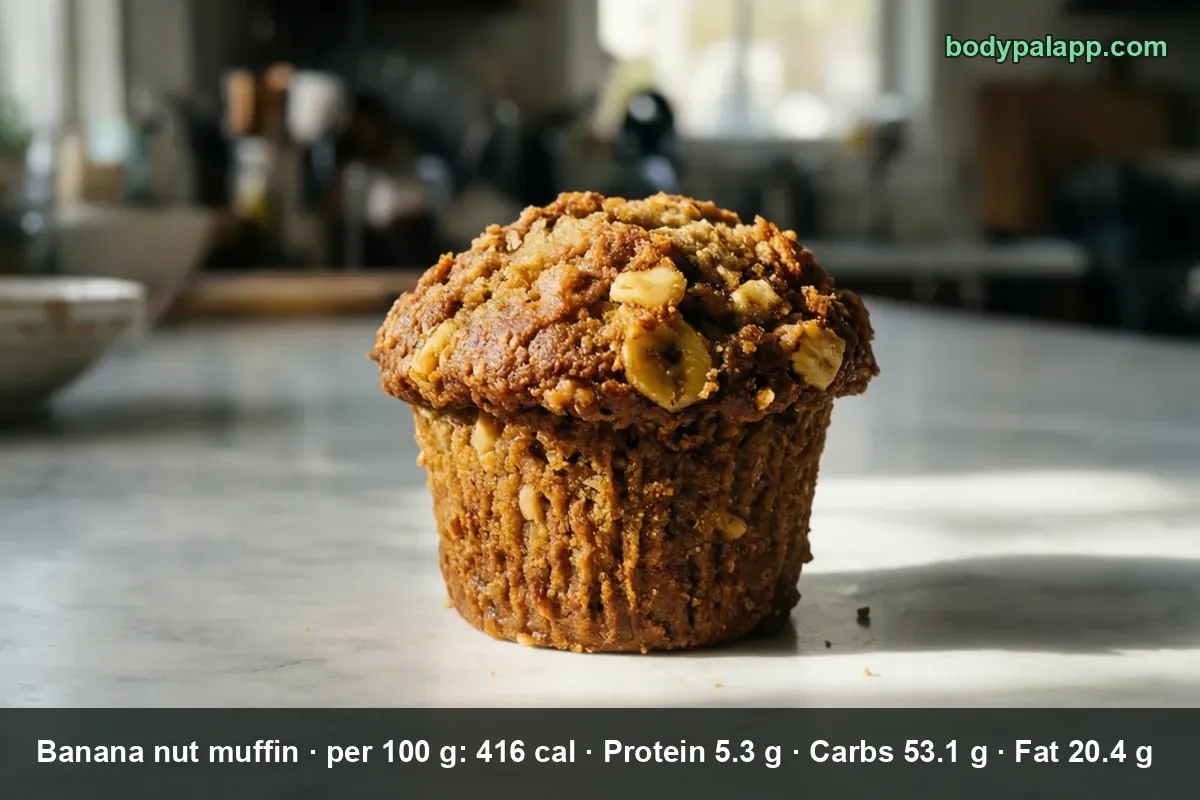
A standard packaged banana nut muffin weighs 113 g and carries 470 calories. Per 100 g the muffin runs 416 calories, which puts it above the plain, fruit and pumpkin muffins USDA lists. Most of that comes from fat and sugar, not from the banana: 23.0 g of fat and 33 g of sugars per muffin.
On this page
- Banana nut muffin quick facts
- US servings, from a mini to a jumbo
- Mini, jumbo, store brand and no-nut versions
- Fat and sodium are the rows to watch
- How does a banana nut muffin compare?
- Most popular banana nut muffin brands
- FAQ
Banana nut muffin quick facts
USDA has no generic banana nut muffin. There is no Foundation Foods entry, no SR Legacy entry, and the FNDDS survey codes stop at "Muffin, fruit," which has no nuts in it at all. The closest match to the thing you are actually holding is a branded label: Otis Spunkmeyer "Banana Nut Muffin," FDC ID 1939765, the muffin that shows up in office kitchens, gas stations and school cafeterias across the country.
That label serving is one 113 g muffin, and everything below scales from it. It is worth saying plainly that these are one manufacturer's numbers rather than an average of the category, because other brands sit as low as 324 and as high as 453 calories per 100 g.
| Nutrient | Per 100 g | Per 1 muffin (113 g) | % Daily Value |
|---|---|---|---|
| Calories | 416 | 470 | — |
| Total fat | 20.35 g | 23.0 g | 29% |
| Saturated fat | 3.1 g | 3.5 g | 18% |
| Carbohydrate | 53.1 g | 60.0 g | 22% |
| Dietary fiber | 0.9 g | 1.0 g | 4% |
| Total sugars | 29.2 g | 33.0 g | — |
| Protein | 5.31 g | 6.0 g | 12% |
| Sodium | 345 mg | 390 mg | 17% |
% Daily Value is based on a 2,000-calorie diet.
Verified nutrition data
Numbers on this page come from USDA FoodData Central, the U.S. Department of Agriculture’s food composition database, and from manufacturer labels where a branded product is named. Last verified September 2026. How we verify our data →
There is no added sugars row here: USDA does not publish added sugars for this record, because the label predates the mandatory line. Comparable brands list 21 to 28 g per 100 g, so most of the 29.2 g of total sugars is almost certainly sugar from the batter rather than fruit sugar from the banana. The muffin also carries 45 mg of cholesterol (15% DV) and 210 mg of potassium (4% DV) per piece. The percentages follow the FDA Daily Values for a 2,000-calorie diet.
US servings, from a mini to a jumbo
| Serving | Weight | Calories |
|---|---|---|
| 1 mini muffin | 25 g | 104 kcal |
| 1 oz | 28 g | 116 kcal |
| Half a muffin | 57 g | 237 kcal |
| 1 muffin, package label | 113 g | 470 kcal |
| 1 jumbo bakery muffin | 180 g | 749 kcal |
| Per 100 g | 100 g | 416 kcal |
Only one line on that table is a USDA serving: the 113 g muffin off the package. The mini, the ounce, the half and the jumbo are our own arithmetic from the USDA 100 g figure, not USDA servings.
The jumbo row is the one that catches people. A 180 g bakery muffin is the same recipe, the same crumb, the same walnuts on top, and it costs 749 calories instead of 470 — 279 calories more, from nothing but a wider pan. Warehouse-club and coffee-shop muffins are usually that size rather than the packaged size, so if you did not read a wrapper, assume the bigger row.
Half a muffin is a genuinely useful serving here. At 237 calories it fits inside a normal breakfast, and it drops the sodium from 390 mg to about 195 mg.
Mini, jumbo, store brand and no-nut versions
| Version | Per 100 g | Typical piece | Calories |
|---|---|---|---|
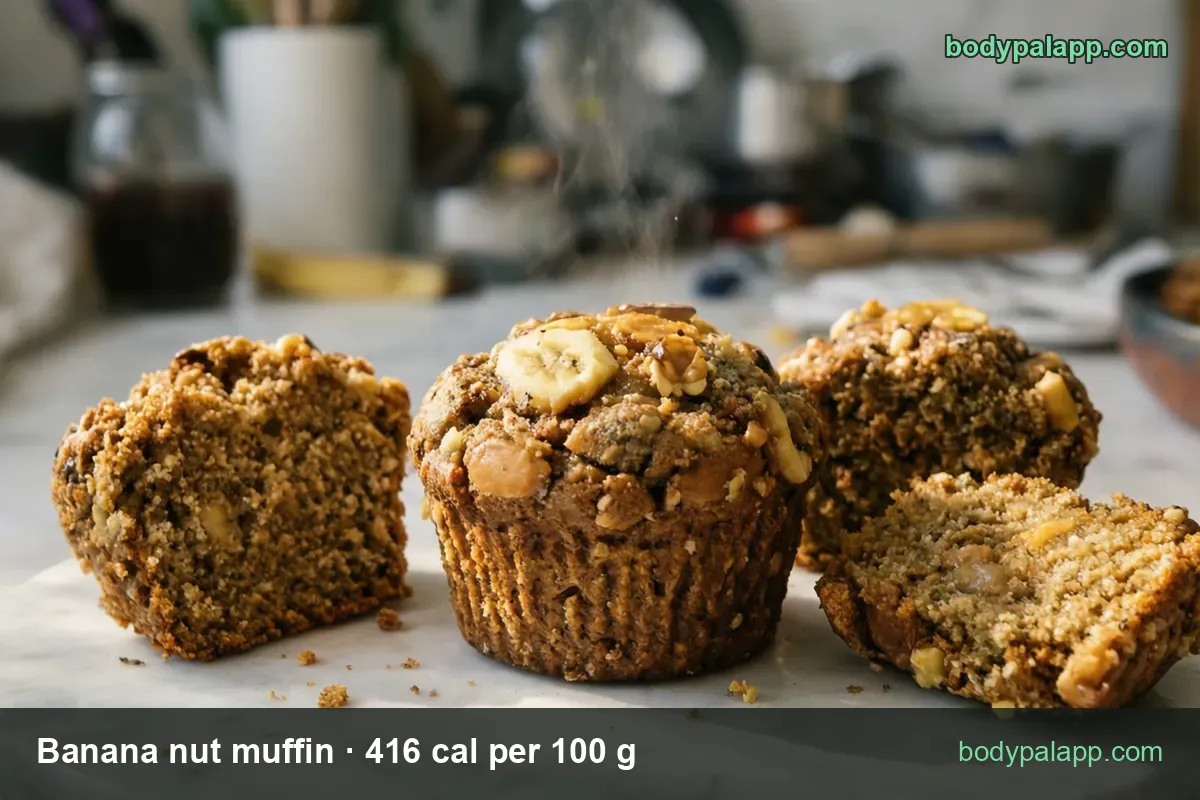
| Mini banana nut muffin | 416 kcal | 1 mini, 25 g | 104 kcal |
| Standard packaged muffin | 416 kcal | 1 muffin, 113 g | 470 kcal |
| Jumbo bakery muffin | 416 kcal | 1 jumbo, 180 g | 749 kcal |
| Store-brand muffin | 354 kcal | 1 muffin, 99 g | 350 kcal |
| Whole-grain banana muffin | 271 kcal | 1 muffin, 85 g | 230 kcal |
| Plain fruit muffin, no nuts | 375 kcal | 1 large, 180 g | 675 kcal |
| Banana nut protein bar | 283 kcal | 1 bar, 60 g | 170 kcal |
Store brands are lighter twice over: less rich batter and a smaller piece. A Target Favorite Day muffin is 354 calories per 100 g in a 99 g piece, so 350 calories — 120 fewer than the Otis Spunkmeyer muffin, for something that looks nearly identical in the wrapper.
The rest of the branded shelf spreads wide. Sweet Sam's sits at 324 calories per 100 g but sells a 136 g piece, which lands at 441. Hill Country Bakery is 433 per 100 g in a 127 g piece, which is 550. First Street is 372 per 100 g and 420 per muffin. Per gram and per muffin do not rank the same way, which is exactly why the wrapper weight matters more than the brand.
The whole-grain banana muffin is the outlier worth knowing about: 271 calories per 100 g, and an 85 g piece is 230 calories. That is less than half a standard banana nut muffin's calories for something that still reads as a muffin at breakfast.
Fat and sodium are the rows to watch
Fat is where a banana nut muffin separates itself from the other muffin types in the USDA data. It carries 20.35 g per 100 g against 16.07 g for a plain fruit muffin — about 27% more fat at almost identical carbohydrate. Walnuts and a richer batter do that. One muffin is 23.0 g of fat, 29% of a day's Daily Value, close to a third before you have eaten anything else.
The saturated fat row is friendlier than you would guess. Only 3.1 g of the 20.35 g of fat per 100 g is saturated, roughly 15% of it, because commercial muffin batter is built on oil rather than butter. Brands that do use butter run higher: one of them lists 4.69 g saturated per 100 g against this record's 3.1 g.
Sodium is the quiet one. A sweet breakfast pastry delivers 390 mg per muffin, 17% of the Daily Value, from baking soda and salt in the batter. If you are watching sodium, the muffin costs you more than its taste suggests.
And the fiber never arrives. One muffin gives 1.0 g, 4% of the Daily Value, despite banana and nuts being in the name. If fiber is the reason you picked it, a whole-grain option or actual fruit does that job instead. The MyPlate grains guidance asks for half your grains to be whole grains, and refined muffin batter is not one of them. On sugar, the Dietary Guidelines for Americans cap added sugars at under 10% of daily calories — a limit this record cannot be checked against, since its added sugars are not published.
How does a banana nut muffin compare?
| Muffin | Per 100 g | US serving | Calories |
|---|---|---|---|
| Banana nut muffin | 416 kcal | 1 muffin, 113 g | 470 kcal |
| Muffin, fruit | 375 kcal | 1 large, 180 g | 675 kcal |
| Muffin, plain | 374 kcal | 1 large, 180 g | 673 kcal |
| Muffin, pumpkin | 305 kcal | 1 large, 180 g | 549 kcal |
Our take: gram for gram, banana nut is the heaviest of the survey muffins USDA publishes — 416 against 375, 374 and 305 for fruit, plain and pumpkin. But the serving column flips the verdict, because the packaged banana nut muffin is 113 g while those survey muffins are measured at 180 g. If you want a muffin and you want the smaller number, buy the small one; a 113 g banana nut muffin beats a 180 g plain muffin by 203 calories. If you want the lightest batter in the case, pumpkin is the pick at 305 per 100 g. And if the goal is simply fewer calories at breakfast, half a muffin at 237 does more for you than switching flavors ever will.
Most popular banana nut muffin brands in the United States
Ranked by how widely each product appears among foods sold in the United States, from the BodyPal food database of over 3.3 million products. Calories are the figures printed on each Nutrition Facts label, checked against USDA FoodData Central.
| Product | Calories (per 100 g) |
|---|---|
| Otis Spunkmeyer Banana Nut Muffin | 416 cal |
| First Street Banana Nut Muffins | 372 cal |
| Favorite Day Banana Nut Muffins | 354 cal |
| Sweet Sam's Banana Nut Muffin | 324 cal |
| Oven Delights Banana Nut Muffin | 385 cal |
| Hill Country Bakery Banana Nut Muffin | 433 cal |
Brand popularity: BodyPal food database. Nutrition: manufacturer labels / USDA FoodData Central.
Banana nut muffin FAQs
How many calories are in a banana nut muffin?
A standard 113 g banana nut muffin carries 470 calories, based on the Otis Spunkmeyer label in USDA FoodData Central. Per 100 g that is 416 calories. Coffee-shop muffins are usually bigger than the packaged kind, so a bakery case muffin can land far above this number.
How many calories in a mini banana nut muffin?
A 25 g mini banana nut muffin comes to 104 calories, our own arithmetic from the USDA 100 g figure of 416 rather than a USDA serving. Minis travel in bags of six or eight, and six of them is 624 calories, more than the full-size muffin.
How many calories in half a banana nut muffin?
Half a standard muffin is 237 calories, 57 g of the 113 g piece. That is our own arithmetic from the USDA 100 g figure, not a label serving. Splitting the muffin also halves the 390 mg of sodium to about 195 mg and the 33 g of sugars to about 17 g.
How many carbs are in a banana nut muffin?
One 113 g muffin holds 60.0 g of carbohydrate, 22% of the Daily Value, of which 33 g is sugars and only 1.0 g is fiber. Per 100 g the figure is 53.1 g. The fiber is the surprise here: at 4% of the Daily Value, the banana and the walnuts add almost none.
How much protein is in a banana nut muffin?
A banana nut muffin gives 6.0 g of protein per 113 g piece, 12% of the Daily Value, or 5.31 g per 100 g. It is a bread-level number, not a breakfast-level one. Pairing the muffin with a cup of milk or a couple of eggs is what turns it into a filling meal.
How much sugar is in a banana nut muffin?
One muffin carries 33 g of total sugars, 29.2 g per 100 g. USDA does not publish added sugars for this record, so there is no way to say how much of that 33 g came from the banana and how much from the batter. Comparable brands list 21 to 28 g of added sugars per 100 g.
Does a banana nut muffin have more calories than a blueberry muffin?
Yes. Banana nut runs 416 calories per 100 g against 375 for a commercially prepared blueberry muffin, so the same weight of batter costs about 11% more. The gap is fat: 20.35 g per 100 g in the banana nut muffin against 16.07 g in the blueberry one.
Is a banana nut muffin healthy?
It is a dessert-weight breakfast. One muffin is 470 calories, 23.0 g of fat and 390 mg of sodium, with 1.0 g of fiber to show for it. There is nothing wrong with it as a treat, but a whole-grain version at 230 calories per 85 g piece does the same job for less.
Similar foods
- Beignet — 188 cal per beignet
- Cake Cone — 17 cal per cake cone
- Chocolate Doughnut — 250 cal per doughnut
- Cheese Croissant — 236 cal per croissant
- Granola Cereal — 462 cal per cup
- Chocolate Croissant — 240 cal per croissant
Count it without the math
Point the camera at the muffin and BodyPal counts it for you, walnuts and all.


How long does it take to burn off 470 kcal of banana nut muffin?
One muffin (113 g) is 470 kcal. Enter your weight and the amount you ate to see how long it takes you to burn that off:
lb
| Activity | Time to burn 470 kcal |
|---|---|
| Walking, brisk | 1 hr 34 min |
| Cycling, moderate | 59 min |
| Swimming, moderate | 1 hr 7 min |
| Jogging | 55 min |
| Weight training, moderate | 1 hr 44 min |
Times are for a 155 lb adult at a steady pace; change the weight to see yours. The amount is set to the portion in the text (113 g); change it to what you actually ate. BodyPal works this out from your steps automatically.
Burning it off is one side of it. The other is knowing your number: work out how many calories you need a day, with macros and a goal date.