
How many calories are in a croissant?
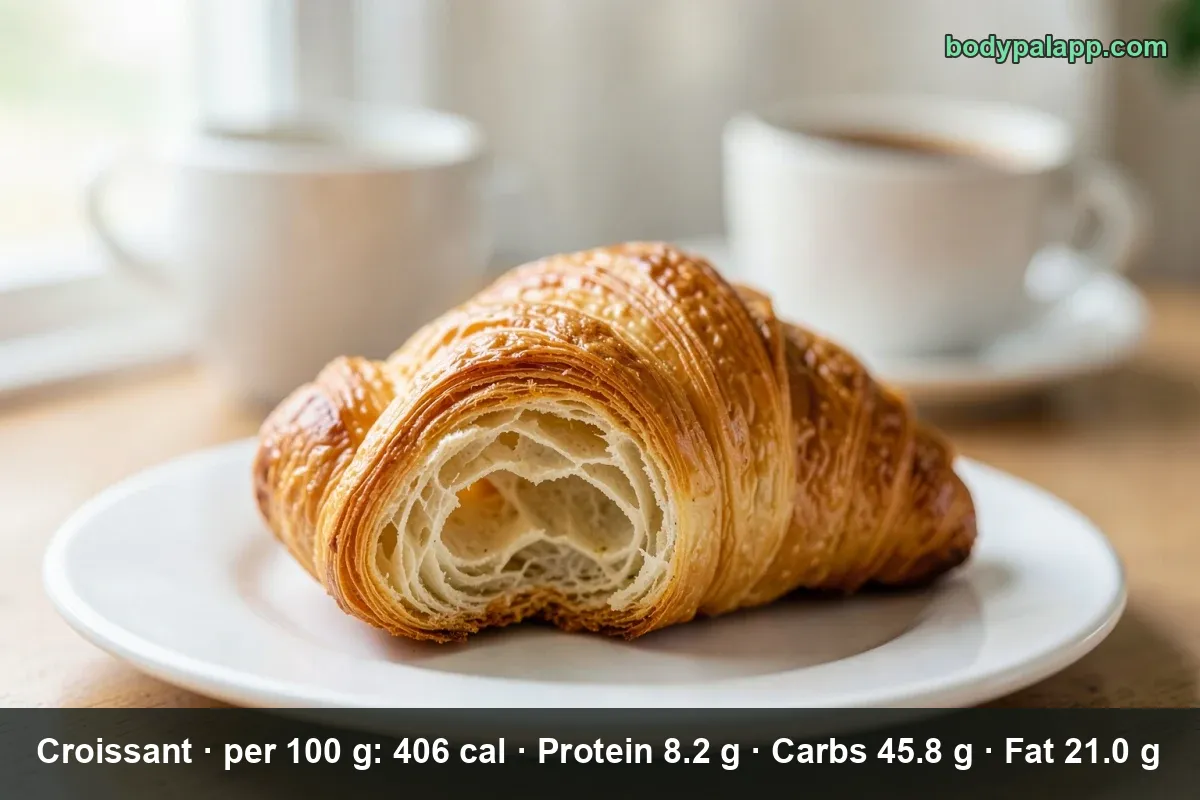
A medium butter croissant weighs 57 g and carries 231 calories. Per 100 g the pastry runs 406 calories, because roughly a fifth of its weight is butter fat. Size does most of the work here: the same word on the same bakery shelf covers a 28 g mini and a 67 g large, and that gap is bigger than any filling.
On this page
- Croissant quick facts
- US croissant servings from mini to large
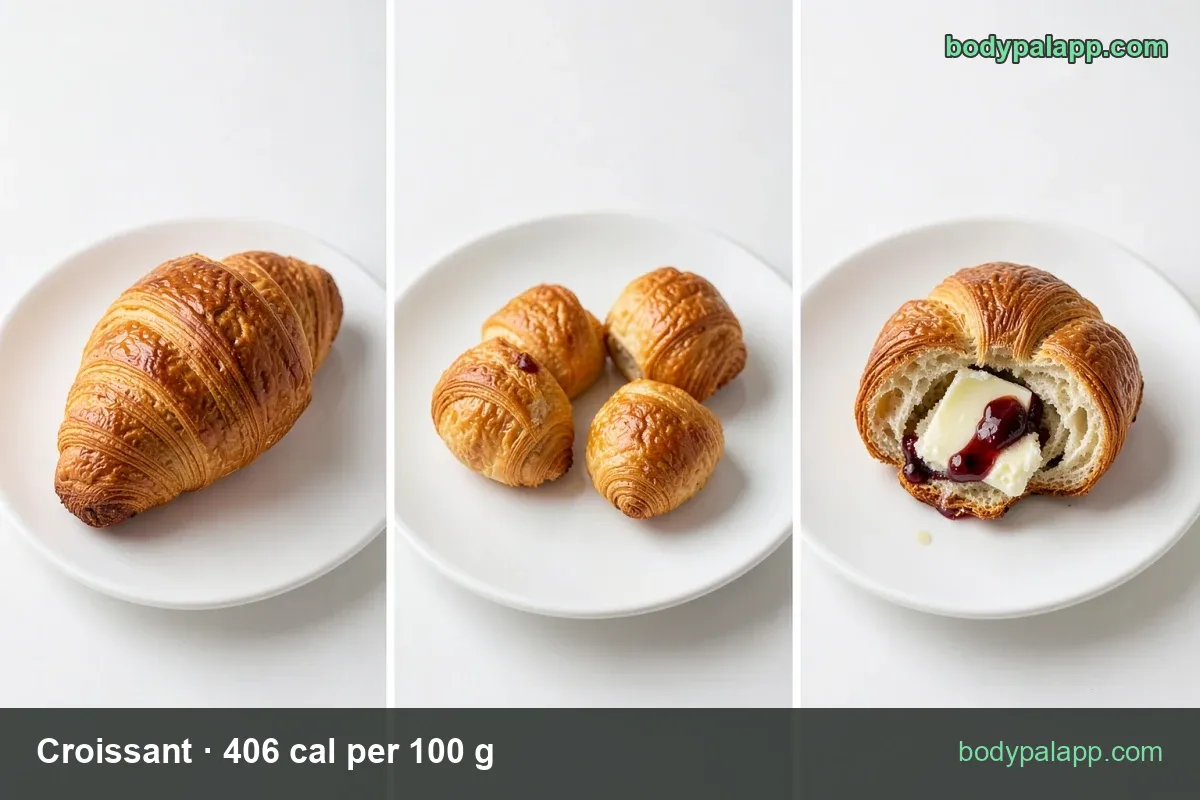
- Filled croissants and the breakfast sandwich
- Saturated fat runs out before the calories do
- How does a croissant compare
- Most popular croissant brands
- FAQ
Croissant quick facts
The row used on this page is SR Legacy 174987, "Croissants, butter". It is the plain butter croissant most people actually pick up: no filling, no sandwich, no glaze. It also happens to be the record that carries the full set of household sizes, from mini through large, which is why the serving table further down needs no guesswork.
There is a second USDA entry for the same recipe in the newer FNDDS release, and its energy and macros are identical. The one number that moves is sodium: 300 mg per 100 g there against 384 mg in the record below. Bakery salt varies that much in real life, so treat sodium as the softest figure on the page and the calories as the firm one.
| Nutrient | Per 100 g | Per 1 medium croissant (57 g) | % Daily Value |
|---|---|---|---|
| Calories | 406 | 231 | — |
| Total fat | 21 g | 12.0 g | 15% |
| Saturated fat | 11.66 g | 6.6 g | 33% |
| Carbohydrate | 45.8 g | 26.1 g | 9% |
| Dietary fiber | 2.6 g | 1.5 g | 5% |
| Total sugars | 11.26 g | 6.4 g | — |
| Protein | 8.2 g | 4.7 g | 9% |
| Sodium | 384 mg | 219 mg | 10% |
% Daily Value is based on a 2,000-calorie diet.
Verified nutrition data
Numbers on this page come from USDA FoodData Central, the U.S. Department of Agriculture’s food composition database, and from manufacturer labels where a branded product is named. Last verified September 2026. How we verify our data →
Two rows you would see on a supermarket wrapper are missing here on purpose. USDA does not publish added sugars or trans fat for butter croissants in this record, so putting a figure in either row would mean inventing it. Cholesterol and potassium do exist: one medium croissant delivers 38 mg of cholesterol (13% DV) and 67 mg of potassium (1% DV). The 219 mg of sodium is worth about a tenth of a teaspoon of table salt, which is modest for something that tastes this rich.
US croissant servings from mini to large
| Serving | Weight | Calories |
|---|---|---|
| 1 mini croissant | 28 g | 114 kcal |
| 1 oz | 28.35 g | 115 kcal |
| 1 small croissant | 42 g | 171 kcal |
| 1 medium croissant | 57 g | 231 kcal |
| 1 large croissant | 67 g | 272 kcal |
| Per 100 g | 100 g | 406 kcal |
Every one of those sizes is a USDA household measure attached to the butter croissant record, not a guess of ours, and that is unusual. Most pastries get one weight and a shrug.
Look at the spread. The mini at 114 calories and the large at 272 are the same food under the same name, and the large is nearly 2.4 times the mini. If you log "a croissant" from memory and the app assumes medium, a coffee-shop large quietly costs you another 41 calories, while a basket mini saves you 117. This is the single biggest source of error on this page, and it is fixed by a five-second weigh, not by a better database.
The 1 oz line is there because US labels still think in ounces. At 28.35 g it lands within a calorie of the mini, which makes it a handy mental anchor: an ounce of croissant is about 115 calories, and a medium is two ounces of pastry.
Filled croissants and the breakfast sandwich
| Version | Per 100 g | Typical piece | Calories |
|---|---|---|---|
| Butter croissant, plain | 406 kcal | 1 medium, 57 g | 231 kcal |
| Cheese croissant | 414 kcal | 1 medium, 57 g | 236 kcal |
| Chocolate croissant | 421 kcal | 1 croissant, 57 g | 240 kcal |
| Fruit croissant | 396 kcal | 1 croissant, 57 g | 226 kcal |
| Apple croissant | 254 kcal | 1 oz, 28.35 g | 72 kcal |
| Croissant breakfast sandwich, egg cheese and sausage | 308 kcal | 1 oz, 28.35 g | 87 kcal |
The 57 g column for the filled versions is our own arithmetic from each USDA 100 g figure, not a USDA serving, since only the plain butter record ships with those four bakery sizes.
Here is the part the calorie count hides. A chocolate croissant is 421 calories per 100 g against 406 for plain butter, a difference of 15 calories that nobody would notice. Its sugar is 19.87 g per 100 g against 11.26 g, so the filling nearly doubles the sugar while barely touching the energy. If you are tracking sugar rather than calories, the chocolate one is a different food; if you are tracking calories, it is the same food with a stripe of chocolate through it.
Cheese pushes protein from 8.2 g to 9.2 g per 100 g and sodium up to 361 mg, which is the trade you would expect. Fruit croissants come in slightly under plain at 396 calories per 100 g. The apple croissant is the outlier at 254 calories per 100 g, roughly 60% of the plain pastry, because the dough carries less butter and the filling is mostly water; USDA does not publish total sugars for that record, so it is left out rather than estimated.
Breakfast sandwiches built on a croissant are a separate story. The egg, cheese and sausage version runs 308 calories per 100 g, which reads lower than a plain croissant only because the egg and meat are wet and heavy. The finished sandwich weighs far more than 57 g, and its sodium is 577 mg per 100 g, roughly 1.5 times the pastry's 384 mg. In USDA's Branded database, incidentally, nearly every popular US croissant listing is one of these sausage-egg-cheese sandwiches rather than a plain retail croissant.
Saturated fat runs out before the calories do
One medium croissant is 231 calories, a bit over a tenth of a 2,000-calorie day. Its 6.6 g of saturated fat is 33% of the FDA Daily Value of 20 g. That mismatch is the honest headline of this page: saturated fat empties roughly three times faster than the calorie budget does.
The Dietary Guidelines for Americans put the ceiling at less than 10% of daily calories from saturated fat, which is about 200 calories, or 22 g, on a 2,000-calorie day. Two croissants get you to 13.2 g before anything else on the plate. Butter is the whole point of the pastry and also the whole reason for that row, so there is no version of a real croissant that dodges it.
None of that makes a croissant a problem food. It makes it a food worth pricing accurately. If saturated fat is what you are watching, a mini at 114 calories and 3.3 g gets you the same flaky ten minutes for half the cost. If you are watching total calories only, a medium fits a normal breakfast without drama, especially next to something with protein in it. Under five grams of protein per croissant is not going to keep you full on its own.
How does a croissant compare
| Pastry | Per 100 g | US serving | Calories |
|---|---|---|---|
| Croissant, butter | 406 kcal | 1 medium, 57 g | 231 kcal |
| Danish pastry, plain | 403 kcal | 1 oz, 28.35 g | 114 kcal |
| Sweet roll, frosted | 404 kcal | 1 oz, 28.35 g | 115 kcal |
| Doughnut, chocolate with chocolate icing | 413 kcal | 1 oz, 28.35 g | 117 kcal |
The per-ounce numbers for the three neighbors are our arithmetic from their USDA 100 g figures, not USDA servings.
Our take: gram for gram these four pastries are the same food. They sit between 403 and 413 calories per 100 g, a spread of 10 calories that no kitchen scale in a bakery could detect. So the croissant's reputation as the sensible choice does not come from its density; it comes from its weight, because a medium croissant is 57 g while a doughnut or a Danish is often heavier. Choose by size and by what else is on the plate, not by which pastry sounds lighter. The one real edge the croissant has is protein, 8.2 g per 100 g against 5.42 g for the chocolate doughnut, and slightly fewer carbs, 45.8 g against 51.01 g.
Most popular croissant brands in the United States
Ranked by how widely each product appears among foods sold in the United States, from the BodyPal food database of over 3.3 million products. Calories are the figures printed on each Nutrition Facts label, checked against USDA FoodData Central.
| Product | Calories (per 100 g) |
|---|---|
| Bimbo Mini Croissants | 438 cal |
| Thomas' Plain Mini Croissants | 375 cal |
| Thomas' Chocolatey Mini Croissants | 489 cal |
| St. Pierre All Butter Mini Croissants | 405 cal |
| La Boulangere Chocolate Croissants | 422 cal |
| Private Selection All Butter Croissants | 369 cal |
Brand popularity: BodyPal food database. Nutrition: manufacturer labels / USDA FoodData Central.
Croissant FAQs
How many calories are in one croissant?
A medium butter croissant weighs 57 g and carries 231 calories, which works out to 406 calories per 100 g. Bakery sizes vary a lot: USDA also lists a small at 42 g and 171 calories, and a large at 67 g and 272 calories. Weigh yours once and you will know which size you usually buy.
How many calories in a mini croissant?
A mini croissant weighs 28 g and comes to 114 calories, half of the 231 in a medium. That is almost exactly one ounce of pastry, so the ounce figure of 115 calories works as a stand-in. Two minis and a medium land within a few calories of each other.
Is a croissant healthier than a doughnut?
Not by density: a butter croissant is 406 calories per 100 g and a chocolate-iced doughnut 413, a gap of seven. The croissant wins on protein, 8.2 g against 5.42 g per 100 g, and on carbohydrate, 45.8 g against 51.01 g. In practice the deciding factor is which one is bigger.
How much saturated fat is in a butter croissant?
A medium 57 g croissant contains 6.6 g of saturated fat, or 33% of the FDA Daily Value of 20 g, from 11.66 g per 100 g. That is triple the share of the calorie budget the same croissant uses. A mini brings it down to 3.3 g, and no croissant recipe avoids it entirely.
How many calories in a chocolate croissant?
At 421 calories per 100 g, a 57 g chocolate croissant comes to 240 calories, only nine more than the plain butter version. The real difference is sugar: 19.87 g per 100 g against 11.26 g. The chocolate adds sweetness rather than meaningful energy, so track sugar, not calories, when you choose it.
Do croissants have protein?
A little: 8.2 g per 100 g, so 4.7 g in a medium 57 g croissant, which is 9% of the Daily Value. That is bread-level protein, not breakfast-level. A cheese croissant nudges it to 9.2 g per 100 g. If you want the meal to hold, pair the pastry with eggs, yogurt or milk.
How many carbs are in a croissant?
A medium croissant has 26.1 g of carbohydrate, 9% of the Daily Value, from 45.8 g per 100 g. Of that, 6.4 g is total sugars and 1.5 g is fiber. Carbohydrate is not what makes a croissant dense; the 12.0 g of fat in the same pastry supplies nearly half its calories.
Is a croissant a good breakfast?
As a whole breakfast it is thin: 231 calories with 4.7 g of protein and 33% of the Daily Value for saturated fat. As part of one it works fine. Add eggs or Greek yogurt for protein, or drop to a mini at 114 calories if the rest of the day is already rich.
Similar foods
- Butter Croissant — 231 cal per croissant
- Crescent roll — 114 cal per crescent roll
- Croissant With Butter — 231 cal per medium croissant
- Pecan Pie — 541 cal per slice
- Cheese Bread — 175 cal per large or thick slice
- Concha — 290 cal per concha
Count it without the math
Point the camera at the plate and BodyPal counts the croissant for you, size and filling included.


How long does it take to burn off a croissant?
One medium croissant (57 g) is 231 kcal. Enter your weight and the amount you ate to see how long it takes you to burn that off:
lb
| Activity | Time to burn 231 kcal |
|---|---|
| Walking, brisk | 46 min |
| Cycling, moderate | 29 min |
| Swimming, moderate | 33 min |
| Jogging | 27 min |
| Weight training, moderate | 51 min |
Times are for a 155 lb adult at a steady pace; change the weight to see yours. The amount is set to the portion in the text (57 g); change it to what you actually ate. BodyPal works this out from your steps automatically.
Want the bigger picture? Calculate your daily calorie needs — your maintenance figure, a target for losing or gaining, and the date you get there.