Croissant with butter calories come to 231 for one medium croissant (57 g) and 406 per 100 g. Fat supplies 47% of those calories and protein only 8%, so this is a rich pastry rather than a filling breakfast. Size swings the total fast: a small is 171 calories, a large is 272.
231kcal
1 medium croissant · 57 g, butter croissant, ready-to-eat
8%protein
4.7 gProtein
26 gCarbs
12 gFat
How to burn off 231 kcal
—Walking, brisk
—Jogging
—Cycling, moderate
—Swimming
Skip the math. BodyPal counts these calories from your steps and workouts automatically.
Nutrition facts
Butter croissant, ready-to-eat · per 57 g
Calories
231 kcal
Protein
4.7 g
Carbohydrate
26 g
Fat
12 g
Saturated fat
6.6 g
Cholesterol
38 mg
Sodium
219 mg
Potassium
67 mg
Iron
1.2 mg
Source: USDA FoodData Central
🛡️
Verified nutrition data
Numbers on this page come from USDA FoodData Central, the U.S. Department of Agriculture’s food composition database, and from manufacturer labels where a branded product is named. Last verified September 2026. How we verify our data →
Croissant with butter: calories, protein and sodium by serving
Percent of daily value uses the FDA reference of 2,000 kcal a day.
Serving
kcal
Protein
Carbs
Fat
Sodium
% DV kcal
1 medium (57 g)
231
4.7 g
26.1 g
12 g
219 mg
12%
1 large (67 g)
272
5.5 g
30.7 g
14.1 g
257 mg
14%
1 small (42 g)
171
3.4 g
19.2 g
8.8 g
161 mg
9%
100 g
406
8.2 g
45.8 g
21 g
384 mg
20%
3 × 1 medium (57 g)
694
14 g
657 mg
5 × 1 medium (57 g)
1,157
23.4 g
1,094 mg
Two medium croissants make a 463-calorie breakfast
The medium croissant (57 g) is the default here at 231 calories, about 12% of the daily value. Bakery sizes vary more than labels suggest. A small (42 g) lands at 171 calories, while a large (67 g) reaches 272, so the jump from small to large is bigger than it looks on the plate.
Doubling up is where the total climbs. Two medium croissants weigh 114 g and add up to 463 calories with 438 mg of sodium. Three come to 694 calories, and a box of five shared over a weekend totals 1,157 calories and 1,094 mg of sodium.
If you weigh food, the per-100 g figure of 406 calories is the one to use, since bakery croissants rarely match a standard size. If you don't weigh, pick the size label honestly: most cafe croissants look closer to large than small. BodyPal can log one from a photo if you'd rather not guess.
Fat supplies almost half the calories
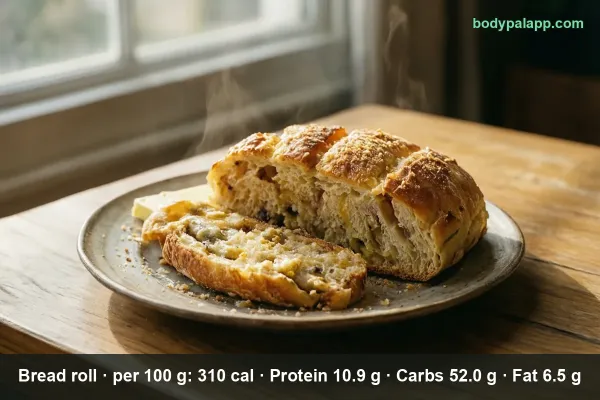
The split is 47% fat, 45% carbs and only 8% protein. Per 100 g that works out to 21 g of fat, 45.8 g of carbs and 8.2 g of protein. Croissant dough is folded with butter in layers, which is why it carries far more fat than a bread roll with butter, at 6.5 g per 100 g.
A medium croissant gives you 12 g of fat, 26.1 g of carbs and 4.7 g of protein. That protein covers 9% of the daily value, which is not much for 231 calories. Fiber is low too, at 1.5 g, so there is little bulk behind all that energy.
Sugar is moderate for a pastry: 6.4 g in a medium croissant and 11.3 g per 100 g. Most of the carbs come from refined flour rather than sugar. That is why a croissant tastes rich rather than sweet, and why the calories add up quietly.
Saturated fat is the row to watch
Per 100 g, a butter croissant carries 11.7 g of saturated fat against a daily value of 20 g. More than half of all the fat is saturated, which tracks with butter as the main fat. Cholesterol sits at 67 mg per 100 g, set against a 300 mg daily value.
Sodium is moderate. A medium croissant has 219 mg, 10% of the daily value, and a large has 257 mg, or 11%. The number matters more once croissants turn into sandwiches with ham or cheese, since those fillings bring their own salt.
If you watch saturated fat, the size choice matters more than anything else. A small croissant (42 g) keeps every row lower, with 8.8 g of total fat versus 14.1 g in a large. Keeping the rest of the meal lean leaves more room in the day.
Pair it with protein to make it a meal
On its own, a medium croissant is 231 calories with 4.7 g of protein, closer to a snack than a breakfast. Adding a protein source turns it into a more complete meal. Eggs, Greek yogurt, cottage cheese or a glass of milk all fit.
Fruit on the side adds volume and the fiber the croissant lacks, given its 1.5 g. Skip extra butter or jam if the goal is keeping the total close to the listed number. The croissant already carries its butter inside the dough.
Coffee drinks are the hidden add-on. A plain coffee changes nothing, while a sweetened latte can push a cafe breakfast well past the croissant itself. Count the drink separately so the log stays honest.
How does croissant with butter compare?
Here is how a butter croissant stacks up against a cheese croissant and two bread-based breakfasts, per 100 g and per usual serving.
Verdict: For fewer calories pick the bread roll and butter at 310 per 100 g with only 6.5 g of fat, against 406 for the butter croissant. For more protein at a similar calorie level pick bread with peanut butter, which has 13.9 g of protein per 100 g versus 8.2 g here.
Croissant with butter FAQs
How many calories are in a croissant with butter?
A medium butter croissant (57 g) has about 231 calories, a large one (67 g) about 272 and a small one (42 g) about 171.
Is a croissant with butter good for weight loss?
It is calorie-dense at 406 calories per 100 g. A medium one gives 231 calories with 12.0 g fat and only 4.7 g protein.
Croissant with butter vs cheese croissant: which has more calories?
A cheese croissant is slightly higher at 414 calories per 100 g versus 406 for a butter croissant.
How much fat is in a croissant with butter?
A medium croissant (57 g) has 12.0 g fat, 26.1 g carbs and 6.4 g sugar. Per 100 g that is 21 g fat.
How many calories are in 2 butter croissants?
Two medium butter croissants (114 g) have 463 calories, along with 438 mg of sodium and 9.3 g of protein. Two large ones come to more, since a single large croissant is 272 calories.
How many calories are in a large butter croissant?
A large butter croissant (67 g) has 272 calories, about 14% of the daily value. It also carries 14.1 g of fat, 30.7 g of carbs and 5.5 g of protein.
How many calories are in a small butter croissant?
A small butter croissant (42 g) has 171 calories. It holds 8.8 g of fat, 19.2 g of carbs, 3.4 g of protein and 161 mg of sodium, making it the lightest way to have one.
How many calories are in 100 g of butter croissant?
100 g of butter croissant has 406 calories, with 21 g of fat, 45.8 g of carbs and 8.2 g of protein. That covers about 20% of the daily calorie value.