
How many calories are in a bread roll and butter?
One commercially prepared dinner roll weighs 28 grams and carries 87 calories, or 310 calories per 100 g. Add a standard pat of butter and the pair lands at 123. The roll is most of the weight, the butter is most of the fat, and that split decides how the whole plate scores.
On this page
- Bread roll and butter quick facts
- US servings, from a pan roll to a foot-long
- How much the butter adds
- French, kaiser, whole-wheat and sweet rolls
- Saturated fat, not sodium, is the row to watch
- How does a bread roll compare?
- Most popular bread roll and butter brands
- Bread roll and butter FAQs
Bread roll and butter quick facts
USDA has no combined record for a roll with butter on it, so this page builds the number the way the bread basket does. The base is SR Legacy 172793, "Rolls, dinner, plain, commercially prepared (includes brown-and-serve)" — the soft white roll that shows up next to the soup, in the steakhouse basket and in the bag from the supermarket bakery. The butter is added separately from SR Legacy 173410, "Butter, salted", because the amount you spread is yours to decide.
The table below is the roll alone, at USDA's own household size of one roll, 1 oz.
| Nutrient | Per 100 g | Per 1 roll (28 g) | % Daily Value |
|---|---|---|---|
| Calories | 310 | 87 | — |
| Total fat | 6.47 g | 1.8 g | 2% |
| Saturated fat | 1.375 g | 0.4 g | 2% |
| Carbohydrate | 52.04 g | 14.6 g | 5% |
| Dietary fiber | 2.0 g | 0.6 g | 2% |
| Total sugars | 5.55 g | 1.6 g | — |
| Protein | 10.86 g | 3.0 g | 6% |
| Sodium | 467 mg | 131 mg | 6% |
% Daily Value is based on a 2,000-calorie diet.
Verified nutrition data
Numbers on this page come from USDA FoodData Central, the U.S. Department of Agriculture’s food composition database, and from manufacturer labels where a branded product is named. Last verified September 2026. How we verify our data →
There is no added sugars row here because USDA publishes only total sugars for this commercially prepared record, and the 5.55 g per 100 g mixes what the dough was made with and what the flour itself contributes. Cholesterol is 4 mg per 100 g, so 1 mg in a roll, and potassium is 139 mg per 100 g, or 39 mg per roll — 1% of the Daily Value.
The protein figure is the quiet surprise. At 10.86 g per 100 g, a plain white dinner roll carries more protein by weight than most people credit bread with, though a single 28 g roll only delivers 3.0 g of it.
US servings, from a pan roll to a foot-long
Rolls are sold by the bag and eaten by the piece, and the piece varies more than the recipe does. All four sizes below are USDA household measures for the same record.
| Serving | Weight | Calories |
|---|---|---|
| 1 small pan or dinner roll, 2-inch square | 25 g | 78 kcal |
| One dinner roll, 1 oz | 28 g | 87 kcal |
| 1 large roll or bun | 43 g | 133 kcal |
| 1 foot-long roll | 86 g | 267 kcal |
| Per 100 g | 100 g | 310 kcal |
That is the first thing worth knowing about this food: the same USDA record runs from 78 calories to 267 without changing anything but the size of the piece. A 3.4-fold spread inside one product is why "a roll" logged from memory is such a rough entry. Weigh one from your usual bag once and reuse the number.
A true ounce is 28.35 g, not 28, which puts an exact ounce at 88 calories — our own arithmetic from the USDA 100 g figure rather than a USDA serving. The one-gram difference is not worth chasing, but it explains why a label and a food database can disagree by a calorie or two on identical bread.
How much the butter adds
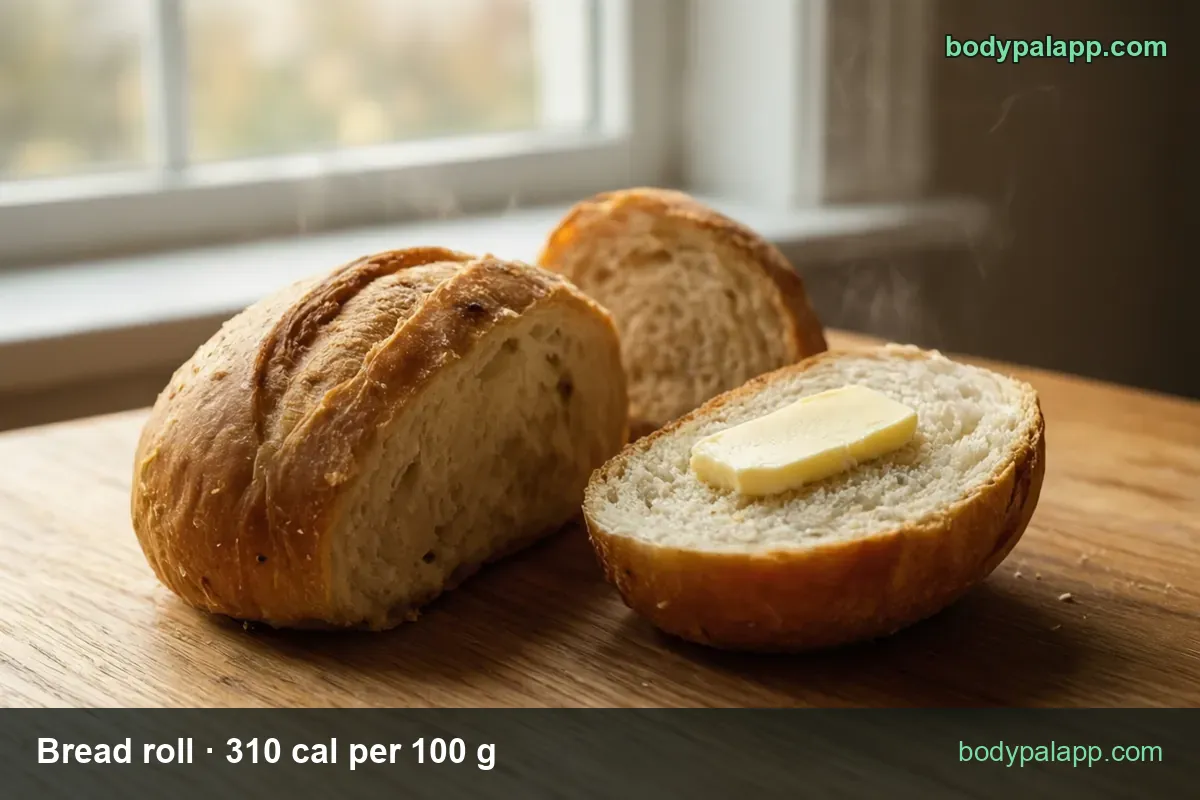
Salted butter is 717 calories per 100 g, which makes the spread the multiplier on this plate. A restaurant pat is 5 g and adds 36 calories — a 41 percent jump on an 87-calorie roll. A tablespoon is 14.2 g and adds 102 calories, more than the roll underneath it is worth.
| Version | Weight | Calories | Saturated fat | Sodium |
|---|---|---|---|---|
| Dinner roll, no butter | 28 g | 87 kcal | 0.4 g | 131 mg |
| Dinner roll + 1 pat of butter (5 g) | 33 g | 123 kcal | 3.0 g | 163 mg |
| Dinner roll + 1 tbsp of butter (14.2 g) | 42.2 g | 189 kcal | 7.7 g | 222 mg |
| Large roll (43 g) + 1 pat of butter | 48 g | 169 kcal | 3.2 g | 233 mg |
| Salted butter on its own | 14.2 g | 102 kcal | 7.3 g | 91 mg |
Every combined row here is our own arithmetic, adding the butter record to the roll record — USDA does not publish a buttered-roll entry. The butter sizes are the standard US ones: a 5 g pat is the foil square on the table, a tablespoon is what comes off a stick with a butter knife when nobody is watching.
Take a position on it. If you are counting down, the roll is cheap and the butter is not: eat the roll plain at 87 calories, or use half a pat. If you want the bread to hold you until dinner, the pat is worth spending, because 123 calories with 3.0 g of fat leaves the stomach slower than 87 calories of plain starch.
French, kaiser, whole-wheat and sweet rolls
Seven roll records sit in USDA's SR Legacy set, and only two of them are denser than the plain dinner roll: the sweet Hawaiian-style roll and the version baked from a recipe.
| Roll | Per 100 g | Typical piece | Calories |
|---|---|---|---|
| Dinner roll, plain | 310 kcal | one roll, 28 g | 87 kcal |
| French roll | 277 kcal | one roll, 38 g | 105 kcal |
| Hard kaiser roll | 293 kcal | one roll, 57 g | 167 kcal |
| Whole-wheat dinner roll | 266 kcal | one roll, 28 g | 74 kcal |
| Sweet Hawaiian-style roll | 321 kcal | one roll, 43 g | 138 kcal |
| Hamburger or hot dog bun | 279 kcal | one bun, 43 g | 120 kcal |
| Dinner roll made from recipe, 2% milk | 316 kcal | one roll, 28 g | 88 kcal |
The 43 g and 28 g figures in the last three rows are our own scaling from the USDA 100 g numbers, not USDA servings.
Two things stand out. The homemade roll made with low fat milk and egg comes in at 316 calories per 100 g, marginally above the store-bought 310, so baking your own does not buy you calories back — it buys you less sodium, dropping from 467 mg to 415 mg per 100 g. And the sweet roll is not sweet by a little: 15.38 g of sugars per 100 g against 5.55 g in the plain roll, nearly three times as much.
Whole wheat is the one real trade. It saves 13 calories on a 28 g roll and multiplies the fiber by 3.75, from 2.0 g to 7.5 g per 100 g, which is the difference between a rounding error and a meaningful contribution to the 28 g Daily Value.
Store brands land close to the USDA record. Rhodes Yeast Dinner Rolls list 100 calories on a 38 g roll, Sara Lee Classic Dinner Rolls 110 on a 40 g roll, and Aunt Millie's Butter Dinner Rolls 120 on a 42.5 g roll — between 263 and 282 calories per 100 g, a touch lighter than USDA's generic 310 because the packaged versions run slightly less dense than the bakery-basket version.
Saturated fat, not sodium, is the row to watch
The instinct with bread is to worry about salt. Here the salt is fine. A plain roll is 131 mg of sodium, and with a pat of butter it reaches 163 mg, or 7 percent of the FDA Daily Value of 2,300 mg. That is about a fifteenth of a teaspoon of table salt.
Saturated fat moves much further. The roll alone contributes 0.4 g, which is 2 percent of the 20 g Daily Value. Add the pat and it becomes 3.0 g, or 15 percent — the butter supplies roughly 87 percent of the saturated fat in the pair. Go to a full tablespoon and you are at 7.7 g, 38 percent of the day's value from a piece of bread. The Dietary Guidelines for Americans ask for less than 10 percent of calories from saturated fat, which is about 22 g on a 2,000-calorie day.
None of that makes a buttered roll a problem. It does mean that if you are watching saturated fat, the roll is not what you cut — the spread is.
How does a bread roll compare?
| Roll | Per 100 g | US serving | Calories |
|---|---|---|---|
| Dinner roll, plain | 310 kcal | one roll, 28 g | 87 kcal |
| French roll | 277 kcal | one roll, 38 g | 105 kcal |
| Hard kaiser roll | 293 kcal | one roll 3-1/2 inch, 57 g | 167 kcal |
| Whole-wheat dinner roll | 266 kcal | one roll, 28 g | 74 kcal |
Our take: the dinner roll is the densest of these four per 100 g, and only the whole-wheat roll costs fewer calories per piece, which is the whole trick — it is small, not light. The kaiser roll costs 167 calories for one sandwich base, nearly double the dinner roll, purely on size. The French roll is the saltiest of the four at 574 mg per 100 g, so it is the wrong pick if sodium is your constraint. If you want the best return for the calories, take the whole-wheat roll: 74 calories, 2.1 g of fiber in a 28 g piece, and it still holds butter.
Most popular bread roll and butter brands in the United States
Ranked by how widely each product appears among foods sold in the United States, from the BodyPal food database of over 3.3 million products. Calories are the figures printed on each Nutrition Facts label, checked against USDA FoodData Central.
| Product | Calories (per 100 g) |
|---|---|
| Rhodes Yeast Dinner Rolls | 263 cal |
| Signature Select Artisan Style Dinner Rolls | 279 cal |
| Heiner's Enriched Dinner Rolls | 289 cal |
| Aunt Millie's Butter Dinner Rolls | 282 cal |
| Sara Lee Classic Dinner Rolls | 275 cal |
| Sara Lee Restaurant Style Dinner Rolls | 289 cal |
Brand popularity: BodyPal food database. Nutrition: manufacturer labels / USDA FoodData Central.
Bread roll and butter FAQs
How many calories are in a bread roll and butter?
123 calories for a 28 g dinner roll with one 5 g pat of salted butter. The roll brings 87 of that and the butter 36. Swap the pat for a full tablespoon and the total climbs to 189, because 14.2 g of butter alone is 102 calories.
How many calories are in one dinner roll?
87 calories in a 1 oz (28 g) commercially prepared dinner roll, which works out to 310 calories per 100 g. A small 2-inch pan roll is 78, a large bakery roll or bun of 43 g is 133, and an 86 g foot-long roll reaches 267 calories.
How many calories does a pat of butter add?
36 calories per 5 g pat of salted butter, since butter runs 717 calories per 100 g. That is a 41 percent jump on an 87-calorie roll. A tablespoon, 14.2 g, adds 102 calories, which is more than the roll underneath it carries on its own.
Is a bread roll with butter healthy?
One roll with a pat is 123 calories, 3.0 g of saturated fat and 163 mg of sodium, so it fits most meals easily. Saturated fat is the number to track: at 15 percent of the Daily Value, two buttered rolls use close to a third of the day's allowance.
How much saturated fat is in a buttered roll?
3.0 g in a 28 g roll with a 5 g pat, which is 15 percent of the FDA Daily Value of 20 g. The roll itself supplies only 0.4 g; the butter brings the other 2.6 g. With a full tablespoon of butter the total hits 7.7 g.
Bread roll vs French roll: which has more calories?
310 calories per 100 g for a plain dinner roll against 277 for a French roll, so the dinner roll is denser. Per piece the French roll still costs more, because USDA sizes it at 38 g for 105 calories versus 28 g and 87 calories for the dinner roll.
Are whole-wheat dinner rolls lower in calories?
Yes, 266 calories per 100 g against 310 for the plain version, and 74 calories for a 28 g roll instead of 87. The bigger gap is fiber: 7.5 g per 100 g versus 2.0 g, which is 3.75 times as much fiber for the same size roll.
How many carbs are in a bread roll with butter?
14.6 g of carbohydrate in a 28 g dinner roll, and butter adds essentially none, so a buttered roll is still 14.6 g. That is 5 percent of the 275 g Daily Value. Fiber is 0.6 g, total sugars 1.6 g, and protein comes in at 3.0 g.
Similar foods
- Onion Roll — 220 cal per roll
- Eggo Frozen Waffle — 103 cal per waffle
- Burrito Tortilla — 220 cal per 10-inch tortilla
- Spinach Tortilla — 132 cal per tortilla
- Wrap Tortilla — 220 cal per wrap
- Zucchini Bread — 122 cal per slice
Count it without the math
Point the camera at the bread basket and BodyPal counts the roll and the butter for you.


How long does it take to burn off 87 kcal of bread roll and butter?
One dinner roll (28 g) is 87 kcal. Enter your weight and the amount you ate to see how long it takes you to burn that off:
lb
| Activity | Time to burn 87 kcal |
|---|---|
| Walking, brisk | 17 min |
| Cycling, moderate | 11 min |
| Swimming, moderate | 12 min |
| Jogging | 10 min |
| Weight training, moderate | 19 min |
Times are for a 155 lb adult at a steady pace; change the weight to see yours. The amount is set to the portion in the text (28 g); change it to what you actually ate. BodyPal works this out from your steps automatically.
One food is easy to picture; a whole day is harder. See how many calories you need a day and what a deficit actually looks like.